Easiest and Hardest Countries for Digital Nomads in 2026, Ranked by Real Hurdles

As a self-proclaimed digital nomad, it's hard to tell what's real and what's not when it comes to the best options. I recently read an article on USA Today and thoroughly disagreed! So I decided to create my own verified version of the easiest places for nomads to hunker down. One caveat... Vietnam isn't in the 'Easy' tier, and, I get it... many nomads 'live there'. That's why it gets its own 'Easy to stay' tier with Peru. This list takes into account whether there's an actual legal mechanism for nomads, and whether you'll be stuck doing the border run every 90 days. Otherwise, let me know your thoughts!
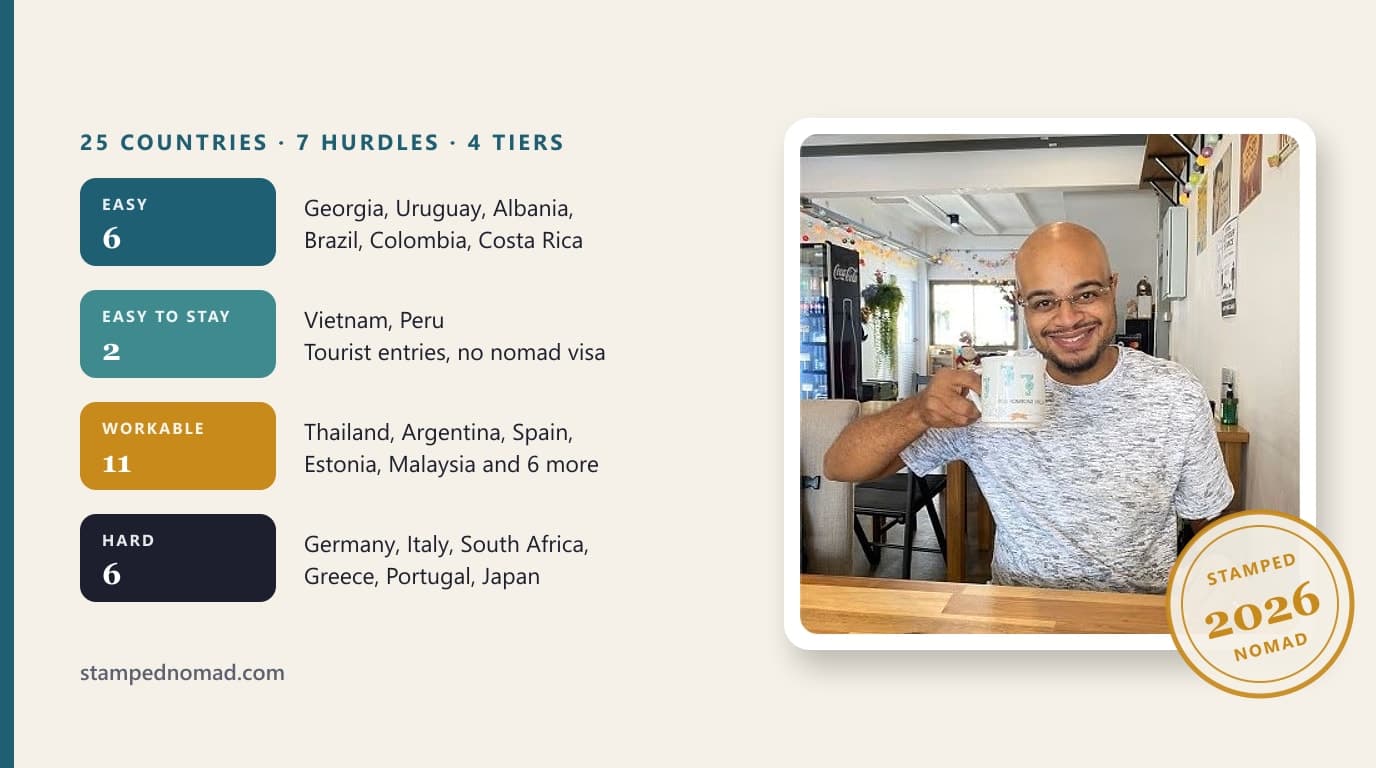
Six of 25 countries clear every paperwork hurdle a digital nomad faces in 2026: Georgia, Uruguay, Albania, Brazil, Colombia and Costa Rica. Two more, Vietnam and Peru, are easy to stay in on tourist entries but offer no legal route for remote work. Six land in the Hard tier, including Portugal, Greece and Japan.
Every country here is scored on the same seven hurdles, from income bars to consulate-only filing, and every figure was checked against program rules from Sept. 23 to Oct. 8, 2026.
How the tiers work
Each country's best legal route for someone working remotely for foreign employers or clients is scored on seven paperwork hurdles:
No legal route: nothing lets a remote worker stay past a tourist visit. This puts a country in its own tier instead of counting toward the others.
High income bar: more than $3,000 a month.
Consulate filing: most applicants must apply at an embassy or consulate abroad, with no online or in-country option.
Paperwork after landing: two or more mandatory in-person government steps, such as address registration, a biometric card, a tax number or a police filing.
Bank refusals: the program operator, banks or official sources say banks generally won't open accounts for holders.
Narrow eligibility: only certain job types qualify, such as employees only, freelancers only or a "highly skilled" test.
Early tax: foreign pay can be taxed locally well before the usual 183-day mark.
Easy means no hurdles. Easy to stay means no legal route for remote work, but most passports can stay 90 days or more on a tourist entry filed online or granted at the border. Workable means one or two hurdles. Hard means three or more. Within a tier, fewer hurdles rank first, then the lower income bar.
Cost of living, internet speed, safety, weather and disaster risk aren't scored: they matter, but mixing them with paperwork hides which problems a nomad can plan around. Passport limits are noted per country. Dollar figures use Oct. 8, 2026 rates; the local-currency figure is the legal one.
All 25 countries at a glance
Country | Tier | Route | Income bar (USD a month) | Longest stay | Hurdles |
|---|---|---|---|---|---|
Easy | One-year visa-free stay | None | 12 months per entry | 0 | |
Easy | Digital nomad identity document | None | 12 months (6 + 6) | 0 | |
Easy | Unique permit for digital nomads | $610 | 1 year, renewable up to 5 times | 0 | |
Easy | VITEM XIV | $1,500 | 2 years (1 + 1) | 0 | |
Easy | Visa V digital nomad | $1,620 | 2 years | 0 | |
Easy | Remote worker stay | $3,000 | 2 years (1 + 1) | 0 | |
Easy to stay | Tourist e-visa (no nomad visa) | None | 90 days per e-visa | No nomad visa | |
Easy to stay | Tourist entry (no working nomad visa) | None | Up to 183 days a year | No nomad visa | |
Workable | Destination Thailand Visa | Savings only | 5-year visa, 180 days per entry (+180) | 1 | |
Workable | Transitory nomad residence | No fixed figure | 360 days (180 + 180) | 1 | |
Workable | Telework visa or authorization | $2,735 | 3 years, then 2-year renewals | 1 | |
Workable | Digital Nomad Visa | $5,040 | About 18 months in 2 years | 1 | |
Workable | DE Rantau Nomad Pass | $2,000 | 2 years (1 + 1) | 2 | |
Workable | Nomad residence permit | $2,570-$2,890 | 2 years (1 + 1) | 2 | |
Workable | White Card | $3,360 | 2 years (1 + 1) | 2 | |
Workable | Remote work residence visa | $3,500 | 1 year, renewable | 2 | |
Workable | Digital nomad temporary stay | $4,060 | 18 months | 2 | |
Workable | Temporary resident visa | $4,430 | 4 years (1 + up to 3) | 2 | |
Workable | E33G remote worker visa | $5,000 | 1 year, extendable | 2 | |
Hard | Freelance residence permit | No fixed figure | 3 years, renewable | 3 | |
Hard | Digital nomad and remote worker visa | $2,310 | 1 year, renewable annually | 3 | |
Hard | Remote work visa | $3,260 | 3 years | 3 | |
Hard | Digital nomad visa, then I.8 permit | $3,920 | 1-year visa, then 2-year renewable permit | 3 | |
Hard | D8 remote work visa | $4,120 | 2-year permit, then 3-year renewals | 3 | |
Hard | Designated Activities (Digital Nomad) | $5,270 | 6 months, no extension | 3 |
Easy: no hurdles
Georgia
Route: One-year visa-free stay; the old Remotely from Georgia program is suspended
Income bar: None
Stay: 12 months per entry
How to apply: Granted at the border
Hurdles: None
Citizens of 95 countries and territories get a year on arrival. Remote work for foreign employers or clients needs no work permit, but insurance with GEL 30,000 of cover (about $11,560) is mandatory. A fresh year on re-entry is border practice, not a written right. Past 183 days, law firms say employees owe the 20% flat tax on work done in Georgia; freelancers settling in Georgia can pay 1% of turnover as registered entrepreneurs.
Uruguay
Income bar: None; a sworn statement of means
Stay: Six months plus one six-month renewal
How to apply: Online, after arriving in Uruguay
Hurdles: None
The small fee is paid in pesos inside Uruguay, so filing happens after entry; visa nationals need a visa to get in. Renewal needs a Uruguayan cédula plus local criminal and vaccination records. After a year the holder must qualify for a regular residence category. Past 183 days, pay for remote work done from Uruguay is taxable there.
Albania
Income bar: ALL 50,000 a month, the minimum wage (about $610); or an ALL 300,000 deposit in an Albanian bank (about $3,660)
Stay: One year, renewable up to five times
How to apply: Online through e-Albania; visa nationals get a D visa through the same filing
Hurdles: None
The start-up law, as amended in 2023, says digital mobile workers aren't tax residents for 12 months; how that counts across renewals is unconfirmed. Applicants already in Albania file within 30 days of entry, then appear for a biometric card; processing takes up to 12 weeks. Five years of living in Albania lead to permanent residence.
Brazil
Route: VITEM XIV digital nomad visa
Income bar: $1,500 a month from a foreign payer; or $18,000 in savings
Stay: One year plus a one-year renewal
How to apply: Online for visa-exempt passports (since Sept. 1, 2026) or inside Brazil; consulate appointment for others
Hurdles: None
Any nationality can apply. Within 90 days of entry holders register with the Federal Police for the CRNM card (BRL 204.77, about $41). After 184 days in Brazil within 12 months, foreign income is taxed monthly under carnê-leão. Digital banks such as Nubank accept the card for banking in Brazil.
Colombia
Route: Visa V digital nomad
Income bar: COP 5,252,715 a month, three times the minimum wage (about $1,620)
Stay: Up to two years
How to apply: Online through the Cancillería, from inside or outside Colombia
Hurdles: None
Only passports exempt from Colombian short-stay visas qualify. Fees total $194 with a 30-day legal decision deadline. Within 15 days of entry holders register for the cédula de extranjería (COP 294,000, about $90). The catch: more than 183 days in any 365 brings tax on worldwide income and assets, with no renewal rule after two years in Colombia.
Costa Rica
Income bar: $3,000 a month; $4,000 with family
Stay: One year plus a one-year renewal
How to apply: Online with the DGME immigration agency or in person
Hurdles: None
Law 10008 exempts the foreign remote-work income from income tax and holders aren't treated as tax residents; family members aren't covered and local income is taxed. Each person needs health insurance with $50,000 of cover. The decision deadline is 15 calendar days, the fee $100. Renewal requires spending 180 days in Costa Rica during year one.
Easy to stay: no nomad visa
Neither country offers a legal status for remote work, so neither passes the rule for Easy. Both still let most passports stay for months on a simple tourist entry, which is how many nomads end up living there.
Vietnam
Route: Tourist e-visa; no nomad visa exists
Income bar: None
Stay: 90 days per e-visa; 45 days visa-free for 13 listed countries
How to apply: Online, open to every nationality
Hurdles: No legal route for remote work
The e-visa costs $25 for one entry or $50 for multiple entries, so staying longer means leaving and applying again. Vietnamese law has no status for working remotely on a tourist entry, and 183 days in a calendar year or in 12 months from arrival makes someone tax resident on worldwide income. The longer visas don't fill the gap: a residence card through investment starts at VND 3 billion of capital (about $117,000), and the UĐ1 visa needs a Vietnamese sponsor and excludes remote employees of foreign firms. Nomads based in Vietnam live on repeat e-visas.
Peru
Route: Tourist entry; the digital nomad status in law isn't operating
Income bar: None
Stay: Up to 183 days in any 365, though officers often grant fewer at entry
How to apply: Granted at the border for visa-exempt passports
Hurdles: No legal route for remote work
Tourists can stay up to 183 days in any 365-day period, and overstays are fined per day. Decree DL 1582 created a digital nomad status in Nov. 2023, but no requirements, fee or procedure have followed. The rentista visa needs $1,000 a month of pension or permanent income and bars paid work, so it suits retirees moving to Peru, not remote workers. Work physically done in Peru counts as Peruvian-source income even for non-residents, so long stays carry tax exposure.
Workable: one or two hurdles
Thailand
Income bar: None; THB 500,000 in savings (about $14,860)
Stay: Five-year multiple-entry visa, 180 days per entry plus a 180-day extension
How to apply: Online e-Visa, from the country of nationality or permanent residence (since Aug. 31, 2026)
Hurdles: Bank refusals
Bangkok Bank stopped opening accounts for tourist-category visas and counts the DTV as one. Other banks generally want a long-term non-immigrant visa, a work permit or a registered lease. From 180 days in a calendar year, foreign income earned since Jan. 1, 2024 is taxed when nomads living in Thailand bring it into the country.
Argentina
Income bar: No minimum set; proof of remote work is required
Stay: 180 days plus one 180-day renewal
How to apply: In person at the immigration directorate (DNM) inside Argentina
Hurdles: Paperwork after landing
Only nationals who don't need an Argentine tourist visa qualify. The DNM filing needs an Argentine criminal record certificate and proof of address; renewal requires half the first 180 days in Argentina. Tax residence starts only after 12 months on temporary permits, so holders living in Argentina on this route normally stay non-resident.
Spain
Route: International telework visa or residence authorization
Income bar: €2,442 a month (about $2,735); some consulates ask €2,849 (about $3,190)
Stay: Up to three years when filed in Spain, renewable for two-year periods
How to apply: Online from inside Spain or through a consulate visa
Hurdles: Paperwork after landing
Filing from inside Spain while legally present gets three years at once; the consular visa covers one. Spanish clients can make up at most 20% of the work. After landing come padrón registration, a fingerprinted TIE card within one month and mandatory Social Security registration, which freelancers meet by paying autónomo contributions. Employees moving to Spain can opt for the Beckham regime, 24% on employment income up to €600,000.
Estonia
Route: Digital Nomad Visa
Income bar: €4,500 a month gross (about $5,040) for the six months before applying
Stay: 12 months; about 18 months at most in any two years
How to apply: Embassy, VFS or the Police and Border Guard Board if already in Estonia
Hurdles: High income bar
It's a visa, not a residence permit: no card, no extension and a cap of 548 days in 730. Decisions take about 30 days. More than 183 days in 12 months brings Estonia's 22% flat income tax. Whether holders get the ID code that banks in Estonia reportedly expect is unconfirmed.
Malaysia
Route: DE Rantau Nomad Pass
Income bar: $24,000 a year for tech roles (about $2,000 a month); $60,000 for non-tech roles
Stay: One year plus a one-year renewal
How to apply: Online with MDEC, from inside or outside Malaysia
Hurdles: Bank refusals; early tax
MDEC's own FAQ says most Malaysian banks don't accept the Professional Visit Pass. It also puts remote employees' foreign pay in the tax net from day 61. The pass costs MYR 1,080 (about $264), covers Peninsular Malaysia and Labuan only and excludes Israeli nationals.
Bulgaria
Income bar: About €27,500-€31,000 a year, 50 times the minimum monthly wage (about $2,570-$2,890 a month)
Stay: One year plus a one-year renewal
How to apply: Type D visa at a consulate, then in person in Bulgaria
Hurdles: Consulate filing; paperwork after landing
The statute points to the previous year's minimum wage (€27,533), but Bulgarian law firm Boyanov applies the 2026 wage (€31,010), so applicants are safer showing the higher figure. In Bulgaria holders file in person, declare an address and collect a biometric card whose LNCH number serves as a tax ID. The employer must sit outside the EU, EEA and Switzerland. Nomads who become tax residents of Bulgaria pay a 10% flat rate.
Hungary
Route: White Card
Income bar: €3,000 a month net (about $3,360), every month for six months before applying and during the stay
Stay: One year plus a one-year extension
How to apply: Consulate abroad; online or in person inside Hungary
Hurdles: High income bar; paperwork after landing
Holders give biometrics for the card and report their address. The ceiling is hard: two years, no switch to any other Hungarian permit and no credit toward later residence. Residents of Hungary pay the 15% flat income tax on worldwide income, subject to treaties.
United Arab Emirates
Income bar: $3,500 a month, shown with six months of bank statements
Stay: One year, renewable
How to apply: Online (ICP or GDRFA) or at service centers; in-country filing possible
Hurdles: High income bar; paperwork after landing
Before the permit issues, holders pass a medical test, give biometrics for an Emirates ID and buy UAE-valid insurance. There's no personal income tax and no individual filing, though home-country rules still apply. The Emirates ID qualifies holders for resident bank accounts in the UAE; reports that some banks decline this visa are unconfirmed.
Croatia
Income bar: €3,622.50 a month (about $4,060); €43,470 in savings for 12 months
Stay: Up to 18 months, then a six-month gap before reapplying
How to apply: Online with the interior ministry (MUP), at a consulate or at a police station
Hurdles: High income bar; paperwork after landing
Pay from an employer not registered in Croatia isn't taxable income under nomad status, even past 183 days; Croatian-source income is taxed normally. The clock is tight: address registration with the police within three days, a biometric card (€31.85) and an OIB tax number, which banks require. There's no renewal past 18 months and no path to long-term residence in Croatia.
Mexico
Income bar: MXN 79,770.80 a month as the legal basis (about $4,430); consulates set their own figures
Stay: One year, then a card renewable for one to three more years
How to apply: Consulate interview abroad, then the INM card within 30 days of entry
Hurdles: High income bar; consulate filing
Consulate sheets vary: San Diego asks $4,049 a month or $68,241 in savings. Mexico has no day-count test; a home there can make someone tax resident. A non-resident's foreign salary is exempt only under 183 days in 12 months. Four years of living in Mexico on this route lead to permanent residence.
Indonesia
Route: E33G remote worker visa
Income bar: $60,000 a year (about $5,000 a month), plus a $2,000 bank balance
Stay: One year, extendable
How to apply: Online, with a decision in about five working days
Hurdles: High income bar; early tax
It covers Bali and the rest of Indonesia, needs no sponsor and issues the ITAS stay permit on arrival; the first year costs IDR 7,000,000 (about $390). Pay from Indonesian people or firms is barred. Tax regulation PER-23/PJ/2025 treats an ITAS valid more than 183 days as intent to reside, so a one-year holder can be taxed on worldwide income from arrival.
Hard: three or more hurdles
Germany
Route: Freelance residence permit; no digital nomad visa exists
Income bar: No fixed figure; livelihood must be secured
Stay: Up to three years, renewable
How to apply: Consulate; some nationalities can apply inside Germany
Hurdles: Consulate filing; paperwork after landing; narrow eligibility
Only freelancers in liberal professions qualify; salaried remote employees have no route. Berlin asks for a revenue forecast plus fee agreements or two client letters of intent. Then come Anmeldung within two weeks, notice to the tax office within one month, German health insurance and a biometric card. More than six months in Germany means unlimited tax liability; the payoff is settlement after five years of living in Germany.
Italy
Income bar: €24,789.93 a year (about $2,310 a month)
Stay: One year, renewable annually
How to apply: Consulate, then the Questura within eight working days of arrival
Hurdles: Consulate filing; paperwork after landing; narrow eligibility
"Highly skilled" means a degree, a regulated qualification, five years of comparable experience or three years as an IT manager or specialist. The upside of a multi-year move to Italy is tax: under the impatriate regime only 50% of Italian-produced work income is taxed for five years, for people not resident in the prior three who stay at least four. The tax agency has said remote work for a foreign employer can qualify.
South Africa
Route: Remote work visa
Income bar: About ZAR 650,800 a year (about $3,260 a month)
Stay: Up to three years
How to apply: In person at a South African mission abroad
Hurdles: High income bar; consulate filing; narrow eligibility
Applicants need a signed contract with a foreign employer and three months of salary statements; freelancers don't qualify. Registering with the revenue service SARS is a visa condition, immediately for residents of non-treaty countries and after 183 days for the rest. The physical presence test keeps most holders non-resident for tax. The fee is ZAR 425, with no renewal past three years in South Africa.
Greece
Route: Digital nomad visa, then an I.8 residence permit
Income bar: €3,500 a month net (about $3,920), plus 20% for a partner and 15% per child
Stay: One-year visa, then a two-year renewable permit
How to apply: Consulate only; the in-country switch ended Feb. 6, 2026
Hurdles: High income bar; consulate filing; paperwork after landing
Before the visa expires, holders apply for the I.8 permit with biometrics (€1,000 plus €16 for the card) and need an AFM tax number for banks and leases. Many guides promise nomads Greece's 50% tax break, but it requires a Greek employer or Greek establishment, so a foreign-company employee doesn't qualify. Tax residence starts after 183 days in Greece.
Portugal
Income bar: €3,680 a month, four times the minimum wage (about $4,120); or €11,040 in savings
Stay: Two-year permit, renewable for three years
How to apply: Consulate, then an appointment with the AIMA immigration agency in Portugal
Hurdles: High income bar; consulate filing; paperwork after landing
The visa is valid four months, for entry and booking AIMA. AIMA is the bottleneck: a law firm told employers in Oct. 2025 to expect 8 to 10 months from entry to residence card. Domestic extensions of expired documents don't allow Schengen travel. The NHR tax regime is closed and its successor covers only qualifying employers; permanent residence comes after five years of living in Portugal.
Japan
Income bar: JPY 10,000,000 a year (about $5,270 a month)
Stay: Six months, no extension
How to apply: Consulate
Hurdles: High income bar; consulate filing; bank refusals
Only nationals of visa-exempt countries with a Japanese tax treaty qualify. No residence card is issued, so banks, Japan Post Bank included, won't open an account. Upside: no registration after landing in Japan; treaty rules usually exempt foreign-employer pay for stays of 183 days or less.
Where the viral ranking gets it wrong
USA Today's Sept. 29 story republished eSIM seller Holafly's Digital Nomad Friction Index 2026, ranking 17 countries from Georgia (easiest) to Colombia (hardest). The index publishes no weights, sources or scores and mixes paperwork with wifi and disaster risk, so no rank can be traced to a cause. Checked claims that don't hold:
Colombia: Ranked hardest, it takes applications online, sets the bar near $1,620 a month and requires one registration after landing. Bancolombia opens accounts on a passport plus visa.
Peru: The rentista bars paid work, so it isn't a remote-work route. The nomad status added by DL 1582 in Nov. 2023 still has no procedure; Migraciones said it would be granted only once regulated.
Croatia: EU tax rules aren't a headache for the core case. Article 9(1)(26) of the Income Tax Act exempts foreign-employer pay earned under nomad status.
South Africa: A tax number isn't optional for many holders. The Home Affairs requirements sheet makes SARS registration a visa condition.
Germany: There is no remote freelancer visa. The route is a freelance permit for liberal professions; Berlin's requirements don't demand German clients, though a German law firm says offices expect them in practice.
Spain: The one-to-three-year spread depends on the route, not permanent residence status: a consular visa covers up to a year, an in-country authorization up to three.
Portugal: The D8 isn't a one-year visa. It's valid four months for entry, then AIMA issues a two-year permit renewable for three years.
Bulgaria: Applications opened in December 2025, after the procedure took effect Dec. 20, 2025, not in January 2026.
Georgia: Right that it's easy. But local work has needed a permit since March 1, 2026. Insurance became mandatory Jan. 1, 2026.
Questions nomads ask
What's the easiest country with no income requirement?
Georgia, for its 95 visa-free nationalities: a year on arrival with no application, fee or income test, only mandatory insurance. Uruguay works for anyone who can enter lawfully, with a sworn statement of means and an online filing after arrival.
Which country has the lowest income bar?
Albania, at ALL 50,000 a month (about $610), the national minimum wage. Brazil follows at $1,500 a month or $18,000 in savings, then Colombia at about $1,620.
Which countries don't tax nomad income?
Croatia exempts pay from employers not registered in Croatia. Costa Rica exempts foreign remote-work income under Law 10008, though not family members' income. Albania treats digital mobile workers as non-residents for 12 months, with counting across renewals unconfirmed. The UAE has no personal income tax; home-country rules still apply everywhere.
Which popular countries have no nomad visa at all?
Vietnam offers only a 90-day tourist e-visa, though any nationality can get one online. Germany has a freelance permit for liberal professions but nothing for salaried remote employees. Peru has had a nomad status in law since Nov. 2023 that no one can apply for yet, though tourists can stay up to 183 days a year.