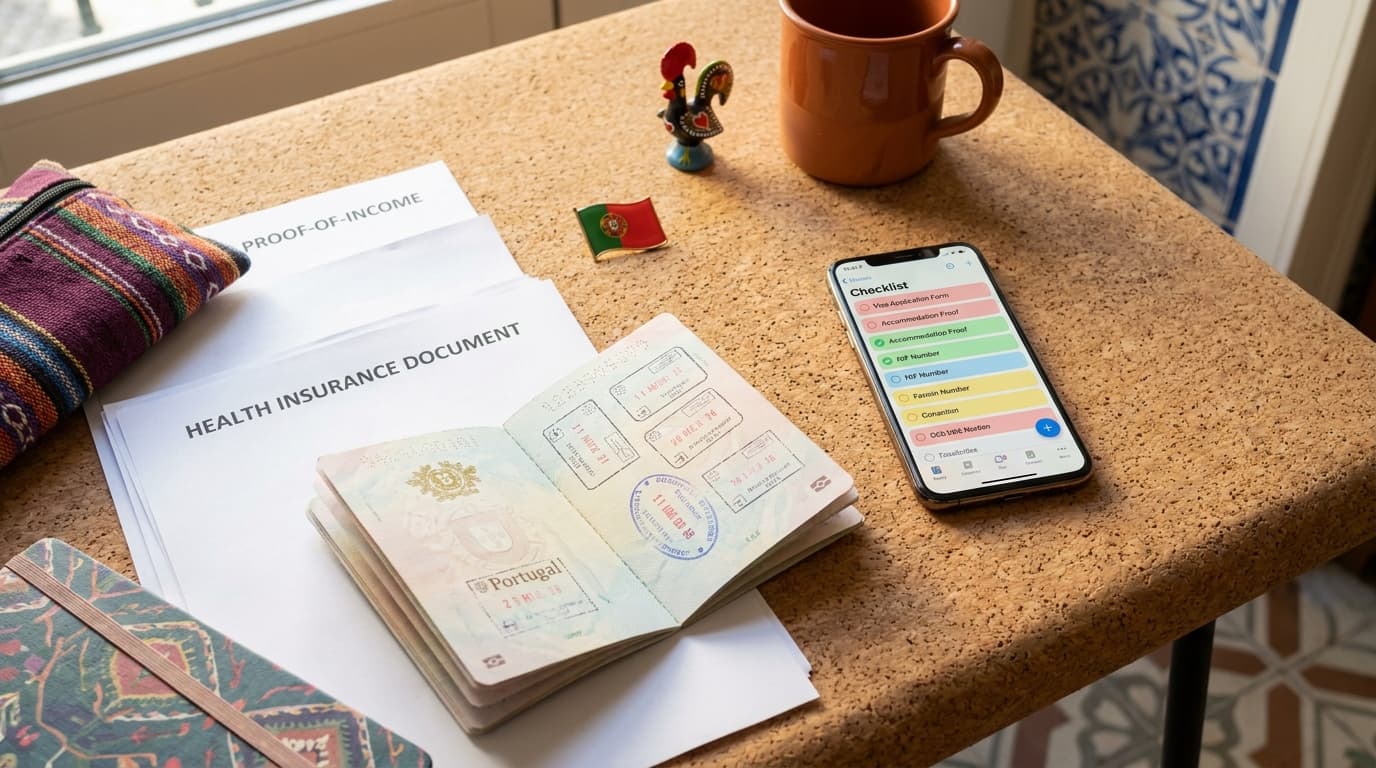
Portugal Digital Nomad Visa

At a Glance
- €3,680 a month4 x RMMG (EUR 920 in 2026), average of the last 3 months · main applicant
- 50% of the RMMG (EUR 460 a month) for each additional adult and 30% (EUR 276 a month) for each childPortaria 1563/2007 per-capita weighting · accompanying family members
- €110 one-timeeach applicant (children under 6 exempt)
- 2 yearsResidence visa valid 4 months (two entries) to enter and apply to AIMA; the permit then runs 2 years
- Renewable for successive 3-year periods while the requirements are still met; permanent residence possible after 5 years of temporary residence
- Residence visa at the Portuguese consulate (or its visa service provider) with jurisdiction over the place of residence; after entry, the residence permit with AIMA within the 4-month visa validity
- 60 dayslegal decision deadline for a residence visa, not an average
- YesResidence permit holders may take employed or self-employed work without special authorization
- YesSpouse and dependants can apply at the same time for a residence visa as accompanying family members; reunification from Portugal needs 2 years of residence (15 months for a spouse, none for minor children)
- Permanent residence after 5 years of temporary residence (basic Portuguese required); naturalization after 10 years of legal residence (7 for EU and CPLP nationals) since 19 May 2026
Last checked Sept. 24, 2026
Portugal's D8 visa, formally the visa for the exercise of a professional activity provided remotely outside national territory, is the country's dedicated route for people who earn abroad and want to live in Portugal legally. It opened in Oct. 2022 as an amendment to Law 23/2007 and it splits into two separate products that share one name, which is where most of the confusion around it starts.
One version is a temporary stay visa. It covers a defined stretch of remote work in Portugal and it does not build toward a residence permit. The other is a residency visa, which functions as an entry document: it gets the holder into Portugal to file with AIMA, the migration agency, for a residence card that renews and eventually supports permanent residence and naturalization. Picking between them is the first real decision, not a formality. One is a long legal working stay that simply ends. The other starts a residency clock that only runs while a valid permit is held.
Neither resembles the 90-day Schengen tourist allowance most non-EU passport holders already carry. Tourist entry grants no right to base a working life in Portugal, no tax framework, no renewal path and no accrual toward anything. The D8 replaces that with a status Portuguese institutions recognize: a tax number, a social security number, a bank account and a residence card that other systems will accept. Guides published before 2026 are unreliable on the figures. Portugal raised its minimum wage on Jan. 1, 2026, which moved the income floor. AIMA reindexed its fee table on March 1, 2026. The nationality law changed on May 19, 2026, lengthening the naturalization timeline. Any page still quoting last year's income floor, the pre-March residence permit fee or five-year citizenship is describing a Portugal that no longer exists.
What follows covers who qualifies and on what earnings, the document set consulates actually check line by line, itemized government costs, the filing sequence and the point where it stalls, how long the permit lasts and what it renews into, plus what crossing into Portuguese tax residency changes.
Non-EU, non-EEA and non-Swiss nationals are the target group. Citizens of those blocs already hold free movement rights and have no reason to apply. Everyone else, including nationals of the United States, United Kingdom, Canada, Australia, Brazil, South Africa and India, files from outside Portugal at the consulate with jurisdiction over their lawful residence.
The relationship test asks where the money originates, not where the laptop sits. Earnings have to come from outside Portugal: a foreign employer, foreign clients or a business registered abroad. Employees evidence this with a contract, a promise of contract or a signed declaration from the employer confirming the working relationship. Freelancers and company owners use articles of association, a service contract, a proposed service contract or documents attesting to services delivered to one or more entities. Work performed for a Portuguese employer falls outside the category and needs a different visa entirely.
The income threshold is four times the Portuguese guaranteed monthly minimum wage. That wage rose to €920 on Jan. 1, 2026, which sets the floor at €3,680 gross per month. Consulates don't read that as one strong month. The official checklist asks for proof of average monthly income earned over the last three months, so the qualifying record has to run at least a quarter and hold together across it.
Savings sit alongside income rather than substituting for it. Consular practice sets the reserve at twelve times the minimum wage, €11,040 in 2026 under the general residence-visa floor in Portaria 1563/2007, evidenced by statements from an account in the applicant's name. That reserve is a subsistence calculation rather than a printed line on the published checklist, so it moves automatically each January with the wage and individual posts apply it with some variation.
Family members raise both numbers on a fixed scale drawn from Portugal's means-of-subsistence rules. The scale weights each person against the minimum wage (RMMG): 50% of the RMMG (EUR 460 a month) for each additional adult and 30% (EUR 276 a month) for each child.
The arithmetic compounds fast, and the savings reserve scales on the same percentages. No official page states a combined D8 family figure, so the consulate handling the file settles the exact amount.
Parents are a different case. First-degree ascendants of the holder or of the spouse count as family where they're genuinely in their care, and that dependency has to be evidenced rather than asserted. The consular checklist lets them apply alongside the main applicant as accompanying family members. Relatives who follow later go through family reunification with AIMA, which since Oct. 23, 2025 requires the holder to have held the residence permit for at least two years, with exceptions for minor or incapacitated children and some spouses.
Several profiles fail before the paperwork is read. Income sourced from a Portuguese entity doesn't count toward the threshold at all. Applicants already inside Portugal on a tourist stamp can't switch from the inside, since this is a consular product and jurisdiction follows lawful residence abroad. A criminal conviction for an offense punishable in Portugal by more than one year of imprisonment is a refusal ground, as is a standing alert in the Schengen Information System or a prior removal order from Portuguese territory.
Stability matters as much as the headline figure. Earnings that dip below the floor in one of the three reference months invite scrutiny even where the average clears, because the assessment is whether the income is repeatable rather than whether one quarter happened to work out. Applicants with lumpy freelance billing tend to file six months of evidence rather than the minimum three for exactly that reason.
Consulates work from a published checklist and tick each line yes or no. A missing item suspends examination of the file rather than closing it, but nothing moves until the gap is filled, so completeness at submission is what actually determines speed.
- National visa application form. Completed and signed by the applicant, with one photograph attached to the form itself and an email address in field 19, which becomes the legal channel for every notification about the case.
- Two passport photographs. Identical, recent and in good enough condition to identify the applicant.
- Passport or travel document. Valid for at least three months beyond the intended period of stay, with blank pages available, plus a photocopy of the biographical data page.
- Proof of legal status where filing. Required whenever the applicant holds a nationality other than that of the country where the application is lodged, and it has to remain valid beyond the expiry of the visa being requested.
- Criminal record certificate. Issued less than 90 days before submission by the competent authority of the country of nationality, or of any country where the applicant has lived more than a year, carrying the Hague Apostille or full legalization where the Apostille doesn't apply. This is the tightest window in the whole file, because the 90 days runs to the submission date and apostille turnaround eats into it.
- Consent to a Portuguese criminal record check. Granted on the application form, authorizing AIMA to query national records.
- Health insurance. Valid cover for necessary medical expenses including urgent medical assistance and possible repatriation. Consulates apply a working minimum of €30,000 in medical coverage valid across the Schengen area, and the policy has to run the length of the requested stay rather than a two-week trip.
- Proof of the employment or client relationship. Employment contract, promise of contract or employer declaration for employees. Articles of association, service contract, contract proposal or evidence of services delivered for the self-employed. The document has to state in plain terms that the work is performed remotely, outside the employer's or client's country.
- Income evidence. Three months of bank statements, payslips or invoices showing average monthly earnings at or above the income threshold, cross-referenced against the contract so the two reconcile without explanation.
- Bank statements. The three most recent months from the account holding the savings reserve, in the applicant's own name.
- Tax residence certificate. Issued by the tax authority of the applicant's current country of residence, confirming where the applicant is taxed today.
- Accommodation in Portugal. A registered lease of at least twelve months, a property deed or a notarized declaration of accommodation from a host. Hotel bookings and short-term rental confirmations are routinely treated as insufficient.
- Portuguese tax number (NIF). Needed to open a bank account, sign a lease and file anything with AIMA. Non-residents obtain it through a fiscal representative or a licensed service. The representative requirement falls away once the holder becomes resident and activates electronic notifications on the tax portal.
- Portuguese bank account. Opened using the NIF, used to hold the reserve and pay rent. A live Portuguese account reads to a consulate as evidence of genuine intent to reside.
- Social security number (NISS). Mandatory for AIMA residence permit applications since April 2025, and grounds for rejection when absent. Since late July 2026 AIMA assigns the NISS automatically during the residence permit appointment, which removes the separate Seguranca Social counter visit that used to sit in the middle of the process.
- Return transport documentation. A copy of the return ticket, required on the temporary stay route.
- Certified translations. Any document not issued in Portuguese needs translation by a certified translator, a notary or the consulate. The Apostille attaches to the original document, never to the translation, which is a frequent ordering mistake.
Every dated document carries its own shelf life and none of them align. The criminal record certificate is the tightest at 90 days. Statements and income evidence should be no older than the month of filing. Tax residence certificates are generally accepted within six months of issue. Building the file backwards from a confirmed appointment date, with the criminal certificate ordered last, is what keeps a complete set from going stale in transit.
CPLP nationals, meaning citizens of Angola, Brazil, Cabo Verde, Equatorial Guinea, Guinea-Bissau, Mozambique, Sao Tome e Principe and Timor-Leste, are exempt from three of these lines under the mobility agreement: travel insurance, the return transport ticket and standard means-of-support evidence. The substitute is a sponsorship letter with a legalized signature from a Portuguese citizen or a foreign citizen resident in Portugal, covering lodging, board and removal costs in case of irregular stay, supported by the sponsor's most recent income tax return and three months of bank statements.
Government charges land in two places and both get paid. The consulate collects at submission abroad. AIMA collects again inside Portugal, and its share is now the larger of the two by a wide margin.
| Item | Amount | Notes |
|---|---|---|
| Consular national visa fee | €110 | Per applicant, set by the Ministry of Foreign Affairs. Children under 6 are exempt. Not refunded if the visa is refused |
| Outsourced application centre service fee | about €40 | Charged where a consulate routes intake through VFS Global or similar. Varies by country and sits on top of the visa fee |
| Appeal against a refusal | €75 | Payable to contest a consular decision. Family reunification cases are exempt |
| AIMA reception and analysis | €99.80 | Charged when the residence permit application is filed, and again at each renewal |
| AIMA residence title, issue or renewal | €85.80 | Per person, for the initial two-year card and again at each three-year renewal |
| Permanent residence grant | Set in AIMA's fee table | Payable at the five-year mark, not before |
| Duplicate residence card | 50 percent of the issue fee | Second copy. Third and later copies cost the full amount |
| NIF stamp duty | €10.20 | One-time charge on non-resident registration |
| Fiscal representative or NIF service | €50 to €150 | Private fee. Some providers bill an annual renewal while non-residence lasts |
| NISS registration | €0 | Free, and assigned automatically at the AIMA appointment since late July 2026 |
| Health insurance premium, visa phase | €300 to €1,200 per year | Depends on age, coverage limits and insurer |
| Certified translation | €20 to €60 per page | Private market rate |
| Apostille | €10 to €50 per document | Set by the issuing country, not by Portugal |
The AIMA line is where older guides go badly wrong. AIMA's fee table, in force since March 1, 2026, applies a 25 percent reduction to in-person service until that service moves to a digital channel. The reduced amounts, €99.80 for reception and analysis plus €85.80 for the title, are what applicants pay today. Pages quoting a higher per-person total usually mix in the unreduced column or a different line of the table, such as the fee for a request to waive the consular visa.
For a single self-filing applicant, the private lines in the table (insurance, translations, apostilles and a NIF service) usually cost more than the government charges combined, so they set the size of the first-year budget. Legal representation sits well above it, with immigration firms typically quoting €1,500 to €3,500 per applicant for a managed filing.
Costs scale per person rather than per household. Every family member pays the full AIMA charge and, from age 6, the consular fee, so a couple with two older children faces four sets of both. The renewal at the two-year mark repeats both AIMA charges for each person, which is the part most first-year budgets forget to model.
Filing happens abroad, without exception. The consulate or embassy with jurisdiction over the applicant's lawful residence owns the file, and in a growing number of countries the intake is outsourced to VFS Global or a comparable centre that collects documents and biometrics while the consulate keeps the decision. Applicants can't shop for a faster post. Jurisdiction follows legal residence, and filing from a country where the applicant holds no status is refused on that basis alone.
- Step 1. Build the Portuguese groundwork. NIF first, then a Portuguese bank account, then a registered lease. Each depends on the one before it and the sequence takes four to eight weeks from abroad. Nothing else can begin until the tax number exists.
- Step 2. Assemble the file. Work through the document checklist covered earlier and order the criminal record certificate last, so its 90-day window is still open on the day of submission.
- Step 3. Book the consular appointment. Slot availability rather than document readiness is usually the binding constraint. Busy posts in the United States, Brazil and India have run one to four months out, and the booking should be locked in before the criminal certificate is ordered.
- Step 4. Attend and submit. Originals plus copies, biometrics, signature and payment of the consular fee set out in the schedule above. An incomplete file is suspended rather than refused, and examination resumes only when the missing item arrives.
- Step 5. Wait on the consular decision. The legal deadline for the consular decision is 60 days, except in cases the law sets apart. Two to four months is the common outcome. A refusal arrives in writing with reasons and opens a 30-day window to appeal at the fee listed above.
- Step 6. Enter Portugal. The residency visa is valid for four months with two entries. That's the window in which AIMA has to be reached, and the clock runs from issuance rather than from arrival, so a delayed departure burns it. Most approved files come back with an AIMA appointment already scheduled inside that window.
- Step 7. Attend the AIMA appointment. Fingerprints, photograph, signature, NISS assignment and payment of the reception and title fees. Documents are checked again against originals, and the insurance policy has to still be live on the day.
- Step 8. Collect the residence card. Production and delivery run two to eight weeks after the appointment. Until it lands, the AIMA receipt paired with the visa stamp is the proof of legal status, and that combination is accepted for travel and for work inside Portugal.
Phase timing is lopsided and the delay concentrates in the second half. Preparation takes four to eight weeks. Consular booking adds one to four months. The consular decision runs two to four months from submission. Entry plus the AIMA appointment consumes the full four-month window in a good case and considerably longer in a bad one. End to end, six to nine months from first document to residence card is the realistic planning figure as of mid-2026.
AIMA's caseload is the reason that second half stays unpredictable. The agency processed 386,000 residence permits in 2025, up around 60 percent on 2024, and still carried an estimated 40,000 to 60,000 actively pending files into early 2026. Initial appointment waits during 2026 have been reported at 12 to 18 months in the Lisbon area, 8 to 14 months in Porto, 10 to 16 months in the Algarve and 6 to 10 months in Madeira, while newer applications routed through pre-scheduled D-visa slots have been landing at two to four months. No published service standard governs any of it, so those figures are practitioner observation rather than a commitment.
Where no appointment is scheduled and none can be booked, applicants increasingly go to the administrative courts to compel one. That has become a routine immigration-law service in Portugal rather than an exotic remedy, and it's priced accordingly.
Legal status doesn't lapse while the queue moves. The visa stamp itself authorizes remote work, and a filed application backed by an AIMA receipt keeps the holder regular even past the face expiry of the visa.
Why applications get rejected:
- Income that can't be traced to a foreign source. Payments routed through a Portuguese entity, or a contract silent on where the client sits, read as domestic earnings and fail the category test outright.
- Too short an earnings record. One or two months of statements filed against a three-month averaging rule. Six months of evidence is materially stronger than the minimum.
- An expired or unapostilled criminal certificate. The 90-day window closes faster than most applicants plan for once apostille and certified translation are stacked on top.
- Accommodation that doesn't look like a home. Hotel reservations, unregistered leases and rentals shorter than twelve months are the most commonly cited accommodation refusals.
- The wrong insurance product. A two-week travel policy standing in for cover across the requested stay, or a policy that omits repatriation.
- Contradictions across documents. A contract naming one job title, tax filings naming another and bank inflows that match neither.
- No remote-work clause. Where the employment contract never states the work can be performed outside the employer's country, the consulate has nothing to approve against.
- Filing in the wrong jurisdiction. Submitting at a consulate that doesn't cover the applicant's country of lawful residence.
- Unverified translations. Documents rendered into Portuguese by someone without certification, which invalidates the underlying evidence rather than merely delaying it.
Two validity schedules follow from the route chosen at the consulate, and they diverge from the first day.
The temporary stay route produces a visa valid for up to one year with multiple entries into the Schengen area. It authorizes remote work in Portugal for that period and nothing beyond it. It doesn't convert into a residence permit, and renewal is understood to require a fresh consular filing from abroad rather than an extension granted from inside Portugal. Time held on it accrues toward neither permanent residence nor naturalization, which is the trade for its simplicity.
The residency route produces a residence permit issued for 2 years from the date of issue, renewable for successive three-year periods provided the underlying conditions still hold: foreign-sourced income at or above the threshold, valid accommodation, live health cover and a clean record. A renewal has to be requested at least 30 days before the permit expires, and a pending renewal receipt keeps the holder regular even after the card's face date passes, which matters given how long AIMA takes to process anything.
Physical presence is measured rather than assumed. Across the first two-year permit the holder has to spend at least 16 months in Portugal. Across the following three-year renewal the minimum rises to 28 months. Both totals are cumulative rather than continuous, which leaves genuine room to travel, but they're checked at renewal and a shortfall is a refusal ground on its own.
Absence caps run alongside those minimums and bite sooner. A temporary resident may not be outside Portugal for more than six consecutive months, or for more than eight non-consecutive months, within the validity of the permit. Breaching either can trigger cancellation rather than a warning. Portuguese law allows exemptions where the absence has legitimate justification such as professional obligations, study, serious illness or a family emergency, but the exemption has to be notified to AIMA with supporting evidence, ideally before the absence rather than after it.
Permanent residence opens after five years of lawful temporary residence. The status that follows is indefinite, with the physical card renewed every five years as an administrative step rather than a fresh eligibility test. Absence tolerance widens sharply at that point, to 24 consecutive months or 30 non-consecutive months within any three-year span.
Naturalization is where 2026 rewrote the arithmetic, and the new version governs anyone starting from here. Lei Organica n.º 1/2026, published May 18, 2026 and in force from May 19, 2026, raised the qualifying residence period from five years to seven years for nationals of EU member states and of Portuguese-speaking CPLP countries, and to ten years for everyone else. Applications filed on or before May 18, 2026 remain under the old five-year rule.
The counting method changed too, and it costs more time than the headline extension suggests. The 2024 rule that counted residence from the date of the permit application was repealed, so months lost to an AIMA queue without a valid title no longer count. Only periods of legal residence under a visa, permit or other title under the immigration law qualify, and they have to fall within a 12-year window for most nationals (9 years for EU and CPLP nationals). The law adds a knowledge test covering Portuguese culture, history, national symbols and civic rights and duties, sitting alongside the existing A2 Portuguese language requirement and a formal declaration of commitment to democratic principles.
Worked through for a non-CPLP holder arriving now, a permit issued in March 2027 starts a ten-year clock running to 2037, with permanent residence reachable in 2032 along the way. No cooling-off period separates one renewal from the next, and no waiting interval sits between permanent residence and a naturalization filing once the residence years are complete.
Family members admitted through reunification hold permits that mirror the main holder's validity and expire with it, so renewals are filed together as a household. Their own residence years accrue on the same terms, which means a spouse who arrived twelve months late reaches permanent residence twelve months later.
Tax residency turns on two independent triggers and either one is sufficient. Spending more than 183 days in Portugal across any 12-month period makes a person resident. So does holding a home in Portugal on any day of that period in circumstances suggesting it's a habitual residence, even where the day count falls short. The days need not be consecutive and partial days count as full ones.
Crossing that line changes the base of taxation rather than the rate. A Portuguese tax resident is taxed on worldwide income: the foreign salary, the foreign client invoices, foreign dividends, foreign rent and foreign capital gains. Before residency, only Portuguese-source income falls in scope. Anyone on the residency route crosses the line in their first full year almost by definition, because the permit presupposes actually living there.
The Non-Habitual Resident regime that built Portugal's reputation is closed. It stopped accepting new entrants on Jan. 1, 2024, and the transitional window for people who had already committed to a move shut on March 31, 2025. Nobody establishing residency in 2026 can reach it under any reading.
Its replacement is the Tax Incentive for Scientific Research and Innovation, known as IFICI and informally as NHR 2.0. It applies a flat 20 percent rate to qualifying Portuguese employment and self-employment income for ten consecutive years, plus exemption on most categories of foreign-source income other than pensions. Qualification is narrow and profession-based. Eligible activities sit in scientific research, higher education teaching, technology, engineering and defined innovation or startup roles, and applicants generally need an EQF level 6 qualification with three years of relevant experience, or a doctorate. Registration falls due by Jan. 15 of the year following the start of residency, so a 2026 arrival files by Jan. 15, 2027 and a late filing costs benefit years that can't be recovered.
Whether a remote worker employed by a foreign company qualifies at all remains genuinely unsettled. The regime was drafted around activity carried on for Portuguese entities and around a listed set of high-value sectors, and practitioners read the fit of a foreign employment contract differently. Credentialed software engineers and researchers have been admitted. Generalist remote roles frequently have not.
Without IFICI, ordinary progressive rates apply. Portugal's 2026 schedule runs nine brackets from 12.5 percent up to a top marginal rate of 48 percent, which begins at €86,634 of taxable income for the 2026 income year. An additional solidarity surcharge layers on top of that: 2.5 percent on taxable income between 80,000 and €250,000, and 5 percent on anything above €250,000. Freelancers who register as self-employed also owe social security at 21.4 percent, applied to 70 percent of service income rather than the gross, with an automatic exemption during the first 12 months of activity.
Foreign income is declared on Annex J of the annual IRS return, filed between April 1 and June 30 for the preceding calendar year. Annex J captures foreign employment, self-employment, rental income, dividends, interest and gains, and it's the form on which double-tax relief gets claimed. Portugal maintains around 80 double taxation treaties, covering the United States, United Kingdom, Canada, Australia, Brazil, South Africa and most of the EU, which generally means foreign tax paid is credited rather than duplicated. US citizens keep filing in the United States regardless of where they live and usually rely on the foreign tax credit or the foreign earned income exclusion.
Crypto follows its own track. Gains on tokens held 365 days or longer are exempt for private individuals. Disposals inside 365 days are taxed at a flat 28 percent under category G, with an option to aggregate into progressive rates where that produces a lower bill. Swapping one token for another resets the holding clock on the new asset, and holdings inside a company or disposals routed through a blacklisted jurisdiction fall outside the exemption entirely.
Paid advice earns its cost at three specific moments. Before the arrival date is fixed, because the day count and the home test both turn on when the move happens. Before the IFICI deadline, which is fixed and unforgiving. And in the first year of self-employment registration, where the social security base and the simplified regime election set a pattern that runs for years.
Frequently Asked Questions
How much income is needed for the Portugal D8 visa?
The floor is four times the Portuguese guaranteed minimum wage, which works out to €3,680 gross per month as of Jan. 1, 2026. Consulates want proof of the average across the last three months, not a single strong month. A savings reserve of about twelve months of the minimum wage (€11,040 in 2026) sits alongside the income test rather than replacing it.
Can family members come on a D8 visa?
Yes. A spouse, minor children and dependent parents can apply at the consulate as accompanying family members, and the income bar rises on a fixed scale: 50% of the RMMG (EUR 460 a month) for each additional adult and 30% (EUR 276 a month) for each child. Relatives who follow later go through family reunification with AIMA, which since Oct. 23, 2025 generally requires the holder to have held the permit for two years.
How long does the Portugal D8 visa take?
Six to nine months from first document to residence card is a realistic planning figure. The legal deadline for the consular decision is 60 days, then the AIMA residence permit stage adds the rest. AIMA publishes no service standard for that stage and appointment waits vary widely by region.
Can the D8 be requested from inside Portugal?
No. Both versions of the D8 are consular products and jurisdiction follows lawful residence, so the application has to be filed at the Portuguese consulate covering the country where the applicant legally lives. Arriving on a 90-day Schengen stamp and trying to switch from the inside is refused on that ground alone.
Does the D8 lead to Portuguese citizenship?
It can, but the timeline changed. Lei Organica n.º 1/2026 took effect May 19, 2026 and raised the naturalization requirement to ten years of lawful residence for most nationalities, or seven for EU and CPLP citizens. Only time spent under a visa, permit or other title counts. Permanent residence stays reachable at five years.
How It Compares
More Portugal programs
| Program | Country | Income / month | Fee | Max stay | Renewable |
|---|---|---|---|---|---|
| Portugal D2 Entrepreneur Visa | Portugal | €11,040 saved | €110 | 24 mo | |
| Portugal D7 Passive Income Visa | Portugal | €920/mo | €110 | 24 mo | |
| Portugal Golden Visa | Portugal | €500,000 saved | €632 | 24 mo |
Similar visas elsewhere
| Program | Country | Income / month | Fee | Max stay | Renewable |
|---|---|---|---|---|---|
| Georgia Digital Nomad Program (Remotely from Georgia) | Georgia | - | - | - | |
| Kyrgyzstan Digital Nomad Status | Kyrgyzstan | - | - | 12 mo | |
| Kenya Class N Permit | Kenya | - | $200 | 24 mo | |
| Nepal Digital Nomad Visa (Not Yet Open) | Nepal | - | - | - |
Portugal Digital Nomad Guide
Cost of living, internet, healthcare, coworking, and every visa option for Portugal.
Visa rules change. We'll tell you.
Get notified about policy updates and new requirements for the Portugal Digital Nomad Visa and other Portugal visas.