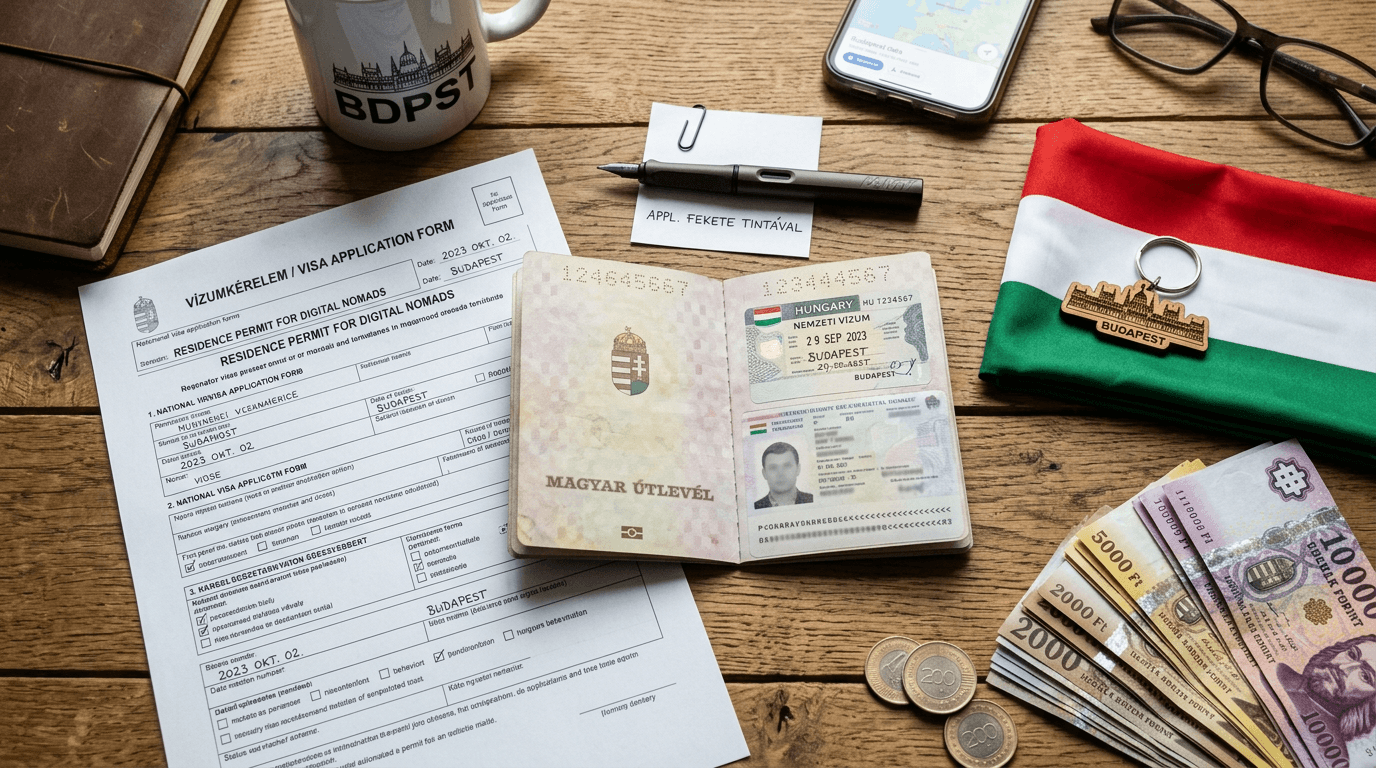
Hungary Digital Nomad Visa
Visa Data Sheet
Hungary’s White Card is the country’s digital nomad permit for non-EU and non-EEA nationals. It’s not a Schengen tourist visa and it doesn’t sit under the short-stay 90/180-day rule. It’s a residence permit for people who work remotely for an employer or business outside Hungary.
The permit is pretty narrow and that’s the point. Hungary wants digital nomads, not people quietly drifting into local work. If you hold a share in a Hungarian company or take gainful work in Hungary, the White Card can be withdrawn.
The basics are straightforward enough, though the rules are stricter than they first look:
- Who it’s for: third-country nationals working remotely from Hungary for a foreign employer or foreign company
- Length of stay: up to 1 year, with one extension for another year
- Income floor: at least €3,000 net a month for the previous 6 months
- Work limits: no local Hungarian work and no shareholding in a Hungarian company
- Family: the White Card isn’t a family reunification route
The paperwork is also more specific than most nomads expect. You’ll need proof of remote work or foreign business activity, proof of income, accommodation in Hungary, valid health coverage and a passport plus return or onward travel. The authority also collects a facial photo and fingerprints for applicants over 6.
Where you apply depends on your status. If you need a visa to enter Hungary, you apply from abroad at a Hungarian consulate or mission and the approval comes with a single-entry type D visa for entry. If you’re visa-free, you can apply in Hungary through Enter Hungary or at the regional directorate tied to your accommodation.
Extensions have their own timing rules. You can file no more than 90 days before expiry and at least 30 days before the permit runs out. You also need to have spent at least 90 days in Hungary during the previous 180 days before extending, so this isn’t a lazy backdoor to long Schengen stays.
Hungary doesn’t give a fixed processing time in the official factsheet. The permit is usually issued for one year at a time, the residence permit must stay valid for at least 3 months beyond expiry of the travel document and if you don’t enter Hungary within 3 months of approval, the approval lapses.
Hungary’s White Card is only for third-country nationals, which means you need to be outside the EU and EEA and you can’t be a family member of an EEA national. If you’re an EU or EEA citizen, this permit isn’t for you. Neither are people who want to earn money from a Hungarian job or hold shares in a Hungarian company.
There are really two qualifying routes. You can be employed by a company outside Hungary and work remotely from here or you can own a profit-making company outside Hungary and run or manage it from Hungary using digital tools. In both cases, the work has to stay outside the Hungarian market.
The permit gets strict fast. You can’t pursue gainful activity in Hungary and if you already fall into another residence category, the White Card usually won’t work for you.
- Employment route: You have a verified job with a non-Hungarian employer and you work from Hungary using digital technology.
- Company-owner route: You own a share in a company outside Hungary that shows verified profit and you work or manage it from Hungary using digital technology.
- Income threshold: You need at least €3,000 net per month, earned for 6 months before entry and you have to keep that level during your stay.
The proof side isn’t light. The official documents include a signed application form, one facial photo, evidence of your remote work or foreign company ownership, 6 months of bank statements or an income certificate, accommodation proof, health insurance and proof you can leave Hungary or pay for onward travel.
Family reunification doesn’t come with this permit. A child born in Hungary to a White Card holder during the permit’s validity is the narrow exception. The White Card is valid for up to 1 year and can be extended once for another year, but the extension has to be filed in Hungary through Enter Hungary, no earlier than 90 days before expiry and no later than 30 days before expiry.
One more catch and it’s a big one. The White Card can’t be used if you’re in several other residence categories, including guest worker, National Card, Hungarian Card, Corporate Card, student residence, asylum-related status, tolerated status and certain EU transfer or highly skilled worker categories.
Hungary’s White Card is the country’s digital nomad residence permit, but the paperwork is less tidy than the marketing. The official immigration authority, the National Directorate-General for Aliens Policing, spreads the requirements across its factsheet and general residence rules, so applicants have to piece the checklist together themselves.
To qualify, you need to be a third-country national working remotely for an employer outside Hungary or owning a profit-making company outside Hungary. You also can’t take gainful work in Hungary or hold a share in a Hungarian company.
- Application form: the White Card residence permit form and the relevant appendix, completed and signed.
- Passport: a valid travel document, with enough validity left for the permit to run its full term. The authorities say your passport should be valid at least 3 months beyond the permit’s expiry date.
- Photo and biometrics: one facial photo for the application, plus fingerprints and a signature specimen when filed in person or through Enter Hungary.
- Proof of income: monthly legal income of at least €3,000 net for the 6 months before entry, then maintained throughout your stay.
- Proof of remote work or foreign business: employer statements, tax or income certificates or company ownership documents showing your work is tied to a business outside Hungary.
- Accommodation: proof of housing in Hungary, such as a lease or other accepted address document.
- Health insurance: coverage for your stay in Hungary.
- Exit conditions: a ticket out of Hungary or proof you have enough money to buy one.
The income rule is one of the few hard numbers the government gives clearly. It’s net income, not gross and it has to be shown for the 6 months before you enter Hungary. Bank statements are accepted and so are certificates from your employer or tax authority if they show regular income.
Timing is also specific. The White Card can be granted for up to 1 year and extended once for another year, but the extension has to be filed in Hungary through Enter Hungary, no more than 90 days and no later than 30 days before expiry. You also need to have spent at least 90 days in Hungary within any 180-day period before applying.
The processing clock isn’t instant either. The official procedural administration period is 21 days and the authority says it makes a merits decision within 30 days from submission. Missing documents can slow that down. One more catch, the White Card doesn’t lead to a national residence card and you can’t switch to another residence purpose while it’s valid or after it expires.
Hungary does charge a government fee for the White Card, but the official immigration materials don’t publish a clean, easy-to-read fee table online. So don’t rely on random blog numbers without checking the specific consulate or the immigration office handling your case.
What the authorities do make clear is that you’ll need to pay an administrative service fee before the application is processed and your file won’t move forward until the fee is paid and biometrics are taken. The permit itself is valid for 1 year and can be extended once for another year, so you’re budgeting for both the first application and, if you stay, one renewal.
What you should budget for
- White Card application fee: Official sources confirm a fee is charged, but they don’t publish a stable public amount in a simple schedule.
- Typical application range: Secondary sources consistently put the filing fee around €110 ($118), though this isn't the official figure.
- Issuance or in-country fee: Some guides report another €110 ($118) or a HUF service fee in the roughly 25,000 to 40,000 HUF range.
- Extension fee: Commonly cited around 23,000 HUF ($62), again from non-official sources.
- Health insurance: Required for the permit, but the government doesn’t set a fixed price or provider.
- Translations and legalization: Foreign documents may need certified Hungarian translation, which can add a noticeable chunk to your total.
Health insurance is the sneaky cost people underestimate. The rules require proof that you’re covered or that you can pay for care yourself, but they don’t name a specific policy type, so private plans can vary a lot in price. For many applicants, that means an extra monthly expense on top of the visa fees.
If your paperwork isn’t already in Hungarian, budget for translation and possible apostille or legalization costs too. Those charges depend on where your documents were issued, so they’re not fixed by Hungary.
Family costs are simpler, because the White Card doesn’t really have a dependent path. Spouses and partners can’t join you through family reunification under this permit, so there’s no standard dependent fee to plan for.
How to apply
Hungary’s digital nomad permit is the White Card. The process depends on where you’re applying from and the rules are tighter than a lot of people expect.
If you’re applying from abroad, you file at a Hungarian diplomatic or consular mission. That route also covers the entry visa you’ll need to collect the residence permit after approval. If you’re a visa-free third-country national and you’re already in Hungary lawfully, you can apply inside the country through Enter Hungary or in person at the competent NDGAP regional directorate for your address.
What you need
- Application form: the main form plus the completed appendix.
- Identity documents: a valid passport and one facial photo.
- Work proof: evidence that you work remotely for a foreign employer or own a foreign company.
- Income proof: bank statements for the previous 6 months or a certificate of regular income showing €3,000 net a month.
- Housing: a lease, courtesy accommodation, proof of ownership or a paid reservation.
- Health cover: comprehensive insurance or proof you can pay healthcare costs.
- Exit conditions: a valid ticket or enough money to buy one.
For employees, NDGAP wants a certified employer statement that spells out the company’s activities, your role and the remote-work arrangement. If you own the company, expect to show that the business really operates, what it does and your ownership stake. The permit is for work done outside Hungary and you can’t use it for gainful activity in Hungary or to hold shares in a Hungarian company.
Steps, fees and timing
- 1. Check eligibility: make sure you meet the White Card rules before you file.
- 2. Gather documents: missing papers slow things down and the clock pauses while NDGAP waits for them.
- 3. Submit the application: abroad at a mission or in Hungary through Enter Hungary or NDGAP if you qualify.
- 4. Pay the fee: €110 at a mission, HUF 39,000 in person in Hungary or HUF 26,000 through Enter Hungary.
- 5. Give biometrics if asked: NDGAP may request fingerprints, photos or extra documents.
- 6. Wait for the decision: the official administration period is 21 days and NDGAP decides within 30 days from submission.
If you’re approved after applying abroad, you get a single-entry type D visa valid for 3 months and allowing up to a 30-day stay, so you can enter Hungary and pick up your permit card. The residence card is then mailed to the address you listed, unless you can prove you can’t receive it by post.
The White Card is valid for 1 year and can be extended once for another year. Extension applications can only be filed in Hungary through Enter Hungary, no earlier than 90 days before expiry and no later than 30 days before expiry.
Hungary’s White Card is strictly short term. You get up to 1 year on the initial permit, then one extension for up to another year, so the maximum continuous stay is 2 years. After that, there isn’t a built-in path to keep rolling it forward.
The rules around renewal are tight. You can apply for the extension only from inside Hungary through Enter Hungary and only while your White Card is still valid. The filing window is narrow, too: you can submit it no more than 90 days before expiry and no later than 30 days before expiry.
- Initial validity: Up to 1 year
- Extension: Once, for up to 1 more year
- Maximum stay: 2 years total
- Application timing: 90 to 30 days before expiry
There’s also a residency requirement baked into the extension. You need to have spent at least 90 days in Hungary within any 180-day period while holding the White Card. If you’ve been using it as a semi-detached travel base, that can become a problem fast.
One of the harsher parts of the system is what happens after the White Card ends. Hungary’s current rules say you can’t switch to another residence purpose while the White Card is valid and that restriction also applies after it expires. So if you want to stay longer under a different status, don’t assume you can just convert it inside Hungary at the last minute.
The White Card also doesn’t lead to permanent residence or citizenship. Time spent on it doesn’t count toward the residence period for a national residence card and White Card holders can’t be granted that status on the basis of this permit. If long-term settlement is your goal, you’ll need to qualify under a different route later, with that new status starting the clock from its own rules.
Family options are limited too. The permit doesn’t support family reunification, which makes it awkward for anyone planning a move with a spouse or partner. One narrow exception exists for a child born in Hungary during the permit’s validity, but that doesn’t change the parent’s 2-year cap.
The White Card is a residence permit, not a tax deal. It lets you live in Hungary while working remotely for a foreign employer or your own foreign company, but it doesn’t create a special tax status or any automatic income-tax break.
That matters because Hungary’s tax rules still decide what gets taxed. If you become a Hungarian tax resident, the general rule is 15% personal income tax on worldwide income. If you stay a non-resident, Hungary usually taxes only Hungarian-source income or income that a treaty assigns to Hungary.
What usually triggers tax residence
- 183 days or more: spending that long in Hungary in a calendar year is a common tax-residency trigger.
- Permanent home or main ties: if your only home, center of life or habitual abode is in Hungary, you may be treated as resident.
- Other residence status: some permanent statuses can also matter under the general rules.
So the White Card doesn’t shield you from Hungarian tax just because your clients are abroad. If you cross into resident status, your remote income can fall into Hungary’s tax net and you may still need treaty relief to avoid double taxation.
What to expect in practice
- No White Card tax holiday: the permit rules don’t include a special exemption for digital nomads.
- Flat PIT: Hungary’s personal income tax is generally 15%.
- Registration: if you have taxable income in Hungary, NAV expects you to register and get a tax ID.
- Returns: you may need to file an annual tax return, even when foreign tax credits or treaty relief reduce what you owe.
Double-taxation treaties can soften the blow, but they’re not automatic and they don’t work the same way for every income type. The U.S.-Hungary treaty is no longer in force for periods starting Jan. 1, 2024, which makes the U.S. a non-treaty country for Hungarian tax purposes now.
If you’re on a White Card and spending real time in the country, don’t assume your tax bill stays simple. The permit rules are clean; the tax side is where people get surprised.
🇭🇺 Hungary Digital Nomad Guide
Cost of living, internet, healthcare, coworking, and every visa option for Hungary.
Visa rules change. We'll tell you.
Get notified about policy updates and new requirements for the Hungary Digital Nomad Visa and other Hungary visas.
