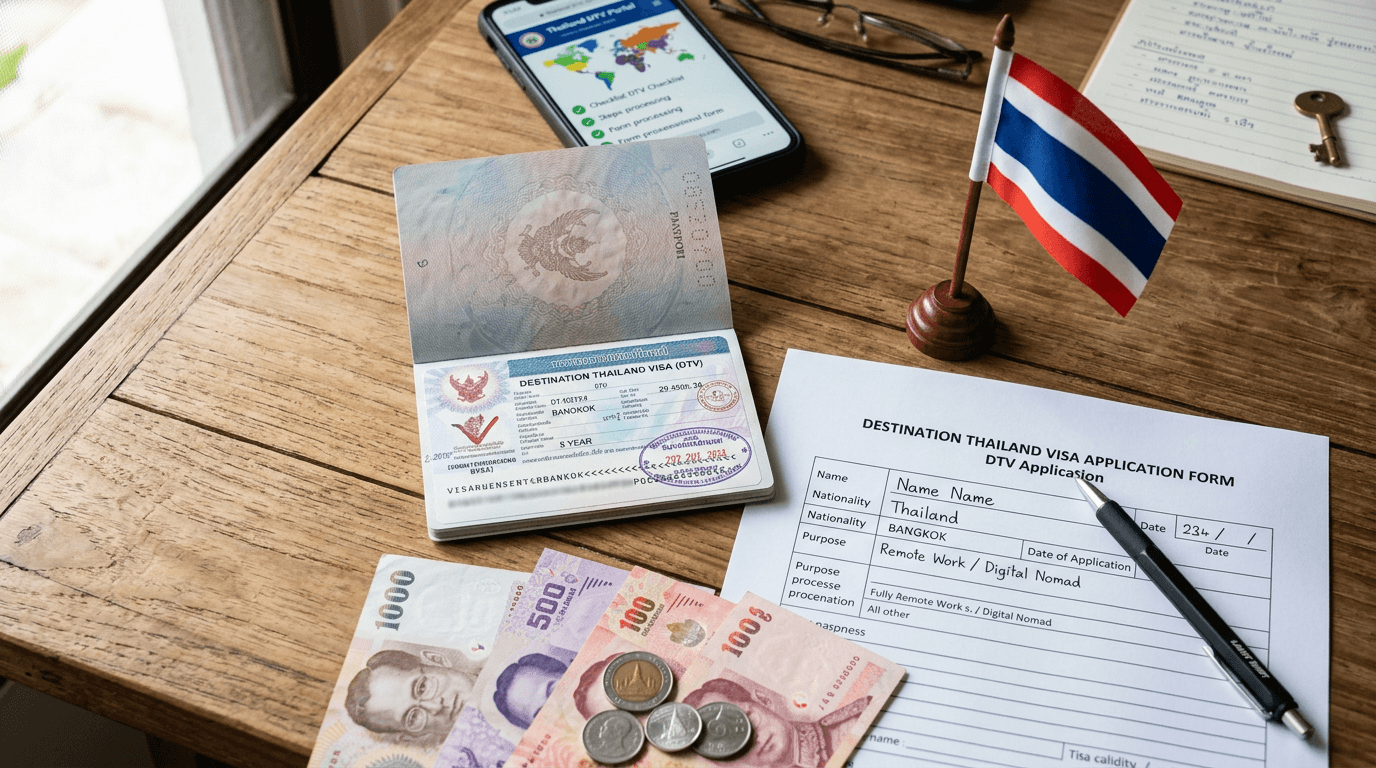
Thailand DTV (Destination Thailand Visa)

At a Glance
- THB 500,000 one-timeno less than; bank statement ending balance · Each applicant; a family bank statement is accepted with proof of relationship
- THB 10,000 one-timeMFA base fee; missions abroad charge a local-currency amount · Each applicant, including dependants
- 5 yearsmultiple-entry visa
- One extension per entry of up to 180 days at the Immigration Bureau. After 180 + 180 days the holder must leave Thailand and may re-enter on the same DTV while it is valid.
- Online through Thai e-Visa (thaievisa.go.th), handled by the Thai embassy or consulate covering the applicant's country of nationality or permanent residence.
- No
- YesSpouse and children under 20 of a DTV holder
The Destination Thailand Visa (DTV) is a multiple-entry visa for remote workers, freelancers and people coming for set activities such as Muay Thai, Thai cooking courses or medical treatment. The visa is valid for 5 years and each entry allows a stay of up to 180 days.
It isn't a work visa. The workcation track covers work for employers or clients outside Thailand, and a job in Thailand needs a work permit.
The rules changed on Aug. 31, 2026. Applicants must now be a national or permanent resident of the country where they apply and must add a criminal record certificate. That ended the common practice of applying at a Thai embassy in a neighboring country during a trip. Applications submitted and paid before that date aren't affected.
- Visa validity: 5 years, multiple entries
- Stay per entry: up to 180 days, extendable once per entry
- Financial evidence: at least THB 500,000
- Visa fee: THB 10,000, charged in local currency by each mission
- Family can join: Yes, spouse and children under 20
- Local work allowed: No
For how the DTV compares with Thailand's retirement and long-term options, see the Thailand guide for remote workers.
The Ministry of Foreign Affairs (MFA) lists three groups of eligible foreigners in its DTV summary:
- Workcation: digital nomads, remote workers, foreign talent and freelancers working for employers or clients outside Thailand.
- Thai soft power activities: people taking part in activities such as Muay Thai courses, Thai cooking classes, sport training, medical treatment, seminars or music festivals.
- Family: the spouse and children under 20 of a DTV holder, who apply for their own DTV.
Every applicant must show financial evidence of at least THB 500,000. A family bank statement is accepted with proof of the relationship.
Since Aug. 31, 2026, applicants must also hold nationality or permanent residence in the country where they apply and provide a criminal record clearance certificate. The embassy in Vientiane states that the new requirements apply worldwide.
Fitting a category isn't the end of the check. Missions ask for more documents when a file is incomplete or unclear, and processing stops until they arrive, according to the London embassy.
The MFA sets a short core list and each mission adds local detail. The London embassy asks for:
- The passport biodata page
- A photo taken within the last six months
- Proof of nationality or permanent residence in the country of application
- Financial evidence of at least THB 500,000, such as bank statements, payslips or a sponsorship letter
- Proof of purpose: for workcation, an employment contract or employment certificate from an employer abroad, or a professional portfolio showing remote work or freelance status; for soft power, confirmation of the course or activity, or an appointment letter from a hospital or medical center
- A police clearance certificate, which London wants issued within six months of the application
Dependents add proof of the relationship, such as a marriage, birth or adoption certificate.
Missions differ on detail. The Washington embassy wants bank statements for the last three months, each with an ending balance of at least THB 500,000, and an FBI certificate issued within three months. The MFA's list doesn't include health insurance.
The MFA sets the DTV fee at THB 10,000 per applicant, and each dependent pays it too. Missions charge it in their own currency, so the amount differs by country: the Washington embassy charges $400 and the London embassy £300.
- Visa fee: THB 10,000, or the local amount set by the mission
- Extension of stay: paid to the Immigration Bureau in Thailand; no official DTV page checked for this update states the amount
- Documents: police certificates, translations and bank letters are priced by whoever issues them
The financial evidence of THB 500,000 isn't a fee. It is money the applicant shows, not money paid to Thailand.
Where to apply: Online through Thai e-Visa (thaievisa.go.th), handled by the Thai embassy or consulate covering the applicant's country of nationality or permanent residence.
- Open an account on the Thai e-Visa portal and pick the embassy or consulate that covers the country of nationality or permanent residence.
- Choose the DTV and the purpose: workcation, soft power or family.
- Upload every document on the mission's list in a clear file. London warns that screenshots or unclear scans bring a request for more documents and a delay.
- Pay the fee in the mission's currency.
No official source allows applying from inside Thailand, and no official DTV processing time is published, so applicants should file well before they plan to travel.
- Visa validity: 5 years, multiple entries
- Stay per entry: up to 180 days
- Extension: One extension per entry of up to 180 days at the Immigration Bureau. After 180 + 180 days the holder must leave Thailand and may re-enter on the same DTV while it is valid.
Each new entry on a valid DTV starts a new stay of up to 180 days. No official source links the DTV to permanent residence.
The DTV has no tax rule of its own, and it brings no exemption for foreign income. Thailand's general rules apply.
A person present in Thailand for 180 days or more in a calendar year is a tax resident under Section 41 of the Revenue Code.
Since Jan. 1, 2024, tax residents pay personal income tax on foreign income they bring into Thailand, whatever year it was earned, under Revenue Department Order Por. 161/2566. Income earned before that date is excluded under Order Por. 162/2566.
DTV holders who stay long enough to become residents and move foreign earnings into Thailand should check how the rule applies to their income. The Thailand guide covers tax in more detail.
Frequently Asked Questions
Can DTV holders work in Thailand?
Local work allowed: No. The workcation track covers work for employers or clients outside Thailand, and a job in Thailand needs a work permit.
Can the DTV still be applied for from a neighboring country?
No. Since Aug. 31, 2026, applicants must apply where they hold nationality or permanent residence and must add a criminal record certificate.
How much money do DTV applicants need?
Financial evidence of at least THB 500,000, such as bank statements. Some missions, including Washington, want three months of statements at that balance.
How long can a DTV holder stay in Thailand?
Up to 180 days per entry on a visa valid for 5 years. One extension per entry of up to 180 days at the Immigration Bureau. After 180 + 180 days the holder must leave Thailand and may re-enter on the same DTV while it is valid.
How much does the DTV cost?
The MFA fee is THB 10,000 per applicant. Missions charge it in local currency, for example $400 in Washington and £300 in London.
How It Compares
More Thailand programs
| Program | Country | Income / month | Fee | Max stay | Renewable |
|---|---|---|---|---|---|
| Thailand LTR Wealthy Pensioner | Thailand | $80,000/yr | THB 50,000 | 60 mo | |
| Thailand Retirement Visa (Non-Immigrant O-A) | Thailand | THB 65,000/mo | THB 5,000↓ | 12 mo |
Similar visas elsewhere
| Program | Country | Income / month | Fee | Max stay | Renewable |
|---|---|---|---|---|---|
| Georgia Digital Nomad Program (Remotely from Georgia) | Georgia | - | - | - | |
| Kyrgyzstan Digital Nomad Status | Kyrgyzstan | - | - | 12 mo | |
| Kenya Class N Permit | Kenya | - | $200↓ | 24 mo | |
| Nepal Digital Nomad Visa (Not Yet Open) | Nepal | - | - | - |
Thailand Digital Nomad Guide
Cost of living, internet, healthcare, coworking, and every visa option for Thailand.
Visa rules change. We'll tell you.
Get notified about policy updates and new requirements for the Thailand DTV (Destination Thailand Visa) and other Thailand visas.