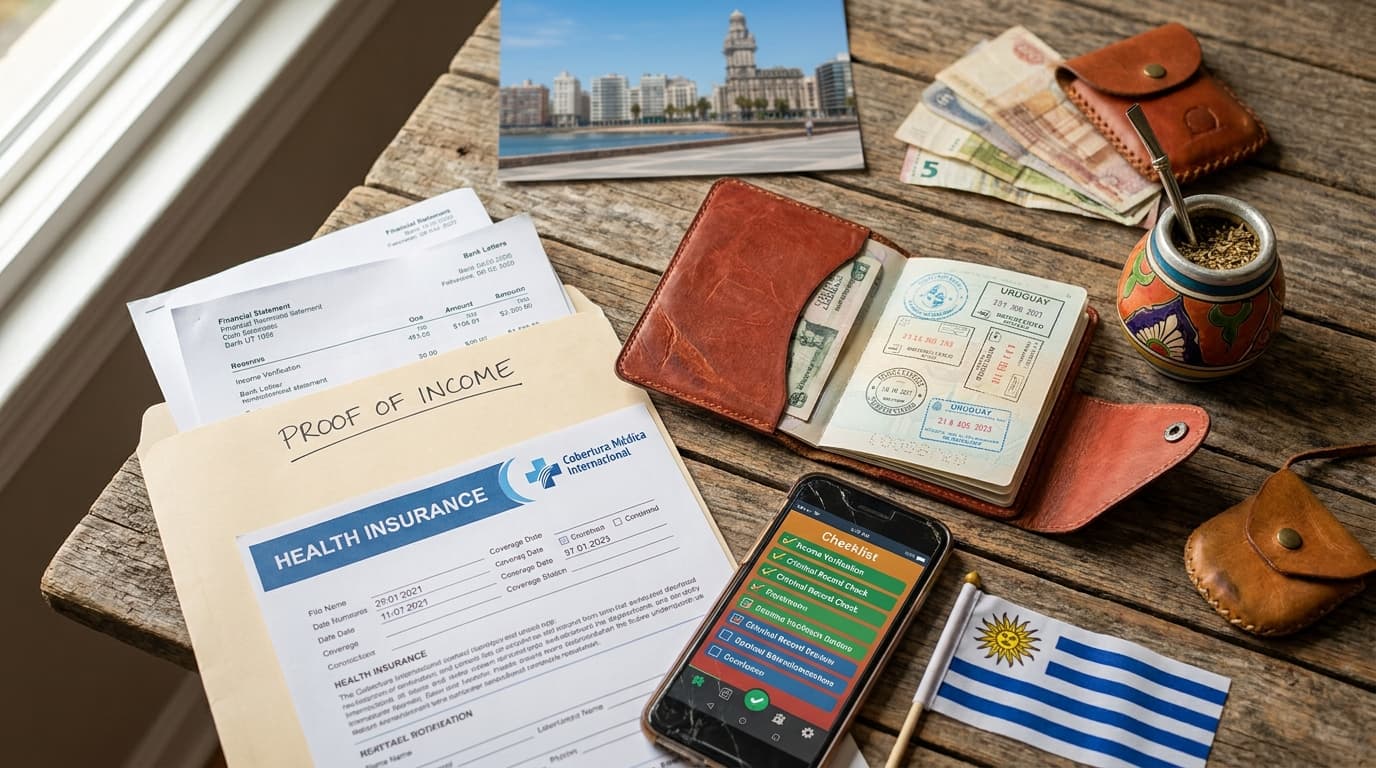
Uruguay Digital Nomad Visa

At a Glance
- No minimum income; applicants sign a sworn statement that they can support themselves during the stayUruguay XXI (government investment and export promotion agency) Live in Uruguay page; DNM requirements list only an ID copy and a sworn statement · main applicant
- UYI 55.71 one-time55.71 UI (Unidades Indexadas, Uruguay's inflation-indexed unit, paid in pesos at the day's UI value); cannot be paid from abroad · each request
- 180 daysresidence for a term under 180 days (Decree 394/009 Art. 8) · main applicant
- Renewable once for another 180 days; the renewal needs a criminal record certificate covering the last five years and a vaccination record issued in UruguayDecree 394/009 Art. 8; DNM renewal requirements · main applicant
- 360 days180 days plus one renewal of 180 days · main applicant
- Online through the gub.uy procedure 'Hoja de identidad provisoria' (digital nomad variant) after arriving in Uruguay; the fee cannot be paid from abroad. The holder then gets a Uruguayan ID card (cédula) from the National Civil Identification Directorate (DNIC)DNM procedure page; Uruguay XXI Live in Uruguay page · all applicants
- Not covered: the permit is for remote work for entities based abroad, with no social security registration; local jobs use the standard provisional permit under Art. 8(A)Decree 394/009 Art. 8(A) and (B) · permit holder
- No automatic path; to stay beyond the permit, holders may apply for temporary or permanent residence if they meet those categoriesDecree 394/009 Art. 8, referring to Arts. 4 (permanent) and 7 (temporary) · permit holder
Uruguay's digital nomad permit is a provisional identity document, the Hoja de Identidad Provisoria for digital nomads, not a visa. Remote workers enter as ordinary visitors, apply online once they're in the country and then collect a Uruguayan ID card (cédula).
- Status: active, under Article 8 of Decree 394/009 as reworded by Decree 238/022, in force since Aug. 4, 2022
- Who it's for: people working remotely from Uruguay for employers or clients based abroad, including the self-employed
- Income: No minimum income; applicants sign a sworn statement that they can support themselves during the stay
- Length: 180 days, renewable once, for 360 days in all
- Fee: UYI 55.71, paid in pesos
The permit is cheap and light on paperwork, but short. Anyone who wants to stay longer needs temporary or permanent residence, such as the residence route for retirees and people with passive income. The Uruguay guide compares the options.
Article 8(B) of Decree 394/009 covers foreigners who work remotely from Uruguay for entities based abroad, including the self-employed. They don't have to register with Uruguay's social security bodies.
- Nationality: the decree sets no nationality limits. Applicants enter on their usual terms, visa-free where their passport allows it or with a visa.
- Income: No minimum income; applicants sign a sworn statement that they can support themselves during the stay. Uruguay XXI, the government's investment promotion agency, says there are no salary requirements at present but that this may change.
- Local work. Not covered: the permit is for remote work for entities based abroad, with no social security registration; local jobs use the standard provisional permit under Art. 8(A).
- Family: the rules have no dependant category, so each family member files a request of their own.
For a first request, the National Migration Directorate (DNM) asks for two documents:
- A copy of the identity document the applicant entered Uruguay with, or will enter with.
- A sworn statement in DNM's format, with a signature matching the identity document.
The renewal asks for more:
- The Uruguayan identity card issued after the first request.
- A new sworn statement.
- For adults, criminal record certificates of national scope from every country where the applicant lived for six months or more in the last five years, apostilled or legalized and translated (Brazilian certificates need no translation).
- A vaccination record from a Uruguayan vaccination center showing the national vaccination scheme is up to date.
- Permit fee: UYI 55.71. The amount is set in Unidades Indexadas (UI), Uruguay's inflation-indexed unit, and paid in pesos at the day's UI value, so the peso price moves over time. It can't be paid from abroad.
- Renewal: DNM lists one fee for every Hoja de Identidad Provisoria request, renewals included.
- ID card: DNIC issues the cédula and may charge for it separately.
- Renewal documents: criminal record certificates, apostilles and translations add to the cost, and prices vary by country.
Where to apply: Online through the gub.uy procedure 'Hoja de identidad provisoria' (digital nomad variant) after arriving in Uruguay; the fee cannot be paid from abroad. The holder then gets a Uruguayan ID card (cédula) from the National Civil Identification Directorate (DNIC).
- Enter Uruguay as a visitor.
- Start the procedure with the "Iniciar trámite en línea" button on DNM's procedure page, logging in with a gub.uy user or an electronic ID.
- Fill in the form, attach the ID copy and sworn statement, and choose how to pay.
- Once DNM authorizes the request, it emails the applicant to go to the National Civil Identification Directorate (DNIC) for the ID card.
DNM publishes no processing time for this procedure.
The permit lasts 180 days.
Renewal: Renewable once for another 180 days; the renewal needs a criminal record certificate covering the last five years and a vaccination record issued in Uruguay. That gives 360 days in all, roughly a year.
After the permit
No automatic path; to stay beyond the permit, holders may apply for temporary or permanent residence if they meet those categories. Retirees and people living on passive income can use the permanent residence route for rentistas, and nationals of Mercosur member and associated states can apply for two-year Mercosur temporary residence.
By comparison, a visitor from a visa-exempt country can stay 90 days, and Decree 394/009 allows one extension of 90 more days.
The permit carries no special tax rules. Uruguay's general test applies: under the personal income tax law, a person who spends more than 183 days in Uruguay in a calendar year, or whose main base of economic or vital interests is there, is tax resident.
A permit of 180 days plus one renewal can cross that line within one calendar year, depending on the arrival date. Nomads planning the full stay should check their position with the tax authority (DGI) or an adviser, in Uruguay and at home.
Frequently Asked Questions
Does Uruguay have a digital nomad visa?
It has a digital nomad permit rather than a visa: a provisional identity document for people working remotely for employers or clients abroad. Applicants enter as visitors and apply online in Uruguay.
Is there an income requirement?
No minimum income; applicants sign a sworn statement that they can support themselves during the stay. Uruguay XXI says there are no salary requirements at present but that this may change.
How long can a digital nomad stay?
180 days, renewable once, for 360 days in total. Staying longer needs temporary or permanent residence.
Can the permit be requested before arriving in Uruguay?
No. The request is made online after arrival, and DNM says the fee can't be paid from abroad.
What does the renewal need?
The Uruguayan ID card, a new sworn statement, criminal record certificates covering the last five years and a vaccination record issued in Uruguay.
How It Compares
More Uruguay programs
| Program | Country | Income / month | Fee | Max stay | Renewable |
|---|---|---|---|---|---|
| Uruguay Pensionado / Rentista Visa | Uruguay | - | UYI 557 | - |
Similar visas elsewhere
| Program | Country | Income / month | Fee | Max stay | Renewable |
|---|---|---|---|---|---|
| Georgia Digital Nomad Program (Remotely from Georgia) | Georgia | - | - | - | |
| Kyrgyzstan Digital Nomad Status | Kyrgyzstan | - | - | 12 mo | |
| Kenya Class N Permit | Kenya | - | $200 | 24 mo | |
| Nepal Digital Nomad Visa (Not Yet Open) | Nepal | - | - | - |
Uruguay Digital Nomad Guide
Cost of living, internet, healthcare, coworking, and every visa option for Uruguay.
Visa rules change. We'll tell you.
Get notified about policy updates and new requirements for the Uruguay Digital Nomad Visa and other Uruguay visas.