We analyzed 1,800 posts about Thailand's DTV. The approvals are winning.

So I was curious about what's REALLY going on with the DTV visa, so, I scrapped more than 100 FB posts and 35+ reddit posts, then ran them through a data analysis, including sentiment analysis, and this is what I've found: looks like there are a lot more positive experiences than negative, though there are some real mines you'll need to navigate.
Thailand's Destination Thailand Visa turned two in July, and the online conversation around it has never sounded more nervous. So we counted instead of guessing.
We pulled 100 consecutive posts from the largest Destination Thailand Visa (DTV) Facebook group, read 240 comments across 34 threads, coded 35 Reddit threads and 177 comments spanning July 2024 to August 2026, then checked the community record against seven official embassy checklists and two years of news coverage.
The short answer: the visa still works. Among community posts reporting a clear outcome, 68.2% were approvals or smooth entries. The anxiety digital nomads moving to Thailand are feeling isn't about whether the DTV is good. It's about whether anyone can predict how it gets administered.
One note before the numbers. The Facebook and Reddit layers are self-reported experiences, not verified case files. That's the value. For a visa where official pages describe maybe half of what applicants actually face, the community record is the only dataset that exists.
The data sheet
Measure | Result |
|---|---|
Facebook posts analyzed | 97 of 100 loaded, chronological feed |
Positive outcome posts | 15 (15.5%) |
Question or neutral posts | 75 (77.3%) |
Negative outcome posts | 7 (7.2%) |
Outcome posts that were positive | 68.2% |
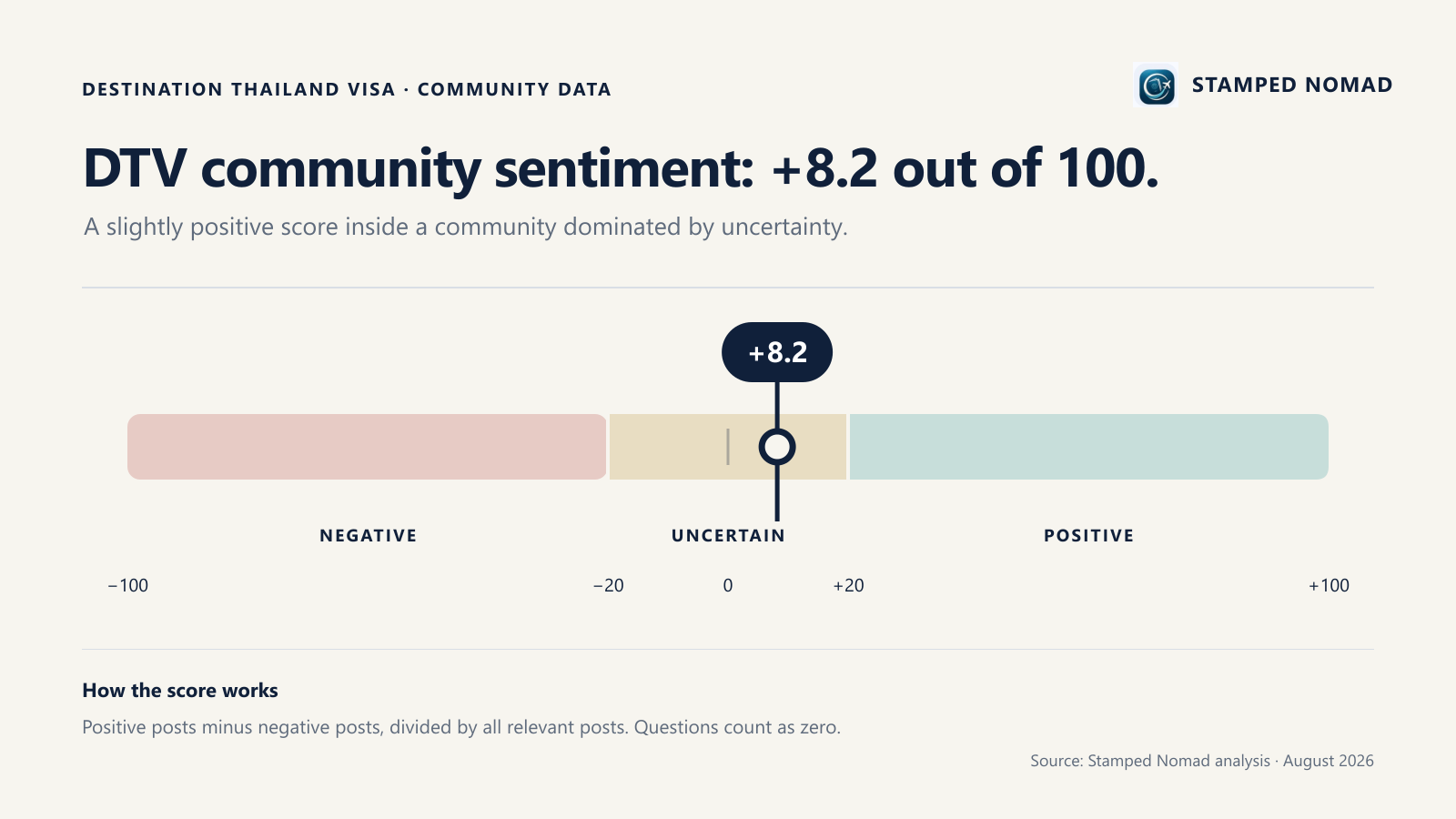
Blended sentiment score | +8.2 out of 100 |
Comments displayed across the sample | 1,629 |
Comments read and coded | 240 on Facebook, 177 on Reddit |
Reddit threads in the ledger | 35 across eight subreddits |
Reported processing times | About an hour to about two months |
The sentiment score is simple math: positive posts minus negative posts, divided by all relevant posts. Questions count as zero.
We built it that way because the dominant state of the DTV community isn't satisfaction or anger. It's uncertainty. More than three-quarters of everything posted is someone trying to predict what an embassy or immigration officer will do next.
Two Phuket posts drove 42% of the conversation
The numbers behind the mood gap:
Negative posts: 7.2% of the sample, 903 displayed comments
Positive posts: twice as many posts, 85 comments
Two Phuket airport incidents: 686 comments and 219 reactions, or 42.1% of every comment in the sample, from 2% of the posts
That's a 10-to-1 attention gap between what goes wrong and what goes right.
Reddit runs the same pattern, with a twist
The two most alarming entry-denial threads of 2026 both came from brand-new accounts, and commenters noticed. Of 19 comments we coded for credibility language, 11 directly challenged the posts as fake or fabricated.
Meanwhile a quieter January 2026 thread full of established users reporting routine border runs drew a fraction of the engagement.
The scary stories may or may not be true. Either way, comment volume isn't a base rate. The chronological data says the typical DTV experience is a bank-statement question followed by an approval, not a secondary-inspection room.
One visa, roughly 90 different checklists
The strongest finding across both platforms is that the DTV isn't one product. It's a 10,000 baht ($308) visa administered by roughly 90 diplomatic posts, each publishing its own checklist.
When something goes wrong, experienced community members don't ask what the applicant submitted. They ask which embassy.
The pattern shows up everywhere in the data:
Facebook: 46 of 97 posts asked about embassy, jurisdiction or process
Reddit: 25 of 177 coded comments led with "which embassy?"
Official pages: the checklists genuinely differ, and not subtly
Consulate by consulate: what the checklists and applicants say
Official requirements first, fetched from embassy pages in August 2026:
Post | Fee (local) | Funds bar | Statement rule | Residence proof |
|---|---|---|---|---|
Washington | $400 | 500,000 baht or $16,000 | 3 months, minimum at every month's end | Green card or valid US visa for noncitizens |
London | £300 | £11,000 (about 465,000 baht) | Months unspecified | BRP or UKVI status, notarized translations |
Tokyo | 52,000 yen | 500,000 baht | 3 months, issued within 1 month | Residence card |
Hong Kong | Per fee table | 150,000 HKD (about 615,000 baht) | 3 months | HKID holders only |
Brussels | €350 | €15,000 (about 550,000 baht) | Statement dated within 30 days | Belgium or Luxembourg residence |
Kuala Lumpur | Not listed | 500,000 baht or 65,000 MYR | 3 months | Lease of 6 months or longer |
Ho Chi Minh City | $340 | 500,000 baht | Unspecified | Document showing current location |
Read that twice. The same visa costs the equivalent of $300 to $400 depending on the counter. The effective financial bar runs from about 465,000 baht in London to about 615,000 in Hong Kong.
Only Washington spells out a month-end minimum. Only London demands notarized translations.
What applicants report, post by post
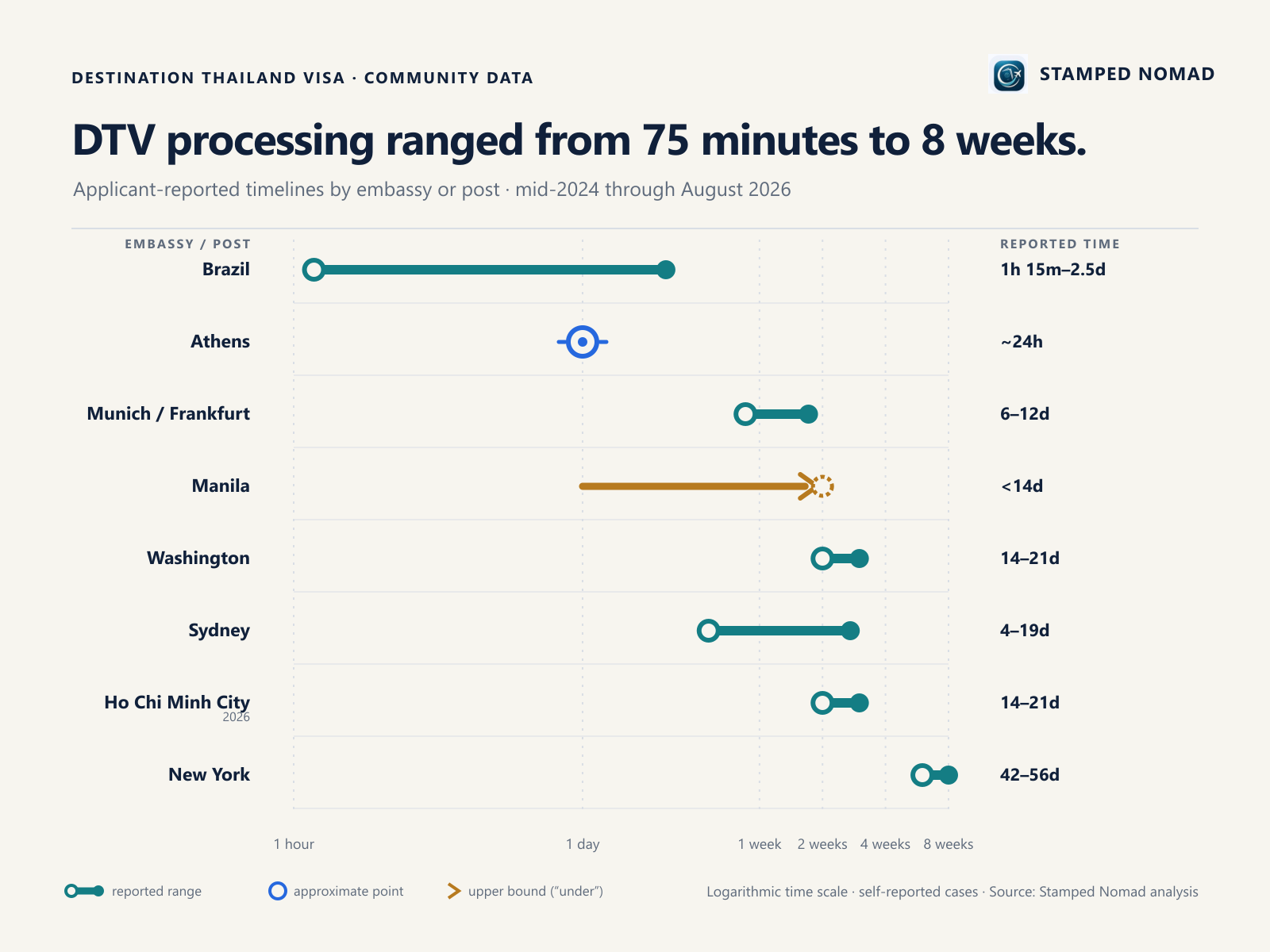
Community record, mid-2024 through August 2026. Treat it as weather, not climate; several entries are single cases.
Where applicants report speed:
Where | What applicants report |
|---|---|
Brazil | Four approvals, 75 minutes to 2.5 days |
Athens | Two roughly 24-hour Workation approvals |
Munich and Frankfurt | Approvals in 6 to 12 days |
Manila | Approvals in under 2 weeks |
Vientiane | Approvals, including after a prior rejection elsewhere |
Where applicants report friction or delays:
Where | What applicants report |
|---|---|
New York | Repeated 6 to 8 week waits |
London | Approvals plus actual-ticket requests and dependant-funds confusion |
Sydney and Canberra | 4 to 19 days, longer pendings at Canberra |
Dubai | Asked for 3 months of funds held in a UAE bank |
Taipei | Canadian approved in 3 weeks, Hong Kong passport spouse pending at week 7 |
Madrid | Told to apply in the country of residence |
Where applicants report the door narrowing:
Where | What applicants report |
|---|---|
Ho Chi Minh City and Hanoi | Weekend-fast in 2024, double rejections and 2 to 3 week waits by 2026 |
Jakarta | A 12-month course applicant got a tourist METV instead of a DTV |
Tokyo | One reported METV substitution, strict checklist |
The Ho Chi Minh City case study
This is the clearest before-and-after in the dataset. In December 2024 a traveler was approved over a weekend with proof of physical presence.
By mid-2026 a self-employed American was rejected twice at the same consulate. The top comment on his thread came from a self-described Thai visa agency owner claiming Vietnam and its neighbors are nearly cut off for applicants who aren't applying from home. We found no official confirmation of that claim, but the direction of travel matches everything else in the record.
The home-country myth
There is no MFA-wide rule requiring application from a home or residence country. What exists is post-by-post residence requirements.
That's exactly why one applicant swears the rule is real and another swears it isn't. Both are describing their own embassy accurately.
The 500,000 baht is a history, not a number
The official requirement reads as one line: show 500,000 baht (about $15,400). The community record says the number is the least important part.
The most instructive rejection involved an applicant who showed six months of statements and was still turned down twice. His balance had dipped below the line during one month. The top-voted advice on the thread was blunt: the balance can't fall below 500,000 for three months, not even for a minute.
What gets applications rejected, per the community
Last-minute deposits: a lump sum that appears right before applying
Screenshots: informal printouts instead of official bank statements
Brokerage and crypto balances: accepted by Washington in one 2025 report, refused by New York over the phone in 2026
Partner transfers: money moving between accounts with no paper trail
A single dip: even one month below the threshold
What strengthens a file
A buffer: one commenter recommended holding 600,000 baht rather than sitting at the minimum
A cover letter: one page mapping each document to a requirement
Business records: registration, contracts, invoices and payments that match bank deposits
Tax returns: the document that turns "I work online" into a verifiable claim
Employees versus everyone else
This is the cleanest dividing line in the whole dataset. Salaried remote workers with an employer letter and payslips report the most repeatable approvals on both platforms.
Freelancers and business owners get approved too. But every successful self-employed case looks the same: a file that makes the business legible to a stranger in 15 minutes. "I work online" is the phrase that shows up in rejection threads.
The Soft Power shift
In 2024 an enrollment letter was enough. By 2026 the route demands a story that holds up:
Hong Kong's checklist asks for an activity plan potentially covering six months
Language schools have reportedly been dropped from eligibility
Course length was debated across the Facebook sample (six versus nine versus 12 months) with no consensus
Verification is real: a gym owner posted that an airport officer phoned to check a holder's attendance
Whatever the route, the activity should be real.
A visa approval isn't an entry guarantee
Most sampled entries at Bangkok's two airports and Samui were stamps and nothing else. One first-entry report: passport, printed e-visa, boarding pass, no questions, stamped in for 180 days.
The friction clusters in two places.
Phuket, and one specific travel pattern
Phuket produced a disproportionate share of secondary-questioning reports, including onward-ticket demands and calls to course providers.
The disputed mid-2026 Reddit threads describe scrutiny of one pattern: repeated stays near the 180-day maximum separated by exits of a few days. Those threads have the credibility problems noted above. A separate report from the Chiang Saen land crossing is harder to dismiss: an officer informally warned a DTV holder that re-entry couldn't be guaranteed and suggested flying instead.
The 2026 enforcement backdrop
Caution is rational even if every viral thread were fake. Per Immigration Bureau figures reported in Thai media, in 2026 Thailand has:
Denied entry to 29,490 foreigners in the first five months of the year
Moved to cut the 60-day visa exemption to 30 days
Capped land-border entries at two per year
Revoked 668 fraudulent education visas
None of it touched the DTV. Officials keep pointing squeezed long-stayers toward it as the compliant option.
What holders carry, per the entry threads
Printed e-visa and passport
TDAC confirmation
Current evidence of the original route: work records or enrollment proof
Accommodation details
An onward-travel option, refundable where possible
Most holders never get asked. The ones who do are glad they had it.
A five-year visa the banks treat like a tourist stamp
The most consistent complaint from people already living on the DTV isn't about the visa. It's about everything around it.
Banking has deteriorated sharply
Thai banks classify the DTV as tourist category. The late-2025 rules against mule accounts, including biometric verification and a Dec. 29, 2025 anti-money-laundering package, effectively ended the tourist bank account. Reports of agent workarounds dried up by mid-2026.
What still works, per community reports and legal briefs:
Enrollment letters from a Soft Power institution
Property ownership, which some banks accept as an account basis
Foreign accounts and fintech wallets as the default fallback
Tax has no clean answer, and we won't pretend otherwise
What's settled: 180 days in a calendar year makes a holder a Thai tax resident, and post-2024 foreign income is taxable when remitted.
What's unresolved: whether remote work performed inside Thailand counts as Thai-source income taxable regardless of remittance. The strict statutory reading says yes. Several major firms treat it as foreign-source in practice, and no Revenue Department ruling settles it.
The remittance exemption that made headlines (remit in the year earned or the next, tax free) was still an unenacted draft in August 2026. The sample's tax threads contradicted each other on every one of these points, which is itself the finding: no comment section can resolve a Thai tax position.
The small print that catches people
90-day reports: a full 180-day stay means one falls due mid-stay
TM30 registration: quietly gates everything from the residence certificate to a driving licence
Tax ID roulette: one holder refused at a district office, another done in 10 minutes with a Thai-language letter and a lease
The extension: 1,900 baht (about $58), once per entry, with some offices demanding the full application package again; agencies often recommend a border run instead
What the data says applicants should do
Apply through the mission serving the applicant's actual residence and read that post's specific checklist. The checklist controls the case, not a Facebook thread and not this article.
Season 500,000 baht plus a buffer for three months without a single dip, in a boring bank account.
Employees: close to a formality with an employer letter and payslips.
Self-employed: build the file that makes the business legible in 15 minutes.
Soft Power: enroll in something real, keep receipts, expect the duration question.
Book refundable travel. Processing ran from about an hour to about two months in this sample, and nothing predicts where a given application lands.
Keep evidence current after arrival. The visa is an invitation. The border decides each entry on its own.
The DTV in August 2026 is what it was at launch: a five-year visa with no income requirement, which remains close to unmatched. What changed is that Thailand now runs it like it means it.
The checklist tests whether the story is real, and the border is where the story gets retold. The people who treat it that way barely appear in this dataset. They get stamped in, and nobody comments on it.
How we did this
We loaded 100 unique posts from the largest DTV Facebook group's chronological feed on Aug. 15, 2026, excluded three off-topic items and coded the remaining 97 as positive, negative or question. We read 240 top-level comments across 34 selected threads plus 19 targeted country searches, which stayed outside the headline score.
The Reddit layer covers 35 threads across eight subreddits from July 2024 to August 2026, with 177 comments coded for evidence type, stance and credibility language. Official checklists came from embassy websites in August 2026, and news, tax and legal claims were checked against government statements, mainstream coverage and law firm briefs.
The limits are real. This is self-reported data from platforms that reward drama, so negative experiences are likelier to be posted and far likelier to draw comments. Nothing here was matched to embassy or immigration records, and none of it is legal or tax advice. Several rules changed while we were researching, and more will.
Sources from the community record:
These are the primary Reddit threads behind the findings above. Facebook threads are cited in aggregate because the group is private.
A self-employed American rejected twice at Ho Chi Minh City, the thread behind the balance-dip finding and the agency claim about Vietnam tightening
The December 2024 weekend approval at HCMC, the before half of the case study
A US employee approved through Washington in 2 to 3 weeks, the model employee application
A Canadian approved in 6 days after swapping an online printout for an official bank statement
A UK company owner approved via HCMC with registration, invoices and a no-Thai-clients letter, the model self-employed file
The disputed "almost denied entry" thread, included as the credibility dispute discussed above, not as a confirmed case
Routine border-run reports from January 2026, the counterweight to the viral denial claims
A Bangkok extension experience with re-submitted documents and a temporary 15-day stamp
The 2026-27 tax and TIN thread, where holders contradict each other on every major tax question
Can DTV holders open a Thai bank account, the branch-by-branch banking record