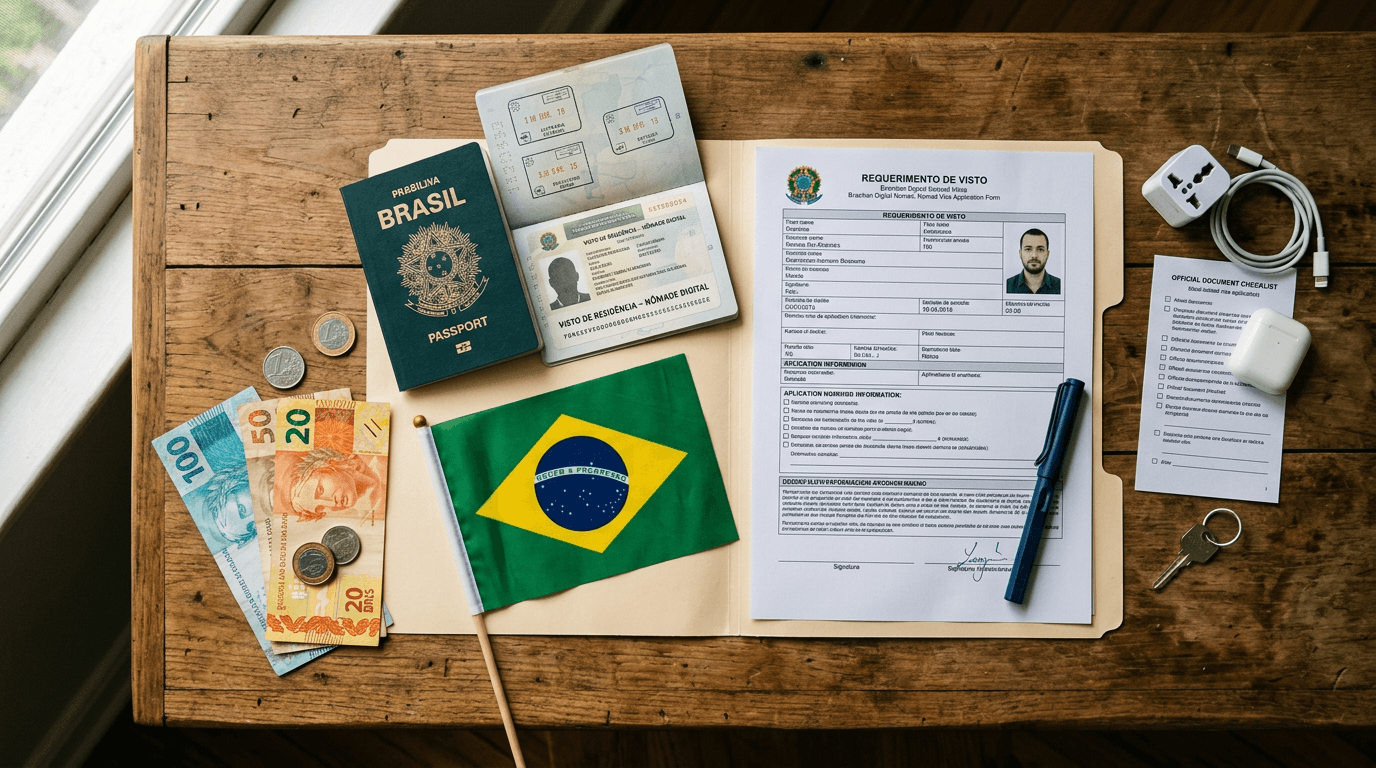
Brazil Digital Nomad Visa

At a Glance
- $1,500 a monthRN 45/2021 art. 5 III; alternative to the US$18,000 savings route · main applicant, visa route and in-country route
- $18,000 one-timeRN 45/2021 art. 5 III, alternative to the monthly income · main applicant
- $100 one-time100 reais-ouro under consular fee table item 230.24 (Portaria MRE 664/2026); one real-ouro equals US$1.00 under the consular regulation and is charged in local currency · nationalities without a reciprocity rate; US nationals pay a reciprocity rate
- R$168.13 one-timeProcessing fee for residence authorization requests, STN revenue code 140066 · people applying from inside Brazil; nationals of Portuguese-speaking (CPLP) countries are exempt
- R$204.77 one-timeCRNM issuance fee, STN revenue code 140120, paid when registering with the Federal Police · all holders registering with the Federal Police
- $290 one-time290 reais-ouro under fee table item 230.14 (reciprocity, United States) · US nationals
- 1 yearUp to one year (RN 45 art. 3 sole paragraph; art. 4 sole paragraph for the in-country route) · all holders
- Renewable once in Brazil for an equal period (up to one more year), on proof that the applicant still meets the digital nomad requirements, a copy of the CRNM card and criminal-record certificates from every place lived during the residence. The regulation sets no further renewals.RN 45 art. 6 · holders already registered in Brazil
- From abroad, at a Brazilian consulate: since Sept. 1, 2026, nationals who do not need a Brazilian visit visa (for example EU countries, the UK, Japan and Mexico) apply fully online in the Sistema Consular Integrado with document uploads and receive the visa by email. Nationals who need a visit visa (for example the US, Canada, Australia and India) fill in the same online form, send documents through the consulate's e-Consular platform and attend an in-person appointment. From inside Brazil: apply to the Ministry of Justice and Public Security for residence authorization online in MigranteWeb. After arrival, every holder registers in person with the Federal Police (biometrics) to receive the migration registration card (CRNM).RN 45 arts. 3 and 4; MRE notice on electronic temporary visas (Aug. 28, 2026); Decree 9.199/2017 arts. 62-67; Federal Police service pages · all applicants; the fully online consular route applies only to visit-visa-exempt nationals
- NoRN 45 art. 1 §2 · main applicant; family members on a family reunion visa may work
- YesFamily members apply for their own family reunion visa (VITEM XI), which can be filed at the same time · spouse or partner, children and other relatives listed in Decree 9.199 art. 45
- No direct path. The visa grants temporary residence only, up to one year and renewable once, with no provision for converting it to permanent residence.Reading of RN 45 arts. 3, 4 and 6 · RN 45 holders
Last checked Sept. 23, 2026
Brazil's digital nomad visa, the VITEM XIV, lets foreign remote workers live in Brazil while they keep working for employers or clients abroad. It rests on Normative Resolution 45/2021 (RN 45) of the National Immigration Council, in force since Jan. 24, 2022.
The money test is $1,500 a month in foreign-source income or $18,000 in bank funds. The first residence term runs up to 1 year and can be renewed once from inside Brazil. Working for an employer in Brazil isn't allowed.
There are two ways in. Applicants abroad get the visa from a Brazilian consulate, while people already in Brazil ask the Ministry of Justice and Public Security for the same status as a residence authorization. Every holder then registers in person with the Federal Police.
Short stays don't need this visa. RN 45 also lets nomads do the same remote work as visitors, within the stay limits and visit-visa rules for their nationality.
The visa is for people who can do their job remotely from Brazil, using information and communication technology, for an employer based abroad. Anyone who works for an employer in Brazil, even without an employment contract, doesn't count as a digital nomad under RN 45.
Freelancers with clients abroad can qualify. RN 45 accepts a service contract as proof of the foreign link. The consulate in Santiago also lists self-employed professionals serving clients outside Brazil among eligible applicants.
Some consulates read the rule more narrowly. New York says the visa isn't open to business owners and asks for an employment contract signed by a foreign employer. Freelancers should check their consulate's list before applying.
The money test is set in US dollars: at least $1,500 a month from a foreign paying source or at least $18,000 in available bank funds. RN 45 sets no nationality limits. Nationality changes how the application is made and, for US nationals, the fee.
Family members don't join the nomad's visa. A spouse, partner, children or other dependents apply for their own family reunion visa (VITEM XI), which can be filed at the same time.
RN 45 lists the core documents for both routes. Consulates can ask for more, so the checklist published by the consulate handling the case is the one to follow.
Applying at a consulate
- Passport: a valid passport or other travel document proving identity and nationality.
- Health insurance: valid in Brazil.
- Visa form and fee: the completed application form and proof the consular fee was paid.
- Travel: proof of transport into Brazil.
- Criminal record: a certificate from the country of origin or, at the consulate's discretion, an equivalent document.
Proof of nomad status
- Declaration: the applicant's own statement that they can work remotely using information and communication technology.
- Foreign link: an employment contract, a service contract or other documents tying the applicant to a foreign employer.
- Money: proof of $1,500 a month from a foreign paying source or $18,000 in bank funds.
Applying from inside Brazil
Applicants already in Brazil send the ministry a valid passport and the same proof of nomad status, plus:
- Residence form: the request form attached to RN 45, signed by the applicant or a representative. A representative also needs a power of attorney.
- Parents' names: a document showing them, legalized and translated by a sworn translator, unless the passport already shows them.
- Fee receipt: proof of payment of the residence processing fee.
- Criminal record: certificates from every place lived in during the past five years, plus a declaration of no criminal record in any country over the same period.
What consulates add
Extra items vary by post. London and New York want the police certificate issued within the last three months, plus a letter from the employer confirming the work can be done remotely. New York also asks for a passport photo and a copy of the birth certificate.
Rules on police certificates differ too. London wants one from every country lived in during the past 12 months, apostilled. Santiago wants apostilled certificates from every country lived in during the past five years. London and Santiago also want health insurance covering the full stay.
The standard consular fee for this visa is $100. US nationals pay a reciprocity rate of $290. Other reciprocity rates can apply to some nationalities, so applicants should confirm the amount with their consulate.
Brazil's consular fee table sets these amounts in reais-ouro, a unit fixed at US$1. Consulates charge the equivalent in local currency.
- Residence processing fee: R$168.13, paid only on the in-country route.
- Registration card (CRNM): R$204.77, paid when registering with the Federal Police.
Health insurance, police certificates, apostilles and sworn translations add to the bill. Their cost depends on the country and the provider.
The route depends on nationality and on where the applicant is.
- Nationals who don't need a visit visa: since Sept. 1, 2026, they apply fully online in the Sistema Consular Integrado (SCI), upload the documents and receive the visa by email. No passport or paper file goes to the consulate.
- Nationals who need a visit visa: those of the US, Canada, Australia and India, among others, fill in the same online form, upload the documents to the consulate's e-Consular platform and attend an in-person appointment with the originals.
- Applicants already in Brazil: they apply online to the Ministry of Justice and Public Security through its MigranteWeb system.
Processing times vary by consulate.
After arrival
Every holder registers in person with the Federal Police, which takes fingerprints and issues the migration registration card (CRNM). Visa holders have 90 days from entry. When residence was granted inside Brazil, the deadline is 30 days from publication of the approval in the Diário Oficial.
The Federal Police asks for its online form, the passport, the visa application form and proof of the card fee. It can request an updated birth or marriage certificate if civil details are in doubt. Documents issued abroad must meet its legalization and translation rules.
The first residence term runs up to 1 year on both routes.
- Renewal: Renewable once in Brazil for an equal period (up to one more year), on proof that the applicant still meets the digital nomad requirements, a copy of the CRNM card and criminal-record certificates from every place lived during the residence. The regulation sets no further renewals.
- Permanent residence: No direct path. The visa grants temporary residence only, up to one year and renewable once, with no provision for converting it to permanent residence.
The status can be cancelled at any time if the application left out relevant information or contained a false statement. Brazil's investor visa, by contrast, can lead to indefinite residence.
Receita Federal, Brazil's tax authority, applies its standard test for temporary-visa holders without a Brazilian employment contract. A digital nomad becomes a tax resident on the day they complete 184 days in Brazil, consecutive or not, within a period of up to 12 months.
Until then, Brazil doesn't tax income received from abroad. From that day, foreign salary and client payments fall under carnê-leão, a monthly tax due by the last business day of the following month. They also go on the annual income tax return.
Tax paid abroad can be credited against the Brazilian bill only where Brazil has a tax treaty or reciprocity with the country that levied it. The residency rules make no exception for digital nomads, so anyone planning a long stay should track their days in Brazil.
Frequently Asked Questions
How much income does Brazil's digital nomad visa require?
Either $1,500 a month from a foreign paying source or $18,000 in available bank funds. The regulation sets both amounts in US dollars.
Can freelancers get Brazil's digital nomad visa?
Yes. The regulation accepts a service contract with a foreign client as proof of the foreign link. Some consulates are stricter: New York says business owners can't use the visa, so applicants should check their consulate's list first.
Can Brazil's digital nomad visa be applied for online?
Since Sept. 1, 2026, nationals who don't need a Brazilian visit visa apply fully online and receive the visa by email. Nationals who need one, such as those of the US, Canada, Australia and India, fill in the online form and attend an in-person consulate appointment. People already in Brazil apply online through MigranteWeb.
How long can a digital nomad stay in Brazil on this visa?
The first term runs up to 1 year. It can be renewed once, in Brazil, for the same length on proof that the holder still meets the requirements. The regulation gives no path from this visa to permanent residence.
When do digital nomads start paying tax in Brazil?
They become tax residents on the day they complete 184 days in Brazil, consecutive or not, within a period of up to 12 months. From then on, income from abroad is taxed monthly through the carnê-leão and reported on the annual return. Before that, Brazil doesn't tax their foreign income.
How It Compares
More Brazil programs
| Program | Country | Income / month | Fee | Max stay | Renewable |
|---|---|---|---|---|---|
| Brazil Investor Visa | Brazil | $27,000-180,000 saved | BRL 100-290 | - |
Similar visas elsewhere
| Program | Country | Income / month | Fee | Max stay | Renewable |
|---|---|---|---|---|---|
| Georgia Digital Nomad Program (Remotely from Georgia) | Georgia | - | - | - | |
| Kyrgyzstan Digital Nomad Status | Kyrgyzstan | - | - | 12 mo | |
| Kenya Class N Permit | Kenya | - | $200 | 24 mo | |
| Nepal Digital Nomad Visa (Not Yet Open) | Nepal | - | - | - |
Brazil Digital Nomad Guide
Cost of living, internet, healthcare, coworking, and every visa option for Brazil.
Visa rules change. We'll tell you.
Get notified about policy updates and new requirements for the Brazil Digital Nomad Visa and other Brazil visas.