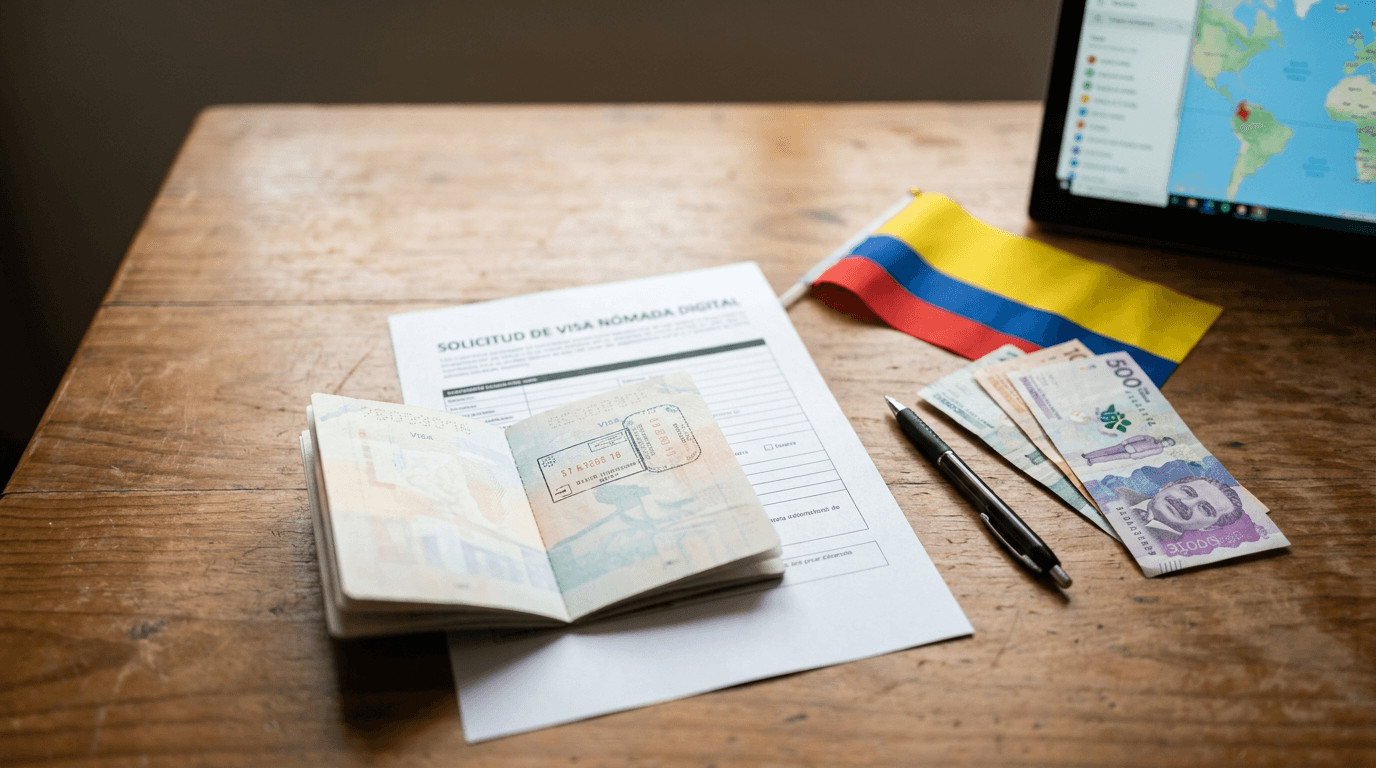
Colombia Digital Nomad Visa

At a Glance
- COP 5,252,715 a month3 SMMLV (salarios mínimos legales mensuales vigentes), shown on bank statements for the last 3 months · main applicant
- $56 one-timeVisa tipo V, etapa de estudio; EUR 44 when paid in the euro zone and Cuba; excludes stamp tax · all applicants outside special exemptions (for example Spanish nationals pay nothing; Japanese and Korean nationals pay only the study stage)
- 2 yearsup to 2 years
- No renewal rule in the resolution; a holder may file a new visa application, and whether a second nomad visa is granted after 2 years is at the consulate's discretion
- Online through the Cancillería visa application platform (Solicitud de visa en línea), from inside or outside Colombia
- 30 daysup to 30 calendar days after a complete application and paid study fee; can run longer when other agencies are consulted
- No
- Yes
- No. Time on a V visa does not count toward the Resident (R) visa, which is reached only through qualifying M visasRes. 5477 Art. 90 (as amended by Res. 10434 de 2023) lists only M visa categories
Colombia's digital nomad visa is a Visitor (V) visa for people who work remotely from Colombia for foreign employers or clients, and for digital entrepreneurs. It's set out in Article 46 of Resolution 5477 of 2022, the rules that govern every Colombian visa.
- Status: active
- Who: passport holders from countries exempt from Colombian short-stay visas
- Income: three monthly minimum wages (SMMLV), which is COP 5,252,715 a month in 2026
- Length: up to 2 years
- Fees: $56 to study the application and $138 to issue the visa
The visa doesn't allow work for Colombian companies or clients, and time on it doesn't count toward permanent residence. The Colombia guide compares it with the M visas, which do.
Article 46 covers remote work or telework from Colombia through digital means, only for foreign companies, whether as an employee or independently. It also covers people starting a digital content or information technology venture of interest to the country.
- Nationality: Applicant must hold a passport from a country or territory exempt from Colombian short-stay visas.
- Income: at least three SMMLV a month over the last three months. With the 2026 minimum wage of COP 1,750,905 a month, that's COP 5,252,715 a month. The amount rises every Jan. 1 with the minimum wage.
- Local work: No. The visa doesn't allow paid work for people or companies based in Colombia.
Family: the main holder can request beneficiary visas for a spouse or permanent partner and for financially dependent children under 25. Beneficiary visas end with the main visa and don't allow work (Article 93).
General requirements for every visa (Article 24):
- The online form, with a recent color photo on a white background, no larger than 300 KB.
- A passport valid at least six more months, with a copy of the biographical page.
- Applicants already in Colombia: the page with the latest entry stamp, or Migración Colombia's equivalent entry record.
- Applicants in a third country: proof of legal stay there.
Specific to the nomad visa:
- A letter in Spanish or English from each foreign company the applicant works for, stating the type of relationship and pay. A contract with the company can be added. Owners or partners of a foreign company show that ownership and a letter saying they work for it remotely.
- Entrepreneurs: a motivation letter describing the venture and the financial and human resources behind it.
- Bank statements for the last three months showing income of at least COP 5,252,715 a month.
- Health insurance valid in Colombia for the planned stay, covering accident, illness, maternity, disability, hospitalization, death and repatriation.
Under Article 21, documents issued abroad need an apostille or legalization and an official Spanish translation. Bank statements are exempt when they're in an official language of the Organization of American States, such as English.
- Study fee: $56, paid when the application is filed and not refundable.
- Issuance fee: $138, paid only if the visa is approved.
Both come from Resolution 3969 of 2026, in force since April 1, 2026, which replaced the older schedule still quoted on many sites. Lower euro amounts apply when paying in the euro zone or Cuba, and some nationalities pay less under reciprocity: Spanish nationals pay nothing, and Japanese and South Korean nationals pay only the study fee.
Other costs: health insurance for the whole stay, apostilles and translations, and the cédula de extranjería from Migración Colombia.
Where to apply: Online through the Cancillería visa application platform (Solicitud de visa en línea), from inside or outside Colombia.
- Fill in the online visa form and upload the documents.
- Pay the study fee within the deadline the platform gives. An unpaid application is treated as withdrawn.
- Cancillería decides within 30 days of a complete, paid application, or longer when it consults other agencies. It can ask for missing documents up to three times, or call the applicant to an interview.
- If the visa is approved, pay the issuance fee within the deadline, and the electronic visa is issued.
- Holders of visas valid more than three months register with Migración Colombia and get a foreigner ID card (cédula de extranjería).
Applicants inside Colombia have to keep a legal status for the whole time the application is under study (Article 13).
- Length: up to 2 years.
- Renewal: No renewal rule in the resolution; a holder may file a new visa application, and whether a second nomad visa is granted after 2 years is at the consulate's discretion.
- Residence: No. Time on a V visa does not count toward the Resident (R) visa, which is reached only through qualifying M visas.
Nomads who want to settle need a Migrant (M) visa that counts toward the Resident (R) visa, such as the visa for company owners and partners. Time spent on the nomad visa doesn't carry over.
The nomad visa carries no special tax regime. Tax residence depends on days in the country. Under the Tax Statute, a person who spends more than 183 days, continuous or not, in Colombia within any 365-day period is tax resident. When that period spans two tax years, residence applies in the second.
Residents are taxed on income from Colombian and foreign sources and on assets held in and outside the country (Article 9). Non-residents are taxed only on Colombian-source income. Anyone who expects to pass the threshold should check the filing rules and any tax treaty with their home country with the tax authority (DIAN) or an adviser.
Frequently Asked Questions
How much income does the Colombia digital nomad visa require?
Three monthly minimum wages (SMMLV), shown on bank statements for the last three months. In 2026 that's COP 5,252,715 a month; the figure rises each Jan. 1 with the minimum wage.
Who can apply for the digital nomad visa?
Remote workers for foreign companies or clients, and digital entrepreneurs, who hold a passport from a country exempt from Colombian short-stay visas.
Can the nomad visa be renewed?
Not as of right. It lasts up to 2 years. No renewal rule in the resolution; a holder may file a new visa application, and whether a second nomad visa is granted after 2 years is at the consulate's discretion.
Does the nomad visa lead to permanent residence?
No. Time on a V visa does not count toward the Resident (R) visa, which is reached only through qualifying M visas.
How much does the visa cost?
$56 for the study of the application plus $138 if it's approved, under Resolution 3969 of 2026.
How It Compares
More Colombia programs
| Program | Country | Income / month | Fee | Max stay | Renewable |
|---|---|---|---|---|---|
| Colombia M Inversionista Visa | Colombia | COP 612,816,750 saved | $56 | 36 mo | |
| Colombia M Pensionado Visa | Colombia | COP 5,252,715/mo | $56 | 36 mo | |
| Colombia M Socio o Propietario Visa | Colombia | COP 175,090,500 saved | $56 | 36 mo |
Similar visas elsewhere
| Program | Country | Income / month | Fee | Max stay | Renewable |
|---|---|---|---|---|---|
| Georgia Digital Nomad Program (Remotely from Georgia) | Georgia | - | - | - | |
| Kyrgyzstan Digital Nomad Status | Kyrgyzstan | - | - | 12 mo | |
| Kenya Class N Permit | Kenya | - | $200 | 24 mo | |
| Nepal Digital Nomad Visa (Not Yet Open) | Nepal | - | - | - |
Colombia Digital Nomad Guide
Cost of living, internet, healthcare, coworking, and every visa option for Colombia.
Visa rules change. We'll tell you.
Get notified about policy updates and new requirements for the Colombia Digital Nomad Visa and other Colombia visas.