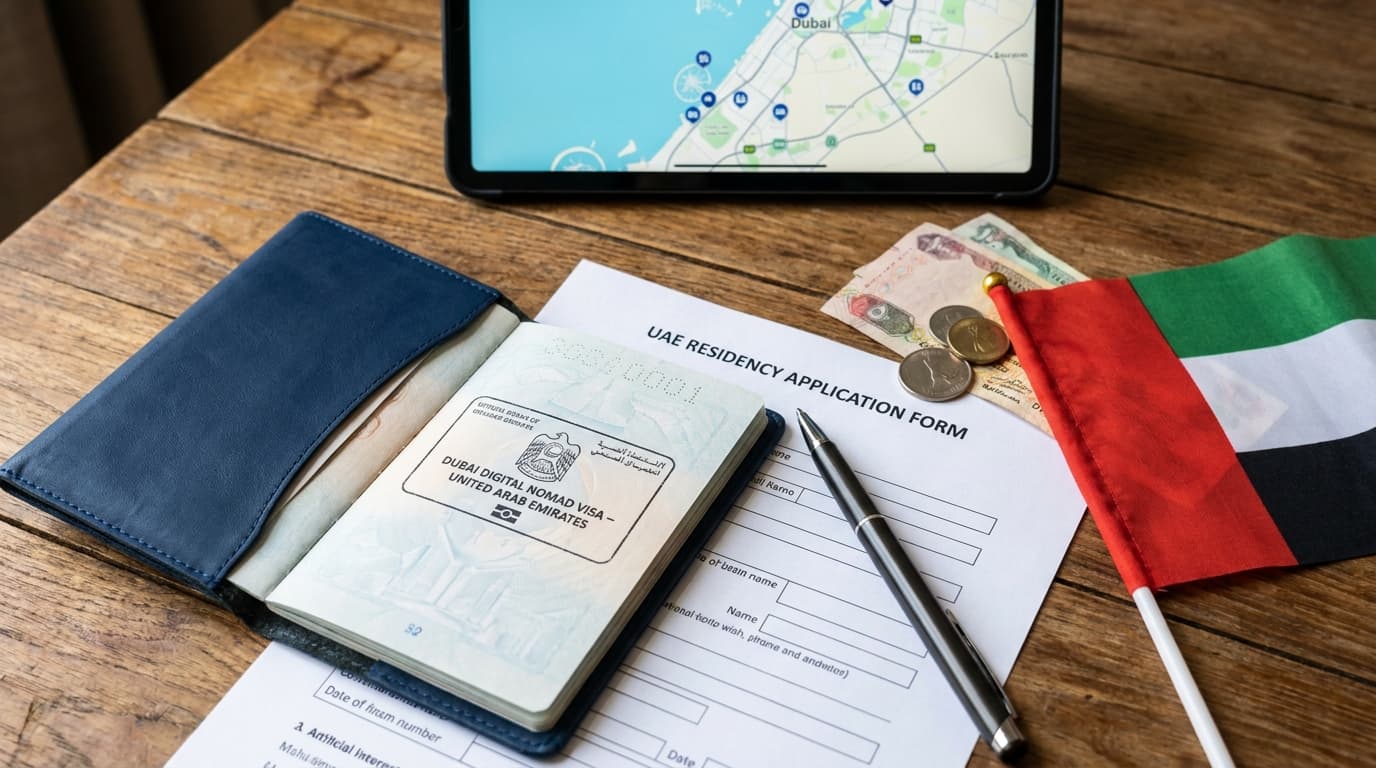
Visa Program Briefing

United Arab Emirates flag

Dubai Digital Nomad Visa

United Arab EmiratesDigital Nomad Visa
Brandon Richards
Brandon Richards ·

Visa Data Sheet

Income Requirement
$NaN / mo
Application Fee
$NaN
Processing Time
1 week
Maximum Stay
12 months
RenewableResidency PathRemote Work
The Full Briefing

Dubai’s digital nomad visa is really the UAE’s Virtual Work Residence Visa and that wording matters. It’s a one-year residence permit for people who work for an employer or clients outside the UAE, so you can live in Dubai, Abu Dhabi or anywhere else in the country without taking a local job.

This isn’t a tourist visa dressed up with better branding. It gives you resident status, which means you can finish the usual paperwork, get an Emirates ID and, if you qualify, sponsor family members for the same one-year period. It’s also renewable if you still meet the rules.

What you need to qualify

  • Income: at least $3,500 a month or the equivalent in another currency.
  • Work status: proof that you work for an entity outside the UAE and do that work remotely.
  • Insurance: valid health insurance covering the UAE.
  • Passport: at least 6 months of validity.
  • Photo: a recent passport-style photo.

The income test is the real gatekeeper here. If your remote pay is lumpy, hard to document or just under the threshold, this visa gets annoying fast. The official federal page doesn’t lock in a fixed bank-statement count, so you should be ready to show whatever proof GDRFA, ICP or an Amer center asks for.

How it differs from a tourist visa

A tourist visa is for visiting. This one is for living in the country while keeping your foreign job. That means residence formalities, a longer stay and a clearer legal basis for remote work, which is the whole point if you’re planning to stay more than a few weeks.

Dubai’s version starts with a 60-day entry period so you can enter the country and complete the residence steps. The visa decision itself is listed by GDRFA as taking 48 hours, but that doesn’t include the medical test or Emirates ID processing, which can add more time.

Costs and practical limits

  • Visa fee: AED 200 plus 5% VAT.
  • Inside-UAE applications: an extra AED 500 fee applies, plus AED 10 each for Knowledge and Innovation Dirham charges.
  • Work restriction: you can’t take a job with a UAE-based employer on this visa.

The upside is simple, 0% personal income tax and a legal path to stay put for a year at a time. The downside is just as clear, you need clean documentation and steady remote income and if you can’t prove that $3,500 monthly floor, this route won’t work.

The Dubai digital nomad route, officially called the UAE virtual work residence permit, is built for people who work for a company or run a business outside the UAE. It gives you a one-year residence permit that can be renewed, but it doesn't let you take a UAE job without switching visas.

There’s no published nationality list for this category. The federal portal and Dubai’s GDRFA describe the route by activity and income, not passport, so eligibility comes down to whether you can show remote work, stable earnings and pass the standard checks.

Who can apply:

  • Employees working remotely for an employer outside the UAE
  • Business owners or freelancers with income from outside the UAE
  • Applicants who can pass medical and security screening
  • People able to prove they make at least $3,500 a month or the foreign-currency equivalent

The income bar is the big one. The official requirement is a salary certificate or similar proof showing at least $3,500 a month, plus evidence that the work is done remotely for an entity outside the UAE. The public guidance doesn’t give an official AED figure, so any local-currency conversion is only an estimate.

Paperwork is fairly straightforward, though not exactly light. You’ll usually need a passport with at least six months left, a recent white-background photo, health insurance that covers the UAE, proof of remote work and proof of income. Officials also require a medical fitness test and Emirates ID steps after entry.

Common documents:

  • Passport: valid for at least 6 months
  • Photo: recent, color, white background
  • Salary certificate: showing at least $3,500 a month
  • Work proof: contract, employer letter or similar evidence of remote work outside the UAE
  • Health insurance: valid coverage in the UAE

Family sponsorship is allowed for the same one-year period, subject to the usual UAE family rules. The official pages don’t set a public cap on dependants, but they do keep the normal relationship, income and documentation checks in place.

Source 1 | Source 2

Dubai’s virtual work residence visa is built for remote workers who already have a job or business outside the UAE. The official income threshold is $3,500 a month or the foreign-currency equivalent and the visa is issued for one year with renewal available if you still meet the rules.

The paperwork is fairly light, but the requirements are specific. Dubai handles the permit through GDRFA, while other emirates use the federal ICP route. The initial entry visa gives you 60 days to land, finish the medical and Emirates ID steps and get the residence permit issued.

What you need to apply

  • Passport: a copy with at least 6 months’ validity.
  • Photo: a recent color photo with a white background.
  • Income proof: a salary certificate showing at least $3,500 a month or equivalent in foreign currency.
  • Remote-work proof: evidence that you work for an entity outside the UAE and do the job remotely.
  • Health insurance: required for residency and also needed for renewal in Dubai.

The official pages don’t spell out a single fixed document format for every applicant, so some people may be asked for extra supporting material. The main point is simple, though, if you can’t prove outside-UAE work and that monthly income level, the application won’t go far.

Fees and timing

  • Virtual work visa fee: AED 200 plus 5% VAT.
  • Inside-the-UAE fee: AED 500, if you’re applying from within the country.
  • Knowledge Dirham: AED 10.
  • Innovation Dirham: AED 10.

GDRFA lists an expected completion time of 48 hours for visa issuance. That’s the official processing figure for a complete application, though real life can still drag if your documents are messy or incomplete.

Renewal rules

Dubai does have a renewal service for the virtual work residence permit. For that, you’ll need a passport copy, health insurance, a medical fitness result, proof of remote work outside the UAE, the salary certificate and your Emirates ID receipt. The visa doesn’t turn into a Golden or Green Visa automatically, so if you want longer-term residency, you’ll need to qualify under a separate route.

Source 1 | Source 2

Dubai’s Virtual Work Programme is cheaper on the government side than many people expect. The official GDRFA fee is AED 200, plus 5% VAT. On top of that, Dubai lists AED 10 for the Knowledge Dirham, AED 10 for the Innovation Dirham and AED 500 if the sponsored person is already inside the country.

That means the visible official total starts at about AED 220 before VAT or roughly $60 and can rise to about AED 720 before VAT or roughly $196, if the in-country fee applies. The portal doesn’t publish a single all-in price, though, so your final bill can still move once you add medical tests, health insurance and any help you pay for with paperwork.

  • Visa fee: AED 200, plus 5% VAT
  • Knowledge Dirham: AED 10
  • Innovation Dirham: AED 10
  • Inside-the-country fee: AED 500, if applicable

Income is the part that’s harder to fake. The official requirement is a salary certificate or proof of monthly income of at least $3,500 or the equivalent in foreign currency. You’ll also need proof that you work for an entity outside the UAE, a passport copy valid for at least 6 months, a recent color photo with a white background and valid health insurance.

  • Monthly income: At least $3,500 or equivalent
  • Processing time: 48 hours
  • Validity: 1 year, extendable
  • Required medical step: Medical fitness test

The fee itself isn’t outrageous. The bigger annoyance is that the visa still comes with extra admin costs and the official pages don’t give a clean total for the full process. If you’re also bringing family, the visa allows sponsorship for dependents for the same one-year period, but the official pages I could verify don’t list a fixed dependent fee, so don’t assume it’ll be cheap.

The UAE’s virtual work visa is filed online and you don’t need to be in the country for the visa to be issued through the federal ICP service. Dubai also runs its own GDRFA route, which can be started through UAE Pass or a username or through an AMER center if you’d rather do it in person.

How to apply

  • 1. Gather your documents: passport valid for at least 6 months, a personal photo, proof of remote employment outside the UAE, a salary certificate showing at least $3,500 a month or the foreign-currency equivalent, valid health insurance and a medical fitness test result.
  • 2. Submit the application: use ICP Smart Services for the federal route or GDRFA Dubai for the Dubai route.
  • 3. Pay the fees: ICP lists a 100 dirham application fee, 100 dirham issuance fee and 100 dirham smart services fee. GDRFA lists a 200 dirham visa fee, plus 5% VAT and, if applicable, a 500 dirham inside-country fee, 10 dirhams for the Knowledge Dirham and 10 dirhams for the Innovation Dirham.
  • 4. Wait for approval: GDRFA publishes a 48-hour expected completion time. The ICP page doesn’t show a fixed decision time in the verified material.
  • 5. Complete residency steps: once approved, the visa is issued as a residence permit, then you can enter and live in the UAE under self-sponsorship.

The income bar is straightforward, but it isn’t low. Officially, you need to show $3,500 a month, not a yearly figure, so monthly bank flow matters more than one strong quarter. The visa is issued for one year and can be extended, which makes it workable for people who want a base without locking into a long contract.

One small wrinkle, if you’re approved through GDRFA Dubai, the page says you can stay in the UAE for 60 days from entry while you finish the residence procedures. That’s not a reason to dawdle. Get the medical test and Emirates ID steps done quickly so the visa doesn’t turn into a paperwork headache.

Dubai’s Digital Nomad Visa, officially the Virtual Work Residence, is issued for 1 year and can be renewed if you still meet the same requirements. The government wording is pretty clear on the validity, but it doesn’t publish a separate long-term path on the official pages reviewed, so treat this as a temporary residence permit, not a route to permanent residency or citizenship.

Renewal is handled through Dubai’s virtual work residence renewal service. The same core conditions apply again, which means you’ll need to keep proving remote employment outside the UAE and maintain the minimum income threshold of $3,500 a month or equivalent, along with valid insurance and the required medical fitness result.

The official pages don’t spell out a fixed maximum cumulative stay. So if you’re planning to use this visa year after year, the safe read is that it’s renewable in one-year blocks, but the government hasn’t published a cap in the material verified here.

  • Initial validity: 1 year
  • Renewal: Available through the virtual work residence renewal service
  • Income threshold: $3,500 per month or equivalent
  • Residence type: Extendable temporary stay, not a confirmed settlement track

Fees are a little messy. GDRFA lists the virtual work visa fee at AED 200, plus 5% VAT. If you apply inside the country, there’s also an AED 500 in-country fee, plus AED 10 for Knowledge Dirham and AED 10 for Innovation Dirham. Delivery is another AED 20.

  • Visa fee: AED 200
  • VAT: 5%
  • Inside-country fee: AED 500
  • Knowledge Dirham: AED 10
  • Innovation Dirham: AED 10
  • Delivery: AED 20

For renewal, the official service page repeats the same basic charges and adds that the issuance fee rises by AED 100 for each year when residency runs longer than 2 years, but it doesn’t clearly publish a separate renewal total for this specific visa. That’s the annoying part, you may need to check the final amount when you submit.

Renewal documents are straightforward. You’ll need a passport valid for at least 6 months, a recent color photo on a white background, proof that you work outside the UAE, a salary certificate, health insurance, the medical fitness result and, for renewal, your ID receipt.

  • Passport copy: 6 months’ validity minimum
  • Photo: Recent color photo with white background
  • Work proof: Evidence of remote work for a non-UAE entity
  • Salary certificate: Showing at least $3,500 monthly income
  • Health insurance: Required
  • Medical fitness result: Required
  • ID receipt: Required for renewal

Taxes & considerations

Dubai’s Virtual Work Visa doesn’t come with any special tax break, because the UAE doesn’t levy personal income tax at all. If you’re living in Dubai on this visa and working for a foreign employer or your own company abroad, your salary isn’t taxed by the UAE in your personal capacity.

That said, the visa itself doesn’t give you a free pass on tax residency or business rules. You can still become a UAE tax resident under the country’s general tests and if you’re actually running a business from the UAE, corporate tax can come into play.

  • 183-day test: Spend at least 183 days in the UAE in a 12-month period and you may be treated as a UAE tax resident.
  • 90-day plus ties test: Spend at least 90 days in a 12-month period, hold a UAE residence permit and have a permanent home or job or business in the UAE and you may also qualify as a tax resident.
  • Center of life test: If the UAE is your main home and the center of your financial and personal interests, that can support tax residency too.

For most remote employees, that still doesn’t mean UAE income tax. The bigger issue is whether your activity looks like employment or a business. If you’re just doing your job remotely for a foreign company, the UAE’s corporate tax rules generally don’t touch that. If you’re freelancing or operating a business from Dubai, especially above the relevant turnover threshold, you may need to register and file.

The UAE also has double taxation agreements, but they don’t work automatically. To rely on one, you usually need to qualify as a UAE tax resident and get a Tax Residency Certificate from the Federal Tax Authority. Your home country may still treat you as tax resident too, so the treaty question can get messy fast.

One last thing, the official immigration pages for the virtual work visa don’t describe any separate tax regime. They just confirm the visa is self-sponsored, valid for 1 year and meant for people working outside the UAE. If your setup is more than a straightforward remote job, get proper tax advice before you assume Dubai’s 0% personal income tax covers everything.

Full Country Guide

🇦🇪 United Arab Emirates Digital Nomad Guide

Cost of living, internet, healthcare, coworking, and every visa option for United Arab Emirates.

Stay Current

Visa rules change. We'll tell you.

Get notified about policy updates and new requirements for the Dubai Digital Nomad Visa and other United Arab Emirates visas.