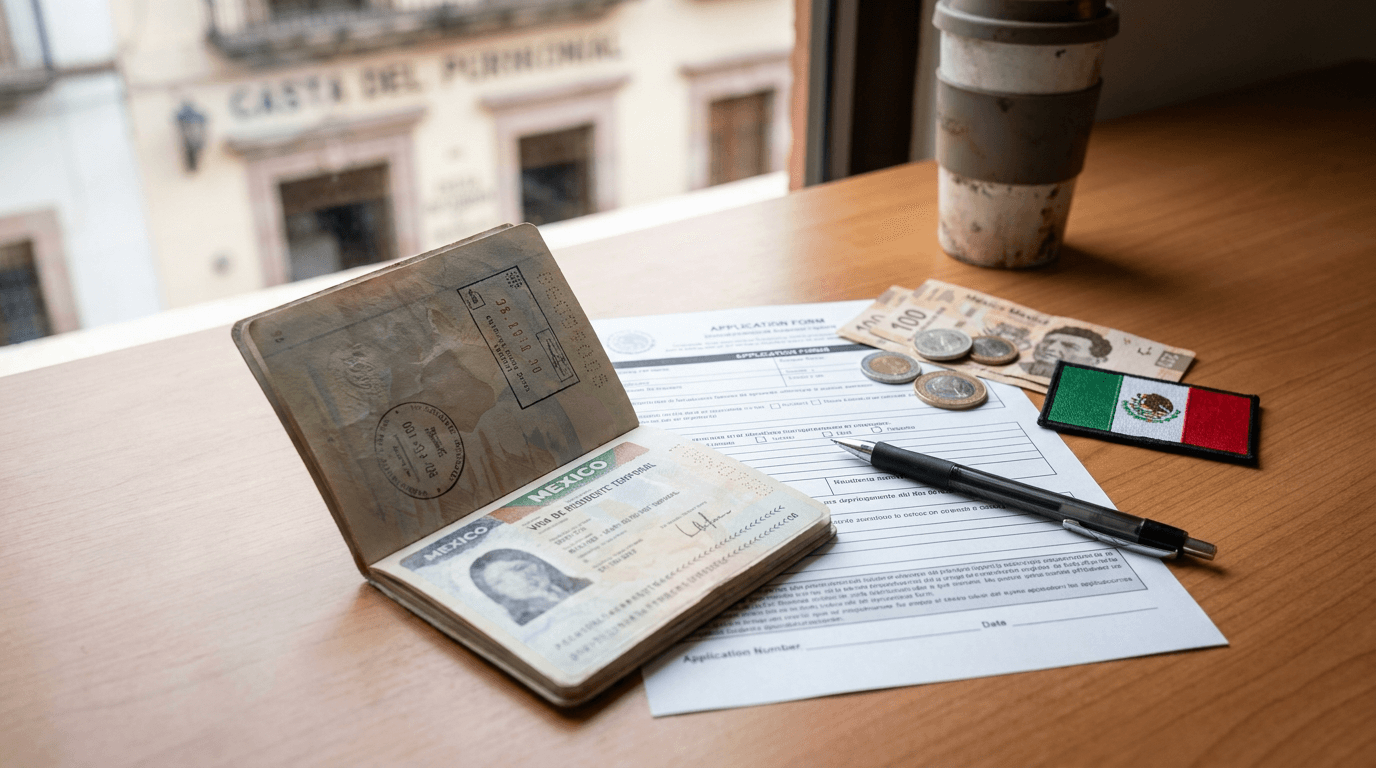
Mexico Temporary Resident Visa
Visa Data Sheet
- $4,000 – $4,700 / mo
- $53 – $54
- 48 months
Mexico’s Temporary Resident Visa is the consular visa for people who want to live in Mexico for more than 180 days and up to four years. It’s not the same thing as a tourist stay, which is a visitor condition and doesn’t create residence rights.
Official consular guidance uses this visa for several lawful bases, including financial solvency, family unity, study, invitations from organizations, real estate ownership, investment and some work-related cases when INM authorizes them. In plain terms, it’s the route for people who want a proper medium-term legal status, not a quick visit.
What it leads to: temporary resident status after you enter Mexico and complete the INM process. You must go to INM within 30 calendar days of arrival to get the resident card.
The Temporary Resident Visa is also the main option for remote workers who don’t qualify for a separate nomad program, because Mexico doesn’t have a standalone digital nomad visa. The catch is that the exact document list and solvency test can vary by consulate, so you can’t assume one office will accept the same paperwork as another.
- Stay length: up to 4 years total, depending on renewals and category.
- Entry purpose: living in Mexico, not short tourism.
- After arrival: 30 calendar days to complete the resident-card step with INM.
- Common bases: solvency, family unity, invitations, property, investment and approved work cases.
The financial rules have also shifted. Consular guidance now refers to UMA for solvency calculations and one SRE consulate page says that from Feb. 1, 2026, UMA is 117.31 MXN per day. That doesn’t give every applicant the same number, though, because consulates can still apply their own checklist and thresholds.
If you’re comparing routes, the main difference is simple. Tourist entry is for short stays and doesn’t give you residency rights. The Temporary Resident Visa is the one that gets you into Mexico as a resident, which is why it’s the better fit if you’re planning to stay longer and do it properly.
Mexico’s Temporary Resident Visa isn’t a single-purpose “digital nomad visa.” It’s a broader residency route and the official consular guidance says you can qualify through several bases, including economic solvency, family unity, real estate in Mexico, investment, student temporary residency, an invitation from an organization or public or private institution, an international mobility instrument and the Pacific Alliance work-vacation visa.
For most remote workers, the practical path is economic solvency. Mexican consulates now use UMA and the official figure for temporary residency is 680 UMA in monthly income or 11,460 UMA in savings or investments. Using the official UMA value of MXN 117.31, that works out to MXN 79,770.80 a month or MXN 1,344,096.60 in savings. In rough USD terms, that’s about $4,200 to $4,300 a month or about $71,000 to $72,000 in savings, depending on the exchange rate.
The consulate will want to see more than just a balance sheet. Official guidance points to passport details, your reason for travel, where you live now, what you do in your home country and what you plan to do in Mexico, plus proof that you can support yourself during the stay. In practice, consulates may ask for bank statements, income statements or other financial proof and the exact format can vary by post.
- Basic qualifying paths: economic solvency, family unity, real estate, investment, student status, invitation, international mobility instrument or Pacific Alliance work-vacation visa.
- Financial threshold: 680 UMA monthly income or 11,460 UMA in savings or investments.
- Application point: a Mexican consulate abroad, not inside Mexico.
- Entry rule: once approved, you must exchange the visa for a resident card in Mexico within 30 days.
There’s no official nationwide rule saying “remote work” by itself is a separate Temporary Resident Visa category. If that’s your plan, you still need to fit one of the recognized bases and follow the specific consulate’s document rules. That part can be annoying, because consulates don’t all ask for the same paperwork.
Family applicants should also pay attention to the details. The official instructions cover minors under 18 and require the application to be signed by a parent, guardian or whoever has legal authority. If your visa is denied, the fee isn’t refunded.
The Temporary Resident Visa starts outside Mexico. You apply at a Mexican consulate, then, if approved, you exchange the visa sticker for a Temporary Resident Card once you’re in the country. That two-step setup is annoyingly old-school, but it’s how the system works.
What you need to submit
Consulates use the same core framework nationwide, though local checklists can differ a bit. The base file usually includes:
- Valid passport: original plus a copy, with enough validity for international travel.
- Visa application form: completed and signed, usually through the consulate’s current process.
- Recent passport photo: some offices still want a printed photo, even if others capture it digitally.
- Proof of legal stay: required if you’re applying in a country where you’re not a citizen.
- Consular fee receipt: paid in the amount set by that consulate.
If you’re applying through economic solvency, the paperwork gets more specific. Consulates normally want monthly statements, not annual summaries and the financial evidence has to match the name in your passport exactly.
Financial evidence for economic solvency
- Income route: proof of monthly income of at least 680 days UMA for the last 6 months. Using the 2026 UMA figure cited by the Mexican consulate in Colombia, that’s about 79,773 MXN a month, roughly $4,000 to $4,700 depending on the exchange rate.
- Savings or investments route: average monthly balance equal to 11,460 days UMA over the last 12 months. In Spain’s consular example, this is shown with 12 months of monthly bank or investment statements.
- Supporting proof: pay slips, pension receipts, work history documents or bank statements showing the deposits clearly.
All financial documents may need sworn translations if they’re not in the consulate’s language. Some consulates also ask for electronic documents with a qualified digital certificate, which can be a pain if your bank doesn’t issue clean PDFs.
Other routes and local variations
Temporary residency isn’t only for remote workers. The consular lineamientos also cover family unity and employment-based cases and those routes come with their own evidence lists. The exact checklist depends on the consulate, so don’t assume one office’s requirements will work everywhere else.
One more practical detail: if the consulate approves you, you must enter Mexico and start the exchange process within the required window, then finish the canje at an immigration office inside the country. The official rules are clear on the sequence, but processing times and appointment availability aren’t fixed nationwide.
Costs & fees
Mexico’s Temporary Resident Visa has two real cost buckets and neither one is tiny. You pay a consular visa fee abroad, then a separate government fee in Mexico for the resident card.
The consular fee is the easier part to budget for. Mexican embassies and consulates generally charge $53 to $54 for the Temporary Resident Visa application and that fee is nonrefundable if you’re denied. The amount in local currency changes with the consulate’s exchange rate, so check the posting at the office where you apply.
Once you enter Mexico and complete the canje process, you pay the INM card fee. The 2026 government schedule puts the standard Temporary Resident card at:
- 1 year: 11,141 MXN
- 2 years: 16,693 MXN
- 3 years: 21,142 MXN
- 4 years: 25,058 MXN
Some family-unit and employer-sponsored cases qualify for a 50% discount on the residency card fee. In those cases, the 1-year card drops to 5,570 MXN and the 4-year card to 12,529 MXN.
If you later convert from Temporary to Permanent Residence after four years, there’s another government charge: a 1,847 MXN change-of-status fee. That comes on top of the permanent-residence card fee.
Budget for the extras too. Translation costs, health insurance and legal help aren’t fixed by the government, so prices vary by provider and city. They can add up fast if your consulate wants certified translations or you hire someone to handle the paperwork.
A realistic budget for the visa process usually looks like this:
- Consular visa fee: $53 to $54
- Temporary Resident card fee: 11,141 to 25,058 MXN, depending on the validity period
- Possible discounted card fee: 5,570 to 12,529 MXN in some qualifying cases
- Change-of-status fee: 1,847 MXN, if you convert to permanent later
- Ancillary costs: translations, health insurance and optional legal help
How to apply
The Temporary Resident Visa starts at a Mexican consulate abroad, then finishes inside Mexico at the National Immigration Institute or INM. You can’t do the whole thing from inside Mexico on a tourist stay, so plan for two separate steps and check the specific consulate’s website before you book anything.
For the standard economic solvency route, consulates usually want proof that you can support yourself without taking a local job. The figures tied to the federal UMA unit are fairly steep. A common official example is 11,460 days of UMA in average savings over the last 12 months or 680 days of UMA in net monthly income over the last 6 months. Using the 2026 UMA value, that works out to about 1,344,693 MXN in savings or about 79,769 MXN per month in income, though the exact foreign-currency equivalent depends on the exchange rate the consulate uses.
Don’t assume every consulate uses the same standard. Some still publish different UMA multiples and they do vary on the documents they’ll accept, so the consulate in your jurisdiction is the one that matters.
- Passport: Original and copy of a valid passport.
- Application form: Completed and signed Mexican visa form.
- Photo: Recent color passport-size photo with a white background.
- Legal stay proof: If you’re applying outside your home country, some consulates want proof that you can legally stay where you apply.
- Financial proof: Bank statements, investment statements, payslips or pension records, depending on whether you’re applying through savings or income.
- Translations and legalization: Some documents may need apostille, legalization or Spanish translation.
If the consulate approves you, they stamp the visa in your passport. That visa is normally valid for a single entry into Mexico for up to 180 days. Once you arrive, you have to go to INM and exchange the visa sticker for a Temporary Resident Card.
That final INM card is the part that really matters. It’s issued for one year first, then can be renewed up to four years total. The fee for the one-year card is about 11,140 MXN in 2026, though INM’s published tariff table should always be checked before you pay because fee updates have been moving around.
The temporary resident card is built for stays longer than 180 days, but it doesn’t run forever. Under Mexican migration rules, it can be granted for up to 4 years total, then you’re expected to move on to permanent residency if you still meet the requirements.
The consular visa you get first is just the entry ticket. It’s usually valid for 180 days, only so you can enter Mexico and finish the canje, which is the exchange of that visa for your resident card inside the country.
What you actually receive on the ground can vary. Mexican law allows temporary residence for more than 180 days and no more than 4 years, but the way those years are issued depends on the consulate and the local INM office. Some people still start with a 1-year card and renew after that, while others may be granted a longer card from the outset.
How renewals work
Renewals are done inside Mexico at an INM office. You can’t renew abroad and you shouldn’t wait until your card is already dead. The current INM guidance expects you to renew while the card is still valid or very close to expiry.
- Current resident card: Bring the original.
- Basic renewal form: Fill it out electronically, then sign it.
- Photos: INM asks for three child-size photos, though it also notes that office staff now often take the pictures themselves.
- Proof of payment: You need the renewal fee receipt required by the Federal Fees Law.
- Supporting documents: INM may want proof that the reason you qualified still exists, such as ongoing employment, continued studies or the same conditions under which you were first approved.
The paperwork gets annoying and the rules aren’t always applied the same way everywhere. That’s just Mexico immigration. If your status is based on work, family unity or economic solvency, check the specific INM instructions for your category before you show up.
What happens after 4 years
Temporary residence has a hard ceiling of 4 years. After that, standard temporary status isn’t meant to keep rolling on indefinitely. If you want to stay, the usual next step is permanent residency, assuming you qualify.
That’s the cleanest path. It also means you don’t get stuck doing yearly renewals forever, which is one of the few genuinely nice things about Mexico’s residency system.
A Mexico Temporary Resident Visa doesn’t create a special tax break by itself. The real question is whether you’re a Mexican tax resident, because that’s what decides whether Mexico taxes you on worldwide income or only on Mexican-source income.
SAT’s rule is pretty plain. If you have a home in Mexico, you can be treated as a tax resident. If you also have a home abroad, Mexico can still treat you as resident if more than 50% of your annual income comes from Mexico or your center of professional activities is in Mexico.
If you’re a tax resident, foreign-earned income is generally part of your taxable base in Mexico. If you’re not a tax resident, Mexico usually taxes only Mexican-source income, so freelance work for clients abroad normally stays outside Mexican income tax unless it’s tied to a Mexican source or a permanent establishment.
What the visa does and doesn’t, change
There’s no official, visa-specific “temporary resident” tax regime that gives you a lower rate just because you hold the visa. The immigration status and the tax status are separate. That’s the part a lot of people get wrong.
If Mexico treats you as a tax resident, you’re generally taxed like any other resident taxpayer. If you’re non-resident, your reporting is usually limited to Mexican-source income and any withholding tied to that income.
Double-taxation treaties and filing duties
Mexico does have an active treaty network, including the United States-Mexico income tax treaty. Treaties can lower withholding or sort out which country gets to tax certain income, but they don’t automatically override Mexico’s domestic residency test. You usually need to claim treaty relief under the treaty’s procedure.
For a Mexican tax resident, the practical to-do list usually includes registering with SAT, getting an RFC and filing the annual return if your tax regime requires it. For a non-resident, the main issue is staying on top of any Mexican-source income and the related filings.
- Tax resident: Mexico generally taxes worldwide income.
- Non-resident: Mexico generally taxes only Mexican-source income.
- Temporary Resident Visa: no special tax status on its own.
- Treaty relief: available in some cases, but not automatic.
If you’re planning to stay in Mexico for more than a short stint, this is the part worth sorting out early. The visa gets you in the country. Tax residency decides what Mexico can tax once you’re there.
Mexico Digital Nomad Guide
Cost of living, internet, healthcare, coworking, and every visa option for Mexico.
Visa rules change. We'll tell you.
Get notified about policy updates and new requirements for the Mexico Temporary Resident Visa and other Mexico visas.
