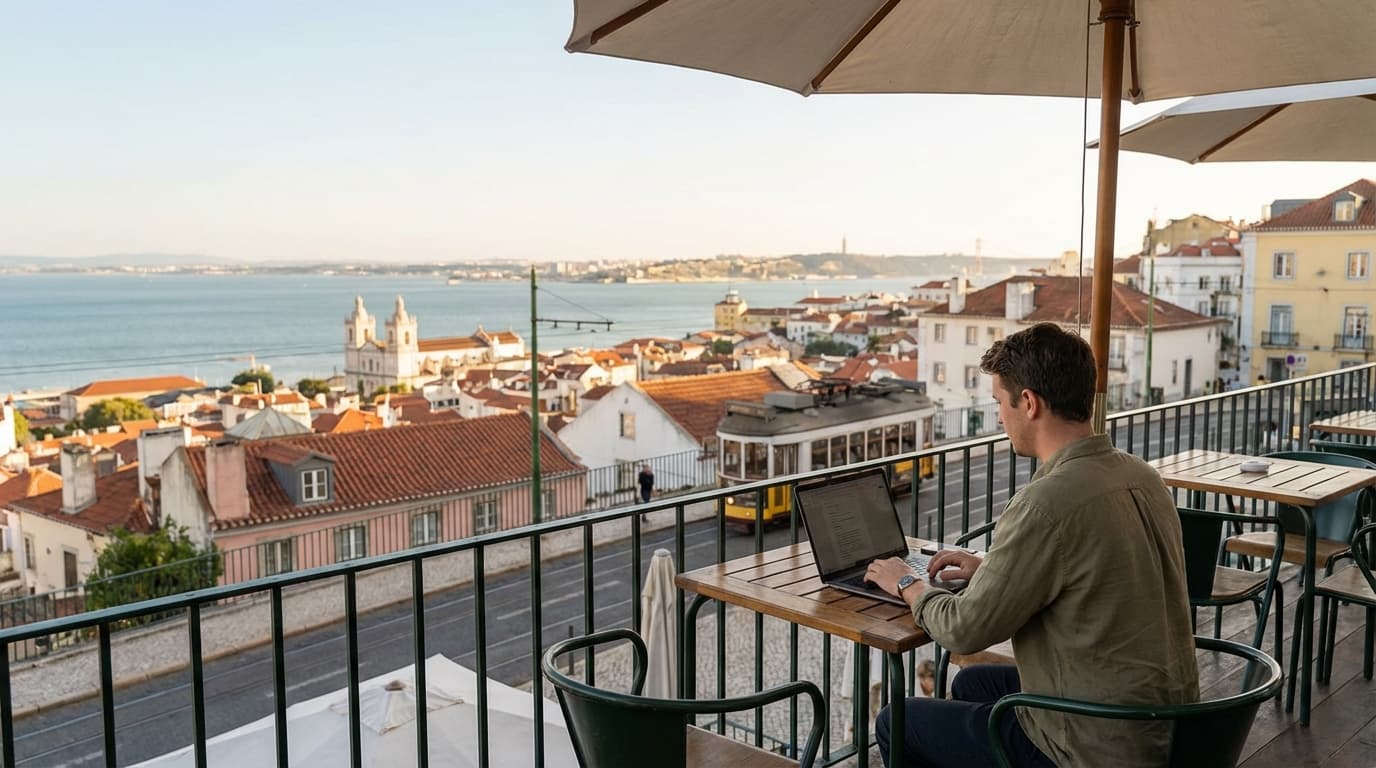
Portugal

Policy Stability
Stamped Nomad ExclusiveHow likely visa and immigration policies are to remain unchanged
Quick Facts
Yes
$2,290/mo
360 Mbps
7/10
High
High
High
WET, WEST
Entry Methods Available
Best For
Last verified: September 24, 2026
Compare Visa Programs
| Program | Best for | Minimum income or savings | Government fee | Initial stay | Where to apply |
|---|---|---|---|---|---|
| Portugal D2 Entrepreneur Visa | Freelance Visa | €11,040 one-time | €110 one-time | 2 years | Residence visa at the Portuguese consulate (or its visa service provider) with jurisdiction over the place of residence; after entry, the residence permit with AIMA within the 4-month visa validity |
| Portugal D7 Passive Income Visa | Passive Income Visa | €920 a month | €110 one-time | 2 years | Residence visa at the Portuguese consulate (or its visa service provider) with jurisdiction over the place of residence; after entry, the residence permit with AIMA within the 4-month visa validity |
| Portugal Digital Nomad Visa | Digital Nomad Visa | €3,680 a month | €110 one-time | 2 years | Residence visa at the Portuguese consulate (or its visa service provider) with jurisdiction over the place of residence; after entry, the residence permit with AIMA within the 4-month visa validity |
| Portugal Golden Visa | Golden / Investor Visa | €500,000 one-time | €632.10 one-time | 2 years | Online on AIMA's ARI Portal after entering Portugal visa-free or on a Schengen visa, within 90 days of first entry, then biometrics in person |
Portugal has four long-stay routes that fit remote workers, retirees, freelancers and investors. Each starts differently and suits a different income source.
- Remote workers with foreign employers or clients: the D8 digital nomad visa asks for proof of income of €3,680 a month. It comes in a residency version that leads to a renewable permit and a temporary stay version of up to one year that does not.
- Retirees and people on passive income: the D7 residence visa sets a much lower floor of €920 a month, but the income has to come from pensions, property or financial assets rather than ongoing work.
- Freelancers and founders working in Portugal: the D2 visa for independent work and entrepreneurs has no minimum investment and allows Portuguese clients.
- Investors who will spend little time in the country: the investment residence permit, or golden visa, starts at €250,000 and asks for only a few days a year in Portugal.
The D8, D7 and D2 are filed at the Portuguese consulate for the applicant's place of legal residence, then finished with AIMA, the migration agency, inside Portugal. The golden visa is filed directly with AIMA after a visa-free or Schengen visa entry.
Three rule changes shape planning in 2026. The minimum wage rose to €920 on Jan. 1, 2026, which moved every income floor. Since Oct. 23, 2025, relatives who join a D8, D7 or D2 holder later generally wait two years for family reunification, so families do better applying together. And since May 19, 2026, naturalization takes 10 years of legal residence, or 7 for EU and Portuguese-speaking (CPLP) nationals. Permanent residence still comes after five years.
Short visits follow the Schengen rule: up to 90 days in any 180-day period for visa-exempt nationals. The Schengen Borders Code counts days across all member states together. The EU Entry/Exit System has registered short-stay visitors at the border since Oct. 12, 2025. ETIAS status: Not yet operating and no official start date. The EU says it will announce the date several months before launch. The earlier official target, the last quarter of 2026, was removed from the official ETIAS website on July 14-17, 2026.
Portugal D2 Entrepreneur Visa
Eligibility, required documents, and how to apply for the Portugal D2 Entrepreneur Visa.
Portugal D7 Passive Income Visa
Minimum income proof, fees, and how to qualify for the Portugal D7 Passive Income Visa.
Portugal Digital Nomad Visa
Income requirements, application steps, and renewal rules for the Portugal Digital Nomad Visa.
Portugal Golden Visa
Investment thresholds, eligible routes, and processing times for the Portugal Golden Visa.
Portugal is cheaper than most of Western Europe outside Lisbon, but rent in the capital now takes a large share of a single remote worker's budget. The ranges below add Numbeo's one-bedroom rent (outside the center to city center) to its estimate of monthly costs for one person without rent.
- Lisbon: about €1,829 to €2,181 a month (Numbeo, Sept. 2026)
- Porto: about €1,569 to €1,871 a month (Numbeo, Sept. 2026)
- Braga: about €1,293 to €1,451 a month (Numbeo, June 2026)
- Coimbra: about €1,236 to €1,440 a month (Numbeo, July 2026)
These are crowd-sourced estimates, not official statistics, and they leave out coworking, health insurance and travel. Short-term furnished rentals in Lisbon, Porto and the Algarve usually cost more than the long-lease figures Numbeo reports, especially in summer.
For D8 applicants the income floor, €3,680 a month, sits well above these budgets. D7 applicants can qualify on far less, but €920 a month would not cover rent alone in Lisbon or Porto.
- Lisbon: the largest remote-work community, the most coworking and the best flight links. Also the most expensive rent in the country.
- Porto: a smaller, walkable city with a strong tech and startup scene and lower rents than the capital. Wetter winters than the south.
- Braga: a university city near Porto with some of the lowest costs among Portugal's larger cities.
- Funchal: Madeira's capital, with a mild climate all year and an established nomad community, at the cost of longer flights to the mainland and Europe.
- Lagos: an Algarve beach town suited to people who want surf and outdoor life, busy in summer and quiet in winter.
Coimbra and Ericeira are worth a look for a quieter base within reach of Lisbon or Porto.
Portugal's fixed broadband is fast. Speedtest Global Index put the national median fixed download speed at 360.09 Mbps and mobile at 209.01 Mbps in Aug. 2026. Fiber is common in cities, while rural inland areas and older buildings can lag, so it pays to ask a landlord for a recent speed test.
Coworking is concentrated in Lisbon and Porto, which both have large international remote-work communities, dozens of spaces and frequent meetups. Braga, Coimbra, Funchal on Madeira and the Algarve towns have smaller but established scenes. Day passes and monthly desks are widely available; prices vary by space and are not tracked by any official source.
Portugal uses a two-part residence test in art. 16 of the IRS Code: more than 183 days in the country in any 12-month period that starts or ends in the tax year, or a home held on any day of that period in conditions suggesting it is a habitual residence. Tax residents are taxed on worldwide income.
Rates are progressive, from 12.5 percent to 48 percent in 2026 under art. 68 of the IRS Code. The Non-Habitual Resident regime is closed to new entrants. Its successor is IFICI: 20% flat IRS rate on eligible Portuguese employment and self-employment income for 10 years, with most foreign income exempt; only for new residents not resident in the prior 5 years who work in qualifying research, innovation or highly qualified roles. Working remotely for a foreign employer does not qualify on its own; the role has to fall within the eligible activities, and registration is due by Jan. 15 of the year after becoming resident.
What to check before moving:
- The arrival date, since the day count and home test decide the first tax year.
- The double tax treaty between Portugal and the country where the employer, clients or pension payer sits.
- Whether IFICI applies, before the registration deadline passes.
- Social security registration for self-employed work.
- Tax number first: a NIF is needed to sign a lease, open a bank account or buy a SIM on contract. Non-residents can request one, often through a representative.
- Banking: Portuguese banks ask for a NIF, passport and proof of address. Many newcomers use a euro account from an EU digital bank while waiting.
- Healthcare: residents can register with the national health service (SNS) at their local health center. Visa applicants need private travel or health insurance first, and many residents keep private cover for faster specialist access.
- Phone: the main networks sell prepaid SIM cards and eSIMs; a passport is enough for prepaid.
- Emergencies: dial 112. The SNS 24 line gives health advice by phone.
- Arrival: short-stay visitors are registered in the Entry/Exit System at the border. Holders of a residence permit or long-stay visa are not.
- Safety: petty theft in crowded tourist areas and on busy public transport is the problem visitors meet most often; home-government travel advisories carry current detail.
Frequently asked questions
Does Portugal have a digital nomad visa?
Which Portugal visa suits retirees?
How long does it take to become a Portuguese citizen?
Can the golden visa still be obtained through property?
When does a remote worker become tax resident in Portugal?
How fast is the internet in Portugal?
Latest Nomad News
9 Schengen nations maintain manual EES fallbacks at congested borders
Nine Schengen nations are using manual fallbacks for the Entry/Exit System at congested borders. Travelers face manual checks instead of full biometric capture.
Portugal resumes 100% EES biometric scans for non-EU arrivals Sept. 6
Portugal will begin collecting biometric data from 100% of non-EU citizens subject to EU Entry/Exit System checks starting Sept. 6. Non-EU digital nomads and visitors entering the country should anticipate longer border processing times during arrival.
Portugal banks require D8 visa proof for non-resident accounts
Portuguese financial institutions are increasing compliance checks on non-resident accounts, requesting detailed verification of nationality, employment, and income sources. Some banks now require proof of a scheduled VFS visa appointment to open an account, complicating early relocation steps for expats and nomads.
Portugal ends in-country study residency pathways for foreign nationals
Portugal approved amendments to its Foreigners Law limiting the ability of foreign nationals to regularize status from inside the country via vocational study enrollment. The measure blocks visitors from transitioning to resident status through short-term study routes without obtaining consular visas beforehand.
Portugal D8 visa income floor rose to €3,680 a month Jan. 1
Portugal has increased the minimum monthly income requirement for the D8 digital nomad visa to €3,680. Applicants must also provide a 12-month rental contract registered with the national tax authority to qualify for residency.
More Guides from Europe


Stay Updated on Portugal
Get notified about visa changes, policy updates, and new information for digital nomads in Portugal.