9 Schengen nations maintain manual EES fallbacks at congested borders

| Maintaining Manual Fallbacks | 9 nations |
|---|---|
| Total Participating Countries | 29 nations |
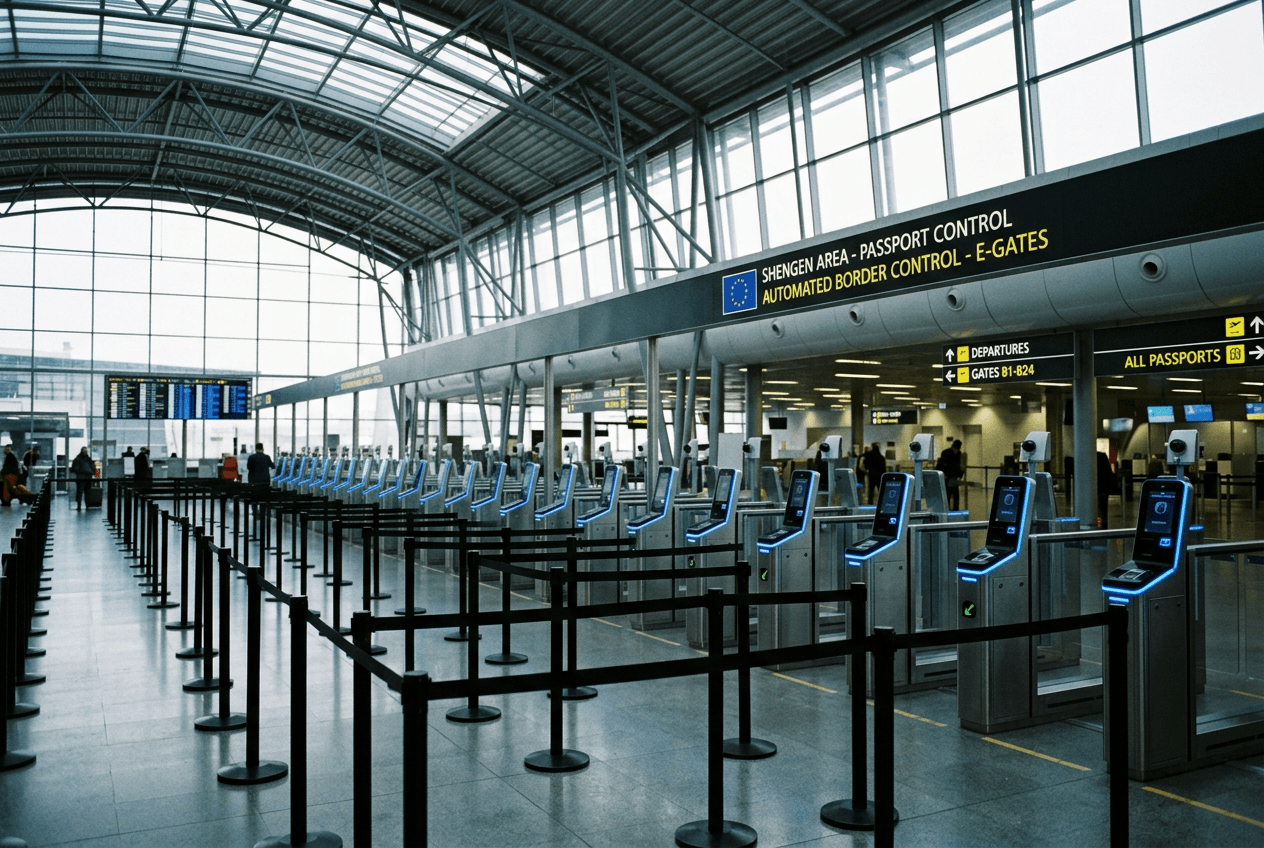
Non-EU travelers crossing Schengen external borders face an uneven patchwork of biometric processing after nine countries quietly maintained manual fallback procedures at congested checkpoints.
Where biometric checks remain patchy
The European Union's automated Entry/Exit System (EES) is running across external borders, but enforcement varies widely by port and airport. Nine Schengen member states continue to delay systematic fingerprint and facial capture at selected high-traffic hubs:
France
Greece
Italy
Portugal
Belgium
Netherlands
Germany
Malta
Switzerland
Most of the bloc's roughly 1,500 border crossing points operate standard automated biometrics without incident, the Guardian reported. Major transit hubs like Amsterdam Schiphol, Frankfurt Airport, the Port of Antwerp and the Brussels Eurostar terminal process passengers under full digital capture.
Bottlenecks remain concentrated at approximately 12 airports and select maritime crossings. French border police haven't yet introduced biometric capture at the Port of Dover and English Channel ferry routes such as Granville have seen queues reach up to three hours when pre-registration kiosks and tablets fail.
The expired deadline and EU tolerance
The legal transition period governing the EES rollout has already closed. EES began progressive deployment Oct. 12, 2025 and became legally operational April 10, 2026, replacing routine physical passport stamps for short-stay third-country visitors.
To prevent crippling border queues, Regulation (EU) 2025/1534 granted member states temporary authority to suspend biometric registration during peak congestion. That emergency flexibility expired Sept. 6, 2026, exactly 330 days after initial rollout.
Border points that skip biometric data collection are now technically in breach of EU regulations. European Commission officials have informally tolerated the delays without initiating legal infringement proceedings while border agencies resolve hardware bottlenecks. The French Interior Ministry confirmed that operational flexibility for self-service kiosks and tablets will continue through the end of the year.
What non-EU nomads should expect at border control
The operational delays don't change legal entry requirements or create special exemptions for remote workers. All non-EU citizens entering the Schengen area for short stays remain subject to standard immigration laws and the 90-day rolling limit.
The system is actively policing borders despite localized hiccups. EES has registered more than 200 million entries across the Schengen zone and flagged roughly 70,000 travelers attempting unlawful entry or overstays since its progressive rollout began.
Travelers should prepare for unpredictable transit times depending on their arrival route. Flying through major international hubs typically offers streamlined automated processing, while ferry terminals and smaller land borders frequently revert to manual passport checks when digital kiosks stall.
Remote workers navigating European border crossings can review updated entry criteria in our destination guides to budget travel buffer times between flights and connecting train connections.
Frequently asked questions
Which Schengen countries are still delaying full biometric checks at some borders?
Are non-EU travelers exempt from EES delays at congested Schengen borders?
How long can non-EU citizens stay in the Schengen area for short stays?
What happens at border points where biometric data collection is skipped?
Where are travelers most likely to get full automated EES processing?
Will manual fallback procedures continue at French border checkpoints?
- theguardian.com
- telegraph.co.uk
- connexionfrance.com
- thetimes.com
- etias.com
- euroweeklynews.com
- chronicle.gi
- europesays.com
- biometricupdate.com
- traveltomorrow.com
- independent.co.uk
- which.co.uk
- ekathimerini.com
- ua.news
- kioskmarketplace.com
- home-affairs.ec.europa.eu
- trans.info
- etias.com
- euronews.com
- diplomacyandlaw.com
- eur-lex.europa.eu
- theguardian.com
- eur-lex.europa.eu
- eur-lex.europa.eu
- secretldn.com
- connexionfrance.com
- newlandchase.com
- travelextra.ie
- blog.wego.com
- theguardian.com
- eur-lex.europa.eu
- diplomacyandlaw.com
- home-affairs.ec.europa.eu
- diplomacyandlaw.com
- home-affairs.ec.europa.eu
- theguardian.com
- theguardian.com
- theguardian.com
- rsgroup.travel
- paxnews.com
- thetraveler.org
- inews.co.uk
Don't miss the next nomad update
Visa changes, travel alerts, and destination news — delivered when they actually matter.