Netherlands

Policy Stability
Stamped Nomad ExclusiveHow likely visa and immigration policies are to remain unchanged
Quick Facts
No
$3,100/mo
226 Mbps
8/10
High
High
High
CET
Entry Methods Available
Best For
Last verified: October 1, 2026
Compare Visa Programs
| Program | Best for | Minimum income or savings | Government fee | Initial stay | Where to apply |
|---|---|---|---|---|---|
| Netherlands DAFT Visa | Freelance Visa | €4,500 one-time | €423 one-time | 2 years | In the Netherlands, directly to the IND (form 7524); U.S. nationals do not need an MVV entry visa |
| Netherlands Self-Employed Residence Permit | Freelance Visa | €1,766.77 a month | €423 one-time | 2 years | Most nationalities apply for the MVV entry visa and residence permit together at a Dutch embassy or consulate; MVV-exempt nationals apply to the IND in the Netherlands |
The Netherlands has no digital nomad visa. Short stays follow Schengen rules, and anyone who wants to live in the country needs a residence permit tied to self-employment, a Dutch employer or study.
- Short stays: visa-exempt nationals and short-stay visa holders can spend up to 90 days in any 180-day period in the Schengen area, a single allowance shared across all member countries (Schengen Borders Code).
- U.S. founders: the DAFT permit lets U.S. nationals live in the Netherlands and run their own business with an investment of €4,500 and no income test.
- Other entrepreneurs and freelancers: the self-employed residence permit is open to all non-EU nationals but needs a business that passes the RVO points test and a profit of €1,766.77 a month.
- Employees and graduates: the IND also runs the highly skilled migrant permit for people hired by a Dutch employer, a start-up permit for innovative founders working with a facilitator and an orientation year for recent graduates. This site has no pages for them yet.
Border checks: the EU Entry/Exit System has recorded non-EU short-stay travelers' fingerprints and facial images at Schengen borders since Oct. 12, 2025 (EU).
ETIAS, the planned EU travel authorization for visa-exempt visitors: Not yet operating and no official start date. The EU says it will announce the date several months before launch. The earlier official target, the last quarter of 2026, was removed from the official ETIAS website on July 14-17, 2026.
Choosing: a U.S. national with a real business plan has the easiest route in DAFT. Others weighing self-employment should start with the points test, since a plan the RVO scores too low ends the application. Nationals of Australia, Canada, Japan, New Zealand, South Korea, the UK and the United States, among others, can apply in the Netherlands without an MVV entry visa; most others start at a Dutch embassy (IND form 7524).
Rent drives the budget, and Amsterdam is clearly the most expensive city. Numbeo figures for a single person, with rent for a one-bedroom apartment plus other monthly costs (dollar amounts at the Sept. 30, 2026 rate of about $1.13 per euro):
- Amsterdam (Numbeo, August 2026): about €2,270 a month for a central one-bedroom or €1,660 outside the center, plus about €1,130 in other costs. Total: roughly €2,800 to €3,400 ($3,170 to $3,860).
- Utrecht (Numbeo, August 2026): about €1,680 central or €1,330 outside, plus €1,060. Total: roughly €2,380 to €2,730 ($2,700 to $3,100).
- Rotterdam (Numbeo, August 2026): about €1,630 central or €1,350 outside, plus €1,080. Total: roughly €2,430 to €2,710 ($2,760 to $3,070).
Residents must also pay for Dutch standard health insurance, which these totals leave out (Government of the Netherlands). Rental housing is scarce in the big cities, so furnished short lets often cost more than the averages above. Smaller cities such as Groningen tend to be cheaper, but this guide has no checked figures for them.
- Amsterdam: the largest international and startup community and the widest choice of coworking spaces, at the highest rents in the country.
- Rotterdam: modern architecture, a big port economy and lower rents than Amsterdam, with a growing creative and tech scene.
- Utrecht: a compact university city at the center of the rail network, so most of the country is a short train ride away.
- The Hague: home to the government, international courts and many international organizations, with beaches at Scheveningen.
- Eindhoven: a technology and design hub around its high-tech industry, quieter and smaller than the Randstad cities.
Each city page covers neighborhoods, internet and costs in more detail.
Connections are fast and fiber is widespread in the cities. The Speedtest Global Index put the median fixed broadband speed at about 226 Mbps and the median mobile speed at about 158 Mbps in August 2026.
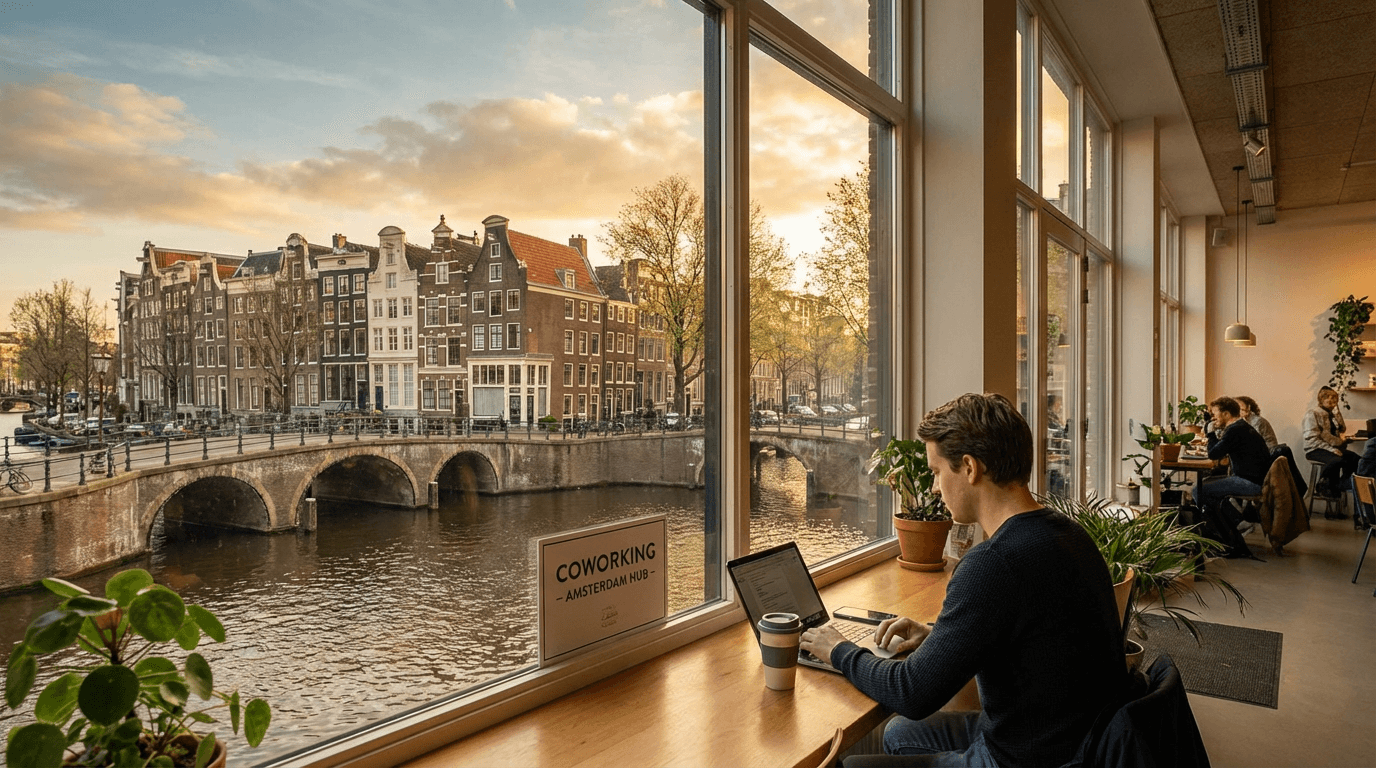
Coworking spaces are easy to find in Amsterdam, Rotterdam, Utrecht, The Hague and Eindhoven, from international chains to startup hubs with day passes and monthly desks. Prices vary by city and neighborhood. Many cafes offer Wi-Fi for lighter work.
The main mobile networks are KPN, Vodafone and Odido, and prepaid SIM cards and eSIMs are widely sold.
The Netherlands has no 183-day rule for tax residence.
The Belastingdienst test. No fixed day count: residence depends on circumstances such as where a person spends most of their time, where their family lives, where they work and where they have health insurance (Belastingdienst). Someone who moves in, rents a home and brings family is likely resident even before half a year has passed; a short visitor with a home elsewhere usually is not.
- Expat Scheme (30% facility): a tax-free allowance for employees recruited from abroad who earn more than €48,013 a year. Self-employed people, including DAFT holders, cannot use it (Belastingdienst).
- Self-employed: DAFT and self-employed permit holders generally pay Dutch income tax on their business profits under the normal rules; neither permit comes with a tax regime of its own.
- Treaties: whether income from abroad is also taxed in the Netherlands depends on the tax treaty with the other country. U.S. citizens keep filing U.S. returns while abroad (IRS).
What to check before a long stay: where the main home is, where family lives and works, which country's health insurance applies and what the relevant tax treaty says about residence.
- Registration: residents register at the town hall in the Personal Records Database (BRP) and receive a citizen service number (BSN). People in the country only briefly for work or study can register as non-residents and still get a BSN (Government of the Netherlands).
- Health insurance: everyone who lives or works in the Netherlands must take out Dutch standard health insurance (Government of the Netherlands). Short-stay visitors need travel insurance instead. The emergency number is 112.
- Money: debit and credit cards are accepted almost everywhere, and some shops are card-only. A BSN and a Dutch address make opening a local bank account much easier.
- SIM and eSIM: prepaid SIMs and eSIMs from the main networks are sold online and in stores.
- Getting around: trains link the main cities, and cycling is the usual way to get around town.
- Arrival: non-EU travelers on short stays give fingerprints and a facial image at the border under the Entry/Exit System (EU).
Frequently asked questions
Does the Netherlands have a digital nomad visa?
Who can use the DAFT permit?
How much profit does the self-employed permit need?
Does staying 183 days make someone a Dutch tax resident?
Can self-employed people use the 30% Expat Scheme?
Latest Nomad News
Mandatory EES checks now required at all external Schengen borders
On 6 September 2026, the European Union’s Entry/Exit System (EES) emergency flexibility measures expired, meaning Schengen states can no longer routinely suspend biometric data collection at busy border points.[10][6] Non‑EU travellers, including British passport holders, now face mandatory biometric registration on every entry and exit, with longer processing times and fewer options for relaxation during peak congestion.[6][10] Digital nomads and expats should plan for slower queues at external Schengen borders and factor in extra time for flights and cross‑border trips.
EU bans return ticket cancellations and sets 250 euro delay payouts
The European Commission’s transport page states that the EU has advanced a landmark agreement to modernise and strengthen air passenger rights across the EU, and it also lists new Commission proposals to simplify regional, long-distance, and cross-border travel planning while improving rail-passenger protection. For travelers who move between Western European countries, this is relevant because it points to a broader EU-level change affecting how cross-border trips and compensation rules are handled.[2] This is a policy-development item rather than an immediate operational rule change, and the
Netherlands EES queues reach 2 hours as biometric checks delay Schiphol arrivals
Non-EU passport holders arriving at Amsterdam Schiphol face 1- to 2-hour queues at border control following the rollout of the EU Entry/Exit System. Digital nomads and third-country travelers entering the Netherlands should budget extra arrival time for biometric registration and passport processing. Passengers with tight international connections through the Schengen hub should adjust travel schedules accordingly.
EU keeps 3 hour delay rule for passengers as new rights wait until 2027
The European Parliament approved updated EU-wide air passenger rights rules that tighten reimbursement and rerouting protections, add clearer pricing rules, and strengthen assistance for families and passengers with disabilities. If formally confirmed and published, the new rules would apply across EU member states after a 1-year preparation period, so travelers should watch for the final entry-into-force date.
EU delays ETIAS enforcement for visa-exempt travelers until 2027
The European Union has pushed back the implementation of the ETIAS travel authorization system until at least 2027. Visa-exempt travelers to the Schengen Area can continue to enter without pre-authorization throughout 2026 as officials address operational concerns with the Entry/Exit System.
More Guides from Europe

Stay Updated on Netherlands
Get notified about visa changes, policy updates, and new information for digital nomads in Netherlands.