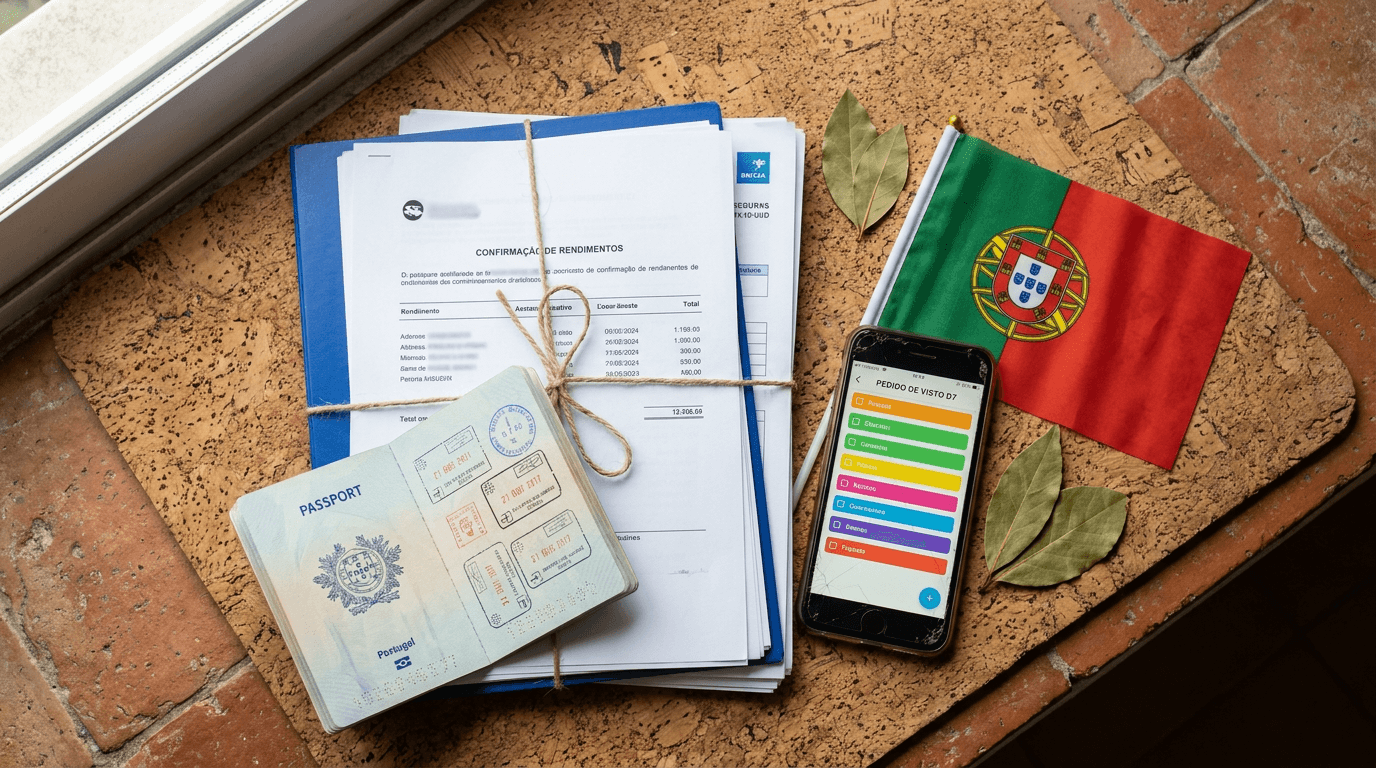
Portugal D7 Passive Income Visa

At a Glance
- €920 a month100% of the RMMG, shown for at least 12 months · main applicant
- 50% of the RMMG (EUR 460 a month) for each additional adult and 30% (EUR 276 a month) for each childPortaria 1563/2007 per-capita weighting
- €110 one-timeeach applicant (children under 6 exempt)
- 2 yearsResidence visa valid 4 months (two entries) to enter and apply to AIMA; the permit then runs 2 years
- Renewable for successive 3-year periods while the requirements are still met; permanent residence possible after 5 years of temporary residence
- Residence visa at the Portuguese consulate (or its visa service provider) with jurisdiction over the place of residence; after entry, the residence permit with AIMA within the 4-month visa validity
- 60 dayslegal decision deadline for a residence visa, not an average
- YesResidence permit holders may take employed or self-employed work without special authorization
- YesSpouse and dependants can apply at the same time for a residence visa as accompanying family members; reunification from Portugal needs 2 years of residence (15 months for a spouse, none for minor children)
- Permanent residence after 5 years of temporary residence (basic Portuguese required); naturalization after 10 years of legal residence (7 for EU and CPLP nationals) since May 19, 2026
Last checked Sept. 24, 2026
The D7 is Portugal's residence visa for retirees, members of religious orders and people living on passive income. It is a two-stage route: a consular visa gets the holder into Portugal, then AIMA, the migration agency, issues a residence permit that renews and can lead to permanent residence.
- Status: active, listed on the Ministry of Foreign Affairs visa portal
- Who it suits: people with regular pension, rental, investment or royalty income
- Income floor: €920 a month for the main applicant as of Jan. 1, 2026
- Visa fee: €110 at the consulate, then AIMA permit fees
- First permit: 2 years, then renewals
Remote workers with a salary or client income usually fit the D8 digital nomad visa better, and freelancers or founders who will work in Portugal fit the D2 route for independent work. The Portugal guide compares all four routes.
The D7 covers three groups named in the consular checklist: people drawing a retirement pension, people living on revenue from movable or immovable property or intellectual or financial assets, and ministers of religion or members of religious institutes.
- Income: at least €920 a month, equal to 100 percent of the 2026 national minimum wage. Under Portaria 1563/2007 the means must be assured for at least 12 months.
- Family: the bar rises for each accompanying member: 50% of the RMMG (EUR 460 a month) for each additional adult and 30% (EUR 276 a month) for each child.
- Nationality: open to non-EU, non-EEA and non-Swiss nationals, who file at the consulate for the place where they legally live.
- Local work allowed: Yes. Once the residence permit is issued, holders may take employed or self-employed work in Portugal.
The income has to be regular and lawful. Salary from ongoing work is not passive income, so a remote employee filing a D7 risks a refusal for the wrong category.
The Ministry of Foreign Affairs lists general documents for every residence visa:
- National visa application form, signed
- Two recent passport photos
- Passport valid for three months after the planned return, plus a copy of the data page
- Proof of legal status in the country of application, for applicants who are not its nationals
- Travel insurance covering medical expenses, urgent care and repatriation (bilateral health agreements can replace it)
- Criminal record certificate from the country of nationality or of residence for over a year, apostilled or legalized (not required under 16)
- Proof of means of subsistence under Portaria 1563/2007
D7-specific evidence:
- Retirement: a document certifying the pension amount.
- Passive income: a document certifying revenue from property or from intellectual or financial assets.
- Religious purposes: a statement of responsibility and a certificate of the applicant's religious status.
- Accompanying family: proof of family ties and of means covering every member for the stay or 12 months, whichever is shorter.
Consulates can ask for more, and many also check accommodation in Portugal and a Portuguese tax number (NIF). The local post's checklist settles the final list.
- Consular visa fee: €110 per applicant, per the Ministry of Foreign Affairs. Children under 6 are exempt. The fee is not refunded after a refusal.
- AIMA reception and analysis: €99.80 per person, charged for the first permit and each renewal.
- AIMA residence title: €85.80 per person for issue or renewal.
The AIMA amounts are the rates in AIMA's fee table in force since March 1, 2026, which apply a 25 percent reduction to in-person service. Private costs sit on top: health or travel insurance, translations, apostilles and any lawyer or NIF service, all priced by the provider.
Where to apply: Residence visa at the Portuguese consulate (or its visa service provider) with jurisdiction over the place of residence; after entry, the residence permit with AIMA within the 4-month visa validity.
- Get a NIF and gather the documents, ordering the criminal record certificate last so it is recent on the filing date.
- Book and attend the appointment at the consulate or its visa service provider, and pay the visa fee.
- Wait for the decision. The legal deadline is 60 days, which covers the consular stage only.
- Travel to Portugal. The residency visa is valid for four months with two entries.
- Attend the AIMA appointment inside that window for biometrics, document checks and permit fees, then collect the residence card.
AIMA publishes no service standard for the permit stage, and appointment waits have varied widely by region.
- First permit: 2 years from the date of issue.
- Renewal: Renewable for successive 3-year periods while the requirements are still met; permanent residence possible after 5 years of temporary residence.
- When to renew: at least 30 days before the permit expires, under art. 78 of Lei 23/2007.
- Absences: a temporary resident may not be away for more than six consecutive months, or eight months in total, during the permit's validity, unless the absence is justified and reported.
Longer term: Permanent residence after 5 years of temporary residence (basic Portuguese required); naturalization after 10 years of legal residence (7 for EU and CPLP nationals) since May 19, 2026. Under Lei Orgânica 1/2026, only time spent under a visa, permit or other title counts.
Family members who follow the holder later use family reunification with AIMA. Since Oct. 23, 2025 that generally requires the holder to have held the permit for two years, with exceptions for minor or incapacitated children.
The D7 carries no tax status of its own. Under art. 16 of the IRS Code, a person becomes tax resident after more than 183 days in Portugal in any 12-month period, or by holding a home there in conditions suggesting habitual residence. Residents are taxed on worldwide income, with double tax treaties deciding which country has the first claim on pensions and investment income.
The old Non-Habitual Resident regime is closed to new entrants. Its successor is IFICI: 20% flat IRS rate on eligible Portuguese employment and self-employment income for 10 years, with most foreign income exempt; only for new residents not resident in the prior 5 years who work in qualifying research, innovation or highly qualified roles. Pensions and passive income do not qualify for it, so D7 holders are generally taxed under the ordinary progressive rates.
Anyone planning a move should check the treaty between Portugal and the country paying the pension or income before fixing the arrival date.
Frequently Asked Questions
How much income does the Portugal D7 visa require?
At least €920 a month for the main applicant as of Jan. 1, 2026, which is 100 percent of the Portuguese minimum wage, assured for at least 12 months. Each accompanying family member raises the bar: 50% of the RMMG (EUR 460 a month) for each additional adult and 30% (EUR 276 a month) for each child.
Can remote workers use the D7?
The D7 is for pensions and passive income such as rent, dividends and royalties. Salary or client income from ongoing work fits the D8 digital nomad visa, which has a higher income floor.
Can D7 holders work in Portugal?
Yes. Once AIMA issues the residence permit, holders may take employed or self-employed work under art. 83 of Lei 23/2007. Work income does not replace the passive income the visa was granted on, which still has to hold at renewal.
Does the D7 lead to citizenship?
Permanent residence after 5 years of temporary residence (basic Portuguese required); naturalization after 10 years of legal residence (7 for EU and CPLP nationals) since May 19, 2026. Only time spent under a visa, permit or other title counts toward naturalization.
How It Compares
More Portugal programs
| Program | Country | Income | Fee | Max stay | Renewable |
|---|---|---|---|---|---|
| Portugal D2 Entrepreneur Visa | Portugal | €11,040 saved | €110 | 24 mo | |
| Portugal Digital Nomad Visa | Portugal | €3,680/mo | €110 | 24 mo | |
| Portugal Golden Visa | Portugal | €500,000 saved | €632 | 24 mo |
Similar visas elsewhere
| Program | Country | Income | Fee | Max stay | Renewable |
|---|---|---|---|---|---|
| Liechtenstein Financially Independent Residence Permit | Liechtenstein | CHF 2,600/mo | CHF 1,060 | 12 mo | |
| Italy Elective Residence Visa | Italy | €31,000/yr | €116 | 12 mo | |
| Dominican Republic Pensionado / Rentista | Dominican Republic | $1,500/mo | $200 | 12 mo | |
| Lebanon Income-Based Residency Permit | Lebanon | LBP 50,000,000/mo | LBP 18,000,000 | 12 mo | - |
Portugal Digital Nomad Guide
Cost of living, internet, healthcare, coworking, and every visa option for Portugal.
Visa rules change. We'll tell you.
Get notified about policy updates and new requirements for the Portugal D7 Passive Income Visa and other Portugal visas.