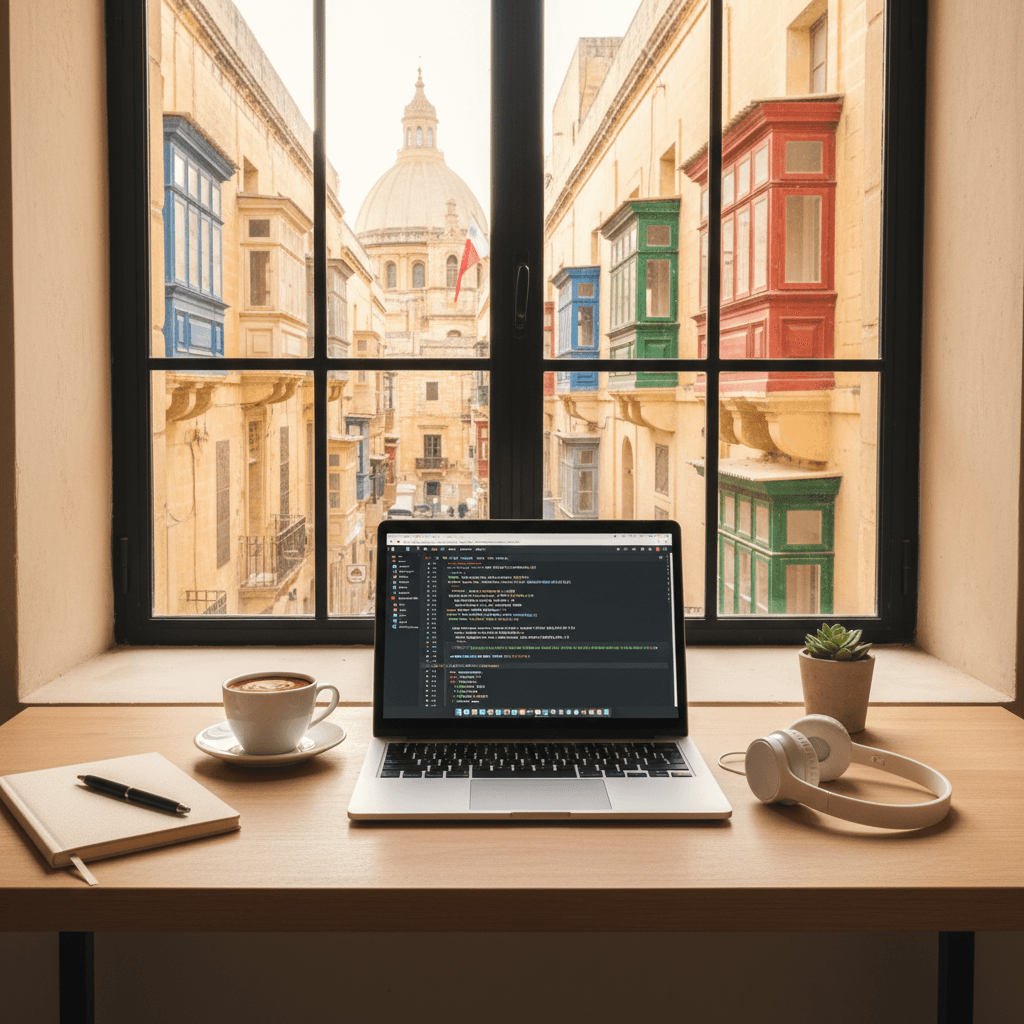
Malta

Policy Stability
Stamped Nomad ExclusiveHow likely visa and immigration policies are to remain unchanged
Quick Facts
Yes
$2,135/mo
301 Mbps
6/10
Medium
High
High
CET, CEST
Entry Methods Available
Best For
Last verified: September 27, 2026
Compare Visa Programs
| Program | Best for | Minimum income or savings | Government fee | Initial stay | Where to apply |
|---|---|---|---|---|---|
| Malta Digital Nomad Visa | Digital Nomad Visa | €42,000 a year | €300 one-time | 1 year | Online through the Residency Malta Agency portal (portal.residencymalta.gov.mt); applicants already in Malta on a valid visa inform the agency and go straight to biometrics |
| Malta Permanent Residence Programme (MPRP) | Golden / Investor Visa | €375,000 one-time | €60,000 one-time | 5 years | Through a Licensed Agent registered with Residency Malta Agency |
Malta offers remote workers two very different routes, plus the standard Schengen short stay.
Visa-free entry suits a first look. Visa-exempt nationals can stay up to 90 days in any 180-day period across the Schengen area, Malta included, under the Schengen Borders Code. The allowance is shared across all member countries, and it is not a work permit.
The Malta Nomad Residence Permit suits remote employees, business owners and freelancers whose employers or clients are outside Malta. It runs a year at a time for up to 4 years, family can join and remote-work income is taxed at a flat rate. It does not allow work for Maltese clients and does not lead to permanent residence.
The Malta Permanent Residence Programme, often called the golden visa, suits people with substantial capital who want permanent residence and are ready to buy or rent qualifying property and pay a government contribution. It is a residence route, not a work arrangement, and it goes through a Licensed Agent.
Malta also runs tax-status programs for residents with foreign income, such as the Global Residence Programme and the Malta Retirement Programme. Stamped Nomad does not cover them yet.
Malta is one of the pricier places to live in southern Europe, driven mostly by rent around the harbor towns. Figures are Numbeo crowd-sourced averages; dollar amounts use the exchange rate of Sept. 26, 2026.
- Valletta: Numbeo (September 2026) puts a single person's monthly costs without rent at about €880. A one-bedroom apartment averages about €990 outside the center and €1,260 in it, for a total of roughly €1,870 to €2,140 (about US$2,135 to 2,440) a month.
- St. Julian's: Numbeo (September 2026) shows one-bedrooms at about €960 outside the center and €1,170 in it. There are too few reports for a full monthly total, but day-to-day costs are likely close to Valletta's.
Nomad permit holders need a rental agreement that covers the whole permit, so short furnished lets priced by the night are rarely an option for the permit itself. Budgets should also include the required health insurance.
- Valletta suits people who want the capital's history, government offices and ferry links on the doorstep, and who can pay central rents.
- St. Julian's suits remote workers who want the busiest social scene and coworking choice, with rents a little below Valletta's.
- Sliema suits nomads who want a walkable seafront town next to St. Julian's and a ferry to Valletta.
- Gozo suits people who want a quieter island base and can live with fewer coworking options and a ferry to the main island.
Fixed internet is fast. The Speedtest Global Index for August 2026 puts Malta's median fixed broadband speed at 301.12 Mbps, comfortably enough for video calls and large uploads.
Coworking spaces cluster in Valletta and the Sliema and St. Julian's area, where most remote workers live. Outside the harbor towns and on Gozo the choice is thinner. Day passes and monthly plans vary by operator, so current prices are best checked directly.
Malta's rules come from the Malta Tax and Customs Administration.
- Residency test: presence in Malta for more than 183 days in a year makes a person tax resident; someone who moves to Malta to establish residence is resident from arrival.
- Remittance basis: Residents who are ordinarily resident and domiciled in Malta are taxed on worldwide income; residents who are not domiciled or not ordinarily resident are taxed on a remittance basis.
- Nomad permit holders: Income from authorised remote work is taxed at a flat 10% under the Nomad Residence Permits (Income Tax) Rules (S.L. 123.210, in force January 1, 2024); other income follows the Income Tax Act, and holding the permit does not by itself make the holder tax resident (MTCA nomad guidelines).
The nomad permit page covers the renewal tax declaration, and the MPRP page explains why permanent residence carries no tax regime of its own. Home-country rules and tax treaties still matter, so nomads should check both sides.
- Arrival: Malta is in the Schengen area. The EU Entry/Exit System has run at all external Schengen borders since April 10, 2026, recording fingerprints and a facial image of non-EU short-stay travelers (EES).
- ETIAS: Not yet operating and no official start date. The EU says it will announce the date several months before launch. The earlier official target, the last quarter of 2026, was removed from the official ETIAS website on July 14-17, 2026.
- Residence card: nomad permit holders give biometrics in Malta and receive their card from Identità three to four weeks later; the card fee is €100 per person.
- Health insurance: the nomad permit requires cover of at least €100,000 for the EU (including Malta) and the UK, prepaid for a year.
- Language: English is one of Malta's official languages alongside Maltese, so paperwork and daily life run in English.
- Banking and phones: a local bank account and phone contract are easier to open with a residence card and a Maltese address. Until then, foreign cards and an EU eSIM cover most needs.
Frequently asked questions
Does Malta have a digital nomad visa?
How much income is needed for the Malta nomad permit?
Do digital nomads pay tax in Malta?
What is the difference between the Malta nomad permit and the golden visa?
How much does it cost to live in Malta as a digital nomad?
Latest Nomad News
9 Schengen nations maintain manual EES fallbacks at congested borders
Nine Schengen nations are using manual fallbacks for the Entry/Exit System at congested borders. Travelers face manual checks instead of full biometric capture.
Malta tripled the eco-contribution to 1.50 euros per night starting July 1
Malta is increasing its environmental contribution for international visitors aged 18 and older to €1.50 per night, capped at €22.50 per stay, starting July 1. The fee applies to hotels and short-term rentals across the country. Remote workers and travelers booking accommodation will see these costs added directly to their stay.
EES now replaces passport stamps at Schengen borders
The EU's new biometric Entry/Exit System (EES) will automate border controls across 29 Schengen countries, digitizing stay tracking and replacing physical passport stamps for non-EU travelers.
Malta Updates Work Permit Rules with Integration Requirements
Third-country nationals applying for residency in Malta must now complete a mandatory course covering language, culture, and rights before arrival.
More Guides from Europe

Stay Updated on Malta
Get notified about visa changes, policy updates, and new information for digital nomads in Malta.