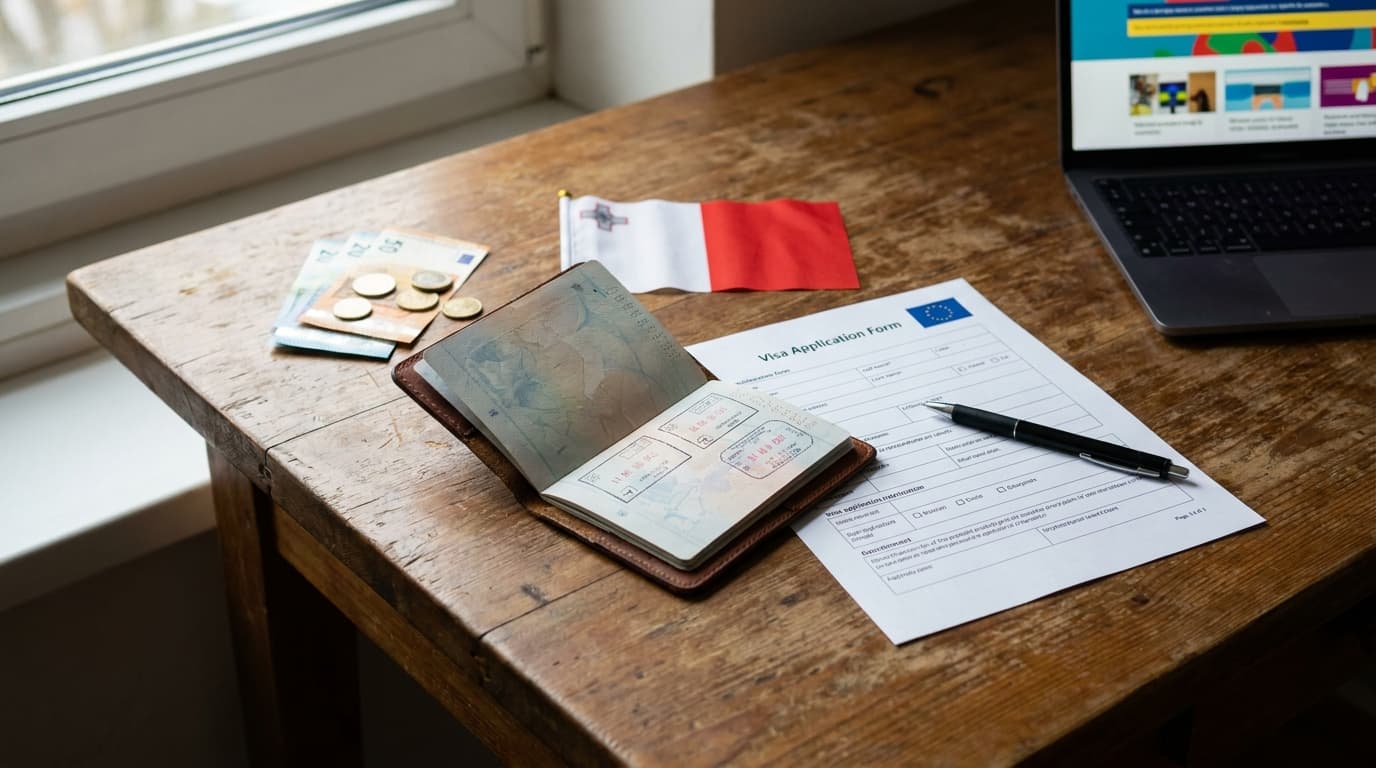
Malta Digital Nomad Visa

At a Glance
- €42,000 a yeargross yearly income; applications submitted on or after April 1, 2024 · main applicant
- €300 one-timenon-refundable, per person, paid to Residency Malta Agency by bank transfer from the main applicant account · each applicant and dependant
- 1 yearfrom issuance of the residence card
- Renewable yearly at the discretion of Residency Malta Agency; the holder must show at least five months of residence in Malta in the previous 12 months and apply two to three months before expiry
- 4 yearsrenewed up to three times
- Online through the Residency Malta Agency portal (portal.residencymalta.gov.mt); applicants already in Malta on a valid visa inform the agency and go straight to biometrics
- 30 daysworking days from the receipt of funds; the residence card then takes three to four weeks
- Nono services, directly or indirectly, to Malta-based companies or individuals; that needs an employment-based permit
- Yesspouse, minor children and unmarried dependent adult children; dependants can also be added at renewal
- None: the permit does not lead to permanent or long-term residence or citizenship; other programs require giving it up
Malta's digital nomad visa is officially the Nomad Residence Permit, run by Residency Malta Agency. It lets third-country nationals (people without EU, EEA or Swiss citizenship) live in Malta while they keep working remotely for employers, businesses or clients based outside Malta.
- Income: at least €42,000 a year gross for applications filed since April 1, 2024
- Length: 1 year at first, renewable up to 4 years in total
- Fees: €300 per person to apply plus €100 per residence card
- Family: a spouse, minor children and dependent adult children can be included
- Local work: not allowed for Malta-based companies or clients
It is a residence permit, not a tourist visa, and it is a temporary one. It does not lead to permanent or long-term residence or citizenship, and moving to another Maltese residence program means giving it up (Residency Malta FAQs).
Applicants must be third-country nationals who can do their work remotely through telecommunications and who fit one of three setups listed by Residency Malta:
- Employee: working for an employer registered in a foreign country, under a contract of work.
- Business owner: running business activities for a foreign-registered company in which the applicant is a partner or shareholder.
- Freelancer or consultant: serving clients whose permanent establishments are outside Malta.
People contracted by a foreign company to work for that company's Maltese subsidiary are not eligible, and the permit rules out providing services, directly or indirectly, to Malta-based companies or individuals. That kind of work needs an employment-based permit.
The main applicant needs a gross yearly income of at least €42,000 a year. The threshold applies to applications filed on or after April 1, 2024; earlier applicants keep the old bar of €32,400. The official FAQs set no extra income amount for dependants.
A spouse, minor children and unmarried dependent adult children can join, either in the first application or when the permit is renewed. Every applicant must also pass a background verification check.
The official eligibility page and FAQs list these requirements. The portal's document checklist has the exact file list.
- Travel document: a valid passport for the main applicant and each dependant.
- Proof of income: showing at least €42,000 a year gross.
- Proof of remote work: an employment contract, company ownership documents or client contracts showing the work is based outside Malta.
- Accommodation: a valid property rental or purchase agreement covering the permit's whole duration.
- Health insurance: cover of at least €100,000 for risks in the European Union (including Malta) and the UK, prepaid for a full year.
- Police conduct certificate: required from applicants, followed by a background verification check.
The rental agreement and insurance can wait until after approval in principle: applicants submit them within 30 working days of receiving the Letter of Approval in Principle.
Residency Malta publishes two government fees, both charged per person (FAQs):
- Application fee: €300, non-refundable, paid by bank transfer.
- Residence card: €100, paid to Identità at biometrics.
A main applicant with a spouse and one child therefore pays three application fees and three card fees. The other costs are set by third parties: health insurance with at least €100,000 of cover, a rental or purchase agreement covering the whole permit, police certificates and any translations or legalizations the home country requires.
Income is the larger hurdle: €42,000 a year gross for the main applicant.
Applications go through the Residency Malta online portal.
- Apply online: upload the documents on the portal. Applicants already in Malta on a valid visa inform the agency and go straight to biometrics once approved.
- Pay the fee: after the documents are checked, pay the non-refundable €300 per person by bank transfer from the main applicant's account.
- Wait for review: processing takes 30 days, counted in working days from the receipt of funds. Residency Malta and other Maltese authorities run background checks.
- Letter of Approval in Principle: submit the rental or purchase agreement and health insurance within 30 working days.
- Entry visa if needed: the Central Visa Unit at Identità contacts applicants who need one.
- Biometrics and card: book biometrics in Malta and pay €100 per person. The residence card is issued in three to four weeks.
Applicants already in the Schengen area should file two to three months before their current permitted stay ends. The agency says it is not responsible for overstays while an application is pending.
The permit is valid for 1 year from the issue of the residence card. It can be renewed three times, for a maximum stay of 4 years.
- Renewal rule: Renewable yearly at the discretion of Residency Malta Agency; the holder must show at least five months of residence in Malta in the previous 12 months and apply two to three months before expiry.
- Evidence: bank statements show the time spent in Malta.
- Tax: a tax compliance declaration is required for the second and third renewals.
- Family: dependants can be added at renewal.
The permit does not lead to permanent or long-term residence or citizenship. Holders who want to stay longer need a different program, and applying for one means giving up the nomad permit.
Malta taxes nomad permit holders under dedicated rules. According to the Malta Tax and Customs Administration guidelines: Income from authorised remote work is taxed at a flat 10% under the Nomad Residence Permits (Income Tax) Rules (S.L. 123.210, in force January 1, 2024); other income follows the Income Tax Act, and holding the permit does not by itself make the holder tax resident.
General tax residence follows the MTCA residence rules: presence in Malta for more than 183 days in a year makes a person tax resident, and someone who moves to Malta to establish residence is resident from arrival. Residents who are ordinarily resident and domiciled in Malta are taxed on worldwide income; residents who are not domiciled or not ordinarily resident are taxed on a remittance basis.
- Remote-work income: the flat rate applies only to income from the authorised remote work.
- Other income: taxed under the ordinary Income Tax Act rules.
- Renewals: the second and third renewals need a tax compliance declaration.
Home-country tax still applies under that country's rules and any tax treaty. Nomads should check both sides before the first year ends.
Frequently Asked Questions
How much income does the Malta digital nomad visa require?
A gross yearly income of at least €42,000 a year for the main applicant, for applications filed since April 1, 2024. The official FAQs set no extra amount for dependants.
How long can a digital nomad stay in Malta?
The Nomad Residence Permit lasts 1 year and can be renewed three times, up to 4 years in total. Each renewal needs proof of at least five months in Malta over the previous 12 months.
How much does the Malta Nomad Residence Permit cost?
€300 per person to apply and €100 per person for the residence card, plus private costs such as health insurance and rent.
How are Malta digital nomads taxed?
Income from the authorised remote work is taxed at a flat 10% under the Nomad Residence Permits (Income Tax) Rules, according to the Malta Tax and Customs Administration. Other income follows the ordinary Income Tax Act rules.
Does the Malta nomad permit lead to permanent residence?
No. It does not lead to permanent or long-term residence or citizenship, and moving to another Maltese program means giving it up.
How It Compares
More Malta programs
| Program | Country | Income / month | Fee | Max stay | Renewable |
|---|---|---|---|---|---|
| Malta Permanent Residence Programme (MPRP) | Malta | €375,000 saved | €7,500-60,000 | 60 mo |
Similar visas elsewhere
| Program | Country | Income / month | Fee | Max stay | Renewable |
|---|---|---|---|---|---|
| Georgia Digital Nomad Program (Remotely from Georgia) | Georgia | - | - | - | |
| Kyrgyzstan Digital Nomad Status | Kyrgyzstan | - | - | 12 mo | |
| Kenya Class N Permit | Kenya | - | $200↓ | 24 mo | |
| Nepal Digital Nomad Visa (Not Yet Open) | Nepal | - | - | - |
Malta Digital Nomad Guide
Cost of living, internet, healthcare, coworking, and every visa option for Malta.
Visa rules change. We'll tell you.
Get notified about policy updates and new requirements for the Malta Digital Nomad Visa and other Malta visas.