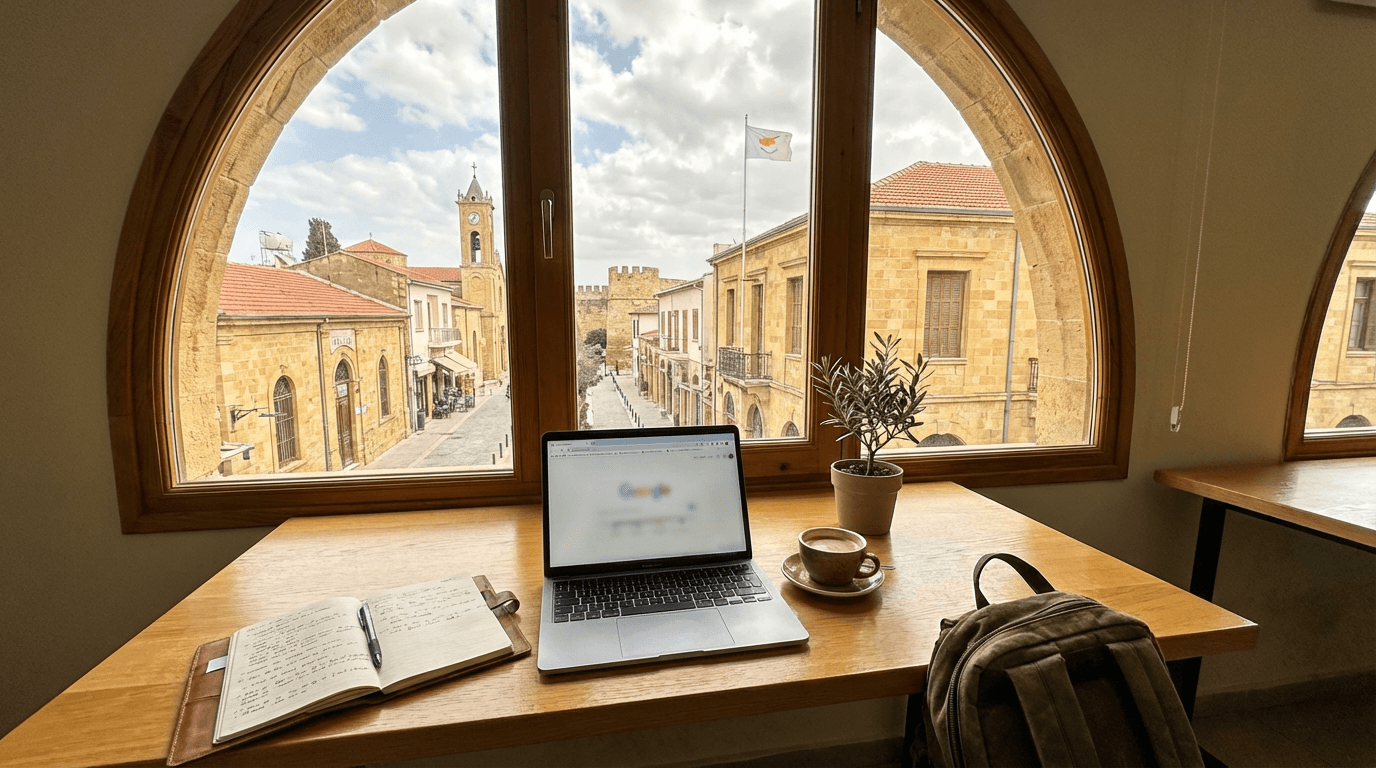
Cyprus

Policy Stability
Stamped Nomad ExclusiveHow likely visa and immigration policies are to remain unchanged
Quick Facts
Yes
$1,745/mo
148 Mbps
7/10
Medium
Medium
High
EET, EEST
Entry Methods Available
Best For
Last verified: September 27, 2026
Compare Visa Programs
| Program | Best for | Minimum income or savings | Government fee | Initial stay | Where to apply |
|---|---|---|---|---|---|
| Cyprus Category F Self-Sufficient Permit | Passive Income Visa | €9,568 a year | €500 one-time | Unlimited right of residence; the residence card expires after 10 years and must be replaced | Only at the Migration Department offices in Nicosia, in person or through an authorized representative, on form MIP2 |
| Cyprus Digital Nomad Visa | Digital Nomad Visa | €3,500 a month | €70 one-time | 1 year | In person or through an authorized representative at the Migration Department central offices in Nicosia, within three months of arrival |
| Cyprus Golden Visa | Golden / Investor Visa | €50,000 a year | €500 one-time | Permanent residence of unlimited validity; the residence card expires after 10 years and must be replaced | In person at the Migration Department or through an authorized representative, by appointment |
Cyprus has one route for remote workers and two permanent residence routes for people with passive income or capital. All three are handled by the Migration Department.
The Digital Nomad Visa suits employees of foreign companies and freelancers with foreign clients who earn at least €3,500 a month net. It lasts 1 year and can be renewed once, to 3 years in total. Applications reopened on Dec. 31, 2025, the scheme is capped at 500 permits and applicants file in Nicosia after arrival.
The Category F permit suits retirees and others who live on pensions, dividends, interest or rent from abroad. It grants permanent residence but bars any work in Cyprus, and no official processing time is published.
The investor residence permit suits people ready to put €300,000 into Cyprus property, a Cyprus company or a Cyprus fund while showing €50,000 a year in income. It is also permanent, and decisions take about 2 months.
Cyprus also runs a Start-up Visa for non-EU founders and a visitor residence permit for people who can support themselves without working. Both are on the Migration Department site.
Short stays: Cyprus is in the EU but outside the Schengen area. Nationals of visa-exempt countries can stay up to 90 days in any 180-day period (gov.cy), counted separately from Schengen days. The EU Entry/Exit System, in use at Schengen borders since Oct. 12, 2025, does not run in Cyprus, which still stamps passports (EES). Cyprus will take part in ETIAS, the planned travel authorization (official FAQ): Not yet operating and no official start date. The EU says it will announce the date several months before launch. The earlier official target, the last quarter of 2026, was removed from the official ETIAS website on July 14-17, 2026.
Cyprus Category F Self-Sufficient Permit
Minimum income proof, fees, and how to qualify for the Cyprus Category F Self-Sufficient Permit.
Cyprus Digital Nomad Visa
Income requirements, application steps, and renewal rules for the Cyprus Digital Nomad Visa.
Cyprus Golden Visa
Investment thresholds, eligible routes, and processing times for the Cyprus Golden Visa.
Numbeo's crowd-sourced figures from mid-2026 put a single person's monthly costs before rent at about 770 to 930 euros across the four main cities. Rent is what separates them.
- Limassol: one-bedroom rents of about 1,190 euros outside the center and 1,360 euros in it, for roughly 2,130 to 2,290 euros a month (Numbeo, June 2026).
- Paphos: rents of about 880 to 980 euros, for roughly 1,680 to 1,790 euros a month (Numbeo, August 2026).
- Nicosia: rents of about 620 to 730 euros, for roughly 1,480 to 1,590 euros a month (Numbeo, June 2026).
- Larnaca: rents of about 610 to 820 euros, for roughly 1,380 to 1,590 euros a month (Numbeo, June 2026).
These are averages for long leases. Furnished short-term rentals and summer stays on the coast usually cost more.
- Limassol suits nomads who want the island's business hub, the largest international community and the most coworking, and can pay the highest rents.
- Paphos suits a slower coastal base with an established expat community and its own airport.
- Nicosia, the inland capital, suits those who want city life, lower rents than Limassol and short trips to the Migration Department, where permit applications are filed.
- Larnaca suits budget-minded nomads and frequent flyers, with a seafront town center close to the main airport.
Cyprus has fast connections for remote work. The Speedtest Global Index for August 2026 puts the median fixed download at 148.23 Mbps and the median mobile download at 109.52 Mbps (Speedtest), enough for video calls and large uploads.
Limassol and Nicosia have the widest choice of coworking spaces, from business centers to community-run hubs with day passes and monthly desks. Larnaca and Paphos have fewer, and cafes fill the gap.
Speeds in rural areas and mountain villages vary more, so it pays to ask a host for a recent speed test before a long booking. Coworking prices change often, so compare current offers before committing to a month.
The Tax Department applies two residency tests. Under the 183-day rule, a person present in Cyprus for more than 183 days in a tax year is tax resident; arrival days count as days in Cyprus and departure days as days outside (Tax Department).
Under the 60-day rule, a person present for at least 60 days can also be tax resident if they spend no more than 183 days in any other country, carry on business or hold a job or office in Cyprus and keep a home they own or rent there.
None of the three residence routes carries a special tax regime. Digital nomad permit holders may not work for Cyprus employers or clients, so for them the 183-day rule is the one that counts: A digital nomad who spends more than 183 days in Cyprus in a tax year becomes a Cyprus tax resident (Migration Department).
Special Defence Contribution applies only to tax residents who are also domiciled in Cyprus. Domicile usually follows birth, and anyone tax resident for at least 17 of the previous 20 years is deemed domiciled.
Points to check: the day count in the calendar year, domicile, any tax treaty with the home country and how the home country taxes income earned while abroad.
- Currency: the euro. Cards and contactless payments are widely accepted.
- Arrival: border officers still stamp passports, so keep entry dates on record. Digital nomad applicants must file within three months of arrival and need a copy of the page with the last entry stamp (document list).
- Health insurance: the digital nomad permit needs private cover for inpatient and outpatient care and repatriation of remains, and the investor permit needs inpatient and outpatient cover. Travelers on short stays should carry their own insurance.
- Paperwork: documents for the Migration Department must be officially translated and certified, and applications missing any listed document are refused for examination (Migration Department).
- SIM and eSIM: the main mobile operators sell prepaid SIM cards at the airports and in shops, and eSIM plans are widely available.
- Getting around: traffic drives on the left. Buses link the main towns, but a car makes the coast and mountains easier to reach.
- Summer: July and August are hot, and coastal rents rise in peak season.
Frequently asked questions
Does Cyprus have a digital nomad visa?
Is Cyprus part of the Schengen area?
Can a digital nomad stay in Cyprus permanently?
How much does it cost to live in Limassol?
Do digital nomads pay tax in Cyprus?
Latest Nomad News
Cyprus requires biometric passports for Lebanese visa filings since Sept. 1
The Embassy of Cyprus in Beirut now requires Lebanese citizens to submit biometric passports for all new visa applications. Travelers with valid long-term Cyprus visas in canceled non-biometric passports can still enter by presenting both their old passport and their new biometric booklet.
New health check rules for Cyprus Immigration Permit Categories A to F take effect
Cyprus now requires third-country nationals applying for Categories A through F permanent residency to submit certified medical examination results. Applicants and their dependants must provide clean test results for Hepatitis B, Hepatitis C, HIV, syphilis, and a tuberculosis chest X-ray.
Cyprus moved 5 residence permit renewal streams to Gov.cy on July 7
Third-country nationals in Cyprus can now renew their residence permits through a new digital portal designed to streamline administrative tasks. The system digitizes the application process, reducing the need for in-person visits to immigration offices.
EES now replaces passport stamps at Schengen borders
The EU's new biometric Entry/Exit System (EES) will automate border controls across 29 Schengen countries, digitizing stay tracking and replacing physical passport stamps for non-EU travelers.
More Guides from Europe


Stay Updated on Cyprus
Get notified about visa changes, policy updates, and new information for digital nomads in Cyprus.