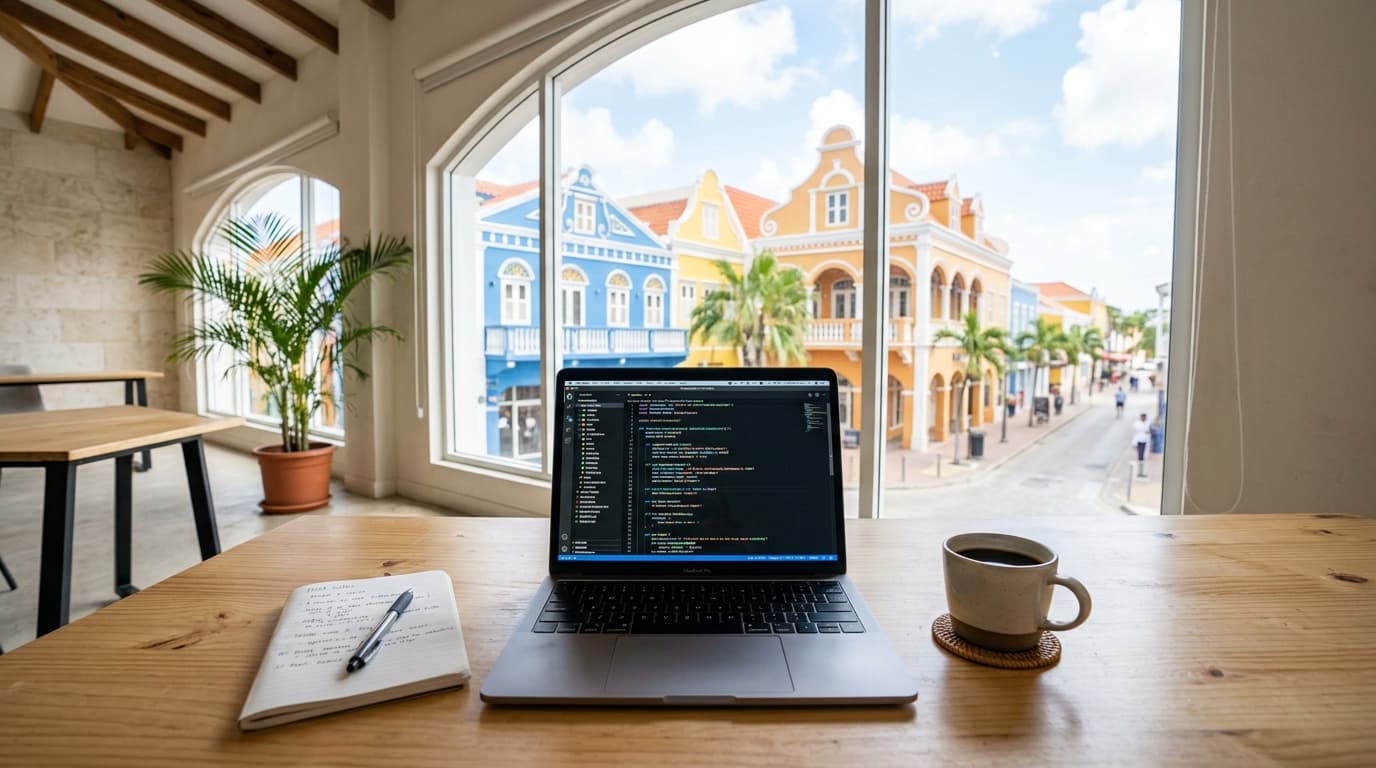
Aruba

Policy Stability
Stamped Nomad ExclusiveHow likely visa and immigration policies are to remain unchanged
Quick Facts
N/A
$5,000/mo
6 months
No
$2,800/mo
114 Mbps
7/10
Medium
Medium
High
AST (UTC-4)
Entry Methods Available
Best For
Aruba doesn’t run a separate visa system for short visits. For tourism, short business trips and family visits, the island follows the Kingdom of the Netherlands’ Caribbean visa rules and there’s no visa on arrival or e-visa option right now.
That matters because the process is a little less intuitive than people expect. If you’re from a visa-exempt country, you usually just show up with the right travel documents. If you’re not, you’ll need a Caribbean short-stay visa arranged through Dutch consular channels before you fly.
Short-stay entry
Many nationalities can enter Aruba visa-free for short stays, including travelers from the U.S., Canada, the U.K. and much of Europe. Short business visits sit in the same bucket as tourism, so there isn’t a separate “business visitor visa” for a quick meeting or conference.
For visa-exempt travelers, Aruba still checks the basics. You’ll need a valid passport, proof of onward travel, enough money for your stay and medical insurance that meets the island’s requirements. The paperwork can feel picky and it's, especially if you’re trying to extend a stay later.
- Standard guest stay: 30 days on arrival
- Possible extension: up to 180 days in a calendar year, subject to approval
- U.S. nationals: up to 90 days without formally requesting an extension beyond the first 30 days
If your nationality needs a visa
If you’re not visa-exempt, you need a Caribbean short-stay visa for Aruba. It covers stays of up to 90 days in a 180-day period and has to be arranged through Dutch embassies, consulates or the Netherlands Worldwide application route, not through Aruba’s immigration office.
The fee depends on your nationality and where you apply, so there isn’t one simple price tag to quote. That’s annoying, but it’s the way the Kingdom’s system works. Check the official application wizard before you plan your trip.
Longer stays and residence permits
Anything beyond a short visit moves into residence permit territory. Work, study, family reunification and some remote-work or digital-nomad style arrangements are handled by Aruba’s DIMAS office, not by the tourist visa rules.
- Short stay: tourism, meetings, family visits, short business
- Residence permit: work, study, family, longer remote-work stays
- Visa processing: Dutch consular system for short stays, DIMAS for residence
Aruba’s entry rules are strict about money and insurance, so don’t wing it. Bring proof of funds, valid coverage and the documents that match your nationality and purpose of stay or you may end up stuck at the airport counter with no warm breeze and a very unhelpful conversation.
Source 1 | Source 2
Digital nomad visa
Aruba doesn’t have a separate digital nomad visa. That’s the short version and it matters because a lot of people expect a tidy remote-work permit that simply doesn’t exist here. In practice, remote workers use normal tourist entry rules, then stay within the limits Aruba already allows.
The closest official branding is the Aruba Tourism Authority’s “One Happy Workation” program. It’s aimed at U.S. nationals who want to work remotely for up to 90 days, but it doesn’t create a new immigration category. No special visa, no special resident status, no extra government document in your hand.
What most remote workers use:
- Tourist entry: The basic route for remote workers staying under Aruba’s visitor rules.
- One Happy Workation: A tourism package for U.S. nationals staying up to 90 days.
- Residence permit: Only needed if you want to live or work in Aruba long term.
Aruba’s immigration rules are pretty clear on the work part. You can work remotely only if you’re employed by or self-employed through, a company outside Aruba. You can’t provide services to an Aruban company or individual unless you’ve got a work or business permit. That’s the line and it’s not fuzzy.
For U.S. nationals, the tourism authority says you can stay up to 90 days without extra government paperwork. The ED card still matters and if you’re using the workation branding, you select “One Happy Workation” as your purpose of visit. It’s simple, but not exactly glamorous. You’re still entering as a tourist.
What you need to qualify:
- Passport: Valid for the full stay.
- Financial means: Proof you can cover lodging and daily expenses if asked.
- Return or onward ticket: Required under the standard entry rules.
- Travel insurance: Needed for some extensions and can be requested during the process.
There’s no official monthly income minimum for remote workers. Aruba just wants to see that you can support yourself. That’s good news if you’ve got a steady client load, though the documentation can still feel a bit old-school and tedious.
Tourist stays can sometimes be extended in Aruba, but the rules vary and the total tourist stay can’t go beyond 180 days per year. If you want to stay longer than that, you’re out of tourist territory and into residence-permit paperwork with DIMAS. For anyone planning a real move, that’s the point where the casual workation ends and the bureaucracy starts.
Source 1 | Source 2
Aruba doesn’t hand out tourist visas on arrival and there isn’t a separate tourist e-visa system either. If you need a visa, you’ll have to sort it out before you fly, through the Kingdom of the Netherlands’ Caribbean visa process. For everyone else, entry is usually straightforward, but it still comes with a stack of checks at the airport and a mandatory online ED card.
Visa-free entry: Many travelers can visit Aruba without a visa, including citizens of the U.S., Canada, the U.K., Ireland, all EU and Schengen states and a long list of countries in Latin America, the Caribbean and Asia-Pacific. Aruba follows the Kingdom-wide Caribbean visa rules, so if you’re visa-exempt for the Caribbean parts of the Kingdom, you’re visa-exempt for Aruba too.
Other ways to enter without a visa: Some travelers qualify because they already hold certain permits or visas, such as a valid multiple-entry Schengen visa or residence permit, a U.S. or Canadian residence permit or in some cases a multiple-entry visa for the U.S., Canada, the U.K. or Ireland. Cruise passengers staying in port for 24 hours or less, certain crew members and some diplomatic or refugee travel document holders can also be exempt.
If none of those categories fit, you need to apply in advance for a Caribbean short-stay visa. That’s the frustrating part, because there’s no airport workaround once you land. Aruba’s system is pretty clear on this point and it doesn’t leave much room for improvisation.
Basic entry rules: Your passport must be valid for the whole stay and can’t be older than 10 years. You also need proof of onward or return travel, proof of where you’re staying, enough money for your visit, valid medical insurance with at least $15,000 in coverage and a completed, approved ED card. The ED card isn’t a visa. It’s the online entry form every traveler has to fill out before arrival.
Money and insurance: Aruba wants proof you can support yourself. The standard guideline is $150 to $200 per person per day if you’re staying in a hotel or $100 per person per day if you’re staying with family. Medical insurance has to cover hospital care, emergency treatment and repatriation, including death.
How long you can stay: Most tourists are admitted for 30 days at first. Extensions may be possible, but your total stay can’t go beyond 180 days in a calendar year. U.S. nationals get a bit more room and can stay longer than 30 days without asking for a normal extension, which is one of the few parts of the system that feels less rigid than the rest.
Source
Long-term stay options
Aruba doesn’t have a dedicated digital nomad visa and there’s no official golden visa program sitting on the shelf either. If you want to stay long term, you’ll usually fit into an existing residence category, such as retiree, investor, family or work-based residence. The system is orderly, but it can feel a bit old-school, with a fair amount of paperwork and a sponsor often doing the filing.
For short stays, tourist entry isn't the same thing as residency. The island’s tourist rules allow a standard 30-day stay, extendable to a total of 180 days per calendar year, while U.S. nationals can usually enter for up to 90 days before needing an extension. Once you’re past those limits, you need a residence permit. Working on a tourist stay isn’t allowed.
Who handles residence permits
The main immigration office is DIMAS, which issues temporary residence permits. If you’re coming to work, your employer also has to deal with the labor authorities. In practice, that means you can’t just show up, rent a condo and sort it out later. A local sponsor, like an employer or partner, usually has to start the process on your behalf.
- Retiree or passive income permit: Built for people living off pension, interest income or other non-working funds. You’ll need to show enough income, plus standard documents like a passport, police clearance, medical certificate and health insurance.
- Investors and shareholders: Aruba does have a route for people with a real business stake or investment. It’s not a flashy citizenship-by-investment setup, just a normal residence path with business ties.
- Work-based residence: If you’re employed by an Aruban company, the employer applies for the combined work and residence permit. Self-employed people and remote workers usually have to fit into another category, which can be frustrating if your situation doesn’t match neatly.
Costs aren’t always easy to pin down from public government pages and that’s annoying. Expect government fees in the low hundreds of dollars for many long-stay applications, plus whatever extra paperwork, translations or legal help you need. DIMAS can confirm the current fee for your category and that’s the only figure worth trusting before you apply.
If you’re aiming for a truly long-term setup, Aruba does have a path to indefinite stay after 10 years of legal residency. That can matter later if you’re looking at Dutch nationality rules too. It’s not quick and it’s definitely not the easy-route island fantasy some people imagine, but it's a real route if your paperwork stays clean and your income stays solid.
Aruba isn’t cheap. Most digital nomads land somewhere around $2,000 to $4,000 a month and if you keep things simple, share housing or live inland, you can sometimes get by on about $1,500. It still costs less than trying to live at a similar comfort level in New York, London or Zurich, but Aruba will test your budget fast if you like beach bars, taxis and eating out a lot.
Most nomads stay in Noord, Palm Beach, Eagle Beach or Oranjestad. The beach zones are the most convenient and the most expensive, with salty air, loud scooters and plenty of short-term rental stock. Oranjestad is a bit more practical and usually a little less punishing on rent.
What housing usually costs
- Budget: $700 to $1,000 for a basic inland or older 1-bedroom.
- Comfortable: $1,200 to $1,800 for a decent 1-bedroom in Noord or Oranjestad with air conditioning and decent furnishings.
- Premium: $2,000 to $3,000+ for a newer condo, pool access or a place near Eagle Beach or Palm Beach.
Food is another place where Aruba bites. Almost everything is imported, so groceries cost more than many nomads expect and the supermarket aisles can feel oddly expensive for what’s in the cart. If you cook most meals, plan on about $350 to $450 a month. Mix in regular dinners out and that jumps quickly.
Monthly food budget
- Budget: $350 to $450, mostly groceries and cheap meals.
- Comfortable: $500 to $750, with a mix of cooking and restaurants.
- Premium: $800 to $1,200+, especially if you like nicer spots and drinks.
Transport is manageable, but it’s not exactly painless. Buses exist, though they’re limited and taxis get expensive in a hurry. Many nomads either rent a car or try to stay close enough to walk or bike, because paying taxi fares regularly gets old fast.
For working, you can stay home and use decent internet, drop into cafés or pay for a coworking space in Oranjestad. A full coworking membership can run around $290 a month, while a lighter setup with coffee-shop work and backup mobile data is much cheaper.
How Aruba compares
- New York: Aruba is cheaper for a similar level of comfort.
- London: Aruba usually comes in below London on rent and daily spending.
- Zurich: Aruba is far less expensive, though it still feels pricey for the region.
Bottom line, Aruba works best for nomads who can handle island prices without flinching. If you want beach access, good Wi-Fi and a slower pace, it’s doable. If you want budget travel pricing, this island will annoy you.
Aruba’s small size changes the question from “which city?” to “which district fits your work style?” The island’s main hubs are Oranjestad, Noord and the Palm-Eagle Beach strip, San Nicolas and the quieter south side around Savaneta and Baby Beach. Each one feels different once you’re carrying a laptop, hunting for coffee and trying to get through a Zoom call without hearing scooters or beach music in the background.
Oranjestad
Oranjestad is the best all-around base. You get coworking options, work-friendly cafés, easier access to services and a more local price tag than the beachfront zones. The city center has colonial streets, museums and a steady but not chaotic energy, so it’s good if you want to work during the day and still have a few bars and restaurants nearby at night.
- Best for: A balanced stay with shops, transit and decent café culture.
- Work setup: Multiple coworking spaces and solid fiber internet in many apartments and hotels.
- Downside: You’re not on the beach and the nightlife is modest.
Noord and Palm-Eagle Beach
Noord and the Palm-Eagle Beach area are the polished, pricey choice. This is where you go for resort-style living, strong Wi-Fi, beach access and the island’s busiest nightlife. It’s convenient if you want to roll out of bed, open your laptop and then walk straight to the sand after work, but it’s also the easiest place to overspend fast.
- Best for: Beach-first living, nightlife and modern short-term rentals.
- Work setup: Dedicated coworking in Noord plus lots of laptop-friendly rentals and café spaces.
- Downside: Usually the most expensive part of Aruba.
San Nicolas
San Nicolas feels more local and less polished. It’s known for street art and lower rents, so it can make sense if you want to save money and don’t mind fewer coworking choices. Days are generally fine, but nights are quieter and a bit less comfortable than the main resort zones, so I wouldn’t pick it if you like walking around late.
Savaneta and Baby Beach
Savaneta and the Baby Beach area suit people who want quiet, water and fewer distractions. It’s a slower part of the island, with a residential feel and decent internet in many rentals, though you’ll want to confirm the connection before booking. Don’t expect much nightlife. That’s the point.
Quick take: choose Oranjestad for the best balance, Noord for beach life and convenience, San Nicolas for lower costs and local character and Savaneta if you want quiet, space and a slower pace.
Aruba is a pretty workable place to earn a living online, but don’t treat every Wi-Fi signal like it’s equal. In the main tourist and residential areas, fixed internet is usually fast enough for video calls, cloud backups and big file syncs and mobile data is a solid backup when a café connection gets flaky or your apartment router starts acting up.
Crowdsourced tests of Aruba Broadband connections put average speeds around 114 Mbps down and 52 Mbps up, with latency around 65 ms. That’s good enough for remote work without much drama, though you’ll still notice the occasional slowdown if you’re on a crowded property or sharing a connection with a bunch of other guests.
What internet looks like in the main areas
- Noord, Oranjestad and Eagle Beach: Many hotels and rentals advertise 50 to 100+ Mbps and some do deliver that.
- Fiber: FTTH is common in the main tourist and residential districts, so Aruba isn’t stuck on dusty old copper lines.
- Best practice: Filter listings for “Wi-Fi” and “laptop-friendly workspace,” then ask the host what speed they actually get during the day.
The coworking scene is small but decent. Workspace Aruba in central Oranjestad is the island’s first coworking space, with open desks, meeting rooms and a few private rooms. Impact Hub Aruba, in Harbour House Condominium downtown, has hot desks, booths, sofas and meeting rooms, plus access-code hours that stretch beyond a standard office schedule.
Piso Tr3s is better for workshops and small events, with a conference room and bar area. Futura Spaces, near Ling & Sons, feels more polished and startup-y, with flex desks, four meeting rooms and space for bigger gatherings. In San Nicolas, The Hub is more community-minded and has an on-site café, which is handy if you like working where the coffee smells better than the air conditioning.
What it costs
- Day pass: Roughly $15 to $30.
- Monthly hot desk: About $150 to $300.
- Impact Hub membership: Public posts start at $80 a month, while fuller access can run about $290 a month.
Aruba’s cafés and hotels usually do fine for routine work, but don’t assume a pretty terrace means good Wi-Fi. Juan Valdez Café near the low-rise hotel area gets mentioned often for reliable internet and air-conditioning and Aruba Experience Café downtown is another laptop-friendly option. Still, test the connection before a client call. A beach breeze is nice until the audio starts cutting out.
For mobile backup, Aruba has SETAR and Digicel, both with airport kiosks and island retail locations. You’ll usually need your passport and SIM cards are cheap, around AWG 10 to 20, with data bundles starting near AWG 10. That said, bigger plans add up fast, so if you depend on mobile data every day, don’t buy the smallest package and hope for the best.
Aruba’s healthcare setup is decent for an island of its size, but it’s not the kind of place where you want to show up uninsured and hope for the best. The public system, AZV, is tied to legal residency, so short-stay visitors and most digital nomads usually lean on private international insurance instead.
That split matters in practice. AZV covers general care for registered residents, but it doesn’t cover everything, including some higher hospital classes, adult dental care, glasses and care abroad while you’re on vacation. If you’re only on the island for a few months, private cover is usually the cleaner option because it can handle hospital deposits, specialist bills and evacuation if things go sideways.
Public and private care
Aruba’s main hospital, Dr. Horacio Oduber Hospital in Oranjestad, takes international patients and says it accepts most insurers if there’s a valid guarantee letter. That’s the key detail, because without it you may be asked to pay up front. The hospital also warns that patients are responsible for all costs and separate bills can come from specialists and labs.
Private or supplemental insurance is common for expats for a reason. It fills the gaps the local system leaves open and gives you evacuation or repatriation coverage, which can matter more than people expect when the closest advanced care isn’t on the island.
Where to go
- Main hospital: Dr. Horacio Oduber Hospital, Oranjestad, with 24/7 emergency care
- Urgent care: Urgent Care Aruba in Noord for non-life-threatening issues
- Other facility: Centro Medico Rudy Engelbrecht in San Nicolas
Routine care is generally manageable locally. Pharmacies are easy to find and usually open Monday to Saturday during daytime hours, with one rotating 24-hour duty pharmacy for emergencies. That’s handy, though it can still be annoying if you need something after hours and have to chase down whichever pharmacy is on duty that week.
Emergency basics and costs
Call 911 for fire or ambulance and 100 for police. For life-threatening problems, the hospital says to call 911 or go straight to the emergency department. For anything serious that needs more than local care, some patients are transferred by air ambulance to Curaçao or the U.S., which is exactly where weak insurance gets expensive fast.
- Ambulance fee: US$250 if applicable
- Deposit: International patients must pay before admission
- Evacuation: U.S. consular guidance puts it around US$15,000 to US$25,000
Bottom line, residents can work with AZV, but most mobile workers are better off buying international health insurance with evacuation coverage. Aruba’s care is solid for routine problems, yet a bad fall, surgery or hospital transfer can turn into a very expensive, very fast headache.
Aruba isn’t the easiest place to open a bank account if you’re just passing through. Banks usually want a clear local tie, like property on the island, a long stay or a business connection and they’ll ask for a lot of paperwork before they even think about saying yes.
That said, foreigners can open accounts in Aruba and the Central Bank says non-residents may open accounts in foreign currency at local commercial banks. In practice, though, the process can feel slow and picky. Expect compliance checks, repeated document requests and at least one in-person visit, even if you start online.
Main banks to check first
- Caribbean Mercantile Bank: Offers a non-resident personal account with an online pre-application and in-person follow-up.
- Aruba Bank: Has a non-resident savings account and a platinum-style segment for higher-value clients.
- RBC Royal Bank: Also works with non-residents, subject to standard know-your-customer checks.
The paperwork is the part that trips people up. Banks commonly ask for a passport or other ID, recent proof of address, proof of income, a bank reference letter and evidence of a local tie, such as a lease, property deed or business interest. If any of that sounds annoying, it's.
Most banks want documents that are recent and easy to verify. A stale utility bill or vague employment letter can stall the process fast, so it helps to bring crisp scans and hard copies, not just files on your phone.
Money, currency and everyday payments
- Local currency: The Aruban florin or AWG.
- USD use: Widely accepted in shops, hotels and tourist areas.
- Exchange rate: The florin stays close to the U.S. dollar, usually around 1 USD to 1.78 to 1.80 AWG.
Cash machines are easy to find and cards from Wise and Revolut generally work fine at ATMs and point-of-sale terminals. That said, local ATM operators can tack on their own fees and the screen may try to steer you into dynamic currency conversion. Decline it. You’ll usually get a better rate letting your card handle the conversion.
Wise and Revolut both help with everyday spending, though your free withdrawal limits depend on your plan. If you’re staying a while, test one or two small ATM withdrawals first so you can see the fee message before you pull out a larger amount.
Crypto and other quirks
Crypto is allowed in Aruba, but it isn’t specifically regulated yet, so don’t expect a neatly packaged local system for buying, selling or banking around it. The island’s financial setup is decent for travelers, but not especially friendly if you want fast account approval without a solid paper trail.
Aruba is friendly for families, but it isn’t cheap. The biggest pressure points are school fees, childcare and private insurance, since the island’s public system is tied to legal residency and many families still buy extra coverage for faster access or off-island treatment.
Residency for spouses and children
Long stays need a residence permit, not a tourist stay. For families, Aruba’s reunification rules can cover a spouse and dependent children, though the paperwork gets stricter with older kids and the age cutoffs can matter a lot. If your child is older than the basic dependent category, expect more questions and more documents.
Tourist stays are limited and the exact allowance depends on nationality, so don’t assume you can just keep resetting a short visit. DIMAS, the immigration office, is the place to check before you move anything across the ocean.
Schools and childcare
The main draw for expat families is the International School of Aruba in Wayaca, near Oranjestad. It runs from pre-K through high school and follows an international, English-language model. Tuition isn’t small. Annual fees reported by expat directories run roughly from AWG 13,600 to AWG 30,100, depending on grade.
There are private and bilingual alternatives, but the choice isn’t huge. Some families go local and use Dutch- or Papiamento-based schools with varying amounts of English, while others stick with international curricula so their kids can move later without a jarring reset.
Childcare is the ugly part. Reliable private daycare, nannies and after-school care can be hard to find and expensive, so families often patch together help from school programs, part-time caregivers and grandparents if they’re nearby. Spots fill fast and quality can vary.
Healthcare for children
Aruba has a universal public system called AZV for legal residents. That means registered children can access family doctors, pediatric care, hospitals and basic dental services through the public setup. The main hospital is Dr. Horacio Oduber Hospital in Oranjestad and emergencies use 911.
Still, many expats keep private international insurance. It’s not just about comfort. It can cover private clinics, pediatric specialists and medical evacuation if a serious issue needs care off-island. For a family with young children, that backup can be the difference between a manageable bill and a brutal one.
Where families tend to live
- Oranjestad and Wayaca: Close to school, hospital access and government services.
- Noord and Palm Beach: Near beaches, resorts and family amenities, but busier and pricier.
- San Nicolas: Quieter and more local, though farther from the main expat school and tourist services.
Aruba feels safe and easy to live in with kids and the island’s small size helps. The tradeoff is cost. If you’re budgeting for family life here, school and childcare deserve as much attention as rent.
Aruba feels easy to live in and that’s part of the appeal. Most nomads settle in tourist-heavy areas like Palm Beach or Oranjestad, where the island’s low crime rate, steady police presence and tourism-first mindset make day-to-day life fairly smooth. Still, don’t get sloppy. Petty theft happens, especially on beaches, in rental cars and around crowded events like Carnival.
The biggest risk is usually boredom-level crime, not anything dramatic. Phones vanish from beach chairs, backpacks disappear from open cars and laptops get taken from unlocked rooms or patios. Violent crime against visitors is rare, but robberies do happen, so avoid isolated stretches after dark and don’t wander onto empty beaches at night with a camera hanging off your shoulder.
Scams in Aruba are more irritating than sophisticated. Unlicensed taxis may quote inflated fares, timeshare sellers can be pushy and rental disputes sometimes turn into a he-said, she-said mess over scratches that were probably already there. Take photos of your car, scooter or water-sports gear before you leave the lot and don’t agree to anything in a rush.
- Beach safety: Keep valuables with you or leave them at home. Don’t assume someone nearby is watching your bag.
- Car safety: Lock doors, hide electronics and don’t leave anything visible in the back seat.
- Night safety: Stick to lit areas and use licensed taxis instead of guessing your way home on foot.
- Payment caution: Be skeptical of high-pressure offers, strange payment requests and anyone asking for banking details on open Wi-Fi.
Culturally, Aruba is welcoming without being loud about it. People are used to foreigners, service is generally friendly and English is widely spoken, so you won’t struggle to get through errands or work calls. A quick “bon dia” or “danki” goes a long way, though and skipping basic greetings can make you seem colder than you mean to.
Dress a little more conservatively once you leave the beach. Swimwear belongs on the sand, not in supermarkets or government offices and public affection can draw stares outside resort zones even if nobody says anything. Tipping around 10% to 15% is common in restaurants and for good service, especially in tourist areas where people are used to it but still appreciate the gesture.
Aruba is also one of the more LGBTQ-friendly places in the Caribbean, with legal protections and a generally relaxed attitude in hotel and tourist circles. That said, it’s still a small island with some conservative social habits, so read the room and don’t expect every local bar or neighborhood to feel the same as a resort lobby.
Aruba doesn’t use a simple 183-day test for income tax. The tax office looks at where your “centre of vital interests” is, which is basically where your life is most anchored, your home, family, work and day-to-day money ties. If Aruba is just a stopover while you keep your real base elsewhere, you’re usually treated as non-resident.
That distinction matters a lot. Residents are taxed on worldwide income, while non-residents are generally taxed only on Aruba-source income, like pay from an Aruban employer or profits from work carried on in Aruba. The resident rates are progressive and can climb to roughly 41% at the top end, which is steep enough to hurt if you accidentally cross the line.
What can trigger residency
- Time in Aruba: Staying longer makes residency more likely, even if there isn’t a fixed day-count rule.
- Housing: A permanent home on the island weighs heavily.
- Family ties: A spouse or children living in Aruba or kids enrolled in school there, can tip the balance.
- Work and business: Running a business, working locally or registering with local authorities all matter.
- Banking and admin: Local bank accounts and other formal ties can add to the case for residency.
For short stays, Aruba can be pretty straightforward. Remote workers using the “One Happy Workation” program can usually work for non-Aruban employers for up to 90 days, with some extensions up to 180 days and that foreign income isn’t treated as Aruba-taxable under the program. Still, you can’t use that setup to take local clients or work for an Aruban employer.
That’s one reason the island stays appealing for nomads who want a simple beach-based base without a full tax move. But it’s not a free pass. If your stay starts looking like a real relocation, the tax office can still argue you’ve become resident, even if you never hit some magic number of days.
Aruba also doesn’t have many double-tax treaties to lean on, so don’t expect treaty relief to save you from getting taxed twice. In practice, you usually depend on your home country’s foreign tax credit or exemption rules to sort that out.
The same applies to crypto. Aruba doesn’t have a special crypto tax regime, so if you become resident, crypto income is generally pulled into the regular income-tax rules like any other earnings. For non-residents earning only foreign income, the tax picture is usually much cleaner, which is why many digital nomads keep their work and banking outside Aruba while they’re on the island.
Aruba is easy to set up on day one, which is part of the appeal. You can land, grab a SIM in the airport and be online before your bags feel unpacked.
Mobile and internet
SETAR and Digicel are the two main carriers. SETAR is state-owned and tends to have the broadest coverage, while Digicel can be very fast in tourist areas. Both have kiosks in the arrivals hall at the airport, so you don’t have to waste time hunting for a phone shop.
Tourist packages change often, but a rough benchmark is $30 for 7 days of unlimited data, about $50 for 14 days and around $70 for heavier 30-day plans. If you work online every day, a local SIM makes more sense as your main line, with an international eSIM as backup for travel days.
If you want an eSIM, Digicel sells one directly and global apps like Airalo, Nomad, Ubigi, Holafly and Saily are common choices. They’re handy if you want service the moment you land, though I’d still lean local for price and reliability.
Getting around
Arubus is the island’s public bus and it’s good enough for the main corridors. It runs between Oranjestad and the beach areas, with frequent service in the day and less frequent runs later on. A retour card costs about $5 and covers two rides, which is useful if you’re bouncing between town and the beach.
There’s no Uber or Lyft here. Use the Aruba Taxi App if you want regulated cabs, because street taxis can be fine but they’re still taxis, not some slick ride-share fantasy. For daily life, Noord and Palm Beach are the easiest areas if you want to walk to cafés, groceries and a few work spots.
Best areas to base yourself
- Noord and Palm Beach: Best for beach access, hotel-strip convenience and a more polished stay. Palm Beach is busier and louder at night, so don’t expect sleep to come easy if you’re close to the action.
- Oranjestad: Better if you want color, local life and a more walkable base. It also puts you closer to coworking options like Impact Hub Aruba.
- Malmok: Quieter and more residential, with villas and condos close to the water. Good for longer stays if you don’t mind being less central.
Food and groceries
Aruba To You is the main app-based delivery option. It works island-wide, but slots can fill up, so don’t assume dinner will arrive in 20 minutes just because your app says yes. Some restaurants also deliver by phone, usually with limited hours.
For groceries and rentals, local agencies are worth a look alongside Airbnb and Booking.com. A decent place with strong Wi-Fi, a desk and quiet nights is usually better than chasing a bargain that turns into a humid, echoey headache.
Latest Nomad News
Aruba opens digital registration for A2 naturalization tests July 1
Foreigners seeking Aruban citizenship must register for the 2026 naturalization exam starting July 1. The process is digital with limited slots, making early application essential for expats pursuing long-term status or a Dutch passport.
Aruba airport passenger traffic rises 6.4% as seat capacity tightens
Aruba is experiencing a significant boom in tourism driven by increased flight capacity from major hubs. For digital nomads and expats, this trend suggests better connectivity but may lead to higher seasonal accommodation costs and reduced availability.
More Guides from Caribbean
Stay Updated on Aruba
Get notified about visa changes, policy updates, and new information for digital nomads in Aruba.