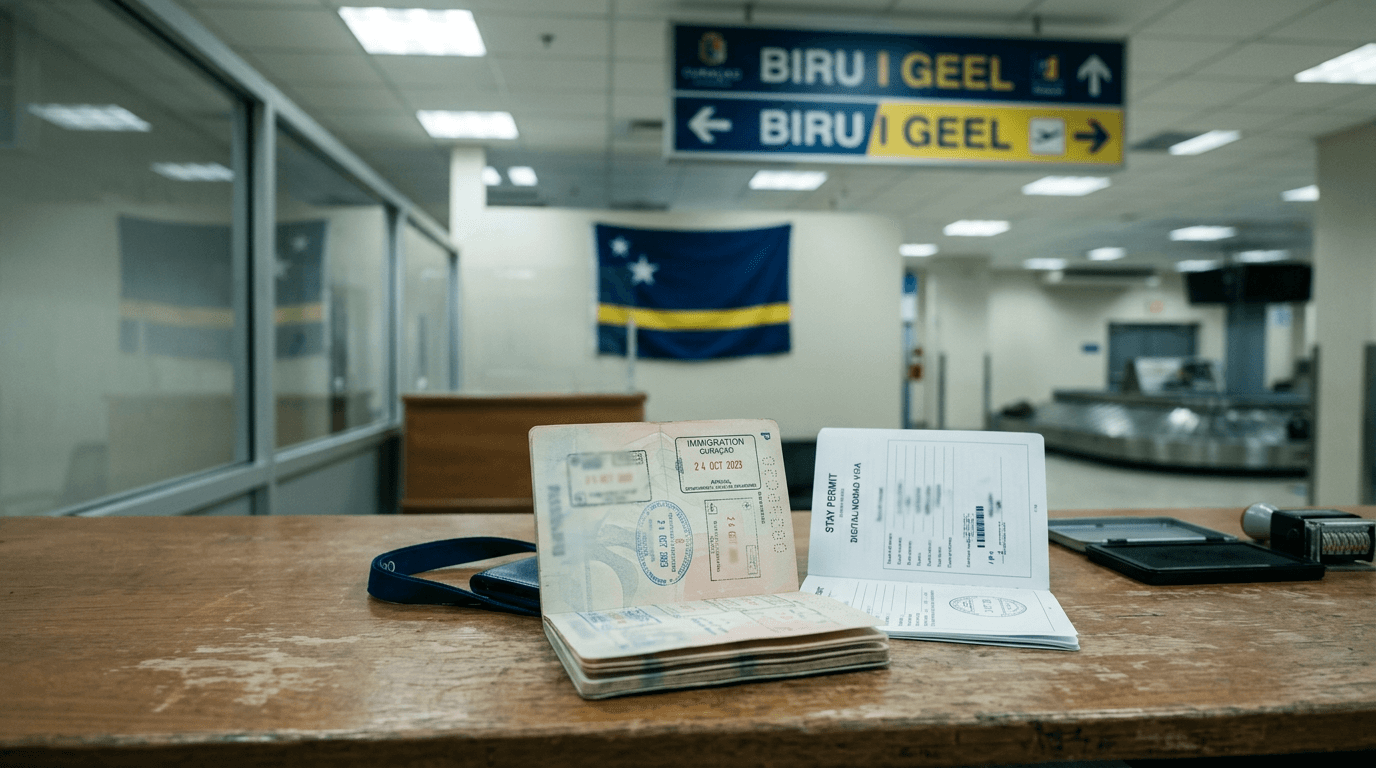
Curaçao

Policy Stability
Stamped Nomad ExclusiveHow likely visa and immigration policies are to remain unchanged
Quick Facts
$294
$150/mo
12 months
Yes
$2,500/mo
100 Mbps
5/10
Medium
Medium
High
AST
Entry Methods Available
Best For
Curaçao uses the Kingdom of the Netherlands’ Caribbean visa system, so you usually won’t need a visa for a short tourist or business trip. If your nationality isn’t on the visa-free list, you’ll need a short-stay Caribbean visa before you fly and that’s handled through Dutch representations, not on the island itself.
The same visa covers Aruba, Curaçao, Sint Maarten and the Caribbean Netherlands. It’s a little clunky, honestly, because the rules depend on your passport, the length of your stay and whether you already hold certain Schengen, U.S., Canadian or U.K. permits.
How long you can stay
For most visitors, Curaçao allows a stay of up to 30 consecutive days per visit, with no more than 90 days in any 180-day period. Dutch and U.S. nationals get a longer runway, up to 180 consecutive days in any 365-day period.
If you need more time, don’t assume you can just keep staying. Extensions aren’t laid out cleanly on the official tourism pages, so you’d need to deal with Curaçao immigration directly and show whatever documents they ask for, often including proof of insurance.
Who needs a visa
Many nationalities don’t need one for short stays, including most EU and EEA passport holders, plus travelers from countries such as Canada, Australia, Japan, South Korea and Singapore. The official Curaçao list is long and it changes less often than people think, but you should still check it before booking anything nonrefundable.
Some nationalities do need a visa in advance. Curaçao’s own immigration guidance specifically mentions Cuba, Haiti and Venezuela and Venezuelan nationals have needed a visa for entry for years now.
- Visa-free short stays: Usually allowed for tourism and short business trips if your passport is on the exempt list.
- Short-stay Caribbean visa: Needed for visitors from non-exempt countries and it’s the same visa for tourism, business and family visits.
- Stay limit: Up to 90 days in 180 days across the Caribbean parts, with no more than 30 consecutive days on one island at a time.
- Longer stays: If you want to live or work in Curaçao, you’re looking at a residence permit, not a tourist visa.
Fees aren’t listed in one simple global chart. They’re tied to the country where you apply, so you’ll need to check the NetherlandsWorldwide page for your location or the visa center they link to. That part can be annoyingly indirect, but it’s the only reliable way to get the current amount.
Source 1 | Source 2
Curaçao does have a real digital nomad route and it’s called @HOME in Curaçao. It’s a temporary stay permit for remote workers, not a path to residence, so don’t expect it to turn into anything permanent by default.
The program is open to all nationalities. To qualify, you need to work location-independently for a foreign employer, a foreign company you own or partly own or foreign-based clients if you’re freelancing or consulting. The government doesn’t publish a fixed minimum income number, but you do need to show proof that you can support yourself. That part can feel a little vague, which is annoying, but that’s how the rules are written.
The permit gives you 6 months in Curaçao, with one possible 6-month extension. So the maximum stay under this route is 12 months. If you’re hoping to work for a local company, this isn’t the right visa. The whole point is that your income stays tied to work outside Curaçao.
Applying is pretty straightforward on paper, though the paperwork still takes some gathering. You’ll need a valid passport, proof of solvency such as an employer letter or contract, proof of fee payment and health or travel insurance. The application fee for remote workers is ANG 535 or about $294 and processing usually takes about 2 weeks.
- Apply online: The process runs through the government portal and can be submitted in Dutch, English or Spanish.
- Pay the fee: Upload proof of payment with your application.
- Enter legally: All travelers also need to complete the Digital Immigration Card before arrival.
- Wait for approval: The permit is issued for a temporary stay, not residency.
Tax-wise, the official guidance says you won’t be required to pay Curaçao income tax under @HOME. That’s a big selling point, but it doesn’t touch whatever tax rules still apply back home, so you’ll want to sort that out separately. You also can’t take a local job while you’re on this permit, though you can rent housing, buy groceries, hire local services and live normally on the island.
Some Dutch and American citizens can stay as tourists for up to 6 months and keep working remotely for foreign clients or employers. That’s a narrower option and if you want to stay longer or do anything local, you’ll need a different status. For most remote workers planning a longer stay, @HOME is the cleaner route.
Source 1 | Source 2
Tourist visa options
Curaçao doesn’t hand out tourist visas on arrival and there isn’t a separate e-visa for casual visitors. If your passport is on the visa-free list, you still need to complete the Digital Immigration Card before you fly, but that card is just an entry form, not a visa.
For most visitors, the system is pretty simple, if a little uneven. Many nationalities can enter visa-free, while others need a Caribbean visa arranged in advance through a Dutch representation or an approved visa center in their home country.
- Visa-free entry: Common for EU nationals, the U.K., U.S., Canada, Australia, New Zealand and many Latin American and Caribbean passports.
- Standard stay: Usually 30 consecutive days, with a maximum of 90 days in any 180-day period.
- Longer stay for Dutch and U.S. nationals: Up to 180 consecutive days in any 365-day period.
- Caribbean visa: Required for nationalities that don’t qualify for visa-free entry, including some travelers from Cuba, Haiti and Venezuela.
The Caribbean visa is the one to look for if you’re not exempt. It covers Curaçao and the other Caribbean parts of the Kingdom of the Netherlands and you’re expected to apply before travel, usually at least a month ahead. There’s no official tourist visa on arrival, so showing up and hoping for the best is a bad plan.
The DI Card can feel a bit annoying because it’s one more form to fill out before departure. Still, it’s mandatory and usually asked for during check-in or on arrival, so don’t leave it to the last minute while you’re juggling bags, boarding passes and a flaky airport Wi-Fi signal.
- Digital Immigration Card: Must be completed online before arrival, usually within 7 days of departure.
- Not a visa: It doesn't replace a visa if your nationality needs one.
- Extensions: Sometimes possible through local immigration, but approvals are case by case.
Stay limits can be confusing because different official pages phrase them differently, but the safest reading is that tourist entry is short term unless you get an extension. If you want to stay longer than your initial permission, deal directly with Curaçao immigration and get the answer in writing if you can. Border runs and overstay fines aren’t clearly spelled out on the main official pages, so don’t assume anything cheap or easy.
Source
Curaçao does have real long-term stay pathways, but the paperwork is the kind that can eat an afternoon and leave your printer sounding unhappy. The main options sit under the Immigration Service, which handles residence permits for retirees, investors, employees, self-employed applicants and family cases. There’s also a short-stay category for remote workers, though that’s not the same thing as a full residence permit.
Retiree and rentier permits
The cleanest long-term route for many foreigners is the rentier or retired permit. Rentiers live off assets, interest or investments, while retired applicants live on pension income. The government says first-time applications should be decided within 4 months, but you have to stay outside Curaçao until the decision comes through by email. Once approved, you book an appointment to collect the permit.
Renewals can be filed 4 months before expiry. If your status changes, say you stop working and switch into retirement, you’re supposed to report it within 6 weeks. Retirees can also ask about the “penshonado” tax arrangement through the Ministry of Finance, though that’s a separate tax issue, not an immigration shortcut.
Investor residence permits
Curaçao doesn’t market a “golden visa,” but the investor permit works much the same way. The official framework sits on the immigration site under the investor category and the related guidelines in the legislation section. The exact investment bands and qualifying assets are set out there and they can be tied to real estate, a business or approved securities.
Expect to show that the money is legitimate, that you can support yourself and any dependants and that you’ve got private health insurance valid on the island. A clean criminal record is usually part of the package too. Fees and guarantee deposits are listed in the same permit system, so don’t assume the headline investment amount is the only cash involved.
Short-stay remote work
Remote workers can apply under a short-stay category, often branded as a digital nomad option. It’s useful, but it’s not a long-term residence path in the same sense as the retiree or investor permits. The official page says you can work remotely for up to 6 months for a foreign employer or your own business outside Curaçao.
- Proof of funds: Employer letter, business registration or contracts.
- Passport: Valid for at least 6 months.
- Fee: NAF 535, paid through the specified bank process.
Other residence categories
There are also standard routes for employment, self-employment, family reunification and study or internship. If you’re planning a longer move, those categories matter more than the short-stay remote-work option. They all run through the same immigration system, so the forms, appointments and fee pages can get annoyingly repetitive fast.
Curacao isn’t cheap and the bill climbs fast once you add housing and a car. A solo digital nomad can usually plan on $1,400 to $2,000 a month for a lean setup, $2,000 to $3,000 for a comfortable life and $3,500 or more if you want a beachy address and easy wheels.
Typical monthly costs
- Rent: $650 to $900 in a budget setup, $900 to $1,500 for comfortable housing and $1,500 to $2,500 or more for premium stays.
- Food: $250 to $400 if you cook most days, $400 to $650 if you mix groceries and restaurants and $700 to $1,200 if you eat out a lot.
- Transport: $40 to $120 on buses and occasional taxis, $150 to $350 if you share or rent a car and $400 or more if you drive full-time.
- Coworking: $50 to $150 for basic access, $150 to $300 for a more regular setup and $300 to $500 or more for a permanent desk.
- Health insurance: $60 to $150 for basic planning, $150 to $300 for stronger coverage and $300 to $700 or more for pricier policies.
For a one-bedroom in Willemstad, current pricing puts the city-centre average at about $782 to $1,317 a month, while places outside the center run around $627 to $1,022. In real nomad terms, Punda, Otrobanda and Scharloo are the practical picks, Pietermaai sits a little higher on price and Jan Thiel usually costs the most.
Food prices bite because so much gets imported. A simple restaurant meal is around $27 and a mid-range dinner for two can land near $140. Groceries are easier to control, but even basics like milk, eggs, chicken, bread and rice feel pricier than they should after a few weeks.
What that means in practice
- Budget lifestyle: Stay in a modest apartment, cook most meals, use buses when you can and keep coworking light.
- Comfortable lifestyle: Pay more for a better flat, mix in taxis or a shared car and use coworking regularly.
- Premium lifestyle: Pick a furnished place in a beach area, rent a car full-time and stop thinking too hard about restaurant tabs.
Transport is where Curaçao can get annoying. Buses are cheap, around $3 one way, but they’re limited and not built for spontaneous plans. A car makes life easier, though parking, fuel and rental fees add up fast, especially if you’re commuting to cafés, coworking spots and the beach.
For most nomads, the smartest base is still Willemstad, especially Punda, Otrobanda, Pietermaai and Scharloo. Jan Thiel is nicer if you want sand nearby and don’t mind paying for the convenience. It’s a tradeoff and on Curaçao that tradeoff shows up on your bank statement pretty quickly.
Curaçao’s best nomad bases are clustered around Willemstad, with Jan Thiel and Mambo, Seaquarium Beach as the main spillover spots. Once you move much farther out, choices get thin fast. The island isn’t huge, so the real decision is less about “which city” and more about which neighborhood fits your work rhythm.
Willemstad core
- Best for: first-time nomads, nightlife, coworking and walking around town
- Pros: Best concentration of coworking spaces, including Workspot Curaçao in Scharloo and Curaçao Coworking in Pietermaai. Internet is usually solid in apartments and hotels and the café scene is the strongest on the island. Evenings feel lively, with music drifting out of bars and restaurants in Pietermaai and downtown.
- Cons: Prices vary a lot and the busiest streets can feel noisy and a little chaotic. Café Wi-Fi can be weak, so don’t assume you can camp out with a laptop and get serious work done everywhere.
Jan Thiel
- Best for: beach-loving nomads, villa stays and a quieter routine
- Pros: Upscale, tidy and generally very safe-feeling. Resorts and villas usually have decent internet and there’s a polished beach-club scene if you want to work with sand under your feet and a breeze off the water.
- Cons: It’s pricier than most parts of Willemstad and the work scene is thin. You’ll also pay for the beach lifestyle, sometimes literally, every time you want a chair, a drink or a decent lunch.
Mambo and Seaquarium Beach
- Best for: people who want beach life plus late-night options
- Pros: Busy, convenient and easy to enjoy. Beach bars, restaurants and hotels give you plenty of places to sit with a coffee or an afternoon drink and there’s more nightlife here than in most residential areas.
- Cons: It’s touristy and can feel a bit manufactured. Beach club spending adds up quickly and some laptop-friendly spots are more about lounging than deep work.
Residential areas around Willemstad
- Best for: longer stays and lower rent
- Pros: Better value, calmer streets and decent internet in many apartments. You can still commute into town for coworking, dinners and social life.
- Cons: Less of a built-in nomad crowd, fewer work cafés and more dependency on your own setup.
Far-west beaches like Kokomo, Cas Abao and Westpunt are beautiful, but they’re better for day trips than basecamp. The water’s clear, the air smells salty and the pace slows down, though the internet can be patchy and the social scene is thin. If work matters most, stay near Willemstad.
Curaçao is workable for digital nomads, but it’s not the sort of place where you can assume every coffee shop has flawless Wi-Fi and every phone signal holds steady. In Willemstad and other built-up areas, fixed internet is usually decent, especially in modern apartments, hotels and coworking spaces. Out in smaller villages or older buildings, speeds can drop and the occasional outage is just part of life.
Most long-stay rentals and city businesses run on Flow’s cable network or growing fiber lines and that’s where you’ll usually get the best results. In practical terms, that often means tens to low-hundreds of Mbps in central and western neighborhoods. Flow’s coax service is generally solid too, while Digicel’s fiber options go higher, with home and office plans reaching 500 Mbps down and 150 Mbps up.
Coworking spaces
The coworking scene is small, but it does the job. Most of the better options sit in Willemstad, so you won’t be hunting around the island for a proper desk, AC and stable Wi-Fi.
- Curaçao Coworking, Pietermaai: Central, social and handy if you want restaurants and nightlife nearby.
- coWorld, Otrobanda: More office-like, with private rooms, meeting space and steady internet.
- Workspot Curaçao, Scharloo: A long-running option with flex desks, dedicated desks and stable Wi-Fi.
- CITI Coworking: Flexible workspace geared toward freelancers and startups.
Pricing can be a bit slippery because some spaces don’t post current rates publicly. coWorld’s memberships start around $50 per month for limited use and run to about $450 for a permanent desk, while private offices can climb past $1,000. If you’re staying longer, ask directly about multi-month rates. You may get a better deal.
Café Wi-Fi and mobile data
Café Wi-Fi is fine for email and light browsing, but it’s rarely exciting. Many places do have password-protected internet, though speeds can crawl under 5 Mbps, especially when the room is full and the espresso machine is hissing in the background. For video calls or uploads, I wouldn’t rely on a café.
Mobile data is useful as a backup. Digicel and Flow both offer prepaid and tourist SIMs at the airport and in town, with local bundles usually cheaper than tourist packs. Expect to pay roughly $14 to $30 for small prepaid plans, while airport tourist options can run closer to $30 to $50. If you want to skip the SIM shop altogether, international eSIMs are available too, usually starting around $9 for 1 GB.
The short version: Curaçao works, but bring a backup. A good apartment connection plus a local SIM is the safest setup if you actually need to stay online.
Curaçao has decent basic healthcare, but the experience changes fast depending on whether you’re in the public system or paying privately. For most expats and digital nomads, private care backed by international insurance is the cleaner option. The public system can work, but it’s not built for speed.
Public and private care
The island’s Basic Health Insurance system, called BVZ, covers residents and people with residence permits for GP visits, hospital care, medicines and some specialist services. In practice, you’re usually registered with one family doctor first and that gatekeeper step can slow things down. Specialist waits can be annoyingly long.
Private care is where Curaçao tends to shine. Clinics are modern, many doctors speak English and appointments are usually quicker and more personal. It’s still cheaper than care in many Western countries, but it’s not cheap enough to ignore insurance.
Who can use what
If you’re on a tourist or short-stay status, don’t assume you can tap into BVZ. Most non-residents can’t, which means you’ll need private or international health insurance from day one. People who later qualify for residency don’t always get public coverage right away, so a private plan can bridge the gap while paperwork is still moving.
For Americans, there’s an extra catch, Curaçao doesn’t accept U.S. domestic health insurance. A travel medical or expat plan is the practical answer and you’ll want one that covers evacuation, not just a basic clinic visit.
Hospitals, clinics and pharmacies
The main hospital is Curaçao Medical Center in Willemstad, a modern facility with 24/7 emergency care. Other options include Taams Clinic and the Antillean Adventist Hospital, plus private clinics such as Medwork that often give faster access to specialists.
Pharmacies or botikas, are easy to find in town areas and usually well stocked. BENU locations tend to keep standard daytime hours and the island-wide Botika di Servicio network has rotating night duty, so you can still get medication after hours if you know which one is open. Hotels usually know.
- Emergency evacuation: If you need specialty treatment that can’t be done locally, you may be flown to the U.S. or Latin America. That’s expensive and the bill can hit $15,000 to $25,000.
- Insurance coverage: Long-term nomads often use international plans from providers like Cigna Global, Allianz Care or SafetyWing, since they’re designed for multi-country living.
- Medication access: Common painkillers, travel meds and mosquito repellent are easy to find, though brand names may differ from home.
Private clinics usually won’t post prices, so ask for an estimate before non-urgent care. If you want peace of mind on the island, get insurance that covers private treatment and evacuation. That’s the setup that keeps a bad day from turning into a financial mess.
Curaçao’s banking setup is workable, but it isn’t quick or especially friendly to newcomers. Foreigners can open personal and business accounts, yet the process usually means more paperwork, at least one in-person visit and a wait that can stretch into weeks.
Can foreigners open accounts?
Yes, non-residents can open accounts in Curaçao, including business accounts. The catch is that banks have tightened onboarding, so don’t expect the kind of fast online signup you might be used to from fintech apps.
Some banks also want a clear local tie, like residency papers, a mortgage or a business setup. Requirements can shift without much notice, so it’s smart to check with the specific bank before you book a trip around account opening.
What you’ll usually need
- Passport: valid and unexpired.
- Proof of address: a utility bill or official extract from home.
- Income proof: pay slips, tax records or bank statements.
- Bank reference: sometimes requested for non-residents.
Plan to show up in person at least once. In practice, that’s the annoying part, because even after you hand over the documents, card issuance and full account access can still take 2 to 4 weeks or more.
Currency, cards and ATMs
Curaçao uses the Netherlands Antillean guilder, usually written as ANG and it’s pegged to the U.S. dollar. Cards are widely accepted in shops, restaurants and hotels, though cash still matters for taxis, smaller spots and random purchases that smell faintly of sunscreen and cigarette smoke at the beach kiosk.
ATMs mostly dispense ANG and some also give out U.S. dollars. Local bank machines from RBC Royal Bank and Maduro & Curiel’s Bank are common and one of the airport ATMs is an MCB machine.
Wise, Revolut and everyday spending
For most digital nomads, Wise or Revolut plus ATM withdrawals is the least painful setup. Travelers report that Revolut works fine in Curaçao, especially if you spend from a U.S. dollar balance, which avoids extra conversion steps.
ATM fees can sting. One local report put an RBC withdrawal fee around $6, on top of whatever your own card provider charges, so making fewer, larger withdrawals usually makes more sense than pulling out small amounts every couple of days.
Crypto rules
Crypto isn’t everyday money here. Curaçao is tightening rules for virtual asset service providers, with licensing, AML checks and tighter oversight, especially in gaming-linked businesses.
For regular travelers, that means you can hold and use crypto privately, but don’t expect shops to treat it like cash. If you deal with a local exchange or gambling operator, expect full KYC and paperwork, because the days of loose, informal crypto use are fading fast.
Curaçao can work for families, but it’s not a plug-and-play move. Residency paperwork gets tied to each dependent and you’ll need to show enough income for every spouse, child or parent you want to bring. First applications can take up to 4 months, so don’t leave this until the last minute if school starts soon or your lease abroad is ending.
There’s also a separate family-formation route that’s applied for per person. That process expects proof of adequate funds and housing already lined up, which is the kind of detail that turns a move into a paperwork grind fast. A 6-month residence permit fee is listed at 535 XCG, so budget for both the fees and the admin headaches.
Schools and childcare
The main international-school option is the International School of Curaçao, a private school that serves early years through grade 12. It’s a real advantage if you want an English-language curriculum, but the pricing isn’t exactly transparent on the public fee page, which is annoying for planning. Older U.S. government figures put annual tuition at US$7,831 for K-4, US$13,901 for K-5 through grade 5 and US$17,452 for grades 6-12, so treat those as rough reference points only.
Childcare is harder to pin down. I couldn’t find a reliable island-wide average and local prices will likely swing a lot depending on age, hours and whether you use a private caregiver, informal care or school-linked care. If your child is under school age, you’ll need to collect quotes directly, because guessing here could leave you short on cash by a lot.
Healthcare for children
Residents can access BVZ, Curaçao’s public health insurance system, through the Social Insurance Bank. It covers general practitioner visits, specialist care by referral, hospital treatment, some dental care for children under 18 and maternity care. That’s helpful, but it’s still a public system on a small island, so don’t assume everything will feel smooth and immediate.
For families staying long term, residency status matters because visitors and some non-residents may need private or international insurance instead. Medical care is generally decent, but serious cases may need evacuation, which is a sobering detail if you’ve got a child with ongoing health needs.
Where families tend to live
Curaçao’s tourism board describes the island as safe, easy to get around and suitable for families. Short driving distances help, especially if you’re trying to juggle school drop-off, groceries and clinic visits without spending half the day in the car. Most practical family housing tends to cluster around Willemstad and nearby suburban or coastal areas, mainly because that’s where the services are.
Safety and day-to-day reality
- Crime: Petty theft and car break-ins do happen, so keep bags, phones and documents out of sight.
- Beaches: Avoid unpopulated or unpatrolled beaches after dark, especially with kids.
- Water: The sea can be rough and rescue services may not match what you’re used to.
For families, Curaçao feels manageable rather than effortless. If you want straightforward school access, decent healthcare and a slower pace, it can fit. If you need lots of childcare options, deep medical backup or ultra-cheap housing, the island may frustrate you pretty quickly.
Curaçao is one of the easier Caribbean bases for digital nomads. Government travel advisories from the U.K., Canada and the U.S. all put it in the lowest risk tier and violent crime against visitors is uncommon. The trade-off is simple: stay alert, especially at night and don’t get lazy with your gear.
Petty theft is the main annoyance. Bags, phones and stuff left in parked cars get grabbed, especially near beaches, busy streets and the port area. Keep your laptop zipped away, don’t leave a backpack on a beach chair while you swim and lock your accommodation properly. If you’re out late, use a registered taxi instead of wandering back through quiet streets with a glowing phone in your hand.
Scams aren’t a huge problem, but a few boring ones do show up.
- Taxis and tours: agree the price first, especially near cruise terminals and tourist spots.
- Packages: never carry anything for strangers, even if they seem friendly.
- Cash deals: be wary of a boat trip or rental that’s weirdly cheap and wants full cash up front with no receipt.
Socially, Curaçao is fairly relaxed. It’s generally more LGBTQ-friendly than much of the Caribbean and the legal environment is shaped by Dutch norms. That said, public affection can still draw looks in more conservative pockets, so the island isn’t one long beach-club bubble. Around Willemstad and the main tourist zones, most people just mind their business.
Local etiquette is straightforward. Say hello when you walk into a small shop, ask before photographing people or private property and cover up outside the beach. Walking into a supermarket in swimwear reads as sloppy, not casual. Tipping 10% to 15% for good service is normal if it isn’t already included.
Language won’t trip up most nomads. Papiamentu, Dutch and English are widely used and Spanish is common too. A few words like “Bon dia” and “Danki” go a long way and people notice when you bother. It doesn’t have to be perfect. It just has to be human.
The remote-worker scene is real but still small. Curaçao’s official temporary-stay remote work program gives nomads a cleaner path to stay and most of the community clusters around Willemstad, beach districts and a handful of coworking spots and cafes. If you want a social life that isn’t just expats and transient visitors, you’ll need to show up consistently. One cafe, one class, one activity, same time every week.
For day-to-day safety, keep it boring: secure your apartment, don’t leave tech unattended in cafes, carry a copy of your passport and visa and avoid isolated places after dark. Curaçao feels easy, sunny and low-stress, but it’s not careless-friendly. Treat it like a small city with warm water and a softer edge, not a place where you can switch your brain off.
Tax residency rules
Curaçao doesn’t use a simple day-count test. Tax residency is based on where your life is actually centered, which means where you live, work, keep your partner or family and handle the practical stuff of daily life.
That can be annoying if you like certainty, because a long stay can tip into residency even if your visa still says “temporary.” A furnished apartment, local doctor, school enrollment or joining local associations can all matter.
What remote workers usually pay
Resident individuals are taxed on worldwide income. Non-residents are taxed only on Curaçao-source income, so a digital nomad earning from foreign clients, a foreign employer or an overseas company usually stays outside the local income tax net if they remain non-resident.
The tax system is progressive and the top personal rate is commonly cited in the mid-30% range. If you do become resident, don’t assume your foreign salary, freelance invoices or business profits are invisible just because the money lands in a non-Curaçao bank account.
How the digital-nomad visa fits in
Curaçao’s remote-worker visa is built for people with foreign income. In practice, that means you’re generally not supposed to work for a Curaçao employer and the local tax treatment is usually more favorable than for a full resident.
Still, the visa label isn’t magic. If you rent long term, move family members over and settle into island life, the tax authorities can look past the paperwork and ask where your real center of life is.
Double tax and foreign reporting
Curaçao has relief rules for double taxation and treaty coverage exists in some cases. If you’re taxed abroad first, you may be able to claim an exemption or credit, but the details depend on your home country and the type of income.
That’s where many nomads get tripped up. You can be non-resident in Curaçao and still owe tax somewhere else, especially if your home country taxes citizens, remote employees or business owners on worldwide income.
Crypto income
Crypto tax rules in Curaçao aren’t neatly spelled out, so the gray areas can be frustrating. General guidance suggests crypto gains may be treated as income or capital gains depending on the facts and resident taxpayers are expected to report taxable crypto activity.
If your trading, staking or business activity is run from abroad and you stay non-resident, the local risk is lower. If you settle here for real, keep clean records of every wallet move, exchange and disposal, because sloppy paperwork is where tax headaches start.
Practical tips
Get your phone sorted first. Curaçao doesn’t have Uber or Lyft, so a local SIM or eSIM saves you from hunting for Wi-Fi every time you need a ride, check a map or message a host. Digicel and Flow both sell prepaid SIMs and you can grab them at Hato Airport or in Willemstad without much drama.
Tourist plans usually run about 2 GB to 10 GB for roughly $10 to $30 a month. If your phone supports eSIM, that’s even easier, since you can land with data already working. Don’t expect café Wi-Fi to carry you all day, though. Some spots are fine, others are slow enough to make a video call feel like pulling teeth.
Use local transport apps instead of hoping for a rideshare that won’t show up. 24-7 Taxi Curaçao is the one most people lean on for regulated cabs and upfront pricing. Click Curaçao also covers taxis and some delivery services, which can be handy if you’re staying in town and don’t want to keep flagging cabs in the heat.
If you plan to move around much, rent a car. Buses exist and they’re cheap, but they’re not built for flexible remote-work hours. They’re fine for a slow day. They’re not fine when you’ve got a call at 2 p.m. and the nearest stop is baking in the sun.
Where to base yourself
- Willemstad: Best all-around base for cafés, taxis, bus routes and everyday errands. Punda, Otrobanda and Pietermaai are the main pockets to look at.
- Jan Thiel: Good if you want a beach-heavy stay with restaurants and resorts nearby, though prices are usually higher.
- Mambo Beach: Easy for nightlife, beach time and quick access to town.
- Blue Bay and Piscadera: Better for quieter stays, gated communities and easier car access.
For accommodation, Airbnb and Vrbo are the easiest places to start for 1 to 12 weeks. Filter hard for internet, then message the host and ask for a real speed check if you need stable video calls. Hotels are often a safer first-week choice because you can test the neighborhood before locking yourself into a month-long rental.
Food delivery is local, not slick. DushiFood, Bobdelivery and a few smaller services cover a lot of the island, but fees can be annoying, so most people use delivery for lazy nights rather than daily meals. For groceries, local supermarkets are usually the better bet. You’ll spend less and avoid waiting around for a bag of limp lettuce to show up.
Keep a few basics in mind. English is widely understood, but Dutch and Papiamentu come up often, especially in casual settings. Carry some cash for taxis and smaller shops and save local emergency numbers before you need them. The biggest mistake is assuming Curaçao works like a big city. It doesn’t. If you plan around that, the island feels a lot smoother.
More Guides from Caribbean
Stay Updated on Curaçao
Get notified about visa changes, policy updates, and new information for digital nomads in Curaçao.