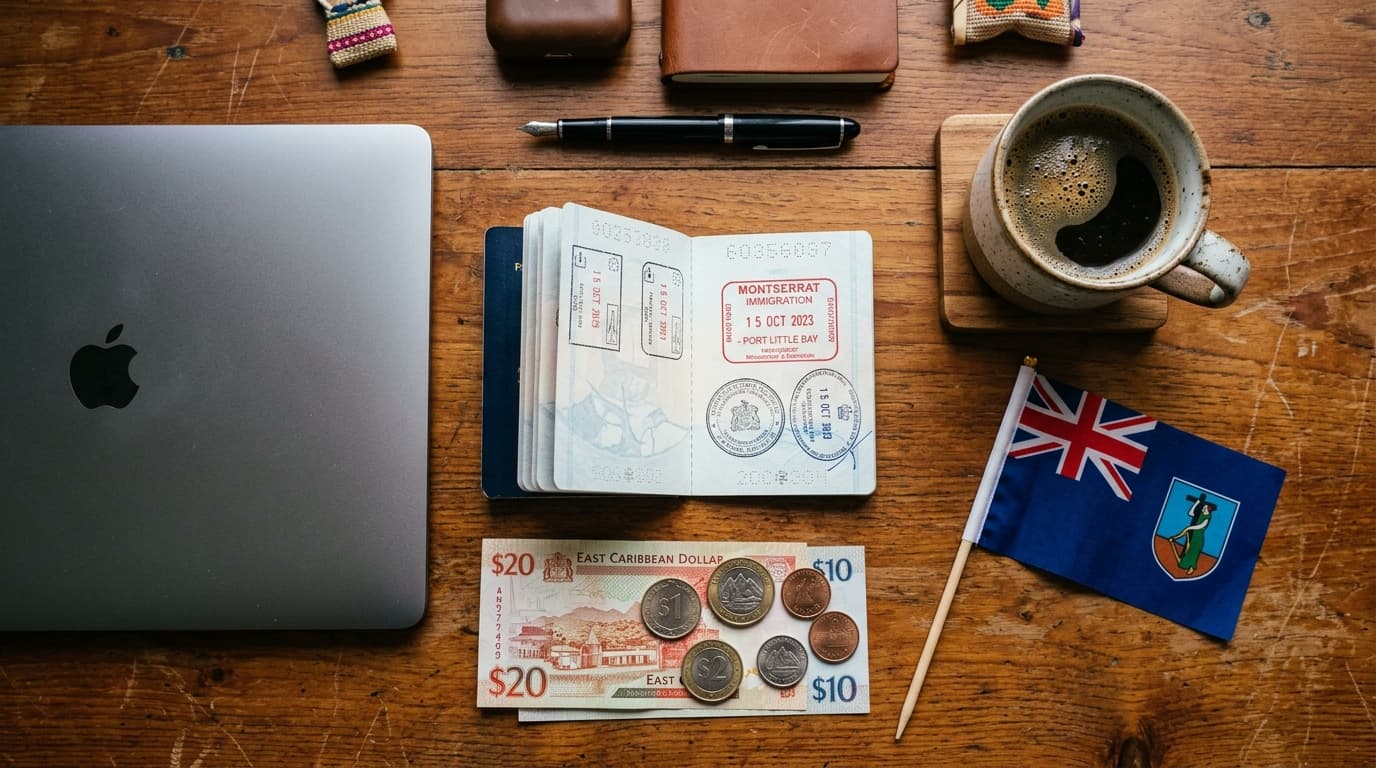
Montserrat

Policy Stability
Stamped Nomad ExclusiveHow likely visa and immigration policies are to remain unchanged
Quick Facts
$500
$5,833/mo
12 months
Yes
$2,500/mo
55 Mbps
9/10
Medium
Low
High
AST (UTC-4)
Entry Methods Available
Best For
Montserrat keeps the visa setup fairly simple, which is a relief if you’re trying to sort things out fast. The official system centers on one online eVisa for visitors and business travelers, while many nationalities can skip the application entirely if they’re on the visa-exempt list.
The government’s eVisa is a straightforward product: US$50, valid for 1 year and good for multiple entries. It’s usually processed within 24 hours or one working day, so you’re not stuck waiting around for long, staring at your inbox and refreshing email like a maniac.
What visa types Montserrat actually uses
- Visitor or tourist eVisa: Available online, valid for 1 year, multiple entry, US$50.
- Business eVisa: Also handled through the same online system, with the same fee and validity.
- Visa-free entry: Available for nationals on Montserrat’s visa-not-required list.
- Visa on arrival: Not shown as a standard option on the official portal.
That’s really the shape of it. The official portal doesn’t present a separate higher-fee business visa or a broad visa-on-arrival program, it points travelers to the online eVisa flow or the exemption list instead.
How the eVisa works
The government says the online visa is equivalent to a conventional visa, but the process happens digitally. You submit passport and credit card details, pay the fee and wait for approval, which is usually quick enough that it doesn’t derail short-term travel plans.
One useful detail is that the eVisa is the only visa available online right now. That keeps things simple, though it also means there isn’t much room for menu-style choices if you were expecting different visa categories for different kinds of trips.
What visa-free travelers should know
If your nationality appears on the visa-not-required list, you don’t need to apply in advance. The government confirms that this list exists, though the public pages I reviewed didn’t display the full nationality list in the text I could access.
So the safest move is to check the official immigration portal before you book anything nonrefundable. The rules are clear on paper, but if your passport sits near the edge of an exemption list, that little verification step can save you a pointless scramble at the airport.
Bottom line
- Best case: You’re visa-exempt and can enter without paperwork.
- Otherwise: Apply for the online eVisa.
- Expect: A 1-year, multiple-entry visa for visitors and business travelers.
- Pay: US$50, with no refund if your application doesn’t go the way you hoped.
For most digital nomads, Montserrat’s visa system is refreshingly low-drama. The catch is that you do need to check your nationality status first, because the difference between “no visa needed” and “fill out the online form” matters a lot once travel dates are fixed.
Source 1 | Source 2
Montserrat’s digital-nomad option is called the Montserrat Remote Work Stamp, sometimes described by officials as the 12-month Remote Workers Stamp. It’s a proper remote-work visa, not a casual long-stay stamp and it’s aimed at people who earn outside Montserrat and work online.
The headline requirement is blunt: you need at least $70,000 in annual income from outside the island. You also have to fit one of three buckets, employee of a foreign company, partner or shareholder in a foreign company or freelancer or consultant serving mostly clients based abroad. If your work depends on local clients, this isn’t the right permit.
The stamp is valid for 12 months. If you want to stay longer, you don’t extend it in some neat automatic way, you reapply. That means each year is a fresh paperwork cycle, with the same income and eligibility checks all over again.
- Single applicant fee: $500
- Family fee, up to 3 dependants: $750
- Each additional family member: $250
Those fees are nonrefundable, so if your application gets knocked back, the money’s gone. Families can apply under the same programme, which is helpful, but it also means more documents, more uploads and more chances for a missing file to slow everything down.
Expect the application to run through Montserrat’s government visa portal, with programme information also published by the government and OECS. The usual document stack includes a completed form, passport bio page, recent passport-style photo, proof of foreign employment or business registration, proof of income above $70,000 and valid health insurance that covers Montserrat. Some guidance also points to visa history where relevant.
Tax-wise, the government says Remote Work Stamp holders aren't liable for Montserrat income tax on their foreign-source earnings. That’s the big draw. Still, it doesn’t give you permission to work for local employers or build a business aimed at the Montserrat market, so don’t treat it like a backdoor work permit.
Health insurance isn’t optional and it needs to stay in force for the whole stay. A police check may come up in the paperwork, depending on what the portal asks for, so don’t assume the basic list is the full list. Check the current application form before you start, because missing one document can turn into a long, irritating delay.
If you don’t meet the income threshold, you’ll need to look at standard visitor entry rules instead. Those can work for short stays, but they’re not built for year-long remote work.
Source 1 | Source 2
Montserrat’s tourist entry rules are fairly simple, but they’re not especially generous if you’re trying to improvise at the last minute. Most visitors either don’t need a visa at all or need to sort out a cheap e-visa before they travel. There isn’t a classic visa-on-arrival setup here.
Visa-free entry
Montserrat publishes an official list of nationalities that can enter without a visa. That list is broad. It includes the United States, the United Kingdom, most EU and Schengen countries, Canada, Australia, New Zealand, many CARICOM states and a long roster of others, including India, Pakistan, Nigeria, South Africa, Brazil, Argentina and Japan.
If your country is on that list, you can usually travel as a visitor without applying in advance. The catch is that the immigration officer still decides how long you get to stay.
- Typical maximum stay: Up to 180 days or about 6 months, though you may be granted less on arrival.
- Initial entry: Often 1 to 3 months for casual tourists, with the option to ask for more time.
- Reality check: 6 months is a ceiling, not a promise.
E-visa for non-exempt travelers
If your nationality isn’t on the visa-exempt list, you’ll need an e-visa before you travel. Montserrat’s system is online and it’s meant to be quick. The official guidance says most applications are decided within about 24 hours, although extra checks can slow things down.
The fee is $50, paid online by credit card and it’s non-refundable. That stings a bit if you get tripped up by missing paperwork, so don’t rush the form. The e-visa works like a normal visa, just without a passport sticker.
- Who can apply: Visitors and business travelers with a valid passport.
- Validity: Usually multiple entries for one year from issue.
- Stay limit: Commonly up to 3 months per visit, with a 3-month total cap in a 12-month period.
Extensions, border runs and overstay risk
Extensions are handled in Montserrat, not on some magical online dashboard. If you want to stay longer than your stamp allows, you need to speak to the Immigration Department before your permission expires. The chief immigration officer has broad discretion and that’s exactly as open-ended as it sounds.
Expect to show funds, accommodation and an onward ticket if asked. Border runs don’t give you a guaranteed reset and overstaying is a bad idea because the rules are enforced at the officer’s discretion. If your trip is going to run long, check the current process with Immigration in Brades before you assume anything.
Source
Montserrat doesn’t have a shiny golden visa or a formal retirement visa. Long-term stays usually run through standard residence permits, permanent residence or the economic residence route, which is the closest thing to an investment-based option.
The plainest route is the Resident Permit. The government’s immigration guide says this permit is for non-nationals who own property in Montserrat, so if you’re renting long-term, that alone doesn’t get you there. The online application fee is listed at $50 per applicant, family members included and applications go through the Immigration Department in Brades.
- Best fit: Property owners who want a longer stay
- Where to apply: Immigration Department, Government Headquarters, Brades
- Contact: +1-664-491-2555
Permanent residence is a separate status, governed by the Immigration (Permanent Residence Permits) Regulations 2005. The government directs applicants to its guidance notes and leaflet, which is a bit annoying because the headline page doesn’t spell out the full test. That means you’ll likely need to ask for the paperwork before you can tell if you qualify.
The economic residence permit is the closest thing Montserrat has to an investor route. It’s still a residence permit, not citizenship and it sits under the Immigration (Economic Residence Permit) Regulations. The official page points applicants to the economic residence guidance notes and the statutory rules, which is where the real thresholds live.
- Status: Residence, not citizenship
- Legal basis: Immigration (Economic Residence Permit) Regulations, Section 39
- Next step: Request the guidance notes from consular@gov.ms
There’s no official digital nomad visa either. Remote workers and freelancers usually end up in visitor status for short stays or in one of the residence categories if they own property or meet the economic or permanent residence rules. If you’re living off foreign income, don’t assume that makes the paperwork easy, because it often doesn’t.
Retirees face the same reality. There’s no pensioner scheme with a neat label and a lower bar, so most people have to piece together a stay through property ownership, permanent residence or economic residence. Before you commit, get written confirmation on whether remote work, foreign pensions, health insurance and police clearance will be accepted for the permit you want.
Montserrat isn’t a bargain island. For a solo digital nomad, a realistic monthly budget usually lands between $1,700 and $3,800 and rent plus health insurance are the two numbers that move the fastest. The island is small, quiet and often lovely in a low-key way, but that calm comes with a price tag.
Typical monthly spend
- Rent: $450 to $700 for a basic 1BR, $700 to $1,300 for something comfortable and $1,300 to $2,500 for a premium villa or short-stay setup.
- Food and groceries: $350 to $500 if you cook a lot, $500 to $800 for a mixed routine and $800 to $1,200 if you’re eating out often or buying imported goods.
- Transport: $60 to $120 with buses and occasional taxis, $150 to $300 if you’re using taxis regularly and $350 to $700 if you rent a car most of the month.
- Coworking or work setup: usually $0 to $150, since most people work from home, a guesthouse or the occasional café.
- Health insurance: about $40 to $210, depending on the plan, with international coverage often required for nomad visas.
Housing is the biggest swing factor. In the west-coast nomad belt around Brades, Woodlands and Salem, a simple local-style apartment can feel perfectly fine, especially if you’re not fussy about finishes. But if you want good internet, air conditioning or a view, the price jumps fast. Monthly Airbnb-style rentals and villas can get expensive in a hurry.
Food costs aren’t wild, but they’re not low either. Cooking at home helps a lot, though imported items can feel pricey once you start checking labels and watching the shelves at the supermarket. Eating out is pleasant enough, but the bill can creep up if you treat it like a habit instead of a treat.
Transport is manageable because the island is tiny, yet it’s not always convenient. Minibuses are cheap, taxis are limited and renting a car makes life easier if you don’t want to wait around in the heat. You can hear the road noise, smell the sea air and diesel in the same afternoon, which is very much part of the deal.
How Montserrat compares
- Mexico City: cheaper overall, especially for rent and food.
- Lisbon: often similar or a little cheaper than Montserrat for basic living, but not by much once you factor in housing.
- Dubrovnik: usually pricier in peak season, especially for short-term stays.
Montserrat makes sense if you want a quiet Caribbean base and don’t mind paying for it. It’s not for budget hunters. It’s for people who’d rather trade city noise for sea breeze, slower days and a smaller, more expensive bill.
Montserrat is too small and too rural for a real city-by-city split, so the practical choice is among villages and coastal pockets. The best bases for nomads are Brades and St. John’s, Little Bay, Salem, Olveston and St. Peter’s, plus Isles Bay. Each one feels different once you’re actually living there, especially when the evening breeze dies down and the island gets very quiet.
Brades and St. John’s
- Best for: Admin, errands and the most practical day-to-day base
- Internet: Usually the best shot at solid fixed-line service and faster help if something breaks
- Cost: Midrange for the island, with apartments and small houses around the standard local rent level
- Community: Busy by Montserrat standards, with offices, shops and a steady local rhythm
- Nightlife: Low-key, more bars and restaurants than anything resembling a scene
This is the island’s working center, so it’s the sensible pick if you care more about getting things done than about a sea view. You’ll find cafes such as Oriole Café and other daytime spots where the coffee’s decent enough, the chairs aren’t great and nobody expects you to linger forever. It’s functional, not pretty.
Little Bay
- Best for: Beachfront living and easy socializing
- Internet: Fine for email and calls, but you’ll still want good home internet for heavy work
- Cost: Higher than most of the island, especially for beachfront rentals
- Community: The most social spot, with locals, expats and passing visitors mixing in the same few places
- Nightlife: The strongest on Montserrat, though it’s still beach bars, live music and casual drinks
Little Bay has the best after-work energy on the island. You get sand, salt air and a few places within walking distance, which matters when you’re tired of driving the same narrow roads. It’s the obvious choice if you want to hear music, smell grilled fish and not spend every evening alone.
Salem, Olveston and Isles Bay
- Best for: Quieter stays with a more residential feel
- Internet: Depends heavily on the property, so check speeds before booking
- Cost: Often better value than the beachfront hot spots
- Community: Smaller and more spread out, with less foot traffic
- Nightlife: Limited, so you’ll usually drive out for dinner or drinks
Salem works if you want a calmer base and don’t mind being a short drive from the action. Olveston and St. Peter’s feel residential and tucked away, while Isles Bay can be a good fit if you want a quieter coastal setup and don’t need much happening outside your door. None of them are lively and that’s the point.
Montserrat’s internet is good enough for remote work, but it’s not the kind of place where you can stop thinking about backups. Fixed broadband can land in the 50 to 60 Mbps range where modern service is installed, though some rental homes still feel closer to the island’s older, slower baseline. Mobile data is widespread, but it often runs on 3G or modest 4G, so don’t expect silky video calls everywhere.
There aren’t any true coworking spaces on Montserrat yet. That means most nomads end up working from their rental, then ducking into a cafe or bar in Brades or Little Bay for a change of scene. It can work fine for email and lighter tasks, but a loud fan, clinking cutlery and the smell of frying food aren't the best backdrop for a long meeting.
What to expect online
- Fixed broadband: Often around 50 to 60 Mbps on newer service, though some places are slower.
- Mobile data: Widely available, but speeds can be uneven and coverage isn’t perfect.
- Starlink: Now available and a strong option if you need steadier internet or live farther out.
- Coworking: None, so your rental is likely your main office.
Starlink changes the picture quite a bit. If your host already has it, that’s a major plus. If not, it’s still worth asking about, especially if you’re staying outside the busier north or you need a dependable line for calls, uploads and cloud work.
For cafes and public Wi-Fi, test before you trust. A place can look fine on the surface, with cold air, a decent table and a view of the harbor, then fall apart the minute everyone logs in around lunch. Bring a speed-test app and a local SIM so you can tether if the connection starts to wobble.
SIMs and mobile data
- Main operators: Flow and Digicel.
- Prepaid SIMs: Usually about $5 to $10.
- Monthly data spend: Roughly $20 to $30 for a practical package.
- Where to buy: Airport, operator shops and local resellers with your passport.
Flow’s postpaid plans are easier to predict if you’re staying a while, with larger data bundles that start around 110 XCD, about $40. Digicel pushes prepaid bundles with local calls included, which can be handy if you’re still sorting out housing and don’t want a monthly bill hanging over you.
The setup that makes the most sense is simple. Rent a place with decent fixed internet, keep a local SIM active and treat Starlink as the upgrade or backup if you need it. That’s the difference between a workable island work life and a morning spent staring at a frozen call screen while the trade winds rattle the shutters.
Montserrat’s health system is fine for everyday stuff, but it’s small and that’s the reality you’re dealing with. For a fever, a cut, a basic checkup or a minor emergency, the island’s public clinics and hospital can handle it. For anything serious, especially specialist care, you’ll likely be sent off-island.
The main hospital is Glendon Hospital in St. John’s and it runs 24-hour casualty services with nurses on duty around the clock and a doctor on call after hours. There are also four district health centres for routine care, so don’t expect a deep private-medical market like you’d find on a bigger Caribbean island. The setup is practical, not fancy.
Public care is the backbone of the system and most expats end up using it for regular treatment. Private options are limited and what passes for private care often still means seeing the same local doctors outside the public queue. If you need advanced imaging, oncology, complex surgery or a specialist consult, that usually means a referral to Antigua or another nearby island.
Emergency access is straightforward. Call 911 or 999 for ambulance and emergency response and keep the hospital’s direct casualty number saved in your phone too. If the problem is life-threatening and beyond local capacity, evacuation by air is the normal route, which is exactly why insurance with medical evacuation cover matters here.
- Pharmacies: The two main options are the hospital pharmacy and Lee’s Pharmacy in Brades.
- Medication supply: Common drugs are available, but shortages do happen, so bring any prescription meds you can’t miss.
- Over-the-counter items: Basic pain relief and common remedies are usually there, though brand choice is narrow.
- Pharmacy service: The public system does have qualified pharmacists, but it’s a small operation, not a big-city setup.
Costs are messy because Montserrat doesn’t publish a neat public price list for everything. Expect to pay up front in many cases, then claim back through insurance if your plan allows it. Routine visits are usually modest, but emergency care, scans, hospital stays and any off-island transfer can get expensive fast.
For digital nomads, the visa rules make the message plain: you need health insurance valid in Montserrat and it has to cover Covid-19. Don’t skim past that. A basic travel policy may not be enough if it excludes evacuation, outpatient care or treatment outside your home country. A solid international plan is the safer bet, especially if you’re staying more than a short visit.
Montserrat’s banking scene is small, old-school and a little slow-moving. Foreigners can open a basic account if they bring the right paperwork, but don’t expect a slick online onboarding flow. Most digital nomads end up using Wise or Revolut for day-to-day spending and then taking the occasional XCD cash withdrawal from a local ATM.
Can foreigners open a bank account?
Yes, it’s possible, but the process is conservative and usually drags. In practice, the main retail bank you’ll deal with is Bank of Montserrat Ltd in Brades and in-person visits are the norm. Even Montserratians living abroad can run into delays, so a non-resident foreigner should expect friction rather than speed.
What the bank usually asks for
- Minimum opening deposit: XCD 50 for a savings account.
- Photo ID: Two forms, usually a passport plus a driver’s licence, national ID or social security card.
- Proof of address: A recent utility bill, usually no older than 3 months.
- Proof of income: A job letter or two character references from professionals or bank customers if you’re not employed.
- Extra paperwork: Account opening forms and tax residency or FATCA declarations.
For a digital nomad, the safest packet is passport, a second ID, recent proof of address, a remote contract or employer letter and a reference from your main bank. That last one isn’t always listed up front, but it can save you a headache if the bank wants more comfort before opening the account.
What local banking actually looks like
Bank of Montserrat’s standard savings account comes with a passbook, 2% annual interest, free online banking and a free ATM card. You also get five free withdrawals a month, then you’re paying XCD 1 each time, plus a monthly maintenance fee of XCD 10. It’s not expensive in absolute terms, but the system feels dated and the paperwork can be annoyingly manual.
Montserrat uses the Eastern Caribbean dollar or XCD. Shops and ATMs operate in XCD and foreign Visa or Mastercard cards usually work where international cards are accepted, though your own bank or fintech will still tack on FX fees and ATMs may charge a local fee.
Best setup for most nomads
- Wise: Good for holding and converting major currencies, then paying or withdrawing locally.
- Revolut: Handy for card spending and ATM use up to your plan’s free limit.
- Local account: Useful only if you need rent payments, deposits or transfers in XCD.
For most people, Wise or Revolut plus cash withdrawals is the cleanest setup. If you do open a local account, expect SWIFT transfers to be possible, but confirm the details directly with the bank before sending anything.
Crypto sits in a gray but not openly hostile space. Montserrat doesn’t have a dedicated crypto law, though any serious business activity tied to digital assets would still face normal financial compliance and AML scrutiny. Personal holding is one thing, running a crypto business from the island is another.
Montserrat is small, quiet and genuinely safe by Caribbean standards, which makes family life easier than on a bigger island. The tradeoff is scale. If you want lots of private-school choice, specialist pediatric care or a long list of daycare options, you won’t find it here.
Visas and dependants
Families usually come in on a visitor visa, an eVisa or the Remote Worker Stamp. Montserrat doesn’t have a big menu of separate dependent visas, so spouses and children are typically attached to the main application. If your nationality needs a visa, each child needs their own application too and minors can’t be filed in isolation.
The Remote Worker Stamp is the cleanest fit for many nomad families. It allows a 12-month stay, accepts dependants and requires health insurance that covers Montserrat, including Covid-19. The family fee is higher than the single-applicant rate, but it’s still fairly straightforward compared with many Caribbean programs.
Schooling
Public schooling is free and follows the British model. Education is compulsory from roughly ages 4 or 5 through 16 and English is the language of instruction. For most resident families, that means the local public system is the default, not a backup plan.
There isn’t a real international-school market here. That’s the biggest education drawback. If your child needs a US, IB or UK private-school track with lots of classmates and specialist staff, Montserrat will feel limited fast. Some families patch things together with online curricula or homeschooling, but that takes planning and a decent internet connection, which isn’t always smooth on a small island.
Healthcare for children
Glendon Hospital is the main facility, with district health centres handling routine care, child clinics and basic paediatrics. For everyday issues, that’s usually enough. For anything complex, families often end up traveling off-island, which is never convenient when a child is sick and the ferry or flight schedule starts looking like a headache.
Resident children now get free healthcare at Glendon Hospital, regardless of nationality, if they can show the right residency paperwork. That’s a big plus for families staying longer term. Visitors and short-stay families should still budget for private costs and keep strong insurance in place.
Where families tend to live
- Little Bay: Newer, close to the port, beach and many services.
- Salem: Central and practical, with a mixed local and expat feel.
- Old Towne: Quieter and more residential.
- Woodlands: Green, calm and good for a slower pace.
- Cudjoe Head: Handy for getting around the island.
- Lookout: More affordable, with strong views and a developing feel.
Childcare is the weakest point. Formal daycare options are limited, so many parents rely on family networks, informal care or one parent working on a very flexible schedule. That can work, but it does make Montserrat better for self-sufficient families than for those who need polished services on demand.
Montserrat is one of the easier Caribbean islands to relax on. Crime is low, the community is small and English is the official language, so day-to-day life rarely feels complicated. That said, don’t get careless. Petty theft still happens, especially when people leave phones on a beach chair, cash in a rental car or a bag in plain sight.
The island’s safety reputation is strong for a reason. Survey data and travel guidance both place Montserrat near the top of the region for low crime and violent crime isn’t what foreign visitors usually run into. The real annoyances are the ordinary ones, like a door left unlocked, a purse left on a patio table or a shiny laptop visible through a car window.
- Basic precautions: Lock doors, use a safe for passports and electronics and don’t flash cash or expensive gear.
- At night: Skip deserted roads and isolated beaches after dark, especially if you’re alone.
- Transport: Use reputable taxis and agree on the fare first.
There aren’t many Montserrat-specific scams on record, which is nice, but the usual island habits still apply. Confirm prices before tours or rides, avoid handing over large cash deposits to people you haven’t vetted and be wary of friendly strangers pitching business deals, investments or “inside” opportunities. Small places can feel very social very quickly and that can be useful or awkward depending on what you’re being asked to buy.
LGBTQ+ travelers should expect a conservative setting. Same-sex activity is legal, but public affection isn’t widely accepted and the local scene is mostly private. Most people are tolerant in practice, yet discretion goes a long way here. Think quiet behavior in town, modest dress away from the beach and reading the room before being open about your personal life.
Culturally, Montserrat feels easygoing and close-knit. People are generally friendly, but courtesy matters. Say hello when you walk into a shop, keep your voice down in public and don’t be flippant about religion, local politics or the island’s volcanic past. The atmosphere can be calm and warm, with the sound of trade winds in the trees and church bells carrying across quiet streets, but it’s not a place for loud, flashy behavior.
English is used everywhere, from government offices to road signs, so communication is straightforward for most nomads. You’ll hear Montserrat Creole too and it can sound fast and musical, but locals usually shift into standard English without fuss. The digital nomad crowd is small, so don’t expect a buzzing expat scene. It’s more intimate than social-media-friendly, which is either a plus or a dealbreaker depending on how much quiet you can take.
Montserrat can be a tax-friendly place for remote workers, but only if you stay inside the rules. The island’s Remote Worker Stamp is the big draw. It lets you stay for up to 12 months, renew by reapplying and avoid Montserrat income tax on foreign remote income, as long as you’re working for clients or an employer outside Montserrat and not carrying on business there.
That last part matters. If you start taking on local clients, opening a local business or moving into ordinary employment on the island, you can fall out of the nomad regime and into normal tax rules, which are a lot less forgiving.
How Montserrat decides tax residency
Montserrat treats you as tax resident for a year of assessment if any of these apply: your permanent place of abode is on the island and you’re physically present for some part of the year, you spend at least 183 days there in the basic year or your presence straddles adjacent years in a way that meets the residency test. In plain English, a long enough stay can pull you into local tax residency even if your money comes from abroad.
- 183 days: The clearest trigger for residency.
- Permanent place of abode: A real home base on the island can matter even before you hit 183 days.
- Local work: Income tied to Montserrat can bring normal tax obligations into play.
If you’re on the Remote Worker Stamp and staying within its conditions, specialist guidance says you won’t pay Montserrat income tax on that remote income. That’s the whole appeal, really. But if you’re not on the stamp and you become resident, Montserrat’s domestic tax system applies and some sources describe progressive rates with social security contributions while others refer to simpler flat-rate treatment for certain income types. The rate chatter online is messy enough that you shouldn’t rely on a blog post and a lucky guess.
What this means with your home country
Montserrat doesn’t have a big network of tax treaties. There is a UK-linked double taxation arrangement, but most nomads shouldn’t assume treaty relief will sort everything out. The safer assumption is that your home country may still tax you on worldwide income, then let you claim foreign tax relief under its own rules if eligible.
Montserrat also has tax information exchange rules, so don’t count on secrecy. If your home tax authority has an exchange agreement, information can move. That’s boring on paper and annoying in real life, especially if you were hoping to keep the paperwork light.
The practical move is simple: keep records of where you were, who paid you and whether any income came from Montserrat sources. If your stay is long, your income is mixed or you’re thinking about local work, talk to a tax pro before the island breeze turns into a tax headache.
Montserrat is small, friendly and still pretty analog. You’ll get more done with taxis, word of mouth and WhatsApp than with flashy apps and that’s not a flaw so much as the reality of the island. Once you settle into that rhythm, it’s easy enough to work from.
Mobile data and SIM cards
Local SIMs are sold by FLOW and Digicel at John A. Osborne Airport, in their shops and through small retailers. Bring your passport, expect to pay about $5 to $10 for the SIM, then another $20 to $30 for a usable data bundle. Coverage is generally solid in the north, around Brades, St. John’s, Olveston and Woodlands, but it gets patchier near exclusion zones and out in the hills.
If your phone supports eSIM, buy one before you land. Several international providers sell Montserrat plans online, usually 1 to 5 GB with 7 to 30-day validity, so you can step off the plane already connected. That’s a lot less annoying than hunting around for a shop when you’ve just arrived and the airport is quiet.
Getting around
There isn’t a real ride-hail or transit-app scene here, so don’t count on anything slick. Taxis are the main option and there are only about 30 licensed ones on the island. They’re marked by green plates starting with “H” and most drivers are easier to reach by phone or WhatsApp than through an app.
Minibuses do run, but they’re irregular and best for loose schedules. Car rental is possible too, though the roads are steep, narrow and full of hairpin turns, with rough edges and limited signage. If you’re not comfortable driving a winding mountain road, skip the rental and lean on taxis.
Where to stay and shop
Most nomads base themselves in the north, away from the exclusion zone around Plymouth. St. John’s and Brades are the most practical if you want shops and services nearby. Olveston and Woodlands are quieter, with villas and apartments that suit longer stays, sea views and a slower pace.
Self-catering places are common and that matters because app-based food delivery basically isn’t a thing here. Some restaurants and groceries may deliver by phone or WhatsApp, but it’s informal and depends on the business. Ask your host what’s nearby, because being able to walk to a mini-mart or café makes daily life much smoother.
Language and day-to-day communication
English is the official language, so there’s no real language barrier for work or errands. You may hear Montserrat Creole in casual conversation, but you won’t need a translator for daily life.
WhatsApp is the app you’ll actually use, along with offline files if a storm slows the internet. The connection in the north is usually decent, though it can dip when weather rolls in. Keep your setup simple, save local numbers and don’t expect island life to behave like a big-city tech stack.
More Guides from Caribbean
Stay Updated on Montserrat
Get notified about visa changes, policy updates, and new information for digital nomads in Montserrat.