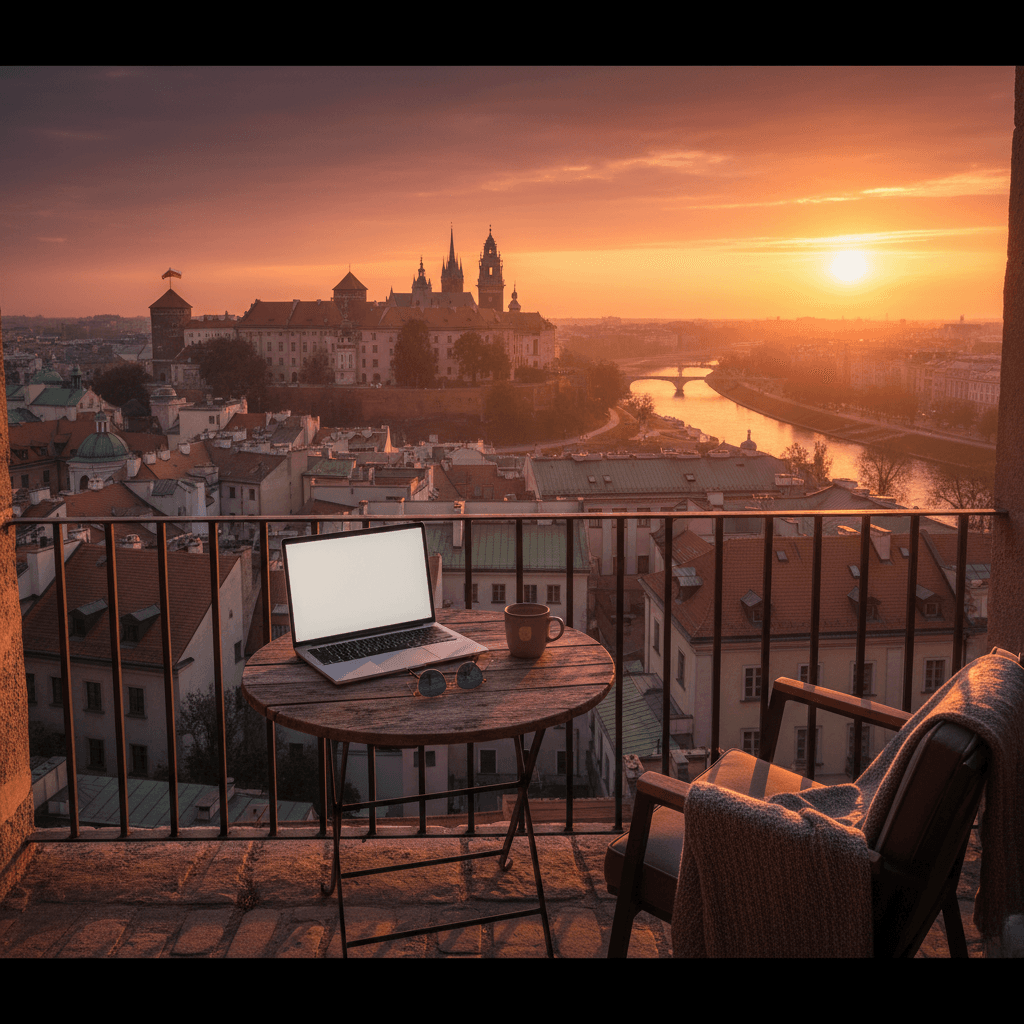
Poland

Policy Stability
Stamped Nomad ExclusiveHow likely visa and immigration policies are to remain unchanged
Quick Facts
No
$2,005/mo
215 Mbps
8/10
Medium
High
High
CET, CEST
Entry Methods Available
Best For
Last verified: October 1, 2026
Compare Visa Programs
| Program | Best for | Minimum income or savings | Government fee | Initial stay | Where to apply |
|---|---|---|---|---|---|
| Poland Business Harbour (Suspended) | Visa Program | Suspended since Jan. 26, 2024 | — | — | — |
Poland has no digital nomad visa. Remote workers choose between short Schengen stays and a residence permit tied to work, business or another purpose.
Choosing a route
- Short stays: visa-exempt nationals can spend up to 90 days in any 180-day period in Poland. That allowance is shared across all Schengen countries, not counted per country.
- A job in Poland: a national work visa on general terms, applied for at a Polish consulate, followed by a residence permit for a longer stay.
- Freelancers and founders: a temporary residence permit for business activity, issued by the voivodeship office. The Office for Foreigners sets out the permit types and their conditions.
- Anyone reading older advice: the Poland Business Harbour visa for IT workers has been suspended since Jan. 26, 2024 and is no longer a route in.
The EU's Entry/Exit System has registered short-stay visitors at external Schengen borders since Oct. 12, 2025, taking fingerprints and a facial image. On ETIAS, the travel authorization planned for visa-exempt visitors, the official position is this: Not yet operating and no official start date. The EU says it will announce the date several months before launch. The earlier official target, the last quarter of 2026, was removed from the official ETIAS website on July 14-17, 2026.
Poland uses the zloty (PLN). In Numbeo's crowd-sourced prices, a single person's monthly spending excluding rent was about PLN 3,310 to PLN 3,520 in the three biggest nomad cities. Rent sets them apart, and Warsaw is the most expensive.
| City | One-bedroom, outside the center | One-bedroom, center | Other monthly costs | Monthly total | Numbeo data |
|---|---|---|---|---|---|
| Warsaw | PLN 3,748 | PLN 4,655 | PLN 3,522 | PLN 7,270 to PLN 8,180 | Oct. 2026 |
| Kraków | PLN 2,847 | PLN 3,623 | PLN 3,370 | PLN 6,220 to PLN 6,990 | Sept. 2026 |
| Wrocław | PLN 2,588 | PLN 3,267 | PLN 3,311 | PLN 5,900 to PLN 6,580 | Sept. 2026 |
Each total adds the average one-bedroom rent, outside the center and in it, to Numbeo's estimate of other monthly costs. The figures are averages of user reports, not official statistics, and furnished short lets usually cost more.
At the Sept. 30, 2026 exchange rate, that is about US$1,890 to US$2,120 a month in Warsaw, US$1,610 to US$1,820 in Kraków and US$1,530 to US$1,710 in Wrocław for one remote worker renting a one-bedroom apartment.
- Warsaw: the capital and business hub, with the most flights, coworking spaces and international employers. It suits remote workers who want a big city and do not mind the highest rents in Poland.
- Kraków: a historic city with a large student and tech community and a busy social scene. It suits first-time visitors and those who want culture on the doorstep.
- Wrocław: a riverside city with a strong IT sector and the lowest costs of the three in Numbeo's data. It suits people who want a mid-sized city with good transport links.
- Gdańsk: the Baltic port city, next to Sopot and Gdynia. It suits those who want the coast and a quieter pace in summer.
Poland's fixed broadband is fast. In the Speedtest Global Index for August 2026, the median fixed download speed was 215 Mbps and the median mobile speed 109 Mbps.
Coworking is well developed in Warsaw, Kraków and Wrocław, with international chains and local spaces offering day passes, hot desks and private offices. Gdańsk and Poznań have a smaller but growing choice. Fiber is common in city apartments, and cafes in the larger cities are used to laptop workers.
Poland treats a person as tax resident with a center of personal or economic interests in the country, or after more than 183 days there in a tax year. A resident declares all income in Poland, wherever it was earned, under unlimited tax liability (Ministry of Finance).
Poland has no special tax regime for remote workers or digital nomads. Points to check:
- Days in the country: a long stay on Schengen days plus a residence permit can cross the day test within one tax year.
- Center of interests: a home, family or business in Poland can make someone resident even with fewer days.
- Tax treaties: a treaty between Poland and the home country can decide residence for people with ties to both.
- Business activity: freelancers with a Polish business registration should confirm their filing duties with the tax office.
- Arrival: Schengen entry rules apply, with EES registration for short-stay visitors. Days in other Schengen countries count toward the same 90-day allowance.
- Money: Poland uses the zloty, not the euro. Cards and contactless payments work almost everywhere in the cities.
- Phone: prepaid SIM cards and eSIMs from Polish operators are cheap and quick to set up.
- Health: public care is run by the National Health Fund for insured residents. Visitors and new arrivals rely on travel or private insurance, and private clinics are common in the big cities.
- Emergencies: 112 reaches police, fire and ambulance services free of charge, as everywhere in the EU.
- Paperwork: residence permit cases at voivodeship offices can take months, so filing early and keeping copies of every document avoids gaps in status.
Frequently asked questions
Does Poland have a digital nomad visa?
How long can visa-exempt visitors stay in Poland?
Is Poland Business Harbour still available?
When does a remote worker become tax resident in Poland?
Which Polish city is cheapest for remote workers?
Latest Nomad News
Nomads face 90 minute delays as 4 EU countries extend border checks through March
The European Commission’s Schengen border-control notifications updated on 18 August 2026 list temporary internal-border controls affecting several Central Europe and Balkan-facing routes, including Austria with the Czech Republic, Hungary, Slovakia and Slovenia; Germany with the Czech Republic and Poland; Italy with Slovenia and Spain; and Poland with Germany and Lithuania.[1] For travelers, expats, and digital nomads, this means checks may still occur at affected internal borders and crossing times can be longer, even inside Schengen.[1]
New requirements for Poland work authorization took effect Aug. 22
Starting Aug. 22, citizens of Georgia, Colombia and Venezuela staying in Poland under visa-free travel can no longer work solely on that basis. Affected foreign workers, contractors and expats must secure formal work visas to remain legally employed in the country. The rule change also applies to many individuals currently residing in Poland under visa-free status.
Poland temporary residence waits hit 12 months under stricter June 1 rules
Stricter labor and residency rules in Poland and Hungary have extended processing times for work permits and residency cards to nearly a year. The policy shift reduces permit availability and increases scrutiny for foreign professionals and expats seeking to relocate to these Central European hubs.
EU delays ETIAS enforcement for visa-exempt travelers until 2027
The European Union has pushed back the implementation of the ETIAS travel authorization system until at least 2027. Visa-exempt travelers to the Schengen Area can continue to enter without pre-authorization throughout 2026 as officials address operational concerns with the Entry/Exit System.
EU keeps 3 hour delay rule for passengers as new rights wait until 2027
The European Parliament approved updated EU-wide air passenger rights rules that tighten reimbursement and rerouting protections, add clearer pricing rules, and strengthen assistance for families and passengers with disabilities. If formally confirmed and published, the new rules would apply across EU member states after a 1-year preparation period, so travelers should watch for the final entry-into-force date.
More Guides from Europe
Stay Updated on Poland
Get notified about visa changes, policy updates, and new information for digital nomads in Poland.