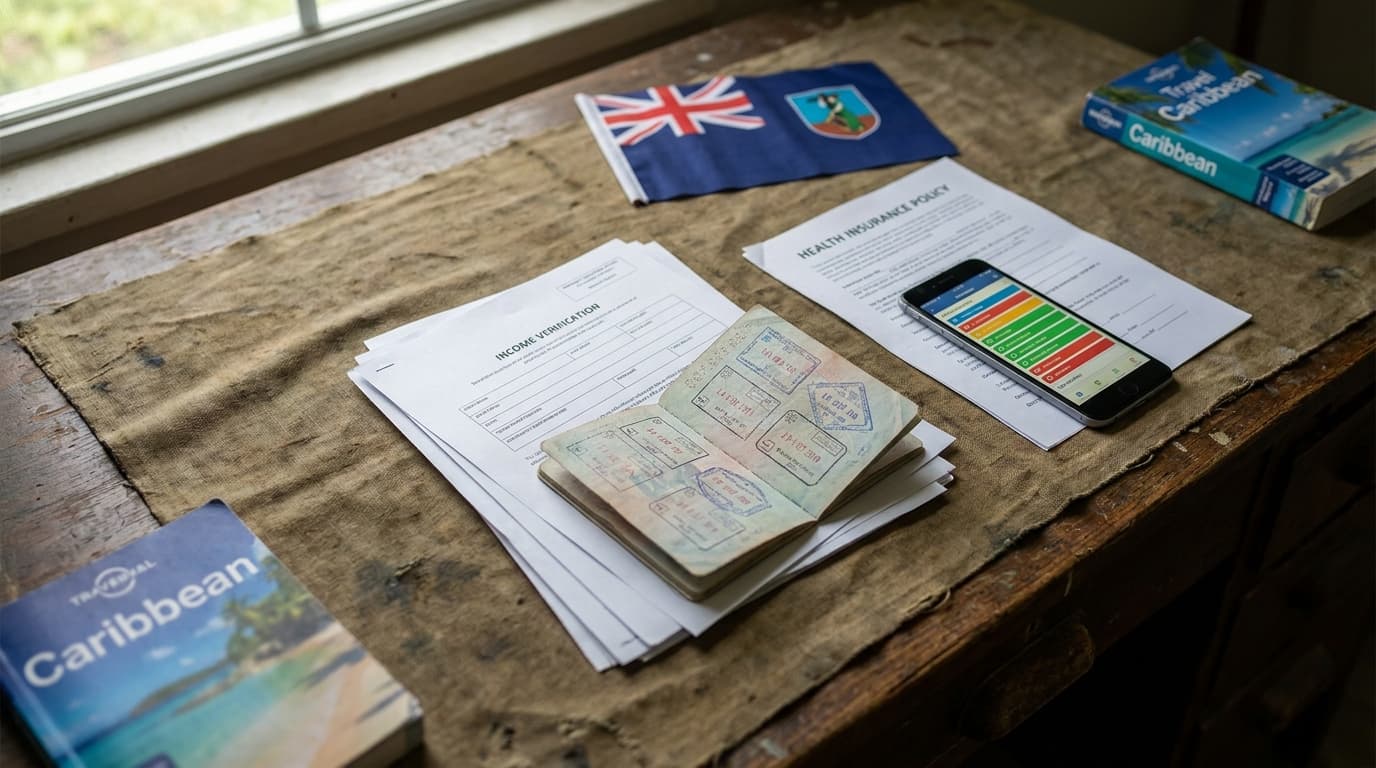
Montserrat Remote Worker Stamp

Visa Data Sheet
- $70,000 / yr
- $500 – $750
- 1.4 weeks
- 12 months
The Montserrat Remote Worker Stamp is a 12-month permit for foreign remote workers and their families who want to live on the island while working for employers or clients based outside Montserrat. It’s not a tourist stay and it comes with its own income, insurance and paperwork requirements.
Official material describes it as the Remote Worker Programme, the Remote Employment Stamp and a remote working visa. The core rules are still the same in the official sources I found, including the $70,000 minimum annual foreign income threshold and the rule that holders don’t pay Montserrat income tax on foreign-sourced income under this status.
Who it’s for
The stamp is aimed at professionals and entrepreneurs who can do their jobs online or through telecommunications technology. That includes employees of foreign companies, business partners or shareholders in foreign-registered companies and freelancers or consultants serving clients based outside Montserrat.
The government also says family applications are allowed, with one applicant plus up to three dependants on a family filing. It’s a practical option if you’re trying to relocate together, though the extra documentation can be a bit tedious.
What it gives you
- Stay length: 12 months per stamp, with the option to reapply if you want to stay longer.
- Work rights: You can keep working remotely for non-Montserrat employers or clients.
- Tax treatment: Foreign-sourced income isn’t subject to Montserrat income tax under this programme.
- Family coverage: Dependants can be included in the same application, subject to the programme rules.
How it compares with a visitor stay
This isn’t the same as entering as a tourist. A standard visitor stay is much shorter, doesn’t allow local work and usually comes with far fewer application steps. The Remote Worker Stamp is a pre-approved residence path, so you’ll need to show income, insurance, proof of work and other documents before you travel.
Government and tourism-linked materials say applications are usually reviewed and decided within about 7 working days. I didn’t find any newer official change to that timing or to the 12-month validity and basic eligibility rules.
Who qualifies
The Montserrat Remote Worker Stamp is aimed at people who can work from anywhere and earn their money outside Montserrat. The core test is pretty simple, but it isn’t loose: you need to be a professional or entrepreneur with location-independent work and your annual income must be at least $70,000 from outside the island.
Official materials don’t name any banned nationalities, so there’s no published list of countries that are excluded from the scheme. If you normally need a visa to enter or transit Montserrat, you’ll also need to show that paperwork where applicable.
To qualify, you must fit one of these work categories:
- Employed abroad: You work for an employer registered in a foreign country and have an employment contract.
- Business owner or partner: You do business for a company registered outside Montserrat and you’re a partner or shareholder.
- Freelancer or consultant: You provide services mainly to clients whose permanent establishments are in a foreign country and you have contracts with them.
The government says the job can be public sector, private sector or nonprofit, as long as it’s remote and handled through telecommunications. What it doesn’t allow is income that depends on working in Montserrat itself.
The money test is annual, not monthly. The official figure is $70,000, which the government also expresses as EC$189,000. There’s no separate monthly minimum in the public guidance, so any monthly amount you see elsewhere is just a rough conversion.
You’ll also need proof of income. The official checklist asks for proof that your annual income exceeds the threshold and comes from outside Montserrat, but it doesn’t give a fixed list of acceptable documents. In practice, expect to back that up with contracts, payslips, bank statements or similar records if asked.
Family applications are allowed too, but dependants need their own passports, photos and proof of relationship where relevant. The programme also requires valid health insurance for the full visa period, for the main applicant and any accompanying family members.
Montserrat’s Remote Worker Stamp asks for a fairly ordinary but still fussy set of documents, all submitted online through the official portal. The core requirements haven’t shown any clear official change since launch, so the list below reflects the latest government and regional publications available.
You’ll need to show that you work outside Montserrat and that your income clears the threshold. The official figure is $70,000 a year or ECD 189,000 and the government wants proof that this income comes from outside the island.
Documents the portal asks for
- Completed online application form
- Passport biographical data page for the main applicant and each dependent
- Recent passport-size photograph for the main applicant and each dependent
- Proof of employment or business, such as an employment contract, employer letter or business incorporation certificate
- Proof of annual income above the threshold
- Valid health insurance for the full stay, with coverage in Montserrat and COVID-19 cover
- Police record for the main applicant
- Proof of visas where applicable, if you need them to reach Montserrat
Family applications need a bit more paperwork. The portal also asks for proof of relationship for children under 18 and a school enrolment letter if a child is in online school. It’s not a tiny list and the insurance requirement is stricter than some remote worker schemes.
Fees and validity
- Single applicant: $500
- Family of up to 3 dependants: $750
- Additional family member: $250 each
Those fees are non-refundable and you pay online by card. The stamp is valid for 12 months and the official material says you may re-apply after that period rather than extend it in place.
The government doesn’t publish a firm processing-time guarantee on the main materials. Other official-adjacent guidance points to roughly 7 days, but that’s best treated as an estimate, not a promise. If you’re applying, make sure every file is ready before you start, because missing documents will slow things down fast.
The Montserrat Remote Worker Stamp has a simple fee structure, but it isn’t cheap. The legal fee is set in the Remote Employment Act 2020 and covers both the initial grant and renewal of the stamp.
- Individual applicant: XCD 1,350, about $500.
- Applicant with family members, up to 3 people: XCD 2,025, about $750.
- Additional family member: XCD 540 each, which the government communication rounds to about $250.
Those are the only government fees the law sets out. There’s no separate official processing charge or service fee in the legislation, though the government does treat the payment as a nonrefundable processing fee in practice.
Montserrat uses the Eastern Caribbean dollar, which is pegged to the U.S. dollar at 2.70 to 1. That’s why the official figures are often quoted as $500, $750 and $250 in government materials, even though the binding amounts are in XCD.
Payment is made online, typically by credit card, as part of the application. The fee is due when you apply and proof of payment has to go with the submission.
What you should budget for
- Solo remote worker: XCD 1,350 or about $500, for 12 months.
- Couple or small family: XCD 2,025 or about $750, for the main applicant plus up to 3 family members.
- Larger family: add XCD 540, about $250, for each extra family member.
Health insurance is a separate cost and the government requires proof of valid coverage for the full stamp period. It doesn’t publish a fixed premium, though, so you’ll need to price that with a private insurer. The same goes for translation help or legal advice, if you want it, those aren’t government-set charges and aren’t required by the official fee schedule.
If you’re trying to keep the budget tight, the stamp fee is predictable. The rest of the costs depend on your family size, your insurance quote and whether you hire outside help.
The Montserrat Remote Worker Stamp is handled online, not through an embassy or in-country office. You apply through the dedicated portal, upload your documents and pay the fee by credit card as part of the same process.
The basic requirements are straightforward, but the income bar is high. You need to show that you earn at least $70,000 a year from outside Montserrat and you also need valid health insurance for Montserrat, including COVID-19 coverage.
What you’ll need
- Completed online application form: This is the starting point for every application.
- Proof of work or business activity: An employment letter or contract for remote employees or a business incorporation certificate or ownership proof if you’re self-employed.
- Proof of income: Payslips, tax returns, bank statements or a signed employer confirmation that clearly show annual income above $70,000.
- Health insurance: Coverage for you and any dependants for the full stay in Montserrat.
- Passport copy and photo: A scan of the passport bio page and a recent passport-size photograph.
- Police certificate: A record showing good conduct.
- Dependant documents: Marriage or birth certificates, if you’re applying with family.
- Transit or other visa proof: Only if your travel route requires it.
Fees are non-refundable and must be paid during the application. A single applicant pays $500. A family application for up to three dependants costs $750 and each additional family member costs $250.
How the process works
- 1. Check eligibility: Make sure your work is fully remote and your income comes from outside Montserrat.
- 2. Gather documents: Have every file ready before you start, because incomplete applications are likely to slow things down.
- 3. Submit online: Upload the form and supporting documents through the portal.
- 4. Pay the fee: Use a credit card, then keep the receipt for your records.
- 5. Wait for a decision: Official guidance says you should hear back in about 7 working days once the application and payment are in.
If you’re approved, you’ll get a confirmation letter to present on entry. The stamp is valid for 12 months and you can apply again after that, but it’s treated as a fresh application, not an automatic renewal.
The Montserrat Remote Worker Stamp is a 12-month permit from the day it’s issued. It lets you live in Montserrat while working remotely for an employer or business outside the island. The catch is simple, if you want to stay longer, you don’t get an automatic extension.
The official line is that the visa "may be re-applied for." In plain English, that means you’d need to submit a new application at the end of the first year and pay the fees again. There isn’t a separate renewal track and the government hasn’t published a different process for extending the stamp in place.
That also means there’s no official answer on how many years you can keep doing this. The public material doesn’t set a maximum cumulative stay and it doesn’t spell out a cap on consecutive approvals. If you’re planning to stay for more than one year, you should check directly with Montserrat Immigration before you build a long-term plan around it.
The renewal cost is basically the same as the original application cost, because the fee is charged per application and it’s non-refundable. The published fee structure is:
- Single applicant: $500
- Families, up to 3 dependants: $750
- Additional family member: $250 each
Processing is fairly quick on paper. A tourism division guide says applicants should know within seven days whether they’ve been approved, though the official portal doesn’t list a fixed statutory deadline. That’s good news if you’re waiting to move, but it’s still not a guarantee you can bank on.
One thing the programme doesn't offer is a direct path to permanent residency or citizenship. The stamp is a temporary remote-work permit, not an immigration back door. If long-term residence is your goal, this programme alone doesn’t get you there.
Montserrat’s Remote Workers Stamp comes with a simple tax pitch, but there are still a few edges to watch. The government says holders “won't be liable to pay Montserrat Income Tax,” and the stamp is described as a 12-month permission that can be renewed. The qualifying income also has to be derived from outside Montserrat.
That said, the stamp doesn’t appear to replace Montserrat’s normal tax-residency rules. Under the Income and Corporation Tax Act, a person can be treated as resident if they’re physically present for at least 183 days in the basic year or if they meet other statutory tests tied to a permanent place of abode or continuous presence across adjacent years. The official material I could verify doesn’t say the stamp overrides those tests.
What that means in practice: the stamp points to an income-tax exemption for remote workers, but it isn’t the same thing as a full tax residency ruling. If you spend a lot of time on the island, you shouldn’t assume the visa alone settles your tax position.
- Foreign-earned income: The government says qualifying income must come from outside Montserrat, so local employment isn't what this program is built for.
- Tax residency trigger: 183 days of physical presence can be enough to trigger residency under Montserrat’s general tax rules.
- Special tax regime: I couldn’t verify any separate reduced-rate regime for stamp holders. The official language I found refers to an exemption, not a special tax band.
- Treaties: I couldn’t confirm a current, broad treaty list from a Montserrat government source. OECD material shows Montserrat has signed 13 bilateral tax information exchange agreements and two double-taxation agreements, but the partner countries weren’t identified in the excerpt I could verify.
One more annoyance, there’s no clear stamp-specific filing rule in the sources I found. So if you need certainty on reporting, residency exposure or how your home-country tax rules interact with Montserrat, you’ll want an accountant who actually handles cross-border cases, not just someone who knows the visa name.
How It Compares
Similar visas elsewhere
| Program | Country | Income / month | Fee | Max stay | Renewable |
|---|---|---|---|---|---|
| Slovenia Digital Nomad Visa | Slovenia | €3,391/mo | €50↓ | 12 mo | |
| Belize Work Where You Vacation Program | Belize | $75,000-100,000/yr | BZD 200-500↓ | 6 mo | |
| Kazakhstan Neo Nomad Visa | Kazakhstan | $3,000/mo | £170↓ | 12 mo | |
| Bahamas Digital Nomad Visa | Bahamas | - | $25↓ | 12 mo |
Montserrat Digital Nomad Guide
Cost of living, internet, healthcare, coworking, and every visa option for Montserrat.
Visa rules change. We'll tell you.
Get notified about policy updates and new requirements for the Montserrat Remote Worker Stamp and other Montserrat visas.