Greece landscape
Smooth SailingDN Visa
🇬🇷

Greece

Complete Digital Nomad Guide

Brandon Richards
Brandon Richards ·

Policy Stability

Stamped Nomad Exclusive
8/10Stable

How likely visa and immigration policies are to remain unchanged

Quick Facts

Nomad Visa Cost

$81

Income Requirement

$3,780/mo

Max Stay

36 months

Renewable

Yes

Cost of Living

$2,000/mo

Avg Internet

81 Mbps

Safety Score

6/10

Healthcare

Medium

Coworking

High

English Friendly

High

Time Zones

EET, EEST

Entry Methods Available

Visa Free

Best For

solofamiliesbeachcityeurope-base

The New Era of Greek Residency

Greece has long been a favorite for nomads, but recent legal updates have fundamentally changed how you'll handle your paperwork. The biggest shift arrived in 2026 with the introduction of the Single Permit system. This streamlined framework replaced the old, clunky two-step process where you had to apply for a visa and a residence permit separately. Now, authorities issue a unified permit that combines your right to stay with your right to work, making the leap to Mediterranean life much smoother.

Most of these transitions happen through the official immigration portal, which now serves as the central hub for tracking your status. Whether you are looking for a quick summer stint or a permanent base in Athens, here is how the categories break down.

Short-Term Stays and the ETIAS

If you are planning to stay for less than 90 days, the Schengen Visa (Type C) remains the standard for many travelers. This allows you to move freely between 25 different countries in the zone. You will need to show proof of €30,000 in medical insurance coverage, a clear travel itinerary, and evidence that you have the financial means to support yourself without local employment.

For those from visa-exempt countries, keep an eye on the calendar. By late 2026, you will be required to register with ETIAS (European Travel Information and Authorization System) before boarding your flight. It is a quick digital screening, but it is mandatory for entry into the Schengen Area.

The Single Permit and Work Options

For stays exceeding three months, the Long-term National "D" Visa is your entry point. Under the new 2026 regulations, most work-related categories now fall under the Single Permit umbrella. This includes:

  • Highly Skilled Employment: For specialists and tech professionals.

  • Tech and Talent Visas: Specific tracks for startup founders and employees of innovative companies.

  • Standard Work Visas: For those with a contract from a Greek employer.

Initial permits are typically issued for 1 to 2 years, with the possibility of renewing them for up to 3 years at a time. The goal of the 2026 reform was to cut the red tape that previously saw nomads waiting months for local appointments.

Investment and the Golden Visa

Greece still operates one of the most popular residency-by-investment programs in Europe. The Golden Visa is ideal if you want residency without the requirement to live in the country year-round. However, the entry price points have become more specific recently:

  • Real Estate: A minimum investment of €250,000 in certain regions.

  • Funds: An investment of €350,000 in Greek capital funds.

  • Startups: A €250,000 investment in companies registered in the Greek National Startup Registry.

The permit is valid for 5 years. While you don't have to live in Greece to keep the visa, if you eventually want citizenship, you must reside there for 7 years (at least 183 days annually) and pass a B1 level Greek language exam.

Other Residency Paths

Greece offers several other specialized "D" visa categories for those not looking for traditional employment. Students enrolled in Greek universities and non-EU citizens looking to retire in the islands have dedicated tracks. Family reunification is also available for spouses and children under 18, and under the 2026 rules, family members often gain immediate access to the labor market through the Single Permit system.

Before you book your flight, check your specific requirements on the government visa website to ensure you have the most current list of supporting documents for your nationality.

Source 1 | Source 2

The Basics of the Greece Digital Nomad Visa

Greece officially launched its Digital Nomad Visa (DNV) to attract remote workers who want to swap their home office for a view of the Acropolis or the Aegean Sea. This permit is designed specifically for non-EU, non-EEA, and non-Swiss citizens who work for employers or clients based outside of Greece.

The program is split into two phases. Initially, you receive a Type D visa that allows you to enter the country and stay for up to 1 year. Once you are on the ground, you can transition this into a residence permit which is valid for 2 years. If you decide you aren't ready to leave the Mediterranean lifestyle behind, you can renew that permit for an additional year, giving you a total of 3 years in the country.

Financial Requirements

The Greek government wants to ensure you can support yourself without leaning on their local economy. To qualify, you need to prove a minimum net monthly income (the amount hitting your bank account after taxes) of €3,500. If you are bringing family along, those numbers scale up:

  • Single Applicant: €3,500 per month

  • Spouse or Partner: €4,200 per month (a 20% increase)

  • Per Dependent Child: An additional 15% on top of the base (e.g., €4,830 for a couple with one child)

Two Ways to Apply

You have two paths to getting your paperwork in order, depending on your current location and citizenship status. Expect processing times to range anywhere from 10 business days to 2 months, so plan your travel dates with a bit of a buffer.

Option 1: From Your Home Country
This is the standard route. You book an appointment at the nearest Greek consulate or embassy. You will pay a €75 visa fee plus an administration fee of roughly €150. Once approved, you enter Greece with your Type D visa and then apply for the longer-term residence permit.

Option 2: From Inside Greece
If you are from a visa-exempt country (like the US, Canada, or the UK) and are already in Greece as a tourist, you can apply directly to the Ministry of Migration and Asylum. This bypasses the consulate phase and goes straight to the 2-year residence permit, though the fees are higher at approximately €1,150.

The Paperwork Checklist

Gathering your documents is the most time-consuming part of the process. Keep in mind that all foreign documents must be legalized with an apostille and translated into Greek. You will need to provide:

  • A valid passport with at least 3 months of validity remaining.

  • Proof of remote work, such as an employment contract or business registration located outside Greece.

  • Financial evidence like bank statements or payslips covering the last 6 months.

  • A clean criminal record certificate from your home country.

  • Private health insurance that covers you for the duration of your stay in Greece.

  • A medical certificate from a recognized doctor.

  • Proof of accommodation, typically a 6-month lease registered on the official Taxinet platform.

  • A signed declaration stating you will not seek employment with any Greek company.

Taxes and Restrictions

While the visa allows you to live in Greece, it does not allow you to work for the Greek market. You are strictly prohibited from providing services to Greek-registered companies. Your work must be done entirely via laptop and stable internet for clients abroad.

Regarding taxes, if you spend more than 183 days in a calendar year in Greece, you are generally considered a tax resident. This means you could be subject to Greek income tax on your worldwide earnings. Greece has high tax brackets that can reach 44%, so check if your home country has a double-taxation treaty with Greece to avoid paying twice. It is a smart move to chat with a cross-border tax specialist before you make the move permanent.

Navigating the Schengen Shuffle

For most nomads, the first step into Greece is relatively painless. If you carry a passport from the United States, Canada, United Kingdom, or Australia, you fall under the visa-exempt category. This means you can show up at the border, get your stamp, and stay for up to 90 days within a 180-day period. It is simple, free, and lets you test the waters of the Athenian co-working scene or the Cretan beaches without any paperwork.

If you are an EU, EEA, or Swiss citizen, the rules are even better. You have the right to live and work in Greece indefinitely, though you should register with the local authorities if you plan to stay longer than three months.

The Traditional Schengen Visa

If your citizenship requires a visa to enter the Schengen Area, such as those from India, China, or South Africa, you will need to plan ahead. Greece does not offer a visa on arrival. You must apply through a Greek consulate or embassy in your home country well before your flight.

The window for application opens 6 months before your trip and closes 15 days prior to departure. Expect a processing time of about 15 days, though this often stretches longer during the busy summer months. You will typically need to show up in person for an interview and to provide biometric data.

Standard Requirements:

  • A valid passport issued within the last 10 years and valid for 3 months after your planned exit.

  • Travel medical insurance with at least €30,000 in coverage.

  • Proof of a return flight and a confirmed hotel or Airbnb booking.

  • Recent bank statements or payslips to prove you can support yourself.

  • A clean criminal record certificate.

The cost for an adult visa is €80. For families traveling together, children aged 6 to 12 pay a reduced fee of €40, and kids under 6 enter for free.

The 90/180 Rule and Extensions

The 90-day limit is a hard cap across the entire Schengen Zone, not just Greece. If you spend 60 days in Italy and then fly to Athens, you only have 30 days left. Overstaying is a bad idea; it can lead to heavy fines and a ban on entering Europe in the future. Extensions are notoriously difficult to get and are usually only granted for medical emergencies or "force majeure" events.

Coming Soon: The ETIAS Requirement

The era of "just showing up" is changing slightly for visa-exempt travelers. Starting in late 2026, citizens from the U.S., U.K., and other visa-free countries will need to apply for an ETIAS (European Travel Information and Authorization System) authorization before they fly.

It is not a visa, but rather a digital pre-screening. The application takes a few minutes online and will be linked to your passport. Once it becomes mandatory, airlines will not let you board without it, so keep this on your radar if you are planning a long-term nomad stint in the coming years.

A Note on Border Runs

In some parts of the world, "border runs" to reset a visa are common. In Greece, this does not work the same way. Because of the 90/180-day rule, leaving the Schengen area for a day and coming back does not reset your clock. You must spend a total of 90 days outside the zone before you are eligible for another 90 days inside. If you need more time, you should look into the Greek Digital Nomad Visa rather than relying on a tourist entry.

Source 1 | Source 2

Making Greece Your Home Base

Living the dream in Greece usually starts with a 90-day Schengen honeymoon, but if you want to swap the hotel life for a long-term rental in Koukaki or a villa in Crete, you will need more than just a passport stamp. Greece has become significantly more welcoming to remote workers and investors lately, though the paperwork still requires a bit of patience and a lot of Greek coffee.

The process generally follows a two-step rhythm. First, you secure a Type D National Visa from a Greek consulate in your home country. Once you land on Greek soil, you trade that visa for a residence permit.

The Digital Nomad Visa (DNV)

This is the gold standard for the Stamped Nomad community. It is designed specifically for those who work for companies or clients outside of Greece. It allows you to live in the country legally while maintaining your remote career.

  • Income Requirement: You must prove a monthly income of at least €3,500. If you are bringing a spouse, add 20%; for every child, add another 15%.

  • Validity: Usually issued for 1 to 2 years and can be renewed.

  • The Catch: You cannot work for a Greek employer or start a local business under this specific permit.

  • Fees: Expect to pay between €150 and €500 for the permit itself, plus health insurance costs.

The Financially Independent Person (FIP) Permit

If you have moved past the hustle phase and rely on passive income like pensions, rental properties, or dividends, the FIP permit is your best bet. It is a favorite for retirees or those with significant savings who do not intend to work at all while in Greece.

  • Income Requirement: A steady passive income of €2,000 to €3,000 per month.

  • Restrictions: This permit strictly prohibits any form of employment within Greece, even remote work in some jurisdictions, so check with a local lawyer first.

  • Duration: Typically granted for 2 years and is renewable as long as your bank account stays healthy.

The Golden Visa (Investment)

Greece’s Golden Visa remains one of the most popular in Europe because it does not require you to actually live in the country to keep your residency. It is an investment play that grants you and your family the right to live in Greece and travel freely through the Schengen Area.

  • Investment Threshold: The entry point is €250,000, though this has jumped to €800,000 in high-demand zones like Athens, Thessaloniki, and popular islands.

  • Family Inclusion: Covers your spouse, children up to age 21, and even your parents.

  • Timeline: Valid for 5 years and renewable indefinitely as long as you hold the investment.

  • Perks: There is no minimum stay requirement, making it perfect for those who want a "Plan B" residency.

The Long Game: Permanent Residency and Citizenship

If you fall in love with the lifestyle and decide to stay forever, the path to permanent residency opens up after 5 years of legal living. You need to be careful with your travel during this time; you cannot be out of the country for more than 10 months total over that five-year span, and no single trip away can last longer than 6 consecutive months.

Permanent residency gives you "Long-Term EU Status," which makes living and working across Europe much easier. If you want a Greek passport, the bar is higher. You generally need 7 years of residency and must pass a Greek language and culture exam. It is a tough test, but it is the final step to becoming a true local.

Keep in mind that while the government fees are relatively low, you should budget between €1,000 and €5,000 for legal fees and professional translations. Greek bureaucracy is famous for a reason, and having a local expert to handle the filing can save you months of headaches.

Source

Greece remains one of the most enticing value propositions in Europe for the 2025-2026 season. While inflation has nudged prices up slightly, your Euro still stretches significantly further here than in London, New York, or Paris. Depending on your lifestyle, a single nomad can live well on anything from €1,200 to €3,500 per month.

The "Greek discount" is most visible in rent and dining. Generally, you can expect housing costs to be two to three times lower than in major US or UK hubs. However, the price tag shifts dramatically depending on whether you are eyeing a gritty-cool apartment in Athens or a sunset-view villa in Mykonos.

The Athens Experience

Athens is the heartbeat of the nomad scene, offering the best infrastructure and a massive variety of neighborhoods. If you stay in central, walkable zones like Psyrri or Exarchia, you are paying for proximity to coworking spaces and the best coffee shops.

  • Budget Lifestyle: Expect to spend around €1,180. This usually means living slightly outside the historical center in a basic apartment, cooking most meals at home, and relying on the €30 monthly metro pass.

  • Comfortable Lifestyle: Sliding into the €1,500 to €2,250 range gets you a modern one-bedroom in the city center, a mix of taverna dinners and home cooking, and a dedicated desk at a coworking space.

  • Premium Lifestyle: At €2,250+, you are looking at luxury central digs, frequent Uber rides, and high-end dining.

Crete and Thessaloniki

If you want your budget to breathe, head North to Thessaloniki or South to Crete. These areas are roughly 20% to 30% cheaper than the EU average. Chania and Heraklion have become legitimate nomad hubs with reliable 100 Mbps+ internet speeds.

  • Rent: A comfortable one-bedroom in these nomad zones typically runs between €500 and €700.

  • Total Monthly Spend: You can live a very high-quality life here for €1,500 to €2,000.

  • Mainland Gems: Cities like Larissa offer even deeper discounts, with basic rents starting as low as €400.

The Mykonos Factor

Mykonos is the outlier. It is a premium destination where the "budget" tier barely exists. During the high season, a modest setup will still cost you at least €2,500. Most nomads find the island only viable in the off-season, as summer prices for villas and transport can easily push a monthly budget past €3,600.

Daily Essentials and Connectivity

Groceries and dining are where Greece truly shines. You can grab a quick souvlaki for a few Euros or a full meal at a local taverna for €15 to €20. A monthly grocery bill for one person typically hovers around €250 to €350 if you shop at local markets.

Digital infrastructure is robust. Most nomads rely on a mix of fast home internet and the country's vibrant café culture. If you prefer a professional environment, coworking spaces in Athens and Crete cost between €150 and €250 per month. For those on the move, a €30 monthly transport pass in Athens covers the metro and buses, while island life usually requires a scooter or car rental starting at €100 per week.

Healthcare and Legal Requirements

If you are applying for the Digital Nomad Visa, keep in mind you must prove a monthly income of at least €3,500. While public healthcare is available to residents, nomads are required to carry private insurance. Basic expat plans start around €50 to €100 per month, while comprehensive coverage for families or those wanting premium private clinic access can exceed €200.

Where to Set Up Your Base

Greece isn't just a summer vacation destination anymore. It’s rapidly becoming a year-round hub for remote workers who want a mix of ancient history and modern infrastructure. While you can find a decent WiFi connection on almost any island, a few specific spots have invested heavily in the nomad lifestyle. Whether you want the grit and energy of a major metropolis or a slow-paced life by the Aegean, these five locations are your best bets.

Athens: The High-Energy Hub

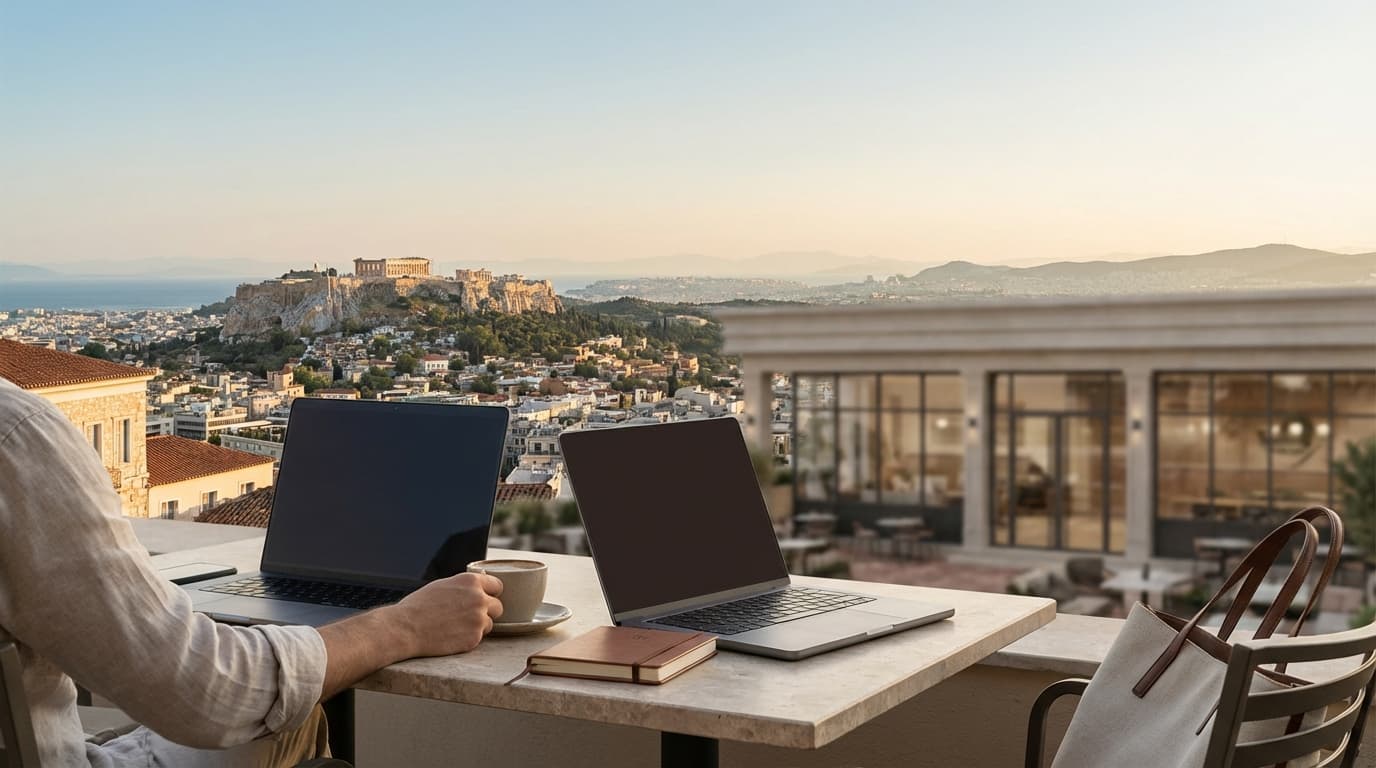
Athens is the obvious starting point for most nomads, and for good reason. It’s the only place in Greece where you’ll find a truly massive, established community of remote workers. The city feels alive, slightly chaotic, and deeply cultural. You can spend your mornings working from a rooftop overlooking the Acropolis and your nights lost in the bars of Psirri or Koukaki.

  • Monthly Cost: Expect to spend between €1,200 and €1,800. Rent in popular central districts has climbed recently.

  • Infrastructure: This is the gold standard for Greek connectivity. You’ll find dedicated spaces like Selina Theatrou and Athens Hub Hostel that offer reliable desks and high-speed fiber.

  • The Vibe: Fast-paced, urban, and incredibly social. It’s perfect if you hate feeling isolated.

  • The Trade-off: It gets hot, loud, and crowded during the peak summer months.

Thessaloniki: The Cultural Capital

Often called Greece’s "second city," Thessaloniki has a distinct, more relaxed personality than Athens. It’s a massive university town, which means the cafe culture is elite and the nightlife is driven by locals rather than tourists. The waterfront promenade is the perfect place to decompress after a long day of Zoom calls.

  • Monthly Cost: More manageable than the capital, usually ranging from €1,000 to €1,500.

  • Infrastructure: Solid urban WiFi and a growing number of coworking spaces listed in most remote work directories.

  • The Vibe: Intellectual, creative, and breezy. You get the sea breeze without the "tourist trap" feel of the smaller islands.

  • The Trade-off: Winters are surprisingly chilly here, so pack a real coat if you’re staying past October.

Rhodes: The Community Builder

Rhodes is currently the "rising star" for nomads in Greece. Unlike other islands that shut down in the winter, Rhodes is actively courting remote workers through organized meetups and community events. It’s one of the few places where you’ll find a dedicated scene focused on networking and social impact.

  • Monthly Cost: Very reasonable for an island, sitting between €900 and €1,400.

  • Infrastructure: While a major dedicated hub is in the works, the city is packed with "lovely" cafes that are very welcoming to laptops. Most have free, reliable WiFi.

  • The Vibe: Historical and community-driven. You’ll find yourself invited to nomad dinners and weekend excursions.

  • The Trade-off: You might have to hunt a bit for a professional office setup until the new hub officially opens.

Crete (Chania and Heraklion): The All-Rounder

Crete is so large it feels like its own country. Chania and Heraklion are the two main anchors for nomads. Chania offers a more picturesque, Venetian-style backdrop, while Heraklion provides a more "real city" feel with better tech infrastructure. Both give you access to some of the best food in the Mediterranean.

  • Monthly Cost: Affordable island living at €900 to €1,400.

  • Infrastructure: Good speeds in the main towns. Emerging coworking spots are popping up to meet the demand of the growing remote community.

  • The Vibe: Rugged and authentic. It’s for the nomad who wants to hike a gorge on Saturday and hit a beach bar on Sunday.

  • The Trade-off: Public transport between towns is slow; you’ll likely want to rent a car or scooter to really explore.

Kalamata: The Authentic Alternative

If you want to skip the "nomad bubble" and live like a local, head to Kalamata in the Peloponnese. It’s famous for its olives, but it’s becoming a favorite for nomads who want low costs and high quality of life. The city is walkable, safe, and sits right on the coast.

  • Monthly Cost: One of the cheapest options at €800 to €1,200 per month.

  • Infrastructure: Surprisingly good. The House by Phaos offers two central coworking locations that are as professional as anything you’d find in London or Berlin.

  • The Vibe: Quiet, authentic, and unpretentious. You’ll spend your evenings in local tavernas rather than flashy clubs.

  • The Trade-off: The community is small. If you don't make an effort to meet people at the coworking space, it can feel a bit lonely.

Making the Connection: Fiber and 5G

The old rumors about Greece's sluggish internet are officially dead. By 2026, the country has undergone a massive digital facelift. Fiber optic cables now snake through the streets of major hubs like Athens and Thessaloniki, offering speeds that rival any major European capital. You can comfortably host a Zoom call from a rooftop in Koukaki without the dreaded lag.

The 5G rollout has been equally aggressive. It is not just limited to the mainland either. High-speed coverage now blankets popular nomad islands like Crete and Rhodes. While you might still find the occasional "dead zone" in a remote mountain village, the urban centers and digital nomad hubs are fully equipped for heavy lifting, whether you are pushing code or editing 4K video.

Top Coworking Hubs

Athens has solidified its position as the primary startup engine of the Mediterranean, housing over 67 dedicated workspaces. Thessaloniki follows closely with a gritty, creative energy that appeals to the tech crowd. Here are the spots where you will actually get work done:

  • The Cube Athens: A 4.5-star staple in the community. It is known for its massive event spaces and a crowd that actually knows how to network.
  • Stone Soup: Boasting a 4.9-star rating, this is the place for those who want a tight-knit community feel alongside their standing desk.
  • Regus: For the corporate nomad, Regus offers consistent reliability at locations on Kifissias Avenue and Messogion Avenue. These are perfect if you need a professional backdrop for client meetings.
  • Selina Athens Theatrou: This is the go-to for the "work-hard-play-hard" crowd, blending accommodation with a trendy rooftop and functional desks.
  • BCO, Vios, and Pi55: These spaces are highly rated for their modern infrastructure and are popular with international remote workers.

The Cost of a Desk

Budgeting for your "office" in Greece is straightforward, though prices vary depending on how much "premium" you want in your coffee. Monthly hot desk passes generally start around €175 and can climb to €465 for high-end dedicated spots in the city center.

  • Regus Kifissias: Monthly hot desks start at €249.
  • Regus Messogion: Premium dedicated spaces reach €465 per month.
  • Impact Hub & BCO: Expect to pay roughly €350 (approximately GBP 300) for a monthly membership.
  • Day Rates: If you just need a spot for the afternoon, WorkSpot Athens offers desks for about $20.25. Other central spots may charge up to €60 (GBP 50) for a single day pass.

Cafe Culture and Mobile Data

If you prefer the hum of a grinder to the silence of an office, Greek cafe culture is incredibly welcoming to laptops. Neighborhoods like Psirri are packed with spots where the WiFi is fast and the freddo espresso is strong. Most cafes have caught up with the fiber rollout, making them viable secondary offices for a few hours of deep work.

For your phone, local providers offer competitive 5G data packages. It is smart to grab a local eSIM upon arrival to use as a hotspot backup. The 5G speeds in Athens are remarkably stable, providing a safety net if your Airbnb router decides to take a siesta. Most nomads find that a combination of a coworking membership and a local data plan covers all bases, even when island hopping.

The Greek Healthcare Landscape

Greece operates a dual healthcare system where public services (ESY) and private clinics exist side-by-side. While the public system is robust and handles emergencies for everyone regardless of status, it often feels the weight of bureaucracy. You will find long wait times for specialists and aging infrastructure in some public wards, particularly after years of economic austerity. Most digital nomads find that the private sector is the way to go for day-to-day needs.

Private facilities often share the same top-tier doctors as public hospitals, but the experience is vastly different. You get shorter wait times, modern equipment, and a much higher likelihood of staff who speak fluent English. In fact, many Greek doctors train in the US or UK, so the standard of care in major cities is excellent.

Public vs. Private Care

  • Public (ESY): Free emergency care for all. For non-emergencies, you need an AMKA (social security number) and must pay into EFKA. Expect significant paperwork and potential delays for elective procedures.
  • Private: Preferred by the expat community for speed and comfort. You pay out-of-pocket or via insurance, but you get direct access to specialists and "hotel-style" hospital rooms.

Insurance Requirements for Digital Nomads

If you are applying for the Greece Digital Nomad Visa, private health insurance is not just a recommendation; it is a legal requirement. You must prove you have coverage for the duration of your stay to get your application approved. Since non-EU nomads do not initially contribute to the Greek social security system, you will not have an AMKA right away, meaning you cannot access subsidized public care.

Most nomads opt for international plans that offer flexibility. Popular choices include SafetyWing, PassportCard, or AXA Global Healthcare. These plans are designed for the remote lifestyle and often include perks like virtual doctor consultations and mental health support. If you plan to stay long-term, you can also look into local Greek private plans, which are specifically designed to fill the gaps in the public system.

Hospitals and Facilities

Greece does not have "international hospitals" in the way some Southeast Asian hubs do, but the private clinics in Athens and Thessaloniki are world-class. If you are in Athens, Hygeia Hospital and Metropolitan Hospital are the gold standards. They are accustomed to dealing with international patients and insurance providers.

Outside of the major cities or on the smaller islands, facilities can be more basic. While every inhabited island has a medical center or pharmacy, serious issues usually require a transfer to a larger mainland hospital. If you are living the island life, ensure your insurance includes medical evacuation coverage.

Typical Costs and Procedures

Healthcare costs in Greece are generally much lower than in the US or Northern Europe. Even without insurance, out-of-pocket costs for basic services are manageable for most remote workers.

  • Specialist Visit: Expect to pay between €50 and €100 for a private consultation.
  • Public Doctor Visit: Usually €10 to €20 for those with insurance, or free in emergencies.
  • Dental Check-up: Prices vary, but a standard cleaning usually starts around €40 to €60.
  • Prescriptions: Often highly subsidized if you have an AMKA, but even full-price medications are relatively affordable.

Pharmacies and Emergencies

Pharmacies (farmakeia) are everywhere in Greece, marked by a bright green neon cross. They are a primary point of care for minor ailments. Pharmacists in Greece are highly trained and can often give medical advice or provide over-the-counter remedies that might require a prescription elsewhere.

In a true emergency, dial 166 for an ambulance. Emergency treatment at public hospitals is free for everyone, including tourists and nomads. While the response time in Athens can be affected by traffic, the medical staff are experienced and capable. For non-life-threatening issues, your private insurance will likely allow you to head straight to a private clinic for faster service.

Money Basics

Greece operates entirely on the Euro (€). While the country was once heavily reliant on cash, the last few years have seen a massive shift toward digital payments. You can tap your card for everything from a freddo espresso at a beach bar to a taxi ride in Athens. However, keeping a small amount of cash is still smart for smaller islands or remote mountain villages where the signal might be spotty.

Opening a Local Bank Account

If you are planning to stay for the full duration of a Digital Nomad Visa (DNV), a local account makes life much easier. It simplifies paying utilities or long-term rent and integrates you into the local system. Traditionally, this required an in-person visit and a stack of paperwork, but things are modernizing. Eurobank now offers digital onboarding for nomads who hold a valid DNV and an ID from a country participating in the PRADO system.

For most other banks, you should prepare for a physical meeting. You will generally need:

  • A valid passport or national ID.

  • Your Digital Nomad Visa or residence permit.

  • Proof of your Greek Tax Number (AFM).

  • Documentation showing your source of income, such as a work contract or bank statements.

The Know Your Customer (KYC) process is thorough. Banks will scrutinize the origin of your funds to comply with EU anti-money laundering laws. Expect the approval process to take anywhere from three to seven days before your account is fully active.

The Fintech Shortcut

Unless you are settling down for several years, you might find local banking more of a headache than it is worth. Most nomads in Greece rely on fintech giants like Wise or Revolut. These platforms do not require Greek residency and allow you to hold Euros without the high maintenance fees typical of traditional Greek institutions.

Using these services is often the cheapest way to handle international transfers. You get the mid-market exchange rate, which saves a significant amount compared to the 3% to 5% margins often hidden in traditional bank transfers. They also offer virtual cards that you can add to your phone immediately upon arrival.

ATMs and Avoiding Fees

Greek ATMs are notorious for their convenience fees. If you use a foreign bank card, you will likely be charged between €2.50 and €5.00 per withdrawal, regardless of what your home bank charges. To minimize these costs, always use a card with no foreign transaction fees and decline the ATM's offer to do the currency conversion for you. Always choose "Proceed without conversion" to let your own bank handle the math; the ATM's internal rate is almost always a rip-off.

Managing Crypto

Greece follows the broader EU MiCA framework for cryptocurrency. Digital assets are treated as property rather than currency. You can freely hold and use crypto, but if you spend more than 183 days in the country, you become a tax resident. At that point, any capital gains from crypto sales must be declared. Local banks are still quite conservative regarding crypto, so if you plan to move large sums from an exchange to a Greek bank account, be prepared for additional questions during the KYC process.

Financial Checklist for Nomads

  • Local Account: Best for DNV holders and those staying 12+ months.

  • Fintech Apps: Best for short-to-medium stays and avoiding currency markups.

  • ATM Strategy: Use Wise or Revolut and always select "Euro" as the billing currency.

  • Tax Residency: Keep track of your days; the 183-day mark triggers local tax obligations.

Taking the Whole Crew to Greece

Moving your family to the Mediterranean is more than just a lifestyle upgrade; it is an invitation into a culture that genuinely prioritizes children. In Greece, kids are welcome almost everywhere, from late-night tavernas to bustling village squares. While the paperwork requires some heavy lifting, the path for dependents is well-trodden and relatively straightforward for digital nomads and remote professionals.

The Visa Logistics

If you are applying for the Digital Nomad Visa, your family can join you by applying for their own individual residence permits. You will need to show a bit more financial cushion to keep everyone covered. The base income requirement for a single applicant is €3,500 per month. For your spouse, add 20% to that total, and for every child, add another 15%.

The paperwork centers on proving your family ties. This means you need original marriage and birth certificates that are officially translated and legalized, usually with an Apostille stamp. Everyone will need a valid passport, a clean criminal record from your home country, and a certificate of health. Most families start this process at their local Greek consulate before making the move to ensure everything is lined up before arrival.

Education and Integration

Once you have your residence permit, your children have the legal right to attend Greek public schools for free. This is the fastest way to get them fluent in the language and integrated into the local community. The curriculum is rigorous and focuses heavily on history and culture, though the language barrier can be a hurdle for older kids.

For families who prefer an international curriculum, Athens and Thessaloniki are your primary hubs. These cities host several private schools offering the International Baccalaureate (IB) or the British and American systems. While these come with a significant price tag, they provide a softer landing for English speakers. If you choose this route, start your search early as waitlists for the top schools in Athens can be long.

Health and Safety

Safety is one of Greece's biggest selling points for parents. Violent crime is extremely low, and it is common to see children playing in neighborhood parks well after sunset. The sense of community "eyes on the street" provides a level of security that is hard to find in many other Western capitals.

Regarding healthcare, you must have private health insurance to secure your initial visa. This ensures your children have access to high-quality private clinics and pediatricians. Once you are fully settled and have your AMKA (social security number), you can access the public healthcare system. However, many expats choose to keep a private policy to skip the wait times for non-emergency specialist visits.

Where to Plant Your Roots

While the islands are tempting, most nomad families find their stride in the larger cities or their leafy suburbs. These locations offer the best access to international schools, specialized pediatric care, and logistical support like consulates.

  • Athens: The northern suburbs like Marousi or Kifisia are popular for their proximity to international schools and greener spaces.
  • Thessaloniki: Offers a more relaxed pace than the capital with excellent infrastructure and a very walkable city center.
  • Crete (Chania or Heraklion): A great middle ground for families who want a slower island pace but still need reliable hospitals and year-round services.

Key Requirements at a Glance

  • Financial proof: €3,500 base plus €525 per month for each child.
  • Health Insurance: Private coverage is mandatory for all family members during the application.
  • Legalization: All foreign documents must be translated into Greek by a certified professional.
  • Age limits: Dependent children are generally covered up to age 21.

You can find more detailed application forms and local consulate contacts through the Ministry of Foreign Affairs portal. Planning for these administrative steps a few months in advance will make the transition much smoother for everyone involved.

Greece offers a lifestyle that most nomads dream of, blending a deep sense of history with a relaxed, Mediterranean pace. While it feels incredibly safe compared to many Western hubs, living here requires a bit of local "know-how" to move from being a target for pickpockets to a part of the local fabric.

Safety and Common Sense

Violent crime is rare in Greece, and the country consistently ranks well on the Global Peace Index. You can generally walk most neighborhoods at night without a second thought. However, petty theft is a reality in high-traffic areas of Athens and Thessaloniki. Pickpockets are active on the metro and around crowded tourist spots like Omonia Square and Exarchia. It is best to keep your bag in front of you and stay alert in these zones.

You might encounter the occasional street scam, such as the "photography trick" where a stranger asks you to take their photo, drops their own camera, and then demands cash for the "damage." Just keep walking. Interestingly, taxis are remarkably reliable here with very few reports of fraud, though using apps like FreeNow can give you extra peace of mind.

The Nomad Social Scene

The community is booming, especially in Athens and Thessaloniki. Athens has established itself as a year-round hub with plenty of co-working spaces that average around €160 per month. If you prefer a more academic, high-energy vibe, Thessaloniki is often called the "Silicon Valley of Greece" due to its massive student population and burgeoning tech scene.

For those looking for a long-term base, the Greek Digital Nomad Visa is a solid path. You will need to show a monthly income of at least €3,500 from sources outside of Greece. This 12-month visa can eventually be extended into a 2-year residence permit, making it one of the more attractive options in Europe.

Cultural Nuances

Greek culture is centered around the outdoors and long, lingering meals. Integration happens at the kafeneio (coffee house) or the local taverna. One thing you will notice immediately is that Greece is still very much a cash-first society. While cards are accepted in major supermarkets and malls, smaller shops and islands often prefer euros. Always keep some cash on you to avoid awkward moments at the register.

Smoking is another cultural staple. With nearly half the population lighting up, expect to see people smoking in outdoor seating areas and even some indoor spaces. If the smoke bothers you, it is better to quietly move to a different table rather than making a scene, as it is a deeply ingrained social norm.

Daily Life and Connectivity

Language is rarely a barrier in the cities. Most Greeks speak excellent English, especially the younger generation and those in the service industry. You will only really need to brush up on your Greek phrases if you head to remote mountain villages or tiny, non-tourist islands.

Infrastructure is a bit of a mixed bag. While the community is great, internet speeds can be hit or miss. The national average sits around 9.64 Mbps, though fiber is becoming more common in Athens apartments. If you are heading to the islands, stick to bottled water and check the local Wi-Fi speeds before committing to a month-long stay.

Best Neighborhoods for New Arrivals

  • Plaka & Kolonaki (Athens): These are the gold standard for safety and proximity to co-working hubs. They are well-policed and very walkable.

  • Thessaloniki Center: Perfect for those who want a vibrant nightlife and a younger, tech-focused crowd.

  • Rhodes: A top pick for nomads who want to stretch the summer season as long as possible while staying in a safe, community-oriented environment.

Focus on building connections in co-working spaces early on, and you will find that Greece is one of the most welcoming places to call home.

Understanding the 183-Day Rule

Greece is incredibly welcoming, but their tax office, the AADE, keeps a very close eye on the calendar. The magic number here is 183 days. If you spend more than half the year in Greece within any rolling 12-month period, you are generally considered a tax resident from your very first day of arrival. This means the Greek government will expect a cut of your worldwide income, not just what you earn while sitting at a cafe in Athens.

It is not just about counting days, though. Greece also uses a "centre of vital interests" test. If your spouse and children live in Greece, or if your primary economic ties are rooted there, you might be deemed a resident even if you stay under that 183-day threshold. If you are just passing through for a few months on a standard tourist visa or a short-term remote stint, you typically won't owe Greek taxes on your foreign-source salary.

The 50% Tax Break for Nomads

If you decide to make Greece your home base for the long haul, there is a massive silver lining. The Greek government introduced a powerful incentive to attract remote talent. Qualifying professionals can snag a 50% income tax reduction for up to 7 years. This is not a small perk; it effectively slashes your tax burden if you are moving your tax residency to Greece for the first time.

To qualify for this break, you must meet a few specific criteria. You cannot have been a Greek tax resident for five of the last six years, and you must commit to staying in the country for at least 2 years. Whether you are self-employed or work for a foreign company, this regime is the most common path for digital nomads to keep their overhead low while enjoying the Mediterranean lifestyle. Just remember to get your application in to the AADE by the March 31 deadline of your first qualifying year.

Other Specialized Tax Regimes

While the 50% reduction is the go-to for most nomads, there are other paths depending on your financial profile:

  • The 7% Flat Tax: Originally designed for pensioners, this 7% flat rate on foreign income can sometimes apply to specific classes of skilled workers and retirees.
  • The Non-Dom (Golden Visa) Regime: If you are a high-net-worth individual willing to invest €500,000 in Greece, you can opt for a €100,000 annual flat tax on all foreign income for 15 years.
  • Standard Progressive Rates: If you do not apply for a special regime, you will fall into the standard Greek tax brackets, which scale upward based on your total earnings.

Double Taxation and Treaties

Nobody wants to pay tax twice on the same Euro. Thankfully, Greece has a robust network of double taxation treaties, including a long-standing agreement with the United States. These treaties follow OECD guidelines to ensure you aren't hit twice. For Americans, you can often utilize the Foreign Earned Income Exclusion via IRS Form 2555 if you spend at least 330 days outside the U.S., helping to offset what you might owe back home.

Reporting and Logistics

If you are applying for the Digital Nomad Visa, you already know about the income requirements. You need to prove a net monthly income of at least €3,500. If you are bringing a partner, add 20% to that figure, and another 15% for each child. These numbers are net, meaning what hits your bank account after your home country takes its initial share.

Keep in mind that the Digital Nomad Visa itself is a great foot in the door, but it does not lead directly to permanent residency on its own. You will need to track your days meticulously and keep receipts of your tax payments. For the most current forms and official filings, you should coordinate with a local accountant or visit the AADE official portal. Tax laws in Greece can be fluid, and having a local expert to handle the March 31 filings is usually worth every penny.

Connectivity and Data

Sorting your internet should be your first priority before you even touch down at Eleftherios Venizelos. While airport Wi-Fi exists, it is notoriously fickle. For most nomads, an eSIM is the path of least resistance. You can skip the passport registration lines at physical kiosks and activate your data via a QR code while you are still on the tarmac.

  • Airalo: Great for quick setups. They use the Nova network and offer packages ranging from 1GB for $5 up to 20GB for $49.

  • Nomad: Often the most reliable in Athens and on islands like Santorini or Rhodes. Prices start around $4.50 for 1GB.

  • Holafly: The best choice if you are a heavy user who does not want to count gigabytes. They offer unlimited data plans that are perfect for hotspotting during Zoom calls.

If you prefer a physical SIM, head to a Cosmote or Vodafone shop in the city. You will need your passport for registration. Cosmote generally has the best 5G coverage across the islands, while Vodafone is often the budget-friendly pick with street vendors frequently offering deals like unlimited data for €12.

Getting Around

Athens has a solid metro system, but for everything else, you will want a few apps on your home screen. Google Maps works well for bus schedules, but Citymapper is often more accurate for navigating the chaos of Athenian traffic. For rideshares, Uber and Bolt are active, but Beat is the local favorite for hailing licensed taxis with transparent, cashless payments.

Island hopping requires a different strategy. Download Ferryhopper to book tickets and track live ferry locations. Signal can drop out in the middle of the Aegean, so download your maps for offline use before you leave the port.

Where to Set Up Shop

In Athens, Psyrri is the heartbeat of the nomad scene. It is packed with cafes and co-working spaces like The Hub. If you want something more historic, Plaka and Monastiraki put you within walking distance of everything, though they can be noisy. For a quieter, high-end vibe, look at Kolonaki.

On the islands, Chania in Crete is a powerhouse for remote workers because the infrastructure is reliable year-round. If you are heading to Santorini, stick to Fira for the best connectivity. Avoid the more remote villages if your job requires heavy bandwidth; the views are great, but the copper wiring in old stone houses often is not.

Housing and Lifestyle

While Airbnb and Booking.com are the standard for short stints, they get expensive quickly. For stays of a month or longer, check Flatio or HousingAnywhere. These platforms cater specifically to remote workers and often include utilities in the price. Always message the host to ask for a Speedtest screenshot before booking; "high-speed internet" is a subjective term in rural Greece.

When it comes to food, Wolt and efood are the two apps you need. They are both English-friendly and cover everything from your morning freddo espresso to late-night souvlaki. Delivery fees are usually low, between €1 and €3, and you can pay directly with a foreign card.

Language and Safety

English is widely spoken in tourist hubs, but Google Translate is helpful for reading nested menus or signs in smaller villages. DeepL is a better bet for formal emails if you are dealing with a local landlord. For emergencies, dial 112. This is the EU-standard emergency line that works even if your SIM card is not active. You can also reach the police at 100 or an ambulance at 166.

Common Pitfalls to Avoid

  • The "Cash is Dead" Myth: While cards are accepted almost everywhere, small kiosks (periptera) and some island tavernas still prefer Euros. Always keep €20 in your pocket.

  • The Passport Requirement: Do not walk into a phone shop without your physical ID. They cannot legally sell you a physical SIM card without registering it to your passport.

  • Slow Island Speeds: If you are moving to a smaller island, do not rely on the hotel Wi-Fi. Check if there is Cosmote 5G coverage in the area and use your phone as a mobile hotspot instead.

  • Skipping Offline Maps: Ferry rides and mountain drives often have dead zones. Download your maps and ferry tickets to your digital wallet ahead of time.

Latest Nomad News

More Guides from Europe

Stay Updated on Greece

Get notified about visa changes, policy updates, and new information for digital nomads in Greece.