France

Policy Stability
Stamped Nomad ExclusiveHow likely visa and immigration policies are to remain unchanged
Quick Facts
Yes
$2,000/mo
332 Mbps
5/10
High
High
Medium
UTC+1
Entry Methods Available
Best For
Last verified: October 1, 2026
Compare Visa Programs
| Program | Best for | Minimum income or savings | Government fee | Initial stay | Where to apply |
|---|---|---|---|---|---|
| France EU Blue Card | Visa Program | €59,373 a year | €99 one-time | 4 years | Apply for the long-stay visa at the French consulate or visa centre in the country of residence, then apply online on the ANEF portal for the card within 2 months of arrival. Holders of another EU Blue Card held for at least 1 year can move under the mobility rules. |
| France Freelancer Visa | Freelance Visa | €1,867.02 a month | €99 one-time | 1 year | First entry on a long-stay visa from the French consulate in the country of residence; later cards through the prefecture of residence. |
| France Long-Stay Visa | Long-Stay Visa | €1,477.93 a month | €99 one-time | 12 months | Online on France-Visas, then at the French consulate or visa centre in the country of residence; validate the VLS-TS online within 3 months of arrival. |
| France Talent Card (Qualified Employee) | Visa Program | €39,582 a year | €99 one-time | 4 years | Long-stay visa from the French consulate in the country of residence, then the card online on the ANEF portal within 2 months of arrival. |
| France Tech Visa | Visa Program | €39,582 a year | €99 one-time | 4 years | Eligibility step through Business France's Welcome to France platform, then a long-stay visa from the French consulate in the country of residence and the card online (ANEF) after arrival. |
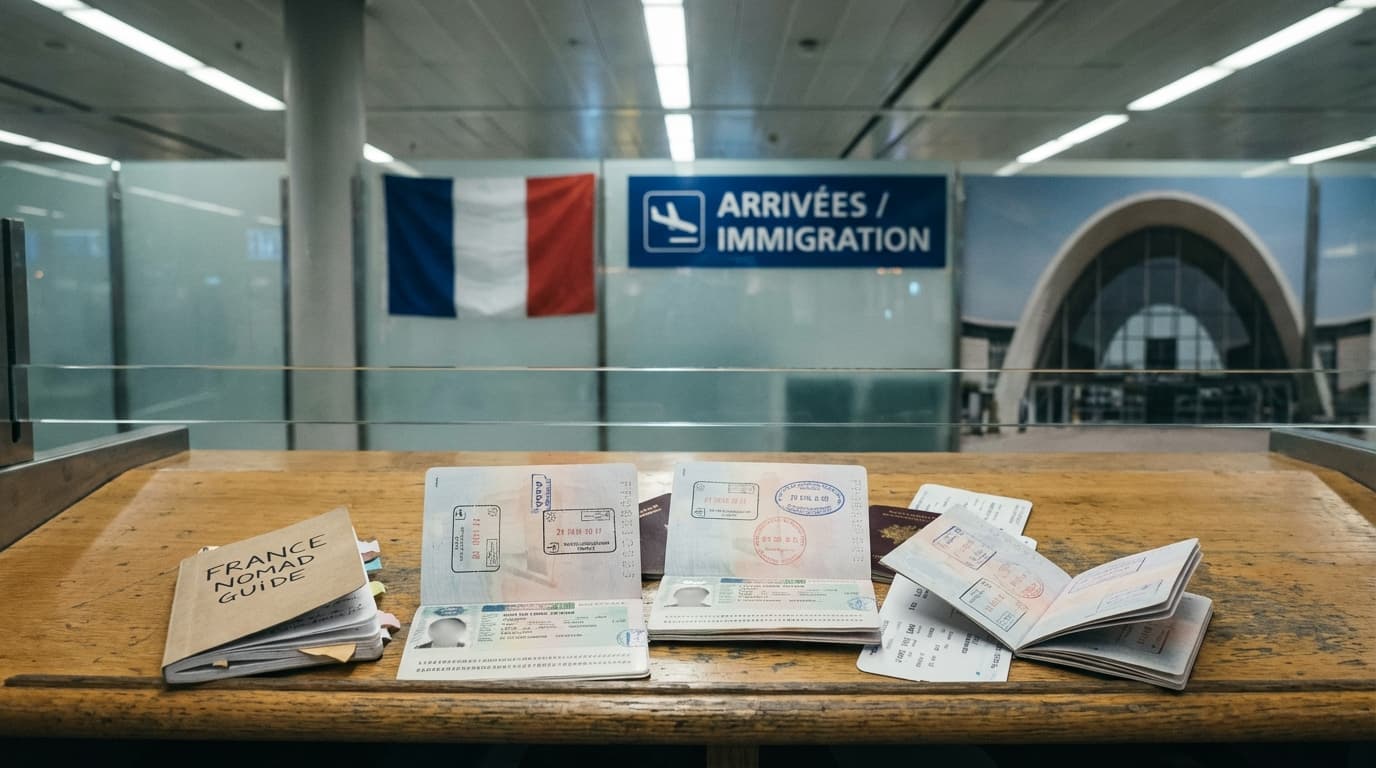
France has no digital nomad visa. A remote worker who wants to stay longer than a short visit has to fit one of the existing long-stay routes, and each one is built around a specific situation: living on savings, running a business in France or taking a French job.
- Living on savings, a pension or other income: the long-stay visitor visa gives up to a year and can be followed by a renewable visitor card. Visitors may not work in France, and the official pages don't say that remote work for a foreign employer is allowed.
- Freelancers and the self-employed: the entrepreneur and liberal profession card suits people who register and run their main activity in France and can show it pays at least the minimum wage.
- Graduates hired in France: the talent card for qualified employees, formerly the Talent Passport, covers jobs with a French employer.
- Highly paid specialists: the EU Blue Card has a higher salary bar and lets holders move within the EU more easily later.
- Startup staff, founders and investors: the French Tech Visa is a fast track into the same talent card.
Every multi-year card can lead to the 10-year EU long-term resident card after 5 years of legal residence, with French at level B1 and stable resources (Service-Public).
Short stays: nationals of visa-exempt countries can spend up to 90 days in any 180-day period in the Schengen area, a shared allowance across all 29 member countries (Schengen Borders Code). Others need a short-stay Schengen visa. A short stay doesn't give a right to work in France.
France EU Blue Card
Eligibility, requirements, and how to apply for the France EU Blue Card.
France Freelancer Visa
Eligibility, required documents, and how to apply for the France Freelancer Visa.
France Long-Stay Visa
Stay limits, requirements, and the application process for the France Long-Stay Visa.
France Talent Card (Qualified Employee)
Eligibility, requirements, and how to apply for the France Talent Card (Qualified Employee).
France Tech Visa
Eligibility, requirements, and how to apply for the France Tech Visa.
Costs depend more on the city than on anything else. Paris is the most expensive place to live in France, and rents on the Riviera are also high. Regional cities such as Lyon, Bordeaux, Toulouse or Lille usually cost less, and smaller towns less again.
Two official figures give a floor rather than a budget:
- Minimum wage: the gross monthly SMIC is €1,867.02 a month since June 1, 2026 (Service-Public). The freelancer card uses it as its income test.
- Visitor resources: a single applicant for a visitor card must show at least €1,477.93 a month (Service-Public).
Both are administrative minimums. A remote worker renting alone in Paris or Nice should plan well above them, while a shared flat in a regional city comes closer. Rent is usually the biggest line: furnished flats on short leases cost more than unfurnished ones on standard leases, and landlords often ask for a French guarantor or a guarantee service.
Budget too for health insurance until public cover applies, visa and residence card fees, and a deposit on any lease.
France offers very different bases within a few hours by train.
- Paris: the biggest job market, the largest startup scene and the most coworking spaces, at the highest cost. It suits people building a network or working with French companies.
- Lyon: a large city with a strong business base and lower rents than the capital. It suits those who want big-city services at a calmer pace.
- Bordeaux: a mid-sized city near the Atlantic coast and the wine country. It suits people who want a walkable center and weekend trips to the sea.
- Marseille: France's main Mediterranean port, with beaches and hills close to the center. It suits those who want sea and sun in a large city.
- Nice: the hub of the Riviera, with an international airport. It suits people who value the coast and easy flights, and can accept higher rents.
Other city pages include Toulouse, Montpellier and Lille.
Fixed broadband in France is fast. Speedtest's Global Index for August 2026 puts the national median at 332.1 Mbps for fixed connections and 132.91 Mbps on mobile (Speedtest Global Index). Speeds in a given flat depend on the line, so it's worth asking whether a rental has fiber before signing.
Coworking spaces are easy to find in Paris and the large regional cities, from big chains to small independent spaces. Paris also has large startup campuses tied to the startup scene that the French Tech Visa targets. Smaller towns have fewer options, and a café or a library is often the fallback there.
Day passes and monthly desks are common. Prices vary a lot by city and neighborhood, so compare a few spaces before committing.
France taxes people who are tax resident there, and the test is broad. Service-Public lists four criteria, and meeting any one of them is enough (Service-Public):
- the household or main home is in France
- the person spends at least 183 days in France in the year
- the main professional activity is carried out in France
- the center of economic interests, such as main investments or business base, is in France
So a stay shorter than 183 days doesn't guarantee non-residence. A tax treaty between France and another country can set different rules, and Service-Public advises checking with the foreign tax authority too.
None of the long-stay routes comes with a special tax regime on the official pages. A residence card and tax residence are separate questions: holding a card doesn't settle tax status, and not holding one doesn't prevent it.
Before moving, nomads should check:
- whether any of the four tests will be met in the calendar year
- which treaty applies to their home country and income
- how income from foreign clients or employers will be reported
- Arrival at the border: non-EU visitors on short stays are registered in the EU's Entry/Exit System, in use at all Schengen external borders since April 10, 2026 (EU travel portal). ETIAS is not running yet: Not yet operating and no official start date. The EU says it will announce the date several months before launch. The earlier official target, the last quarter of 2026, was removed from the official ETIAS website on July 14-17, 2026. (EU travel portal).
- After arrival on a long-stay visa: a VLS-TS must be validated online within 3 months, with a €300 tax (Service-Public). Residence card applications and renewals for most categories run online on the ANEF portal.
- Fees: residence card fees are paid with tax stamps (timbres fiscaux), which can be bought online.
- Health: visitor card applicants need health insurance for the whole stay (Service-Public). People who work in France should check with the national health insurance fund when public cover starts and keep private cover until then.
- Banking: banks usually ask for a passport, proof of address and proof of income. A multi-currency account from abroad can bridge the first weeks.
- Phone: prepaid SIM cards and eSIMs are widely sold, and operators ask for ID at sign-up.
- Paperwork: keep certified French translations of civil-status documents, since prefectures ask for them across most permit types.
Frequently asked questions
Does France have a digital nomad visa?
Can a remote worker for a foreign company live in France on a visitor visa?
How much money is needed for a France long-stay visitor visa?
When does someone become a French tax resident?
How long can visitors stay in France without a visa?
Latest Nomad News
Mandatory EES checks now required at all external Schengen borders
On 6 September 2026, the European Union’s Entry/Exit System (EES) emergency flexibility measures expired, meaning Schengen states can no longer routinely suspend biometric data collection at busy border points.[10][6] Non‑EU travellers, including British passport holders, now face mandatory biometric registration on every entry and exit, with longer processing times and fewer options for relaxation during peak congestion.[6][10] Digital nomads and expats should plan for slower queues at external Schengen borders and factor in extra time for flights and cross‑border trips.
EU bans return ticket cancellations and sets 250 euro delay payouts
The European Commission’s transport page states that the EU has advanced a landmark agreement to modernise and strengthen air passenger rights across the EU, and it also lists new Commission proposals to simplify regional, long-distance, and cross-border travel planning while improving rail-passenger protection. For travelers who move between Western European countries, this is relevant because it points to a broader EU-level change affecting how cross-border trips and compensation rules are handled.[2] This is a policy-development item rather than an immediate operational rule change, and the
France raises student visa funding floor to 877.50 euros a month
Non-EU students and long-stay visa applicants in France must now prove monthly funds of €877.50, up from the previous €615 threshold. The update also includes reinforced border controls and tighter immigration scrutiny for foreign residents entering the country.
EU keeps 3 hour delay rule for passengers as new rights wait until 2027
The European Parliament approved updated EU-wide air passenger rights rules that tighten reimbursement and rerouting protections, add clearer pricing rules, and strengthen assistance for families and passengers with disabilities. If formally confirmed and published, the new rules would apply across EU member states after a 1-year preparation period, so travelers should watch for the final entry-into-force date.
EU delays ETIAS enforcement for visa-exempt travelers until 2027
The European Union has pushed back the implementation of the ETIAS travel authorization system until at least 2027. Visa-exempt travelers to the Schengen Area can continue to enter without pre-authorization throughout 2026 as officials address operational concerns with the Entry/Exit System.
More Guides from Europe

Stay Updated on France
Get notified about visa changes, policy updates, and new information for digital nomads in France.