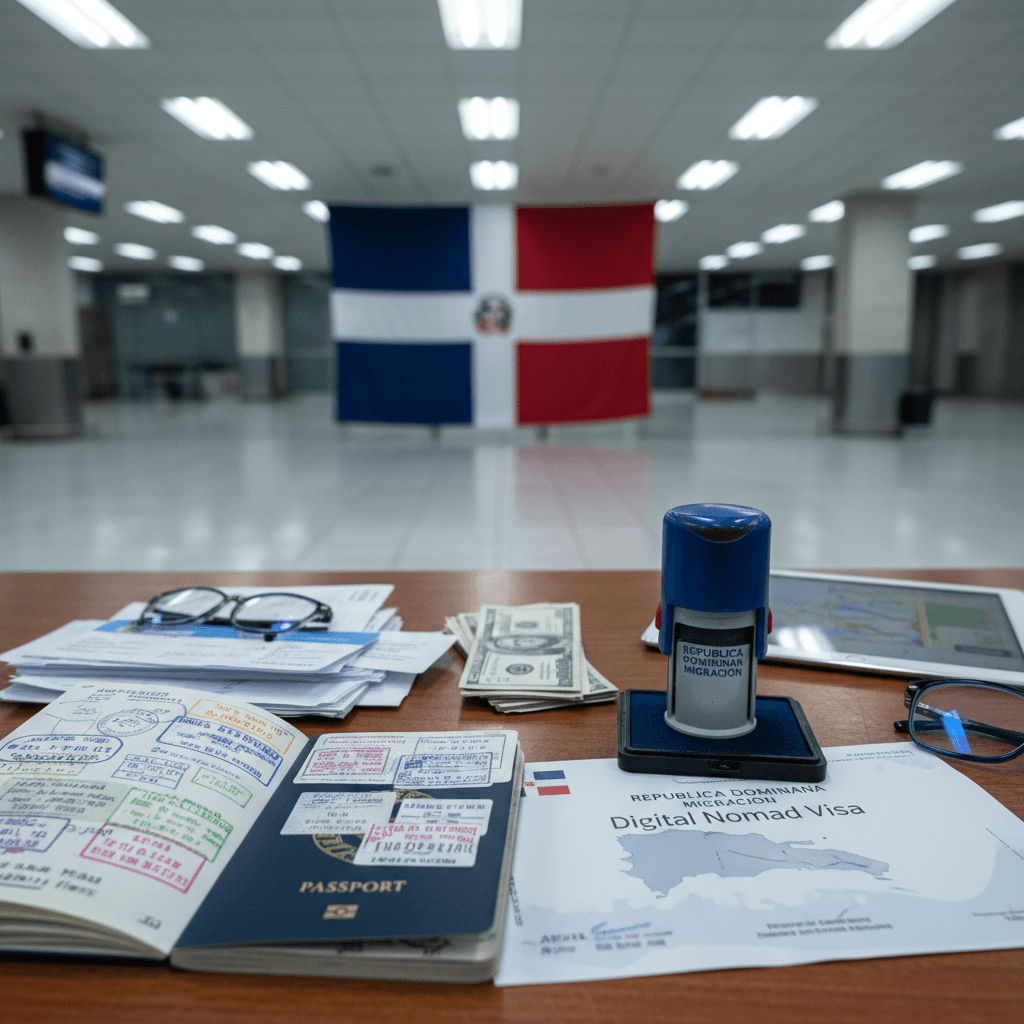
Dominican Republic

Policy Stability
Stamped Nomad ExclusiveHow likely visa and immigration policies are to remain unchanged
Quick Facts
No
$1,180/mo
108 Mbps
5/10
Medium
Medium
Low
AST (UTC-4)
Entry Methods Available
Best For
Last verified: September 27, 2026
Compare Visa Programs
| Program | Best for | Minimum income or savings | Government fee | Initial stay | Where to apply |
|---|---|---|---|---|---|
| Dominican Republic Pensionado / Rentista | Passive Income Visa | $1,500 a month | $200 one-time | 1 year | First a single-entry residence visa (RS) from the Dominican consulate for the applicant's country of residence; within its 60 days the holder enters and files the residence application with the DGM foreign investment desk online (personal.migracion.gob.do), then deposits originals in person in Santo Domingo. |
The Dominican Republic has no digital nomad visa. One has been proposed, but none is in force, so remote workers choose between tourist stays and residence routes built for other purposes.
Choosing a route
- Short and medium stays: visa-exempt tourists get 30 days on arrival. The DGM sells an online extension that takes the stay up to 120 days; staying past 30 days without it is charged on departure. Which nationalities are visa-exempt depends on the passport, so it should be checked with a Dominican consulate.
- People living on a pension or passive income: pensionado and rentista residence under Law 171-07 needs a pension of $1,500 a month or foreign income of $2,000 a month, and gives a renewable residence card plus tax benefits.
Remote workers paid a salary by a foreign employer do not qualify as pensionados, since salaries never count toward the pension minimum. Freelancers and employees without passive income therefore have no residence route designed for them, and the practical option is a tourist stay with an extension.
Pensionado or rentista
The two routes share one application process and one set of benefits. The pensionado route suits people drawing a pension from a former employer or a government; the certificate must come from the body that pays it and confirm it can pay for at least five years. The rentista route suits people living on dividends, rents or investment returns from abroad, shown with at least five years of history. Each dependent adds $250 a month to either threshold.
Residence also brings a Dominican ID card (cedula) and, under Law 171-07, the right to take paid work, which tourist status does not give. The trade-off is paperwork: apostilled documents, a Spanish translation of the income certificate, a medical exam in the country and yearly or two-yearly renewals that ask for proof the income was received and spent locally.
The pensionado and rentista route starts at a Dominican consulate with a residence visa and finishes at the DGM in Santo Domingo. The DGM also runs investor residence categories for people putting capital into a Dominican business.
The Dominican Republic uses the peso (DOP), so costs for someone paid in dollars or euros move with the exchange rate. Santo Domingo is the only city with a full Numbeo estimate for a single person.
| City | One-bedroom, outside the center | One-bedroom, center | Other monthly costs | Monthly total | Numbeo data |
|---|---|---|---|---|---|
| Santo Domingo | DOP 20,311 | DOP 39,875 | DOP 40,328 | DOP 60,600 to 80,200 | June 2026 |
| Santiago de los Caballeros | DOP 15,000 | DOP 23,000 | not published | not published | Sept. 2025 |
| Puerto Plata | DOP 18,333 | DOP 26,667 | not published | not published | Sept. 2026 |
| Punta Cana | not published | DOP 56,690 | not published | not published | May 2026 |
The Santo Domingo total adds the average one-bedroom rent, outside the center and in it, to Numbeo's estimate of a single person's other monthly costs. The figures are averages of user reports, not official statistics.
At the Sept. 26, 2026 exchange rate, the Santo Domingo range is roughly $1,020 to $1,350 a month. Rents in Santiago and Puerto Plata run well below the capital's, while Punta Cana's resort-area apartments cost more. Furnished short lets and tourist-area prices sit above these long-term averages.
Budgeting by lifestyle
- Santo Domingo, one-bedroom outside the center: about DOP 60,600 a month on Numbeo's averages, or roughly $1,020.
- Santo Domingo, central one-bedroom: about DOP 80,200, or roughly $1,350.
- Santiago or Puerto Plata: one-bedroom rents average DOP 15,000 to 26,700, so totals can sit well below the capital's, though Numbeo publishes no full monthly estimate for these cities.
Health insurance, backup power and coworking come on top of these figures.
- Santo Domingo: the capital has the most coworking, hospitals, flights and city life, and the DGM office where residence files are deposited. It suits people who want services close at hand.
- Santiago de los Caballeros: the second city, inland, with lower rents than the capital and a more local feel.
- Puerto Plata: a north coast city with an international airport and moderate rents, and a base for exploring the coast.
- Cabarete: a small north coast town known for kitesurfing, with a long-running foreign community and a relaxed pace.
- Punta Cana: the resort region in the east, with a major international airport and the highest rents in the data. It suits people who want beaches and easy flights.
Las Terrenas on the Samana peninsula and Jarabacoa in the mountains are quieter options for longer stays.
The Speedtest Global Index for August 2026 put the Dominican Republic's median fixed broadband speed at about 108 Mbps and its median mobile speed at about 206 Mbps, so a good mobile plan can outpace a home line.
Coworking spaces are concentrated in Santo Domingo and, to a lesser extent, Santiago and the main tourist areas such as Punta Cana and Cabarete. In smaller beach and mountain towns, remote workers rely on home connections and cafes. A mobile data plan on a second carrier makes a sensible backup connection.
Under the Tax Code, a person who stays in the Dominican Republic more than 182 days in a fiscal year, continuously or not, is tax resident.
Article 269 taxes residents on Dominican-source income and on foreign-source income from investments and financial gains. Article 271 delays tax on foreign-source income until the third year after someone becomes resident. Whether pay for remote work done in the country counts as Dominican-source income is not addressed in these articles and is a question for the DGII.
Pensionados and rentistas get a separate set of benefits under Law 171-07: the declared pension or income is exempt from income tax, alongside property, mortgage, dividend, interest and capital gains reliefs. Later reforms may have changed parts of these, so the details on the pensionado and rentista page should be confirmed with the DGII.
Nomads staying close to half a year should count days carefully and check how their home country taxes people living abroad.
- Arrival: every traveler fills in the free e-Ticket form for entry and exit, which the DGM, customs and the health ministry require.
- Staying longer: the DGM stay extension is bought online; staying past 30 days without it means paying on departure.
- Money: the peso is the currency. Card payments are common in cities and tourist areas, and cash is still needed in small towns.
- Phone: prepaid SIMs and eSIMs from local carriers give a Dominican number, and mobile data is fast by regional standards.
- Health care: the best private hospitals are in Santo Domingo, Santiago and Punta Cana. International health insurance is sensible, and residence applicants need a Seguros Reservas guarantee policy.
- Weather: the Atlantic hurricane season brings storm risk in the second half of the year, so travel plans need some slack.
- Safety: petty theft and road safety are the main everyday risks; checking an official travel advisory before arrival is sensible.
Frequently asked questions
Does the Dominican Republic have a digital nomad visa?
How long can tourists stay in the Dominican Republic?
Can remote workers get residence through the pensionado route?
When does someone become tax resident?
What does it cost to live in Santo Domingo?
Latest Nomad News
Dominican Republic and Azerbaijan allow 90 day visa free stays for tourists
The Dominican Republic and Azerbaijan signed a mutual visa waiver allowing travelers to stay for up to 90 days within any 180 day window without a visa.
Dominican Republic Extends Relaxed Passport Rules Through 2026
Clarifying the Visa Rules for Chinese Nationals Entering the Dominican Republic
China remains on the Dominican Republic's visa list, but Chinese nationals who can legally enter the United States, Canada, the United Kingdom or the European Union can enter for tourism with only the tourist card.
More Guides from Caribbean
Stay Updated on Dominican Republic
Get notified about visa changes, policy updates, and new information for digital nomads in Dominican Republic.