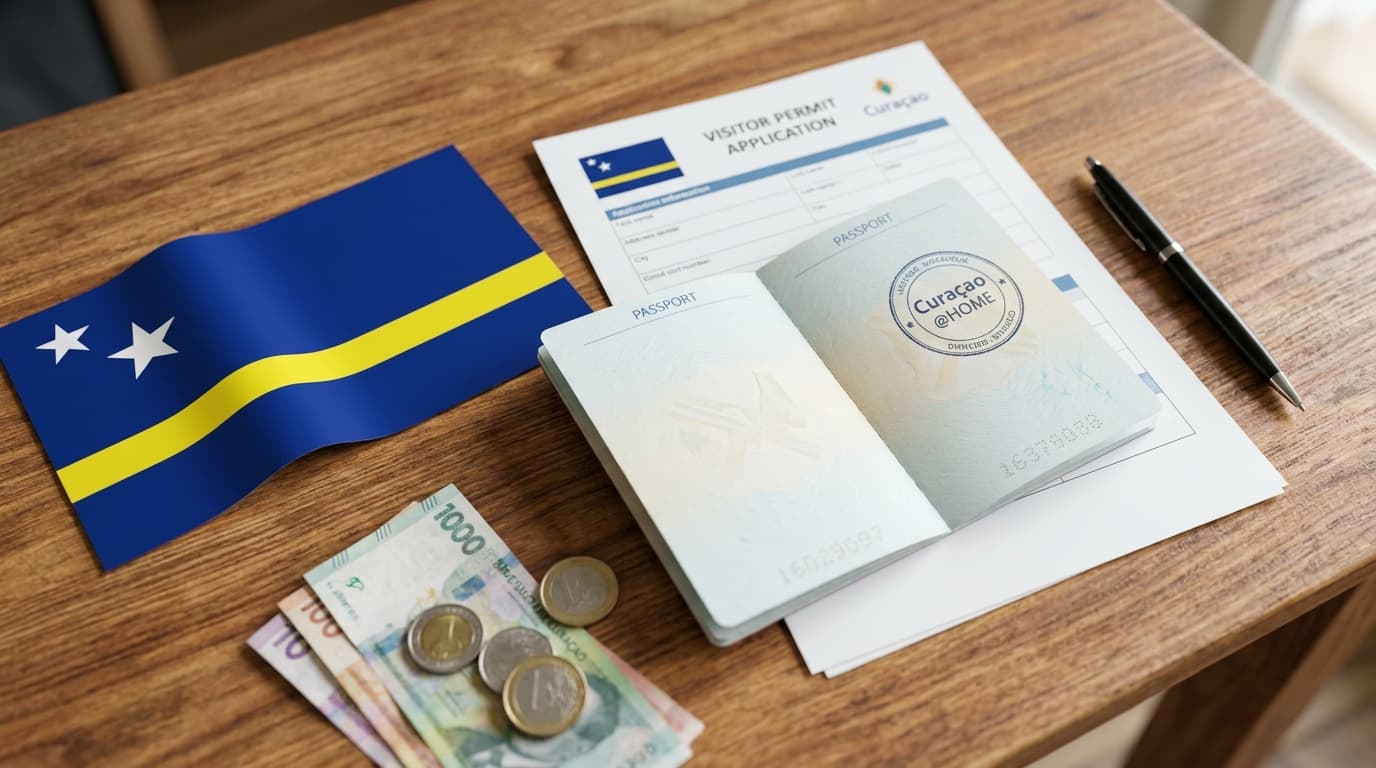
Curaçao @HOME in Curaçao Program

Visa Data Sheet
@HOME in Curaçao is the island’s official temporary stay permit for people who want to live there while working or investing abroad. It covers remote workers, extended-stay visitors, often called hibernators or snowbirds and high net worth investors.
The permit is a cleaner fit than a tourist stay if you need more time and want explicit approval for remote work. It’s a formal government process with an online application, a fee and supporting documents, not just a longer stamp in your passport. Remote workers also aren’t subject to Curaçao income tax on their remote work under the program rules.
The stay is temporary and that’s the point. Remote workers and hibernators can get up to 6 months, with one possible 6-month extension and the program doesn’t lead to Curaçao residency. If you’re hoping to settle permanently, this isn’t the route.
The government launched the program in 2021 to attract people who can work location-independently and want a longer stay in Curaçao under a structured permit. The core setup hasn’t changed in the official material available now, including the target groups, stay length and basic application framework.
Who it’s for
- Remote workers: People employed or self-employed outside Curaçao who can work from anywhere.
- Hibernators or snowbirds: Extended-stay visitors who want to spend part of the year on the island without becoming residents.
- High net worth investors: Applicants who want to live in Curaçao while investing abroad.
There are real upsides here, but don’t overstate them. You get a legal, work-authorized stay with a clear endpoint, decent connectivity is part of the pitch and the tax treatment for remote work is straightforward. Still, it’s not a back door to residency and it’s not meant for local employment.
@HOME in Curaçao is open to all nationalities, but only if you can prove you’ll be working from outside the island’s local job market. It’s a temporary stay permit for remote workers, extended-stay visitors and some investors, not a back door to residency.
The remote-worker route is the one most people care about. To qualify, you need to work location-independently using telecommunications technology and fit into one of these three buckets:
- Employed abroad: You work for an employer registered in a foreign country and have an employment contract.
- Business owner or partner: You’re doing business for a company registered in a foreign country where you’re a partner or shareholder.
- Freelancer or consultant: You have contracts with clients whose permanent establishments are in a foreign country.
There’s no published fixed minimum income threshold. Instead, the program asks for proof that you can support yourself, usually through employer declarations, company assignment letters or contracts. If you’re looking for a low-barrier option with no paperwork, this isn’t it. The application is formal and the permit is tied to specific remote-work rules.
One hard line stands out, you can’t work for a Curaçao company. That restriction applies during the application and after the permit is issued. If your income comes from local employment, you don’t fit this category.
Families can apply, but each person needs an individual electronic application. Children 12 and older also have to sign. The program doesn’t mention any bundled family fee, so don’t assume there’s a discount just because you’re applying together.
There are a couple of other paths under the broader program. Hibernators or snowbirds, usually self-employed people or retirees who stay temporarily and may own property, can also spend up to 6 months in Curaçao, but they still can’t work locally. High net worth investors follow separate rules and must show an investment of at least ANG 500,000, along with enough financial resources and private health insurance.
If you miss required documents, can’t show foreign employment or foreign business ties or try to work for a local employer, your application can be delayed or denied. The official portal doesn’t publish a fixed list of disqualifications, so the safest move is to match your status to the category before you apply.
The @HOME in Curaçao permit isn’t a loose tourist waiver. It’s a formal, government-run stay permit for remote workers, extended-stay visitors and investors who want to live in Curaçao for up to 6 months, with a possible 6-month extension.
The paperwork is fairly specific and the portal wants it uploaded digitally. Applicants need to complete the online form and submit the documents the government asks for, not just the bare minimum you’d hand over at the airport.
- Fee payment: Proof of payment for the required fee, listed as $294 in the government announcement and ANG 535 in the FAQ.
- Passport: A clear copy of the photo page of your passport. The FAQ says your passport must be valid on arrival, but it doesn’t give a fixed remaining validity period.
- Solvency proof: A recent declaration of assignment if your own company is in your country of origin or a recent employer declaration from a foreign employer or a recently certified copy of your employment contract.
- Appendix D: The completed proof of payment form.
- Insurance: A valid international travel or medical insurance policy, preferably with COVID-19 coverage. If you can’t show international insurance, Curaçao says local insurance can be arranged.
Payment details matter here. The FAQ says the fee has to be sent to the Ministry of Finance’s specified bank account, with the listed SWIFT or BIC for international transfers and you’re on the hook for any transfer charges.
There are a few other arrival rules that can trip people up. You need a return ticket that matches your approved stay, so a one-way ticket won’t work. Travelers also have to meet current COVID-19 entry requirements through the government’s travel and dicard process, which can include a Passenger Locator Card and, for some origins, a PCR test.
The application can be submitted in Dutch, English or Spanish. The official sources don’t spell out extra items like criminal record checks, accommodation proof or translation and apostille rules for remote workers, so don’t assume those are required unless the portal asks for them.
The fee depends on which @HOME in Curaçao track you use, but for most remote workers and digital nomads, it isn’t a huge bill. The official fee is ANG 535, which the government lists at about USD 294 for a remote worker or digital nomad application. Hibernators and snowbirds pay the same amount.
Investor permits cost more. The official FAQ lists ANG 635 for a 1-year investor stay and that’s before you get into the separate investment amount rules tied to that permit category.
There’s no family discount or bundle. Each person files their own application and pays the full fee, including dependents.
- Remote worker or digital nomad: ANG 535, about USD 294
- Hibernator or snowbird: ANG 535, about USD 294
- Investor permit: ANG 635 for a 1-year stay
Payment has to go to the Ministry of Finance account at Maduro & Curiel’s Bank, using the bank details the government provides. If you’re paying from abroad, any transfer charges and exchange-rate differences are on you and you must upload proof of payment with the application.
The official materials don’t give a separate price list for health insurance, translations, legal help or other extras, so don’t expect much hand-holding on total out-of-pocket costs. They do require valid international travel or medical insurance, but they don’t publish a standard price for it.
Refund rules are a little murky. Some guidance describes the application fee as nonrefundable, but the official announcement and FAQ don’t spell that out clearly, so I wouldn’t count on getting money back if your file doesn’t go through.
The @HOME in Curaçao application is handled online and that’s the only route the program describes. You apply through the official portal while you’re staying abroad, although tourists who are still inside their allowed 90-day stay in Curaçao can also submit from the island.
The form is available in Dutch, English and Spanish. Each applicant has to sign their own application, including family members age 12 and older, so don’t expect a broker or agent to file it for you.
- Pay the fee: ANG 535 for remote workers, digital nomads and hibernators.
- Prepare proof of payment: You’ll need to upload it with the application.
- Gather documents: Passport photo page, proof of solvency, Appendix D and valid international insurance.
- Show solvency: The program accepts an employer declaration, company assignment letter or employment contract.
Missing paperwork can slow things down or get the application denied, so this isn't the kind of form you want to rush through. The official guidance says processing takes about 2 weeks.
Once approved, the permit is issued electronically. You still need to complete the Digital Immigration Card and follow any COVID-19 travel protocols before arrival, then travel with your passport and return ticket.
The permit lets you stay for up to 6 months, with a possible 6-month extension. You can leave and come back during the permit period, as long as your approval is still valid.
@HOME in Curaçao is built for temporary stays, not a backdoor to residency. For remote workers, the permit covers 6 months and can be extended for another 6 months, so the longest stay under this category is 1 year.
That extension is allowed in the official rules, but the portal doesn’t spell out the exact renewal steps or any extra fee beyond the original application. The program is still described as an online permit process with formal approval, so don’t treat it like a loose tourist extension.
There’s also a hard line on status. Remote workers and hibernators don’t become Curaçao residents just because they stayed for 6 months or even the full year. If you want to settle permanently or work in the local labor market, you’d need a different route, usually a regular temporary residence permit plus work permit.
The program does have a longer runway for investors. Depending on the investment size and the investor permit rules, permits can be issued for 1, 3 or 5 years and some may be open-ended. That’s a separate category from the remote-worker permit, though and it follows its own rules.
For most applicants, the key point is simple: this is a temporary, work-authorized stay, not a path to permanent status. If your plan is to keep living in Curaçao after the permit ends, you’ll need to look at a different immigration option.
The tax picture for @HOME in Curaçao is pretty straightforward, which is part of the appeal. Remote workers under the program aren't required to pay Curaçao income tax and the government also lists “no taxation for remote workers” as one of the main benefits.
That said, this isn’t a back door into local work or local tax advantages. The permit is built for people earning from abroad and official materials say remote workers can’t take jobs in Curaçao’s local labor market or work for local employers. That matches the way the program treats your income, as foreign-sourced and outside Curaçao’s income tax system for the permit holder.
What the official materials do say:
- Income tax: Remote workers under @HOME in Curaçao won’t be required to pay Curaçao income tax.
- Local work: You can’t work for Curaçao employers or join the local labor market.
- Residency: The permit doesn’t lead to residency.
- Tax detail: The program pages don’t spell out broader personal tax rules, day-count thresholds or reporting duties tied to the permit.
That last point matters. The official FAQ doesn’t give a full tax residency test and it doesn’t mention special reduced tax regimes or double-taxation treaty treatment for permit holders. So if you’ve got income, assets or filing obligations in more than one country, you’ll need to sort those out separately. The Curaçao permit itself doesn’t answer them.
There’s one more wrinkle. The FAQ notes that Dutch and American nationals staying as tourists or under remote worker permits for up to 6 months are treated differently from people who move under a “Declaration of Law,” which suggests other residence routes can trigger different tax and registration rules. The program materials don’t go into those rules, so don’t assume the @HOME permit works like a longer-term move.
Bottom line, the permit is tax-light on the Curaçao side, but that doesn’t mean you’re tax-free everywhere. If your situation is simple, the program is clean. If it isn’t, get advice before you rely on the permit alone.
How It Compares
Similar visas elsewhere
| Program | Country | Income / month | Fee | Max stay | Renewable |
|---|---|---|---|---|---|
| Slovenia Digital Nomad Visa | Slovenia | €3,391/mo | €50↓ | 12 mo | |
| Belize Work Where You Vacation Program | Belize | $75,000-100,000/yr | BZD 200-500 | 6 mo | |
| Kazakhstan Neo Nomad Visa | Kazakhstan | $3,000/mo | £170↓ | 12 mo | |
| Bahamas Digital Nomad Visa | Bahamas | - | $25↓ | 12 mo |
Curaçao Digital Nomad Guide
Cost of living, internet, healthcare, coworking, and every visa option for Curaçao.
Visa rules change. We'll tell you.
Get notified about policy updates and new requirements for the Curaçao @HOME in Curaçao Program and other Curaçao visas.