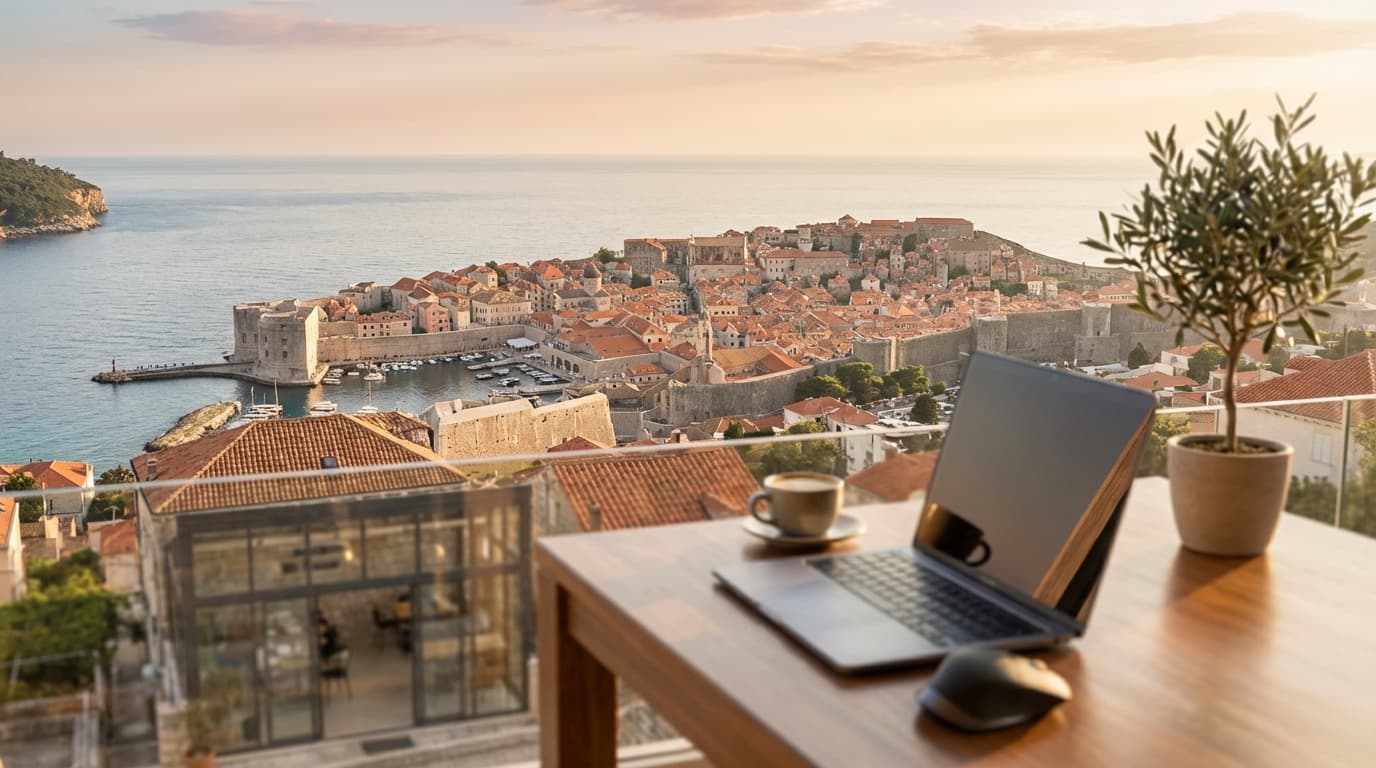
Croatia

Policy Stability
Stamped Nomad ExclusiveHow likely visa and immigration policies are to remain unchanged
Quick Facts
Yes
$1,700/mo
212 Mbps
8/10
High
High
High
CET
Entry Methods Available
Best For
Last verified: September 24, 2026
Compare Visa Programs
| Program | Best for | Minimum income or savings | Government fee | Initial stay | Where to apply |
|---|---|---|---|---|---|
| Croatia Digital Nomad Visa | Digital Nomad Visa | €3,622.50 a month | €46.45 one-time | 18 months | Online through the MUP digital nomads portal, at a Croatian embassy or consulate, or (visa-exempt applicants legally in Croatia) at the police administration or station for the intended address. Visa-required nationals must file abroad or online and then collect a visa D. |
| Croatia Family Reunification Visa | Visa Program | 50% of the average monthly net salary for one person, increased by 15% for two people and by a further 10% for each additional person | €46.45 one-time | 2 years | At a Croatian embassy or consulate abroad, or at the police administration or station for the intended address if already legally in Croatia |
Croatia has one residence route written for remote workers and one for families. The digital nomad temporary stay fits people who work for an employer or their own company outside Croatia and want up to 18 months in one place. Family reunification brings a spouse, partner or children to join someone already living in Croatia, including a nomad whose stay has been granted.
Choosing between them
- Remote workers with foreign income: the nomad stay is the direct route. It needs €3,622.50 a month or savings for the whole stay, and qualifying foreign pay isn't taxed as income in Croatia. It can be extended once within the cap, but the cap and a six-month wait before any new stay mean it doesn't lead to long-term residence.
- Partners and children: they don't apply as nomads. They file for family reunification after the main applicant's stay is granted, and each additional family member raises the nomad's income test by 10% of the average net salary.
- People planning to settle: family reunification and other temporary stays count toward long-term residence after five continuous years. The nomad stay doesn't.
- Anyone who wants Croatian clients: the nomad stay rules out work for Croatian employers, so local work needs a stay and work permit instead.
Visits without a permit
Croatia is in the Schengen area, so nationals of visa-exempt countries can stay 90 days in any 180-day period, and that allowance is shared across every Schengen country rather than counted per country. Days on a residence permit or long-stay visa don't count toward it.
The EU's Entry/Exit System has registered short-stay visitors at external borders since Oct. 12, 2025, taking fingerprints and a facial image. On ETIAS, the travel authorization planned for visa-exempt visitors, the official position is this: Not yet operating and no official start date. The EU says it will announce the date several months before launch. The earlier official target, the last quarter of 2026, was removed from the official ETIAS website on July 14-17, 2026.
Croatia has used the euro since Jan. 1, 2023, so nomads paid in euros carry no exchange-rate risk. In Numbeo's crowd-sourced prices for September 2026, a single person's monthly spending excluding rent ran from about €720 in Osijek to €825 in Zagreb. Rent is what separates the cities.
| City | One-bedroom, outside the center | One-bedroom, center | Other monthly costs | Monthly total |
|---|---|---|---|---|
| Zagreb | €592 | €775 | €825 | €1,420 to €1,600 |
| Split | €661 | €898 | €819 | €1,480 to €1,720 |
| Rijeka | €477 | €621 | €788 | €1,270 to €1,410 |
| Osijek | €365 | €571 | €717 | €1,080 to €1,290 |
Each total adds the average one-bedroom rent, outside the center and in it, to Numbeo's estimate of a single person's other monthly costs. The figures are averages of user reports, not official statistics, and coastal rents climb in the summer season.
A realistic budget for one remote worker renting a one-bedroom apartment is therefore about €1,100 to €1,300 a month in Osijek, €1,300 to €1,400 in Rijeka and €1,400 to €1,700 in Zagreb or Split. Anyone who meets the nomad stay's income test earns more than every total in the table.
Five bases cover most remote workers' needs, from the capital to the Adriatic.
- Zagreb: the capital and the most complete base, with the largest coworking scene, the main government offices for residence paperwork and a city that stays busy all year. It's inland, so the coast is a trip rather than a daily walk.
- Split: the pick for a coastal city with a working-week rhythm, ferry links to the central Dalmatian islands and an airport. It had the highest center rents of the four cities in Numbeo's September 2026 data, and summer brings crowds and seasonal rents.
- Rijeka: a port and university city on the Kvarner Gulf, cheaper than Split, close to Istria and the islands of Krk and Cres. It suits people who want the sea without a resort town.
- Zadar: a smaller coastal city with an old town on a peninsula and quick access to national parks. It's quieter out of season, which suits focused work more than nightlife.
- Osijek: the budget choice in eastern Croatia, with the lowest rents in the table above and a student population. Coworking options are limited, so it fits people who work from home.
Other city guides cover Dubrovnik, Pula and Rovinj, all popular in summer and much quieter in winter.
Fixed broadband is fast by European standards. Speedtest's Global Index put Croatia's median fixed download speed at 211.72 Mbps in August 2026 and its median mobile speed at 193.52 Mbps, so mobile data is a workable backup for video calls in covered areas.
Speeds on islands and in older stone buildings along the coast can fall well short of the national median, so a short-term rental's connection is worth testing before a long booking.
Coworking spaces cluster in Zagreb and Split, the two largest cities, and both have year-round communities. Rijeka, Zadar and Osijek have fewer dedicated spaces, and many remote workers there use cafes or rent a desk by the month. On the coast, some spaces cut hours or close outside the summer season, so opening months are worth checking in advance.
EU roaming rules let a SIM from another EU country work in Croatia without extra charges on trips, but not for permanent use, so anyone staying for months is better served by a Croatian plan.
Croatia treats a person as tax-resident with a habitual residence of at least 183 days in one or two calendar years, and a home owned or held for that long also counts, under the General Tax Act. Residents are taxed on income from Croatia and abroad; non-residents only on Croatian income.
The digital nomad exclusion
Pay received for work for an employer not registered in Croatia under digital nomad status is not treated as income under the Income Tax Act, so it is not taxed in Croatia. Because it removes the pay from income rather than changing residence, the exclusion applies whatever the day count. It covers only that foreign pay. Work for Croatian clients isn't allowed on the status, and rental income, investment income or pay from other sources is taxed under the normal rules.
Everyone else
Income tax is charged at a lower rate on the first €60,000 of the annual tax base and a higher rate above it. Local councils set both rates, and where a council sets none the Act applies 20% and 30%. Family reunification and other residence permits carry no special regime.
What to check
- Whether the home country keeps taxing the same income, and whether a tax treaty with Croatia settles which country taxes first.
- Social security: the nomad status is an immigration and income tax rule and doesn't by itself settle where contributions are due.
- Any Croatian-source income, which falls outside the nomad exclusion.
- Money: Croatia uses the euro. Cards work widely in cities, but small cafes, markets and island businesses may prefer cash, so carrying some is sensible.
- Address registration: foreigners on temporary stay report their address to the police within three days of entering Croatia, and register their temporary residence within 30 days of approval. Short-stay visitors are registered by their accommodation provider.
- Health insurance: the nomad stay requires travel or private cover valid in Croatia for the whole stay. Checking that a policy covers routine care, not just emergencies, avoids surprises.
- Phone and data: a local prepaid SIM or eSIM from one of the national operators gives a Croatian number for bank and delivery apps. EU roaming covers visits, not permanent use.
- Emergencies: 112 reaches police, fire and ambulance services free of charge, as everywhere in the EU.
- Seasons: the coast is busiest in July and August. Rents, flights and ferries cost more then, and some island services shut in winter, so many long-stay visitors choose May, June, September or October to arrive.
- Documents: criminal record certificates must be legalized and in Croatian or English, so ordering them before leaving home saves a trip back.
Frequently asked questions
How long can digital nomads stay in Croatia?
How much income does the Croatian digital nomad stay require?
Do digital nomads pay income tax in Croatia?
How long can visitors stay in Croatia without a visa?
Can a digital nomad bring family to Croatia?
Is Croatia expensive for remote workers?
Latest Nomad News
Nomads face 90 minute delays as 4 EU countries extend border checks through March
The European Commission’s Schengen border-control notifications updated on 18 August 2026 list temporary internal-border controls affecting several Central Europe and Balkan-facing routes, including Austria with the Czech Republic, Hungary, Slovakia and Slovenia; Germany with the Czech Republic and Poland; Italy with Slovenia and Spain; and Poland with Germany and Lithuania.[1] For travelers, expats, and digital nomads, this means checks may still occur at affected internal borders and crossing times can be longer, even inside Schengen.[1]
Croatia gives foreign workers 3 to 6 months to find jobs after June 4 shift
New Croatian rules in force since June 4 let residence and work permit holders who lose their job stay three months, or six after two years on a permit, up from 60 days. Renewals also need a Croatian language test.
Croatia requires health exams for visa-regime renewals as of April 30
Third-country nationals subject to Croatia's visa regime must now undergo a mandatory medical examination when extending their temporary residence permits. While the employer is responsible for the cost, the rule adds a procedural step for foreign workers and non-citizens maintaining legal residency.
EU keeps 3 hour delay rule for passengers as new rights wait until 2027
The European Parliament approved updated EU-wide air passenger rights rules that tighten reimbursement and rerouting protections, add clearer pricing rules, and strengthen assistance for families and passengers with disabilities. If formally confirmed and published, the new rules would apply across EU member states after a 1-year preparation period, so travelers should watch for the final entry-into-force date.
EU delays ETIAS enforcement for visa-exempt travelers until 2027
The European Union has pushed back the implementation of the ETIAS travel authorization system until at least 2027. Visa-exempt travelers to the Schengen Area can continue to enter without pre-authorization throughout 2026 as officials address operational concerns with the Entry/Exit System.
More Guides from Europe
Stay Updated on Croatia
Get notified about visa changes, policy updates, and new information for digital nomads in Croatia.