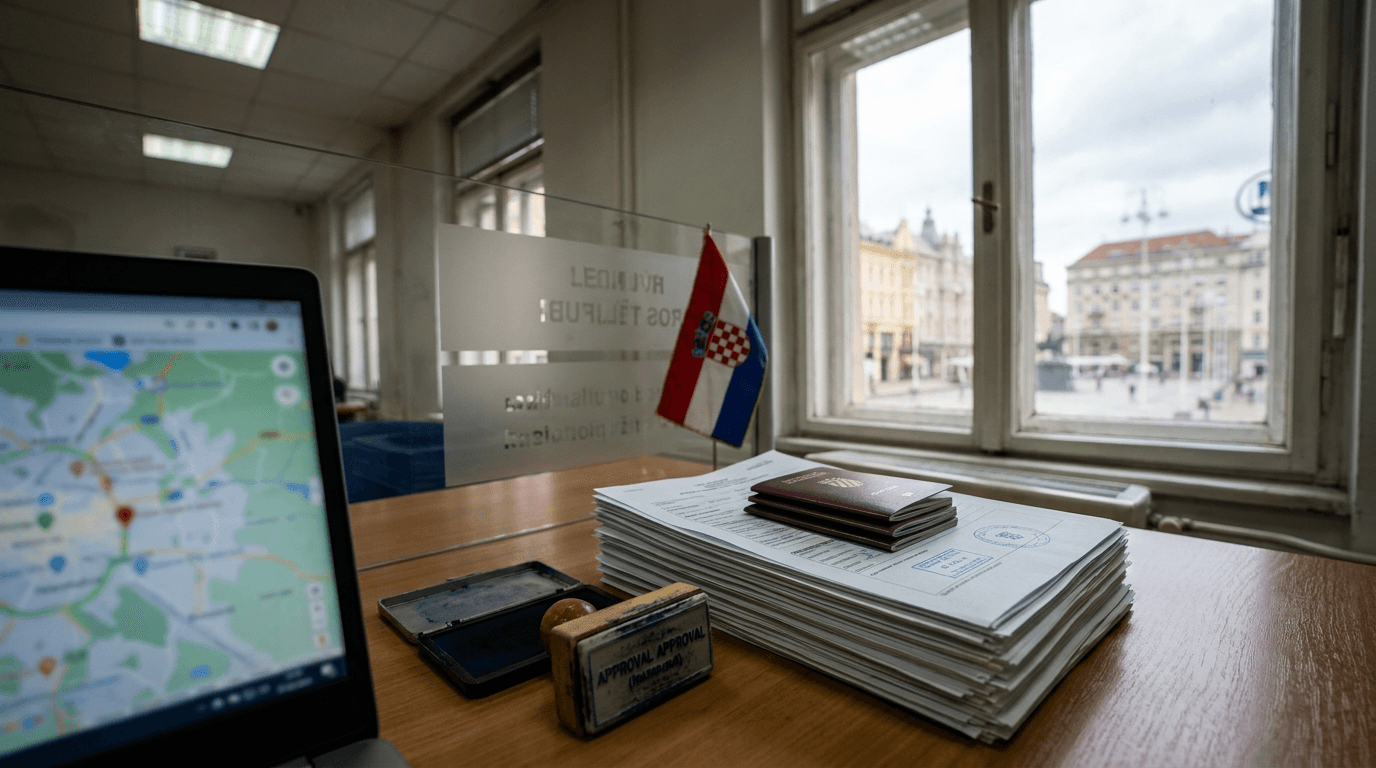
Croatia Family Reunification Visa
Visa Data Sheet
- $95 – $225
- 60 months
Croatia doesn’t have a separate “family reunification visa” label. What it has is temporary residence for the purpose of family reunification, usually paired with a long-stay visa or visa D, if the family member needs one to enter Croatia.
This route is for close family members of someone who's already legally resident in Croatia. It’s a long-stay path, not a tourist visa, so it’s treated very differently by the Ministry of the Interior and the foreign affairs ministry.
Who can sponsor the application
The sponsor is usually a Croatian citizen, a third-country national with temporary, permanent or EU long-term residence or a person who has been granted international protection. In plain English, the sponsor has to be properly settled in Croatia already.
Eligible family members include a spouse, a common-law or life partner, minor unmarried children, including adopted children and parents or adoptive parents of a minor child in certain cases. Croatian authorities can also treat another relative as a close family member in exceptional humanitarian cases, but that’s not the normal route.
What the applicant has to show
The basic file is straightforward, though the paperwork can be annoying if your documents need legalization or translation. The applicant generally needs to prove the family link, hold a valid travel document, have health insurance and show enough means of support.
- Photo: one color photo, 35 x 45 mm.
- Family proof: marriage certificate, birth certificate or another document showing the relationship.
- Travel document: a copy of a valid passport or equivalent.
- Funds and insurance: proof of sufficient means of support and health insurance, unless the applicant is family of a person granted international protection.
- Police certificate: a criminal-record certificate for first-time applicants, from the home country or any country where they lived for more than one year before arrival, unless exempt.
How the process works
The standard rule is to apply at a Croatian embassy or consulate in your country of residence. If you don’t need a visa to enter Croatia, you may be able to submit the temporary-stay application at the local police administration while you’re legally in the country. If a visa is required, you’ll usually apply for temporary stay first, then get visa D to enter and collect the residence permit.
The permit is normally granted for up to one year or until the sponsor’s own residence permit expires if that’s sooner. The residence card is biometric and the official portal lists the current card fees separately, at EUR 31.85 for standard processing or EUR 59.73 for accelerated processing, plus EUR 9.29 for issuance.
Croatia doesn’t have a separate “family reunification visa” in the usual sense. The official route is temporary stay for the purpose of family reunification and it’s meant for close family members of people who already have lawful residence in Croatia.
The sponsor has to fit one of a few categories. That can be a Croatian citizen, a third-country national with permanent stay, long-term EU residence, temporary stay, stay-and-work permission or recognized international protection. If the sponsor is on a one-year stay-and-work permit under Article 97, they must already have held temporary stay for at least one year before family reunification is allowed.
Not every residence status opens the door. Family reunification is excluded if the sponsor is in Croatia on seasonal work, a non-renewable temporary stay such as tourism, a short language course or use of their own real estate or if they are a service provider or posted worker.
Close family members usually include:
- Spouse: A legally recognized husband or wife.
- Common-law partner: An unmarried partner if the relationship can be proven.
- Minor children: Biological or adopted children, including a minor child shared by the partners or a minor adopted child of either partner, if unmarried.
- Parents or adoptive parents: Only in limited cases tied to a minor child who's a Croatian citizen or a third-country national with permanent stay, long-term residence, asylum or subsidiary protection.
In exceptional cases, Croatia can treat another relative as a close family member if there are serious personal or humanitarian reasons. For sponsors with international protection, the family circle can also extend to an adult dependent child or dependent parents who lived in the same household.
There’s no official fixed income threshold for this route, which is annoying but true. The law requires sufficient means of support and health insurance, but the Ministry of the Interior and EU portal don’t publish a single euro amount for family reunification. Expect the police administration or consulate to ask for proof of income or savings, then decide whether it’s enough.
Applicants can still be refused if they have an entry ban, a Schengen alert for refusal of entry or are seen as a threat to public order, national security or public health. A clean criminal record from the country of nationality or recent residence is commonly required too.
The permit is typically granted for up to one year and can be renewed. It also counts toward long-term residence after five years of legal stay, which is the part most people care about if they plan to stay for the long haul.
Croatia’s family reunification route is paper-heavy and the ministry doesn’t leave much room for sloppy files. The core ask is straightforward, though, a valid travel document, proof of the family relationship, proof of sufficient means, health insurance and, for first-time temporary stay applications, a criminal-record certificate from your home country and any country where you lived for more than one year before arriving, duly legalized.
Your passport needs to be valid for at least three months beyond the requested stay. Since temporary stay is usually issued for up to one year, that often means more than 15 months of validity from the date the permit is issued if you want to avoid problems.
What you’ll need to submit
- Valid travel document: A passport that meets the validity rule above.
- Proof of family relationship: For a marriage, submit an extract from the marriage register. For a parent-child relationship, use a birth register extract or an adoption decision.
- Common-law partnership evidence: Croatia accepts several forms of proof, including a child’s birth extract, an adoption decision, status documents, partner statements, witness statements, proof of a shared household for at least three years or other evidence showing the partnership and intent to keep living together.
- Proof of sufficient means: The official pages require means to support yourself, but they don’t publish a fixed family reunification income threshold on the pages reviewed.
- Health insurance: Required for temporary stay, unless you fall under a specific exemption.
- Criminal-record certificate: Required for first-time temporary stay applications and must be duly legalized.
- Photo and copies: The EU Immigration Portal also lists a color photo and a copy of the valid travel document.
The Ministry of the Interior says you normally apply at a Croatian diplomatic mission or consular post. If you’re visa-exempt for entry, you can also apply at a police administration or station in Croatia. Visa-required applicants generally start through the consulate, with limited exceptions.
On fees, Croatia’s official pages are a little split. The Ministry of Foreign and European Affairs lists the visa D fee at €93 ($101) and says visa D is exempt for some family members of Croatian nationals, including spouses and children. If you apply for temporary stay at a police station, the ministry lists €46.45 ($50) for temporary stay, €31.85 ($35) for biometric residence permit production and €9.29 ($10) for issuance, with an accelerated biometric-production fee of €59.73 ($65) instead of €31.85.
Temporary stay is generally granted for up to one year or until the sponsor’s stay expires if that happens first. It can be renewed and Croatia’s long-term residence rules can later open the door after five years of continuous temporary stay. For family members or life partners of Croatian nationals, the permanent-residence path can be faster, but only if you meet the legal conditions in force.
Croatia’s family reunification route isn’t wildly expensive, but it isn’t free either. The main government charges are fairly clear, while the extras, like translations, insurance and legalization, can vary a lot depending on where you file.
- Temporary stay application fee: €46.45
- Biometric residence permit card, normal procedure: €31.85
- Biometric residence permit card, accelerated procedure: €59.73
- Additional biometric card fee: €9.29
That means the official cost for the residence decision plus a standard biometric card comes to €87.59 before any outside expenses. If you need the accelerated card issue, the total rises to €115.47. Those are the figures the Croatian and EU portals actually publish.
The long-stay visa D question is a bit messier. The Croatian Foreign Ministry lists a €93 fee for visa D in general, but it also says family reunification is exempt from visa D fees for family members of a Croatian national, including spouses and children. The official pages don’t clearly confirm a blanket fee waiver for every family-reunification case, so don’t assume you’ll pay nothing unless your situation fits that exemption.
The bigger wild card is the paperwork around the application. Official sources say you may need a health-insurance policy, certified translations and legalization or apostille, but they don’t publish fixed prices for those items. If you’re applying from abroad, those extras can easily end up costing more than the government fee itself.
- Proof of family relationship: marriage register extract, birth register extract, adoption decision or accepted evidence for a common-law partnership
- Photo: one color photo, 35 x 45 mm
- Travel document: copy of a valid passport
- Financial proof: evidence of sufficient means, but no fixed income threshold is published on the family-reunification page
- Health insurance: required, though the official portal doesn’t give a set price
- Criminal record check: required for first-time applicants, if applicable under the rules for your case
Renewals are usually straightforward on paper. The temporary stay is granted for one year or until the sponsor’s permit expires if that comes sooner and renewal should be filed at the local police administration or station at least 60 days before expiry.
How to apply
Family reunification in Croatia isn’t a stand-alone visa. It’s a request for temporary stay for the purpose of family reunification, handled by the Ministry of the Interior, usually with the local police administration or a Croatian embassy or consulate involved along the way.
The default route is pretty clear, even if the paperwork isn’t. If you’re abroad, you usually file at the Croatian diplomatic mission or consular office responsible for where you live. If you’re a visa-exempt third-country national already in Croatia, you can often apply directly at the competent police administration or police station, as long as you’re legally in the country.
- Step 1: Confirm the sponsor in Croatia is eligible. That means a Croatian citizen, a third-country national with temporary stay, permanent stay, long-term residence or international protection.
- Step 2: Gather your documents, including passport, one 35 x 45 mm photo, proof of the family link and proof of the sponsor’s legal stay.
- Step 3: Add any supporting papers the authorities ask for, like proof of income, health insurance, accommodation and a criminal-record certificate, depending on your case.
- Step 4: File the application at the embassy, consulate or police office, depending on where you are allowed to apply.
- Step 5: If you need a visa to enter Croatia, apply for a long-stay visa D after the stay approval is issued.
There’s one annoying wrinkle for some sponsors. If the family member in Croatia is on a one-year work-and-stay permit, family reunification is generally only possible after that person has already held at least one year of granted temporary stay. Family members of people with international protection get a lighter treatment and the usual proof of means and health insurance can be waived.
The official portals don’t give a fixed processing time for family reunification. That means you shouldn’t plan your move around a guessed deadline. In practice, the safer play is to start early, check the exact consulate rules and make sure every foreign document is properly legalized or apostilled and translated into Croatian if required.
Croatia’s family reunification route is a temporary stay permit, not a separate visa. That matters because the renewal rules follow the residence system under the Aliens Act, which is a little less tidy than people expect, but at least it’s clear enough once you know where to look.
The standard temporary residence period is one year. For family reunification with a Croatian citizen or for life partnership, the permit can be issued for up to two years or for the length of your travel document if your passport expires sooner. If you’re joining a third-country national sponsor, the default is usually a one-year permit, again limited by passport validity.
Renewal is possible if the family relationship still qualifies and the sponsor still has the right status in Croatia. There isn’t an official published cap on the number of renewals for this category, so the system is built around continued eligibility, not a hard stop after a set number of years.
What renewal depends on
- Valid family relationship: your marriage, life partnership or other recognized family tie has to still exist.
- Sponsor status: the sponsor must still be a Croatian citizen or otherwise hold a qualifying residence status.
- General conditions: accommodation and means of subsistence still need to check out.
- Passport validity: your travel document must be valid at least three months longer than the permit period being issued.
The official pages don’t give a single, fixed lead time for renewal applications in English, so don’t guess on timing. Check directly with the local police administration office or the Croatian consulate handling your case, because that’s the only safe way to avoid a gap in status.
If your goal is to stay long term, family reunification time can count toward residence milestones. After five uninterrupted years of legal stay, you may qualify for long-term residence and some family members of Croatian citizens can reach permanent stay sooner, after four years. Minor children in certain cases can qualify after three years.
There’s no official statement on a maximum number of years you can keep renewing family reunification status. In practice, Croatia expects you to either keep qualifying for temporary stay or move into long-term or permanent residence once you hit the residence thresholds.
Family reunification doesn't come with its own tax break in Croatia. If you hold a temporary stay for family reunification, you're taxed under the standard Croatian personal income tax rules, the same way other residents are.
The key question isn't the permit itself. It's where you’re considered tax resident. Croatian tax rules define a resident as someone with permanent residence or habitual residence in Croatia, while a non-resident is someone without either, but who still earns Croatian-source income. That means the tax treatment follows your real-life setup, not the sticker on your residence card.
Once you're treated as a resident, Croatia taxes your worldwide income, including salary, self-employment income, property income and investment income earned abroad. Non-residents are taxed only on Croatian-source income. So if you live in Croatia with your family and your home is there, your foreign income can fall into the Croatian tax net too.
That can get messy fast if you also have income in another country. Croatia has double-taxation agreements with many countries and those treaties can reduce or remove tax on the same income being taxed twice. The treaty outcome depends on your own tax residency under both countries’ rules, not just your family-reunification permit.
The tax rates themselves are also local, not fixed nationwide. Croatia’s personal income tax has a lower band up to €60,000 a year, then a higher band above that, with exact rates set by the municipality within the legal range. There’s no separate rate for family-reunification holders and the government materials don’t point to any special exemption tied to this status.
- If you live in Croatia: expect to be taxed on worldwide income if you’re treated as resident.
- If you only have Croatian-source income: non-resident rules may apply, even if you hold a family-reunification permit.
- If you have income in two countries: check the relevant double-tax treaty before you assume anything is exempt.
- Annual filing: some taxpayers must submit an income tax return by the end of February for the previous tax year.
The annoying part is that the official English guidance doesn’t spell out every residency trigger in plain numbers. Public summaries often mention a 183-day rule, but that should be confirmed directly with the Croatian Tax Administration or a tax adviser before you rely on it.
Croatia Digital Nomad Guide
Cost of living, internet, healthcare, coworking, and every visa option for Croatia.
Visa rules change. We'll tell you.
Get notified about policy updates and new requirements for the Croatia Family Reunification Visa and other Croatia visas.
