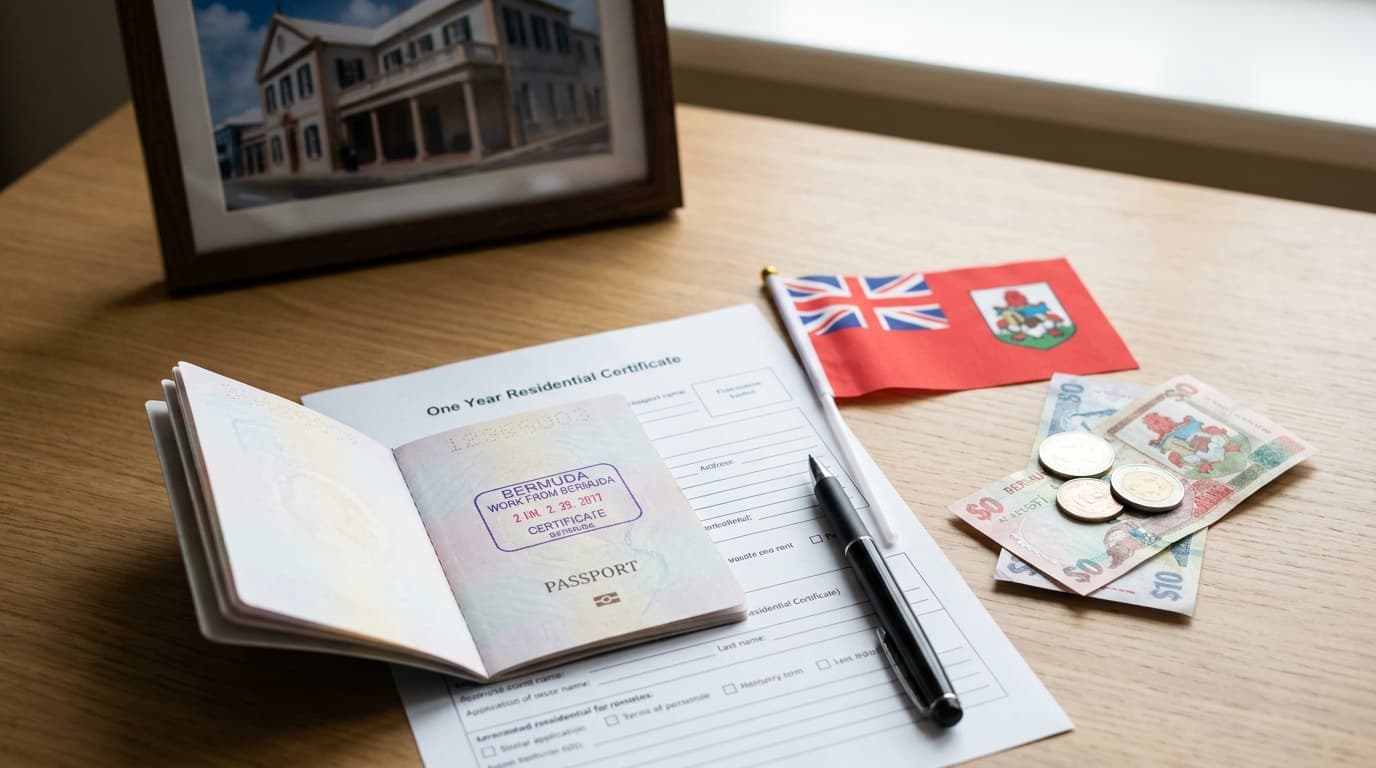
Bermuda Work From Bermuda Certificate

Visa Data Sheet
The Bermuda Work From Bermuda One Year Residential Certificate was the island’s remote-work residence route for non-Bermudians who wanted to live in Bermuda for up to one year while working for an overseas employer, running an overseas business or studying with an overseas institution. It wasn’t a tourist visa. It gave holders long-term visitor status with permission to work remotely or study from Bermuda, while still barring any local employment.
The government pitched it to remote professionals, self-employed digital nomads and post-secondary students who could support themselves and any dependents during their stay. That self-support point mattered, because the program was built for people whose income or funding came from outside Bermuda, not from the local job market.
It launched on Aug. 1, 2020, during the COVID-19 period and drew strong interest in the first couple of years. The permit was created under section 32 of the Bermuda Immigration and Protection Act 1956, so it sat within the island’s immigration system rather than as a simple travel permission.
There’s a major catch for new applicants. The government officially discontinued new Work From Bermuda Certificate applications on Feb. 28, 2025 and said it was moving back toward multi-year residency applications and annual Permission to Reside options. That means the certificate is no longer open to new applicants now, though existing holders are covered by separate transition rules.
For anyone comparing Bermuda’s options, the practical difference is simple: this certificate was the special remote-work track, not a general stay-and-see visa. It gave a clearer legal basis to live in Bermuda for a year while staying tied to an overseas employer, business or school, but it did not open the door to local work.
The Work From Bermuda One Year Residential Certificate is for non-Bermudians who can live in Bermuda while working remotely for an overseas employer or studying with an overseas institution. It’s not a route into local employment. If you want to take a job in Bermuda, this isn’t the right permit.
The basics are straightforward. Applicants must be at least 18, pay the application fee and have no convictions that the Minister considers to involve moral turpitude. They also can’t have indictable convictions in Bermuda or foreign offences that would be indictable if committed in Bermuda.
There’s no nationality rule listed in the official policy, so the program appears open to a broad group of applicants if they meet the other criteria. The catch is that you need to fit one of the permitted categories and prove you can support yourself.
- Remote workers: You must show employment with a firm or your own company, that’s registered and operating overseas.
- Students: You need evidence that you’re enrolled in a research, undergraduate, graduate or doctorate program and can complete it from Bermuda.
- Financial support: You must have means or a continuous source of annual disposable income enough to cover yourself and any dependents without working in Bermuda. The policy doesn’t give a fixed minimum income figure.
- Health insurance: You need valid coverage or you have to buy local health insurance.
Dependents may be allowed to live with the certificate holder and the government-affiliated material also refers to domestic staff, but only if the main applicant can support them financially. That’s a real hurdle, because the policy is clear that nobody on this certificate can take gainful employment in Bermuda.
One more thing: new applications for the Work From Bermuda Certificate have been discontinued and the government is moving back to multi-year residency applications. Existing certificate holders are covered by transition rules, so current permits don’t just vanish overnight.
The Work From Bermuda Certificate asks for a fairly lean document set, but the rules aren’t as loose as a tourist stay. You need to show that you’re actually a remote worker or a student, that your passport and visa details are in order and that you can support yourself while you’re in Bermuda.
- Proof of employment or school enrolment: remote workers need proof they’re employed and students need evidence of enrolment with an overseas tertiary institution.
- Passport photo page: a color scan of the photo page from a valid passport.
- Visa information: a color scan of any visa information, if it applies to you.
- Supporting documents in English: the policy says this should be provided in English where practical.
The online form itself has a few extra requirements. It must be completed in English and you’ll also need to pay the non-refundable application fee for the application to be processed. The official portal doesn’t publish a fixed processing time in the material provided here.
Health insurance is another box you can’t skip. Applicants must have valid coverage or buy locally provided insurance, but the policy doesn’t give a minimum coverage amount or name specific insurers. It also doesn’t set a fixed minimum passport validity period, so the safest reading is that your passport just needs to be valid enough to support the application and stay.
Financial self-support is part of eligibility too. The government says applicants need means or a continuous source of annual disposable income sufficient to support their household and lifestyle in Bermuda and overseas, but it doesn’t publish a hard income figure or bank balance threshold in the certificate policy.
One thing that trips people up, the policy doesn’t explicitly ask for a police certificate for the Work From Bermuda Certificate. Criminal history still matters, though, because the eligibility rules exclude applicants with certain offences. So don’t assume a clean application is automatic just because no police report is listed.
The fee side of the Work From Bermuda Certificate is pretty simple, which is nice for once. The government set the application fee at $275 and because Bermuda’s dollar is pegged 1:1 to the U.S. dollar, that works out to USD 275 as well.
That fee is nonrefundable. It also has to reach the Government of Bermuda before the application gets processed, so this isn’t one of those forms where you can submit first and sort out payment later.
There isn’t a separate government fee listed for dependents in the certificate policy and the official material doesn’t mention any extra processing charge beyond the main application fee. If you’re budgeting, that’s the only fixed government cost the policy clearly spells out.
- Application fee: $275
- Currency: Bermuda dollar, pegged 1:1 to the U.S. dollar
- Refunds: None, the fee is nonrefundable
- Other government fees: None stated in the certificate policy
The catch is that the certificate itself isn’t the whole cost of moving. The policy doesn’t put dollar figures on health insurance, flights, housing or day-to-day living costs, but you’ll still need to cover them. It also doesn’t give a separate published renewal fee, because a later certificate means a fresh application and whatever the current fee is then.
One more wrinkle, the program stopped taking new Work From Bermuda Certificate applications on Feb. 28, 2025 and is shifting back to multi-year residency applications. If you already hold a certificate, the transition rules may affect you, but the official fee schedule for new applicants is no longer the active path.
The Bermuda Work From Bermuda One Year Residential Certificate used to be a fully online application handled by the Department of Immigration. Applicants completed the form through the government portal and sent it with supporting documents to the Chief Immigration Officer.
The process was pretty straightforward on paper, but it wasn't casual. The official form had to be completed in English and the portal said it took about 15 minutes if you already had everything ready. A non-refundable application fee had to be paid before the application could be processed.
- Proof of overseas employment or school enrollment: Required to show you’re working for an overseas employer or studying with an overseas institution.
- Passport photo page: A copy of the biographical page from your passport.
- Visa information: Needed where applicable.
- English-language documentation: Required where practical, if your supporting papers aren’t already in English.
You didn’t need to be in Bermuda to apply. The program was designed for people living and working remotely from abroad who wanted to relocate, then continue working or studying from Bermuda without taking local employment.
Processing was relatively fast once an application was complete. The policy says a certificate was issued within 10 business days of receiving a complete application, while the main landing page says applicants would get a response within five business days. That mismatch is a little annoying, so don’t treat the timing as exact. The safe read is that decisions were usually made within about one to two weeks.
There’s a catch, though. New applications for the Work From Bermuda initiative are no longer being accepted and the government has moved back toward other residency routes, including Permission to Reside on an Annual Basis. That means the steps above are mainly relevant for historical reference and any transition cases, not fresh applications in 2026.
The Bermuda Work From Bermuda Certificate was built for a one-year stay. It let non-Bermudians live in Bermuda for up to 1 year while working remotely for an overseas employer or studying with an overseas institution and it didn’t allow local employment.
That one-year clock mattered. The certificate gave holders long-term visitor status, not a tourist stay, so you could base yourself in Bermuda and keep working or studying from there for the full validity period.
Renewal wasn’t automatic and that’s the part people sometimes miss. The policy says a 1-year Residential Certificate doesn’t entitle someone to renewal, so any follow-on stay required a new application that would be assessed on its own merits.
Still, renewals did happen in practice. Government updates said one-year residents could apply for a further 1-year extension after 6 months of residency and 2021 statistics mentioned some certificate holders being approved for another year.
So the practical ceiling was usually 2 consecutive years, but only if a new application was accepted. There wasn’t any official path from this certificate to permanent residency or citizenship and it wasn’t treated as a stepping-stone to Bermudian status.
The policy changed later. New applications for the Work From Bermuda Certificate were discontinued and existing holders were told they had 90 days from the certificate’s expiration date to settle their affairs and leave Bermuda.
- Initial validity: 1 year
- Renewal method: New application, not automatic renewal
- Possible extension: A further 1-year extension after 6 months of residency was referenced in government updates
- Longer stay after the program ended: Existing holders could apply for Permission to Reside on an Annual Basis, which is a separate regime
If you’re looking at old advice or archived guidance, don’t assume the certificate still works the same way. The program is closed to new applicants and the only real question now is how existing holders are being handled under the transition rules.
The tax picture for the Work From Bermuda Certificate is pretty plain and a little inconvenient if you want certainty. The official policy doesn’t spell out a special tax regime for certificate holders, tax-residency triggers or reporting rules for remote workers. Instead, it tells applicants to get professional tax advice and sort out the consequences for their home country before they move.
Bermuda itself generally doesn't levy personal income tax on employment or investment income, but that’s a broad feature of the jurisdiction, not a perk built into this certificate. The certificate also doesn’t give you any special treatment just because you’re working remotely from the island. If you need a clean answer on tax residency, the program doesn’t provide one.
That matters because the certificate is built around a narrow setup: you’re meant to work for an overseas employer, run an overseas business or study with an overseas institution and you’re not allowed to take local employment in Bermuda. So the real tax question usually sits with your home country, where your employer is based or where you remain tax resident. Bermuda’s immigration documents don’t go further than that.
- No local income tax guidance: The certificate policy doesn’t explain how certificate holders are taxed in Bermuda.
- No special remote-worker tax break: There’s no evidence of a reduced tax regime tied to this permit.
- Home-country rules still matter: Your main tax obligations will usually depend on your home jurisdiction and any applicable agreements.
- Professional advice is recommended: The official guidance says to seek tax advice before applying or relocating.
There’s one more practical issue. New applications for the Work From Bermuda Certificate have been discontinued, with the government moving back to multi-year residency applications. Existing certificate holders are covered by transition rules, so if you already have one, don’t assume your tax position or residence status is identical to a new applicant’s.
How It Compares
Similar visas elsewhere
| Program | Country | Income / month | Fee | Max stay | Renewable |
|---|---|---|---|---|---|
| Slovenia Digital Nomad Visa | Slovenia | €3,391/mo | €50↓ | 12 mo | |
| Belize Work Where You Vacation Program | Belize | $75,000-100,000/yr | BZD 200-500 | 6 mo | |
| Kazakhstan Neo Nomad Visa | Kazakhstan | $3,000/mo | £170↓ | 12 mo | |
| Bahamas Digital Nomad Visa | Bahamas | - | $25↓ | 12 mo |
Bermuda Digital Nomad Guide
Cost of living, internet, healthcare, coworking, and every visa option for Bermuda.
Visa rules change. We'll tell you.
Get notified about policy updates and new requirements for the Bermuda Work From Bermuda Certificate and other Bermuda visas.