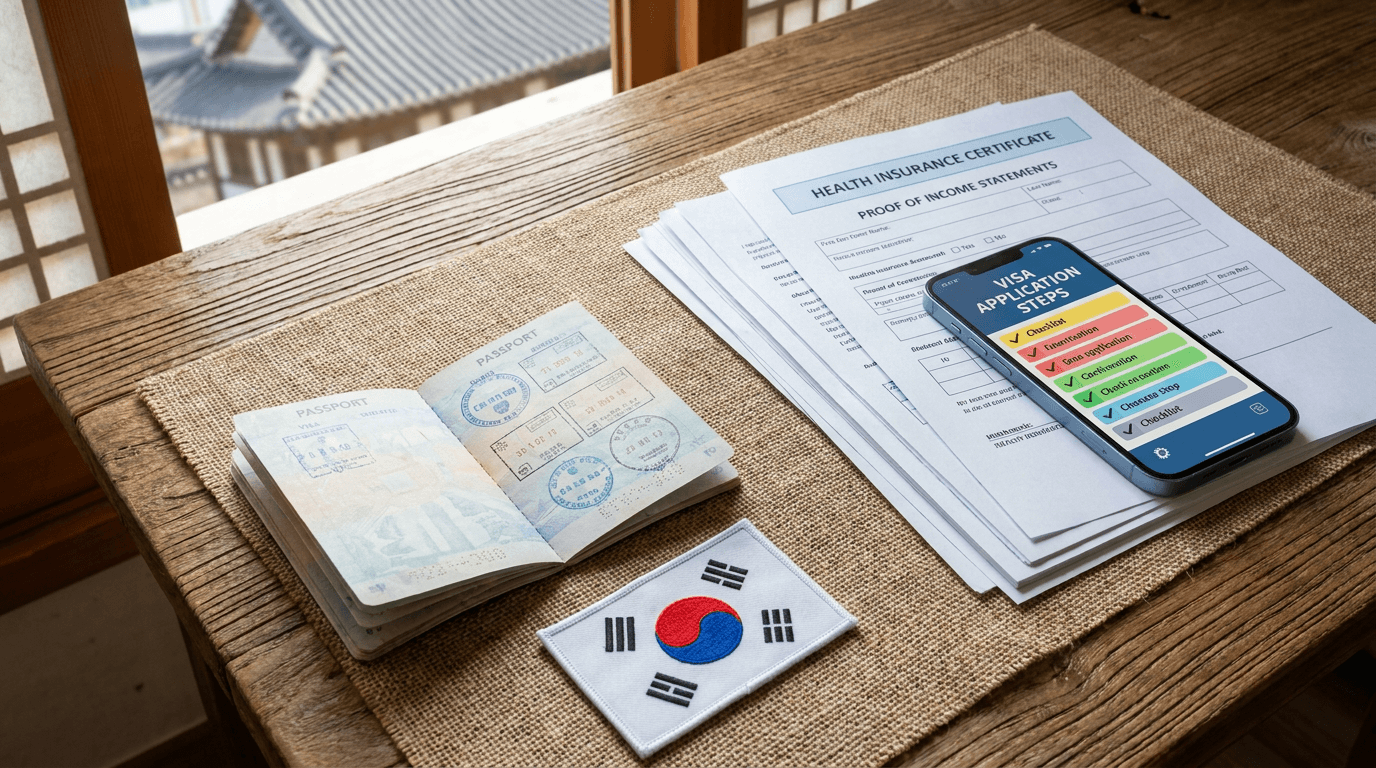
South Korea Digital Nomad Visa

At a Glance
- ₩52,410,000 a year1x the prior-year per-capita GNI published by the Bank of Korea (2025 GNI: about 52.41 million won); approximate figure · main applicant aged 18 to 34 living outside the capital region (Seoul, Incheon, Gyeonggi) or in a population-decline or decline-concern area, without accompanying family
- $60 one-timestandard fee for a single-entry visa for 91 days or longer; adjusted or waived for some nationalities under reciprocity · most nationalities
- 1 yeargranted from the date of entry at foreigner registration
- Extendable inside Korea one year at a time, up to three years in total
- 3 years
- Korean embassy or consulate abroad; people in Korea on a B-1, B-2 or C-3 short-term status who meet the requirements can change status in Korea
- Noemployment and profit-making activity in Korea are restricted
- Yesspouse and minor children; family raises the income tier
South Korea's digital nomad visa is officially the F-1-D, often called the Workation visa. It stopped being a pilot on June 30, 2026. The Ministry of Justice converted it into a standing program, raised the maximum stay from two years to 3 years and replaced the flat income requirement with a sliding scale keyed to age, region of residence and whether family comes along.
The income change is the big one. Under the pilot, every applicant faced the same bar: twice South Korea's per-capita gross national income, which on the 2025 figure equals today's top tier of ₩104,830,000 a year. The lowest tier now sits at ₩52,410,000 a year, exactly half, for solo applicants aged 18 to 34 who base themselves outside the Seoul capital region or in a designated population-decline area.
The visa is built for income earned outside Korea. Holders work remotely for a company abroad. Taking a job with a Korean company or doing profit-making work in Korea is still off-limits. A spouse and minor children can accompany the main applicant and school-age children can enroll locally.
Most South Korea digital nomad visa guides are now outdated
Anything published before July 2026 almost certainly describes the old rules. The flat requirement above 100 million won no longer applies to everyone and the two-year maximum is gone. Several Korean consular pages were still describing the F-1-D as a test-operation visa with a two-year cap weeks after the change took effect. Applicants should expect some embassy staff to quote the older figures and should be ready to point to the June 30 change. The third-year extension is handled by immigration inside Korea, not by the consulate abroad.
Why South Korea loosened the rules
The pilot barely moved. Between January 2024 and May 2026, Korea issued 743 digital nomad visas. Only 398 holders were still registered as residents in May 2026 and 340 of those, about 85%, lived in Seoul, Gyeonggi or Incheon. The ministry pitched the redesign as a tool against regional depopulation, which is why the deepest discount is reserved for people willing to live outside the capital region.
The F-1-D is open to foreign nationals aged 18 or over who work remotely for a company abroad and have worked at least one year in the same field. The ministry's program outline names employees of overseas companies, so owners of a business registered abroad should confirm their case with the mission before applying. Local Korean employment stays prohibited for the whole stay.
Income is where the June 30 redesign bites. The benchmark is South Korea's per-capita gross national income for the previous year as published by the Bank of Korea, ₩52,410,000 for 2025, and applicants are assessed on after-tax income. The multiple applied to that benchmark now depends on three things: age, whether the applicant will live inside the capital region of Seoul, Incheon and Gyeonggi and whether family comes too.
| Applicant | Capital region (Seoul, Incheon, Gyeonggi) | Outside the capital region |
|---|---|---|
| Old pilot rule, everyone (2025 GNI basis) | 2x GNI, ₩104,830,000 | 2x GNI, ₩104,830,000 |
| Aged 18 to 34, no accompanying family | 1.5x GNI, ₩78,620,000 | 1x GNI, ₩52,410,000 |
| Aged 18 to 34, with family | 2x GNI, ₩104,830,000 | 1.5x GNI, ₩78,620,000 |
| Aged 35 and over | 2x GNI, ₩104,830,000 | 1.5x GNI, ₩78,620,000 |
The won figures govern. Dollar conversions move with the exchange rate, so missions may quote different estimates.
The full schedule, including the 1.5x tier and the family rule, is set out in the program outline attached to the Ministry of Justice release of July 7, 2026. Because the benchmark is the previous year's GNI, the won amounts reset every year.
Two details decide which cell applies:
- Capital region: Seoul, Incheon and Gyeonggi Province. The reduced rates are built for the provinces, not the Seoul suburbs. Busan, Daegu, Gwangju, Jeju and smaller cities all sit outside it.
- Population-decline areas: a separate designated list that also qualifies for the reduced rate. The designation is set by the Korean government and changes, so it's worth checking the current list rather than assuming a given county counts.
For proof of income, missions generally ask for pay slips and bank statements covering the last three to six months, plus employer documentation confirming the job, the remote-work arrangement and the one-year history. Because the GNI benchmark resets every year, applicants who cleared the bar in 2024 can fall short at renewal if their earnings stayed flat while the threshold rose.
The paperwork for the F-1-D isn't light, and it varies more by consulate than most visas. The two requirements that trip people up are the income proof, which is assessed after tax against the tiered GNI schedule, and the private medical insurance floor of ₩100,000,000.
Core documents usually include:
- Visa application form: completed and signed.
- Passport: valid, with at least six months' validity on some consular checklists, plus one or two recent passport photos.
- Employment proof: a certificate of employment from the overseas company showing at least one year in the same field.
- Income proof: pay slips, a bank certificate or statements and tax documents such as an income tax return, showing after-tax income at or above the applicable tier.
- Criminal record check: an apostilled or legalized certificate from the country of nationality, and sometimes from another country of residence over the past five years.
- Medical insurance: a private policy with at least ₩100,000,000 of coverage for hospital treatment and repatriation for the whole stay.
- Family documents: marriage or birth certificates if a spouse or minor children are applying as dependants.
- Proof of residence in Korea: where the applicant will live, especially for an in-country change of status.
Some missions ask for more. The Chennai checklist adds a tuberculosis test report, a health condition form and travel insurance valid for 120 days from entry. That kind of variation is normal for this visa, so the mission handling the case is the only reliable source for the final list.
Note that the insurance figure and the income figure are different numbers that happen to look similar. Coverage is ₩100,000,000. The top income tier is ₩104,830,000 a year. Mixing them up is a common error in secondhand guides.
Korea sets consular fees on a reciprocity basis, so the government charge depends on nationality and on the mission handling the application. The standard fee for a single-entry visa for a stay of 91 days or longer is $60 for most nationalities, according to the Korean Embassy in the United States. Some nationalities pay a different amount or nothing, and visa application centers may add service and courier charges.
- Visa application fee: $60 for most nationalities, adjusted or waived for some under reciprocity. The consular fees page of the relevant embassy or consulate has the exact amount.
- Status change and extensions inside Korea: charged under the Immigration Act's enforcement rules. The local immigration office confirms the current amounts.
- Private health insurance: mandatory at ₩100,000,000 of coverage. Korea doesn't set the premium, so the price turns on age, health and insurer, and this is usually the largest line item.
- Criminal record certificate: plus apostille or consular legalization, priced by the home country rather than by Korea.
- Translation and notarization: often required for foreign documents.
The visa fee itself is modest. The real bill comes from insurance, document legalization and translation, so applicants should budget for those before booking an appointment.
Applications go through a Korean embassy, consulate or Korea Visa Application Center in the applicant's country of residence. Neither the ministry nor the missions publish a single processing time, so that answer has to come from the mission handling the case.
The sequence is straightforward:
- Confirm the income tier first: work out which cell of the age, region and family schedule applies before gathering anything else, because it decides how much income has to be documented.
- Assemble the file: application form, passport and photo, employment certificate, pay slips and bank records, tax return, apostilled criminal record certificate and the ₩100,000,000 insurance policy.
- Book and submit: at the relevant mission or visa application center.
- Enter and register: once the visa is issued, enter Korea and complete foreigner registration. The first year of stay is granted at registration, counted from the date of entry.
Applicants already in Korea can switch in some cases. The ministry's program outline lets people on a short-term B-1, B-2 or C-3 status who meet the requirements change to the F-1-D without leaving. Anyone on another status should check with the local immigration office before relying on an in-country switch.
One practical warning. Consular guidance lagged the June 30 change by weeks, and some pages still described the pilot rules. If a mission quotes a flat requirement above 100 million won or a two-year cap, the ministry's July 2026 announcement is the document to cite.
The F-1-D grants 1 year of stay, counted from the date of entry and set at foreigner registration. Since June 30, 2026, it can be extended one year at a time up to 3 years in total. Under the pilot the cap was two years.
- Initial stay: 1 year
- Extensions: one year at a time, inside Korea
- Maximum stay: 3 years in total
Renewal isn't automatic. Holders have to meet the same conditions at each extension: continued remote work for a company abroad, income at or above the applicable GNI tier and private medical insurance of at least ₩100,000,000. Because the GNI benchmark resets annually, a flat salary can quietly fall below the line between renewals.
Extensions are handled in Korea through the local immigration office, not at a consulate abroad. That holds whether the applicant entered on an F-1-D or converted status in-country. The third-year extension in particular is a domestic immigration matter, which is why consular staff may not be able to speak to it.
There's no published cool-off rule that lets a holder leave, return and start a fresh cycle, and the ministry's outline does not describe a route from the F-1-D to permanent residency or citizenship. For now it's best treated as a temporary stay of up to 3 years rather than a settlement route, notwithstanding that the ministry has said it wants remote workers to stay long enough to consider settling.
South Korea gives F-1-D holders no special tax treatment. The visa carries no reduced rate and no blanket exemption. Holders fall under the country's normal resident and non-resident rules, plus whatever treaty relief applies through their country of tax residence.
Tax residence is the first question. Under the National Tax Service rules, a person with a domicile in Korea or a residence there for 183 days or more in the tax year is a resident. Below that line, and without a Korean domicile, most people are non-residents and only Korean-source income is in scope.
The rule that matters most to a longer stay is the foreign-resident remittance basis. A foreign resident with a Korean domicile or residence totalling five years or less in the past 10 years is taxed on foreign-source income only when it is paid in or remitted to Korea. Income kept abroad usually sits outside Korea's tax net during that window. That's a general tax rule, not a visa perk, and the F-1-D's 3 years ceiling fits inside it.
- Under 183 days, without a Korean domicile: usually a non-resident.
- 183 days or more: likely a Korean tax resident.
- Foreign residents inside the remittance window: foreign income kept abroad is generally untaxed in Korea.
- Income remitted into Korea: can become taxable.
Korea also has a wide tax treaty network, which can reduce double taxation through credits, exemptions or lower withholding. Treaties don't override Korea's domestic residence tests in every case, so for anyone splitting time between countries the treaty with their home jurisdiction can matter as much as the visa. The flat-rate option available to some foreign workers depends on Korean employment and doesn't fit the F-1-D model.
Anyone planning a multi-year stay should speak to a tax adviser before arriving. The immigration side is manageable. The tax side is not, once money starts moving across borders.
Frequently Asked Questions
How much income does South Korea's digital nomad visa require?
It depends on age, region and family. The lowest tier is ₩52,410,000 a year for applicants aged 18 to 34 living outside Seoul, Incheon and Gyeonggi without family. The middle tier is ₩78,620,000 a year and the top tier ₩104,830,000 a year. The tiers are multiples of the previous year's per-capita GNI, so they reset each year.
How long can a digital nomad stay in South Korea on the F-1-D?
1 year at first, extended inside Korea one year at a time up to 3 years in total. The cap rose from two years on June 30, 2026.
Can visitors switch to the F-1-D without leaving Korea?
Yes, in some cases. People in Korea on a B-1, B-2 or C-3 short-term status who meet the requirements can change status at an immigration office, according to the Ministry of Justice outline.
Can family come on the South Korea digital nomad visa?
Yes. A spouse and minor children can join. Bringing family raises the income tier: ₩104,830,000 a year in the capital region at any age and ₩78,620,000 a year elsewhere.
Can F-1-D holders work for Korean companies?
No. Employment and profit-making activity in Korea are restricted. The visa covers remote work for a company abroad.
How It Compares
Similar visas elsewhere
| Program | Country | Income / month | Fee | Max stay | Renewable |
|---|---|---|---|---|---|
| Georgia Digital Nomad Program (Remotely from Georgia) | Georgia | - | - | - | |
| Kyrgyzstan Digital Nomad Status | Kyrgyzstan | - | - | 12 mo | |
| Kenya Class N Permit | Kenya | - | $200 | 24 mo | |
| Nepal Digital Nomad Visa (Not Yet Open) | Nepal | - | - | - |
South Korea Digital Nomad Guide
Cost of living, internet, healthcare, coworking, and every visa option for South Korea.
Visa rules change. We'll tell you.
Get notified about policy updates and new requirements for the South Korea Digital Nomad Visa and other South Korea visas.