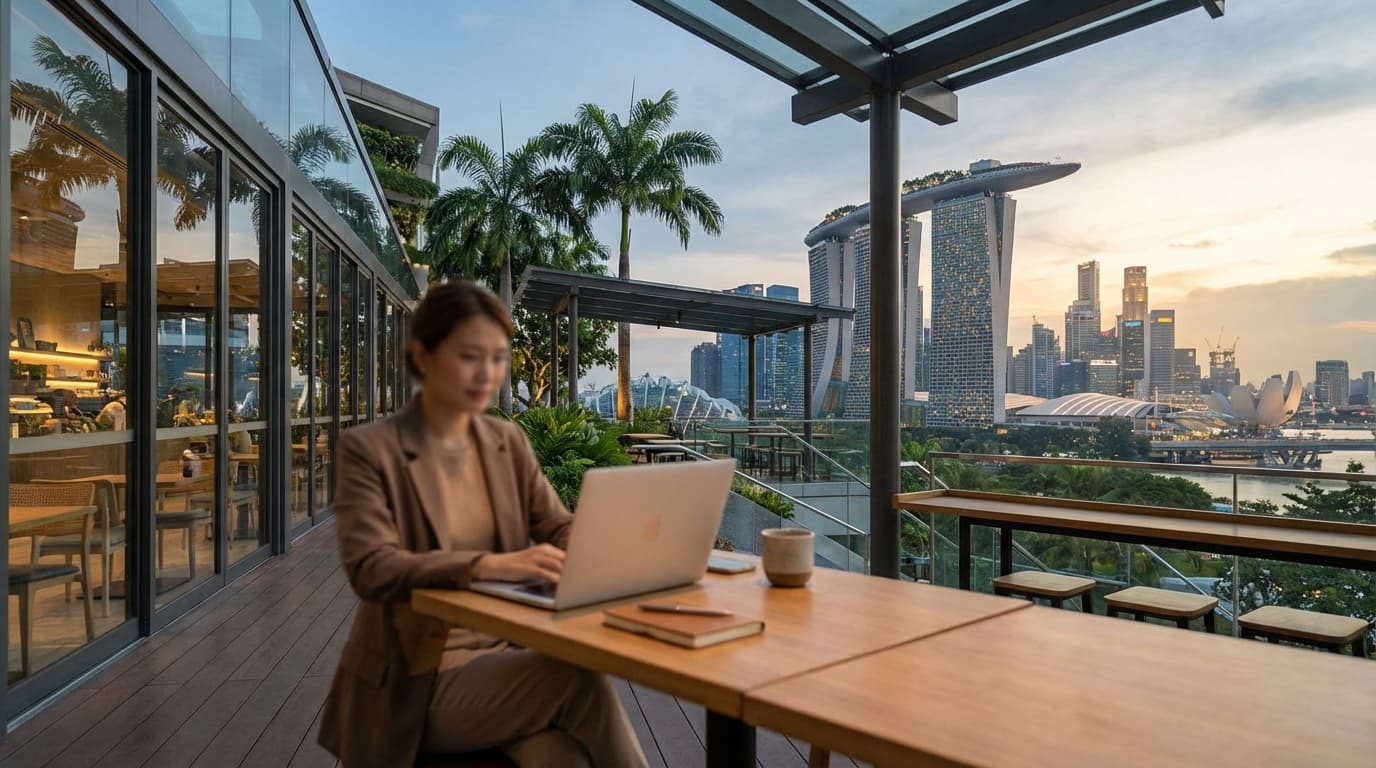
Singapore landscape
🔌Plug & Play
🇸🇬

Singapore

Complete Digital Nomad Guide

Brandon Richards
Brandon Richards ·

Policy Stability

Stamped Nomad Exclusive
10/10Very Stable

How likely visa and immigration policies are to remain unchanged

Quick Facts

Nomad Visa Cost

N/A

Income Requirement

$22,200/mo

Max Stay

6 months

Renewable

No

Cost of Living

$2,205/mo

Avg Internet

300 Mbps

Safety Score

8/10

Healthcare

High

Coworking

High

English Friendly

High

Time Zones

GMT+8

Entry Methods Available

Visa Free

Best For

familiesluxurycityasia-base

Understanding the Entry Process

Singapore doesn't have a specific "Digital Nomad Visa" yet, but its immigration system is one of the most efficient in the world. Most nomads start their journey on a Short-Term Visit Pass (STVP). If you hold a passport from the US, EU, Australia, or many other regions, you’ll likely receive this pass automatically upon arrival without any prior paperwork or fees.

The standard STVP usually grants a stay of 30 days. While it is primarily intended for tourism and social visits, it allows for basic business activities like attending seminars or meetings. If you need more time to scout the local coworking scene, you can apply for a one-time extension through the official immigration portal, typically for an additional 30 days, though approval is never guaranteed.

For those visiting specifically for networking or formal negotiations, a Business Visa is an option. This is a multiple-entry arrangement valid for 2 years, allowing stays of up to 30 days per visit. You will need a local sponsor who is a Singapore citizen or Permanent Resident to assist with the application.

Long-Term Options for Professionals

If you’re looking to move your operations to the Lion City permanently, the Ministry of Manpower (MOM) manages several work passes. These are more rigorous than a simple visitor pass and come with specific salary and qualification benchmarks.

  • Employment Pass (EP): Designed for professionals and executives. You’ll need a job offer with a minimum salary of S$5,000 (which jumps to S$5,500 in the financial sector). It’s valid for 2 years initially and renewable for up to 3 years.

  • Personalised Employment Pass (PEP): This is the "gold standard" for high-earners because it isn't tied to a specific employer, offering much more flexibility for a 3-year period.

  • EntrePass: If you are an entrepreneur looking to launch a venture-backed startup, this 1-year renewable pass is your best bet.

  • Work Holiday Pass: A fantastic option for younger nomads aged 18 to 25 who are current students or recent graduates. It allows you to live and work in Singapore for 6 months.

Bringing the Family

Singapore makes it relatively straightforward to bring family along if you are on a professional work pass. If you hold an EP or S Pass and earn at least S$6,000 monthly, your spouse and children can apply for a Dependant’s Pass. For parents or common-law partners, you’ll likely look at the Long-Term Visit Pass (LTVP).

Key Requirements and Compliance

Singapore does not offer a Visa on Arrival for nationalities that require a visa; those travelers must apply in advance using Form 14A. You can check your specific nationality requirements on the government visa website to see if you need to take action before booking your flight.

The city-state has recently updated its COMPASS framework, which is a points-based system for Employment Pass applications. This system looks at your salary, qualifications, and how your skills fill gaps in the local economy. Always ensure your passport is valid for at least 6 months beyond your arrival date, as this is a strict requirement for entry.

While the rules are firm, the digital infrastructure is seamless. Almost all extensions and applications are handled online.

Source 1 | Source 2

Source 1 | Source 2

The Reality Check: Is There a Nomad Visa?

Let's get the big question out of the way first. Singapore currently does not offer a dedicated "Digital Nomad Visa." While other Southeast Asian neighbors are rolling out specialized remote work permits, Singapore remains a bit more traditional in its immigration structure. You won't find a specific "Nomad Pass" on any official government website.

That said, plenty of nomads still make the Lion City their base for a few months. You just have to be smart about which entry path you choose and understand the boundaries of what is legally allowed. Remote work while on a tourist visit occupies a bit of a gray area; while Singapore is generally business-friendly, doing local work for local companies on a visitor pass is a hard no.

The Tourist Route (Visa-Free Entry)

Most nomads start here. Depending on your passport, you can often land in Singapore and get a stay of 30 to 90 days without any prior paperwork. This is the simplest way to experience the city's world-class infrastructure and high-speed coffee shop Wi-Fi.

  • Duration: Typically 90 days for citizens of the US, EU, UK, and Australia; 30 days for many others.

  • Requirements: A passport valid for at least 6 months, proof of sufficient funds for your stay, and a confirmed onward or return ticket.

  • Cost: Usually free, though some nationalities may need to apply for an e-visa for a small fee of S$30 to S$50.

  • The Catch: You are technically a visitor. You cannot seek local employment or sign long-term leases that require a residency permit.

The Best Alternative: Work Holiday Pass

If you are on the younger side and want a more formal setup, the Work Holiday Pass is the hidden gem of Singapore’s visa system. It allows you to live and work in Singapore for up to 6 months (or a year for certain students), and it specifically allows for remote work for overseas employers.

This pass is restricted to students and graduates aged 18 to 30 from specific countries, including Australia, France, Germany, Hong Kong, Japan, New Zealand, Switzerland, the United Kingdom, and the United States. It offers a much more stable legal footing than a standard tourist entry.

  • Financial Requirement: You must show proof of at least S$3,000 in your bank account.

  • Application Fee: Approximately S$175.

  • Processing Time: Usually around 3 weeks.

  • Renewal: This pass is generally non-renewable, making it a "one-and-done" experience.

You can start your application through the Ministry of Manpower portal. Once you receive your In-Principle Approval (IPA), you can head to Singapore to finalize your thumbprints and get your physical card.

High-Level Options for Entrepreneurs

If you have a serious tech background or a venture-backed startup, you might look into the Tech.Pass or EntrePass. These aren't really for the average freelancer; they are designed for high-net-worth innovators and require proof of significant funding or a massive monthly salary (often S$22,500 or more for the Tech.Pass).

Taxes and the Fine Print

Singapore is famous for its low tax rates, but as a nomad, you likely won't be paying them. If you stay in the country for less than 183 days in a calendar year, you are generally not considered a tax resident. Foreign-sourced income—money earned from clients outside of Singapore and paid into a non-Singaporean bank account—is typically not taxed here.

However, keep in mind that Singapore is one of the most expensive cities on the planet. Even if you aren't paying local taxes, your "tax" will be the cost of a S$25 cocktail or a S$3,000 studio apartment. Always keep your documents ready, as immigration officers may ask for proof of your remote employment contracts or 12 months of bank statements to ensure you can support yourself without working illegally in the local market.

The Entry Reality

Singapore doesn't have a dedicated "digital nomad visa" yet, so most remote workers starting their journey here rely on the standard tourist entry. The city-state is famous for its efficiency, and that extends to the border. However, because Singapore is a small island with strict laws, you need to understand exactly how much time you have before your welcome wears out.

The most important thing to remember is that Singapore does not offer a Visa on Arrival. You either walk in with a visa-free stamp or you must have your paperwork sorted well before you head to the airport.

Visa-Free Entry

If you hold a passport from the US, UK, EU, Australia, or many other Western nations, you are likely eligible for visa-free entry. This is the path most nomads take. When you land, an immigration officer will grant you an electronic Visit Pass (e-Pass) via email.

  • Duration: Most eligible travelers receive 90 days, while others may get 30 days.
  • Requirements: Your passport must be valid for at least 6 months from your date of departure.
  • Onward Travel: You must have a confirmed flight out of Singapore.
  • The SG Arrival Card: Everyone, including visa-free travelers, must submit an SG Arrival Card online within 3 days before arriving. It is free and replaces the old paper disembarkation cards.

The E-Visa Process

If your nationality is on the "Assessment Level" lists (such as India, China, or several Middle Eastern countries), you will need to apply for an e-Visa in advance. This process is handled through the SAVE system or at the nearest Singapore Overseas Mission.

To get this approved, you usually need a local sponsor who is a Singapore citizen or Permanent Resident with a SingPass account. If you don't know anyone locally, you can often apply through authorized visa agents. You should prepare to show proof of funds (often recommended at around $500 to $1,000 USD minimum) and a clear itinerary. Processing can take anywhere from a few days to two weeks, so plan your flight bookings accordingly.

Staying Longer

If your initial 30 or 90 days isn't enough to finish your project or find your favorite hawker stall, you can apply for a one-time extension of your Short-Term Visit Pass (STVP). You do this online via the ICA website before your current pass expires.

Extensions are never guaranteed. The ICA looks at your reasons for staying and your financial means. If you are approved, it is usually for an additional 30 to 89 days, depending on your original entry. Be aware that overstaying even by a single day is a serious offense in Singapore and can lead to fines, detention, or being banned from the country.

The "Border Run" Strategy

In many Southeast Asian hubs, nomads frequently hop over a border and come right back to reset their clock. In Singapore, this is risky. While there is no specific rule against it, the ICA monitors "frequent travelers" closely. If they suspect you are effectively living in Singapore on a tourist pass without a work permit, they can and will deny you entry at the border.

If you plan to leave and return, it is better to spend at least a week or two in a neighboring country like Malaysia or Indonesia rather than trying to pull a same-day turnaround at the Johor Bahru land checkpoint or Changi Airport.

Final Checklist

  • Check your nationality's specific requirements on the official MFA website.
  • Ensure your passport has at least two blank pages.
  • Have a digital or printed copy of your return flight ready for inspection.
  • Submit your SG Arrival Card before you check in for your flight.

Source 1 | Source 2

Source 1 | Source 2

Singapore is a dream destination for many digital nomads, but it doesn't make things easy for the "laptop and a backpack" crowd. Unlike many of its Southeast Asian neighbors, Singapore lacks a dedicated freelancer or digital nomad visa. If you want to stay here for the long haul, you have to play by their specific rules, which usually involve family ties, a high-paying corporate job, or a very large bank account.

The Family Route: Long-Term Visit Pass (LTVP)

If you have a spouse, parent, or child who is a Singapore Citizen or Permanent Resident (PR), the LTVP is your most straightforward path. This pass generally allows you to stay for up to 2 years at a time, and it is renewable. For spouses of locals, there is an upgraded version called the LTVP+, which offers a longer initial stay of 3 years and better access to healthcare subsidies.

  • The Requirements: You need a local sponsor who meets specific income and housing criteria. You will also need to provide official proof of your relationship, such as a marriage or birth certificate.
  • The Costs: Expect to pay a S$45 application fee and a S$60 issuance fee, plus S$30 if you need a multiple-journey visa.
  • The Timeline: Processing usually takes about 6 weeks. You can apply through the ICA e-Service using your sponsor's Singpass.

The Professional Route: Employment and S Passes

Since there is no "freelancer" category, most nomads who want to stay in Singapore full-time end up looking for a local contract. To qualify for an Employment Pass (EP), you generally need a job offer with a minimum monthly salary of S$5,000, though this threshold increases significantly if you are older or working in more competitive sectors like finance.

The S Pass is a similar option for mid-level skilled workers with a lower salary floor. Both passes act as a bridge to long-term residency. Once you have a stable job and have lived in the city for a few years, you become eligible to apply for Permanent Residency (PR). Just keep in mind that these passes are tied to your employer; if you lose the job, you usually have 30 days to find a new one or leave the country.

The Investment Route: Global Investor Programme (GIP)

If you are a high-net-worth individual looking for a "golden visa" equivalent, the GIP is the only game in town. This isn't just a long-term stay; it is a direct fast-track to Permanent Residency. It is designed for serious entrepreneurs who are ready to move their base of operations to the Little Red Dot.

  • The Buy-in: You must invest a minimum of SGD 10 million into a new or existing business, a GIP-approved fund, or a Singapore-based family office.
  • The Perks: You get PR status almost immediately, usually within 9 to 12 months, and you can apply for Singapore citizenship after just 2 years of residency.
  • The Commitment: You are expected to spend at least 183 days per year in the country to maintain your status.

Comparing Your Options

Choosing the right path depends entirely on your personal situation and financial flexibility. Here is how the main options stack up:

Long-Term Visit Pass (LTVP)

  • Eligibility: Family connection to a local citizen or PR.
  • Duration: 1 to 3 years, renewable.
  • Estimated Cost: S$105 to S$135.
  • PR Pathway: Possible for spouses and children.

Employment Pass / S Pass

  • Eligibility: Local job offer with a salary of S$5,000+ per month.
  • Duration: 1 to 2 years, renewable.
  • Estimated Cost: S$330 per issuance.
  • PR Pathway: Very strong after 2 or more years of employment.

Global Investor Programme (GIP)

  • Eligibility: High-net-worth entrepreneurs and investors.
  • Duration: Permanent Residency.
  • Estimated Cost: SGD 10 million investment.
  • PR Pathway: Immediate PR status.

Singapore does not offer a specific retirement visa. If you are looking to retire here, you will likely need to rely on the LTVP through your children or the GIP if you have the funds. For everyone else, the strategy is usually to enter on a short-term social visit pass (which lasts 30 to 90 days for most nationalities) and work on securing a more permanent sponsorship while on the ground.

Source

Source

The Price of Perfection

There is no sugarcoating it. Singapore is one of the most expensive cities on the planet. If you are coming from a digital nomad hub like Chiang Mai or Bali, the "sticker shock" will be real. However, you are paying for a level of infrastructure, safety, and efficiency that is virtually unmatched. For the 2025-2026 window, a single nomad should budget between $2,500 on the low end and $4,500+ for a lifestyle that actually lets you enjoy the city.

Your biggest hurdle is housing. The rental market has stayed aggressive, and unless you are willing to commute from the outskirts, you will likely be looking at coliving spaces or HDB (government-built) flats in areas like Tiong Bahru, Jalan Besar, or Chinatown. These spots are the sweet spot for nomads, offering a mix of heritage charm and proximity to the CBD.

Monthly Budget Breakdown

To give you a realistic idea of where your money goes, we have broken down the monthly costs for three different tiers of spending. All prices are in USD.

The Budget Tier ($2,500–$3,000)

  • Rent: $1,000–$1,700. This usually means a room in a shared HDB flat or a smaller coliving unit.
  • Food: $250–$400. You will be eating at hawker centers and cooking at home.
  • Transport: $50–$100. You are strictly using the MRT and buses.
  • Workspace: $0–$200. Utilizing public libraries and laptop-friendly cafes.

The Comfortable Tier ($3,500–$4,500)

  • Rent: $1,500–$2,300. A furnished studio or a nice room in a condo with a pool and gym.
  • Food: $400–$800. A mix of hawker meals, mid-range cafes, and delivery.
  • Transport: $100–$200. Mostly public transit with the occasional Grab ride.
  • Workspace: $200–$400. A hot desk at a dedicated coworking space.

The Premium Tier ($5,000+)

  • Rent: $2,000–$5,000. A private condo in Orchard or a high-rise in the CBD.
  • Food: $1,000+. Frequent dining at high-end restaurants and cocktail bars.
  • Transport: $200+. Relying heavily on rideshares and taxis.
  • Workspace: $400+. A dedicated desk or private office in a premium space like WeWork.

How Singapore Compares Regionally

Context is everything when you are planning your route through Asia. While Singapore is the most expensive city in Southeast Asia, it actually holds its own when compared to other major global financial hubs.

Singapore

  • Total Monthly Cost: $4,136–$4,491
  • The Trade-off: You pay a premium for world-class internet (averaging 47–305 Mbps) and incredible safety.

Bangkok

  • Total Monthly Cost: $1,920
  • The Trade-off: It is roughly 50–60% cheaper than Singapore, but you deal with more traffic and less public order.

Tokyo

  • Total Monthly Cost: $6,233
  • The Trade-off: Significantly more expensive than Singapore, especially regarding transport and high-end dining.

Kuala Lumpur

  • Total Monthly Cost: $3,920
  • The Trade-off: A great nearby alternative that is about 20–30% cheaper overall while still offering a modern city feel.

Hidden Costs to Watch

Don't forget the "boring" expenses. Utilities like electricity and water will run you $150–$300 a month, and a decent home internet connection is about $50–$100. Health insurance is also a major factor. Private expat plans generally range from $250 to $400 per month depending on your age and coverage needs. You can check current community data and price fluctuations on Nomad List to stay updated on the ground reality.

The "Singapore Hack" for nomads is simple: use the public transit system, which is arguably the best in the world, and embrace the hawker culture. You can get a world-class meal for $5 at a hawker center, but a mediocre burger at a "western" restaurant will cost you $25. If you master that balance, the city becomes much more manageable.

While Singapore is technically a single city-state, don't let its size fool you. The island is divided into distinct districts that feel like entirely different cities. Whether you want the high-octane energy of a global financial hub or a grit-meets-glam neighborhood with a burgeoning cafe scene, there is a pocket of Singapore that fits your workflow.

The infrastructure here is world-class across the board. You can expect internet speeds hitting 90 Mbps in most public spaces and cafes, and a public transit system that makes a car completely unnecessary. Here are the three best neighborhoods to plant your flag.

1. CBD & Marina Bay

This is the heart of the action. If you want to be surrounded by skyscrapers, rooftop bars, and the most prestigious business addresses in Asia, this is your spot. It is the most "corporate" of the options, but for networking and high-end amenities, it is unbeatable.

The Workspace Scene: You will find the highest density of premium coworking spaces here. WeWork at 21 Collyer Quay is a standout, offering hot desks for S$39/day and full access for S$399/mo. If you prefer variety, the workbuddy pass (ranging from S$129 to S$299/mo) grants you access to over 50 spaces across the city, many of which are clustered in this area.

  • Cost of Living: Highest. Expect hotel stays to exceed S$500/night and cocktails to run S$25+.

  • Nomad Community: Largest and most active. You will find constant networking events at incubators like BLOCK71 or business lounges in Marina Bay Sands.

  • Vibe: Fast-paced, polished, and professional.

  • Safety: Excellent, with well-lit streets and constant activity.

2. Duxton Hill & Outram Park

If the CBD feels too stiff, Duxton Hill is the antidote. This neighborhood is famous for its preserved shophouses and walkable streets. It blends heritage architecture with a trendy, creative energy that attracts freelancers and startup founders who value aesthetics as much as productivity.

The Workspace Scene: The community here is more intimate. The Co. Duxton focuses on wellness and stylish design, making it a favorite for those who find glass-and-steel offices soul-crushing. When you need a break, the area is packed with world-class coffee, such as Nylon Coffee Roasters, which doubles as a great unofficial networking hub.

  • Cost of Living: Medium-High. It is still pricey, but you can find more diverse boutique accommodation and mid-range dining.

  • Nomad Community: Strong and focused on lifestyle. You will find more mixers centered around wellness or creative arts than just "business."

  • Vibe: Charming, sophisticated, and very walkable.

  • Safety: Excellent, with a cozy neighborhood feel.

3. Jalan Besar & Kallang

For the nomad on a slightly tighter budget or someone looking for the "next big thing," Jalan Besar is the place to be. It is an up-and-coming district that mixes industrial hardware shops with some of the best specialty coffee shops in the country. It is less polished than Marina Bay but has far more character.

The Workspace Scene: The WeWork at 380 Jalan Besar is a gem for nomads because it includes a rooftop gym and pool, allowing you to bake your workout and recharge time right into your office day. Prices here are generally more accessible than the downtown core.

  • Cost of Living: Medium. This is one of the more affordable areas for nomads to find coliving spaces or local apartments.

  • Nomad Community: Growing. It is not as event-heavy as the CBD, but the coliving scene here is thriving.

  • Vibe: Relaxed, gritty-chic, and authentic.

  • Safety: Excellent, though it feels more like a lived-in residential and industrial area.

Neighborhood Comparison at a Glance

CBD / Marina Bay

  • Coworking Density: Highest (WeWork, JustCo, Great Room)

  • Cost of Living: Highest

  • Nomad Community: Largest with frequent professional events

  • Nightlife & Cafes: Best for high-end bars and luxury dining

Duxton Hill / Outram Park

  • Coworking Density: Medium (Boutique spaces like The Co.)

  • Cost of Living: Medium-High

  • Nomad Community: Strong focus on wellness and creative mixers

  • Nightlife & Cafes: Vibrant cocktail bars and artisanal coffee

Jalan Besar / Kallang

  • Coworking Density: Medium (Modern hubs with lifestyle amenities)

  • Cost of Living: Medium

  • Nomad Community: Growing, centered around coliving spaces

  • Nightlife & Cafes: Emerging craft beer and specialty cafe scene

Singapore is the undisputed heavyweight champion of connectivity. If your income depends on high-bandwidth video calls, massive file transfers, or lag-free remote desktop sessions, you’ve found your paradise. The city-state is blanketed by a nationwide fibre network that makes most "high-speed" Western internet look like dial-up.

The Fastest Home Internet on Earth

In Singapore, 10Gbps is the new 1Gbps. Thanks to the NetLink Trust infrastructure, almost every residential unit in the country has access to symmetrical fibre broadband. This means your upload speeds are just as fast as your downloads, which is a dream for creators and developers.

If you are signing a longer lease, the value is incredible. Most 24-month contracts hover between S$25 and S$50 per month. Here is how the main players stack up for entry-level gigabit speeds:

  • WhizComms: The budget king, offering 2.5Gbps for S$24.80. It is no-frills, but it gets the job done.
  • M1: A solid middle ground at S$29.50 for 3Gbps. They are currently pushing WiFi 7 hardware to ensure your devices can actually handle those speeds.
  • ViewQwest: Known for being "router-agnostic," they offer 3Gbps for S$30.00. They are popular with the tech-savvy crowd who prefer their own networking gear.
  • MyRepublic: A favorite for gamers and heavy streamers, priced at S$37.99 for 3Gbps.
  • StarHub: At S$39.91 for 3Gbps, they often sweeten the deal with free installation and top-tier WiFi 7 routers.
  • Singtel: The premium incumbent. Their basic 2Gbps plan starts at S$50.26, but they offer the most robust 10Gbps bundles if you have the budget.

Coworking Spaces: Where to Set Up Shop

While home internet is cheap, Singapore's apartments can be tiny. Most nomads gravitate toward coworking hubs like WeWork, JustCo, or The Working Capitol. These spaces are enterprise-grade; they leverage the same national fibre backbone but with professional-level redundancy. You can generally expect symmetrical speeds between 3Gbps and 10Gbps shared across the floor.

Monthly hot desk passes typically range from S$300 to S$800 depending on the location's prestige and amenities. If you are just passing through, many spots offer day passes for around S$30 to S$50. These hubs are concentrated in the Downtown Core, Orchard Road, and the hip Tanjong Pagar neighborhood.

Cafe Culture and Public WiFi

Working from cafes is a local pastime, though some popular spots in the Central Business District have "no laptop" policies during lunch hours. Where WiFi is provided, it is usually excellent. Even a basic cafe connection often clocks in at 100Mbps or higher because the underlying infrastructure is so modern.

For a free backup, look for Wireless@SGx. It is the government's free public WiFi network. Once you set up the profile on your device, you will automatically connect at malls, subway stations, and libraries across the island. It is not quite "10Gbps fast," but it is more than enough for emails and Slack.

Mobile Data and 5G

Singapore has near-total 5G coverage. If you are a short-term visitor, grab a Singtel or M1 tourist SIM at the airport. These usually come loaded with 100GB of data for a very reasonable price. For longer stays, look into SIM-only plans from providers like Circles.Life or Giga. These "digital-first" telcos offer massive data buckets for around S$20 a month with no lock-in contracts.

Before committing to a provider, you can check the latest network performance maps on OpenSignal to see which carrier has the strongest signal in your specific neighborhood.

Singapore is world-renowned for its medical care, often ranking at the top of global health indices. For a digital nomad, this means you have access to some of the best doctors and facilities on the planet. However, the system is tiered, and as a non-resident, you are playing by a different set of financial rules than the locals.

Public vs. Private: The Great Debate

The public healthcare system in Singapore is excellent, but it is primarily designed to be a subsidized safety net for citizens and Permanent Residents (PRs). They fund this through a mandatory savings scheme called the 3Ms. As a digital nomad, you do not have access to these subsidies. You will pay the full freight for every visit, and you will likely face longer wait times at public polyclinics.

Most expats and nomads head straight for the private sector. Hospitals like Mount Elizabeth, Gleneagles, and Parkway Pantai feel more like five-star hotels than medical facilities. The wait times are negligible, the staff speaks perfect English, and the technology is cutting-edge. You pay for the privilege, but the efficiency is hard to beat when you are trying to get back to work.

  • Public Polyclinics: High quality, but expect queues. A basic consultation for a foreigner is about SGD 60.88, compared to about SGD 31.99 for a citizen.
  • Private Clinics: Faster service and more privacy. Consultation fees vary wildly but expect to pay a premium for the convenience.
  • Specialists: Singapore is a regional hub for medical tourism, so finding a world-class specialist for any specific issue is easy.

Insurance is Not Optional

Because you are ineligible for government subsidies, a single hospital stay can wipe out your travel budget. If you are in Singapore on a formal work permit, your employer is legally required to provide a minimum of SGD 15,000 in annual coverage. If you are there on a tourist landing or a remote work visa, the responsibility is entirely on you.

You have two main paths for coverage. Local "Integrated Shield Plans" can upgrade your coverage for private wards, but most nomads prefer international plans that follow them across borders. Providers like AXA offer great digital perks like virtual doctor visits and mental health support. If you are hopping around Southeast Asia, look into Nomadwise or IMG Global Prima. These plans often allow you to select "Zone" coverage, which can lower your premiums if you exclude expensive regions like the USA.

Estimating Your Costs

Budgeting for health in Singapore requires a realistic look at the "foreigner rate." Without insurance, you are billed at the highest tier. Here is what to keep in mind for your monthly spreadsheet:

  • Routine GP Visit: SGD 60 to SGD 100 depending on the clinic and medication.
  • Emergency Room Visit: Expect to pay several hundred dollars just for the intake and initial tests.
  • Specialist Consultation: Often starts at SGD 200 and goes up quickly.

Pharmacies and Prescriptions

Finding a pharmacy is the easiest part of staying healthy in Singapore. Major chains like Guardian, Unity, and Watsons are in almost every shopping mall and MRT station. They carry a wide range of Western brands and over-the-counter medications. If you have a prescription from a local doctor, it can be filled at these retail pharmacies or directly at the hospital. Many international insurance plans offer direct billing for outpatient drugs, which saves you the hassle of filing claims later.

In Case of Emergency

If you find yourself in a life-threatening situation, dial 995 for a government ambulance. They will take you to the nearest public hospital emergency department. The care is immediate and world-class. Just be aware that while they won't ask for a credit card while you are in the ambulance, the full, unsubsidized bill will arrive once you are stabilized. For non-emergencies where you still want urgent care, private hospitals run 24/7 clinics that are much faster but significantly more expensive.

Singapore is a global financial powerhouse, but don't let the gleaming skyscrapers fool you. For a digital nomad, opening a traditional bank account here is often more trouble than it's worth. Unless you hold an Employment Pass, Permanent Residency, or have $16,500 to $165,000 USD ready for a minimum deposit, local giants like DBS and OCBC will likely show you the door.

Local banking is great for expats buying property or settling in for a decade. For the rest of us, the smart move is sticking with borderless fintech solutions. They offer the same functionality with none of the paperwork headaches.

The Digital Nomad Power Duo: Wise vs. Revolut

Most nomads in Singapore rely on a combination of Wise and Revolut. These platforms allow you to hold and spend Singapore Dollars (SGD) without the 3% to 5% hidden FX markups traditional banks love to charge.

Wise is the gold standard for transparency. It uses the mid-market exchange rate and charges a small, upfront fee, usually under 1%. It provides you with local Singapore receiving details, meaning you can get paid by local clients via FAST transfers as if you had a local bank account. It also gives you bank details for the US, UK, EU, and Australia, helping you dodge those $15 to $45 intermediary wire fees.

Revolut shines as a lifestyle app. While its exchange rates are excellent during the week, be aware of the 1% markup on weekends when markets are closed. It offers great perks like travel insurance, eSIM data plans, and basic crypto trading, though its ATM withdrawal limits on free plans are tighter than Wise.

Comparing Your Options

  • Wise: Best for receiving client payments and low-cost transfers. It supports 40+ currencies and is available to residents of almost every country.
  • Revolut: Best for budgeting and travel perks. It supports 30+ currencies but is only available to residents in specific regions like the US, UK, Europe, Australia, and Singapore.
  • Traditional Banks: Best for long-term residents. They require strict proof of address and high balances, but offer local credit cards and mortgages.

Cash and ATM Strategy

Singapore is incredibly digital, but you will still need cash for the occasional meal at a hawker center. Both Wise and Revolut work at almost any ATM in the city. Wise allows two free withdrawals per month up to a set limit, while Revolut's free tier has a monthly cap before fees kick in. Since the Singapore Dollar (SGD) is the only currency used, always choose to "Pay in Local Currency" if an ATM or card reader asks to do the conversion for you.

Crypto and Digital Assets

Singapore has clear, strict rules managed by the Monetary Authority of Singapore (MAS). For personal use, you won't run into issues. Revolut allows you to buy and hold crypto directly in the app, which is a convenient way to manage your portfolio while on the move. There are no bans on individuals using multi-currency accounts to fund crypto exchanges, provided you follow standard verification (KYC) procedures.

Best Practices for Money Transfers

  • Use Wise Business if you need to send batch payments to contractors; there are no monthly subscription fees.
  • Avoid using your home country's debit card at ATMs, as your home bank will likely hit you with a 3% foreign transaction fee on top of a bad exchange rate.
  • Keep a small amount of SGD in your Wise or Revolut digital wallet to use with Apple Pay or Google Pay, which are accepted almost everywhere from taxis to high-end boutiques.

Keeping the Family Together: Visas and Paperwork

Moving your family to Singapore is a relatively straightforward process if you meet the income thresholds. If you are holding an Employment Pass or S Pass, you can sponsor your spouse and unmarried children under 21 for a Dependant’s Pass (DP). The main catch is that you need to earn a minimum fixed monthly salary of S$6,000 to qualify as a sponsor.

For those on an EntrePass, the bar is a bit higher. You will need to show your business is hitting specific milestones, like an annual spend of at least S$100,000 and hiring local staff. If you have a common-law partner or parents you want to bring along, you will need to look into the Long-Term Visit Pass (LTVP) instead.

Your employer usually handles the application through the Ministry of Manpower (MOM) portal. Processing generally takes 3 to 5 weeks. Budget for a S$105 application fee and a S$225 issuance fee per person. Make sure you have your marriage and birth certificates ready, as these are non-negotiable.

Health and Schooling Requirements

Singapore takes public health seriously, especially for the little ones. If you have children under 12 born outside of Singapore, you must get a Vaccination Verification from the Health Promotion Board before you even apply for their visa. Diphtheria and measles vaccinations are mandatory requirements for entry.

While Singapore has a world-class public school system, most nomad families opt for international schools due to the difficulty of securing spots in local schools as a non-resident. Be prepared for a significant line item in your budget here. Annual tuition for top-tier schools like United World College or Tanglin Trust typically ranges from S$25,000 to S$40,000 depending on the grade level.

Childcare and kindergarten costs are more varied but still a major expense. You can expect to pay between S$700 and S$1,500 monthly for licensed infant or toddler care. Since foreigners do not qualify for the government subsidies that locals get, your out-of-pocket costs will be on the higher end of that scale.

Where to Set Up Base

Singapore is a compact city-state, so you are never truly far from anything. That said, certain neighborhoods are magnets for families because of their proximity to parks and international schools. Here are the top picks for nomad families:

  • Orchard and River Valley: Central and convenient. You get high-end condos, easy access to malls, and plenty of indoor play areas for rainy days.
  • Bukit Timah: This is the "green" heart of the island. It feels less like a concrete jungle and is home to many of the city's best international schools and the Botanic Gardens.
  • East Coast: Ideal if you want a laid-back vibe. You have the beach, a massive coastal park for cycling, and larger family-sized apartments that offer more bang for your buck.

Safety and Healthcare

You can breathe easy when it comes to safety. Singapore consistently ranks as one of the safest places on Earth. It is common to see children taking public transport alone or families out in parks late at night. The infrastructure is designed with strollers and pedestrians in mind, making it easy to get around without a car.

For healthcare, your family will have access to excellent public polyclinics and hospitals. However, as a DP holder, you will pay "at-cost" rates rather than the subsidized rates citizens enjoy. Private medical insurance is a must. Most EP holders have some coverage through their employers, but you should check if it covers your dependents or if you need to top it up with a private plan for comprehensive pediatric care.

The Gold Standard of Safety

Singapore is famously one of the safest cities on the planet. Whether you are walking home from a late-night coding session in Tanjong Pagar or exploring the outskirts of the island at 3:00 AM, the risk of violent crime is statistically negligible. With a violent crime rate of just 0.2 per 100,000 people, it outranks almost every other nomad hub in the world.

The city's security is built on a foundation of high-tech surveillance and strict social contracts. By 2030, the government plans to have over 200,000 police cameras active across the island. While this level of monitoring might feel intense to some, it results in an environment where you can leave your laptop on a cafe table to use the restroom without much worry. Just keep in mind that while muggings are nearly unheard of, petty crimes like pickpocketing can still happen in packed MRT stations or crowded malls.

Digital Threats and Scams

The real "danger" in Singapore has shifted from the streets to the screen. Transnational scams are the biggest headache for the expat community. Rental scams are particularly common; in 2023 alone, victims lost roughly $1.3 million to fraudulent home listings. If a deal for a luxury condo on Orchard Road seems too good to be true, it almost certainly is. Always verify property agents through the Council for Estate Agencies before handing over a deposit.

You should also be wary of "fake friend" calls and phishing attempts. These schemes often target foreigners who might be less familiar with local banking procedures. If you get an unexpected call asking for a "loan" or sensitive data, hang up and report it. The police are very proactive about these cases, but prevention is your best bet.

The "Fine" City: Rules and Etiquette

Singapore’s reputation as a "fine city" is well-earned. The laws are strict, and they are enforced regardless of your passport. To stay on the right side of the authorities, you need to internalize a few specific rules:

  • No Vaping: Unlike many other nomad hotspots, e-cigarettes are strictly illegal. Possession can lead to a $2,000 fine or even jail time.
  • Public Transit Rules: Do not eat or drink on the MRT. Even a sip of water can result in a $500 fine.
  • Smoking Zones: Only smoke in designated "yellow boxes." Lighting up outside these areas can cost you between $200 and $1,000.
  • Cleanliness: Littering and jaywalking are taken seriously. Stick to the crosswalks and use the bins.

Culturally, the vibe is professional and reserved. People value punctuality and hierarchy. While English is the primary language for business and daily life, you will hear "Singlish" everywhere. It is a colorful mix of English, Malay, and Chinese dialects. You don't need to speak it, but understanding a few terms like "can" (meaning yes/possible) or "chope" (reserving a seat at a hawker center with a pack of tissues) will help you blend in.

LGBTQ+ and Social Inclusivity

Singapore is a multicultural melting pot where nearly 50% of the population is foreign-born. This makes it an incredibly easy place to integrate as a digital professional. While the country decriminalized sex between men in 2023, it remains socially conservative in many ways. Same-sex marriage is not legally recognized, and public displays of affection are generally discouraged for all couples, regardless of orientation.

That said, the expat and tech circles are very progressive and welcoming. You will find a thriving, albeit discreet, LGBTQ+ scene in areas like Neil Road. As long as you respect local norms regarding public behavior, you are unlikely to face any issues.

Pro Tips for Integration

Integrating into the local scene is straightforward if you know where to look. Most nomads gravitate toward co-working spaces like The Hive or WeWork, which serve as social anchors. If you want to meet people outside of work, join Facebook groups or check InterNations for organized meetups.

  • Eat Local: Visit hawker centers like Maxwell or Old Airport Road. It is the fastest way to understand the heart of Singaporean culture.
  • Return Your Tray: It is now mandatory to return your food trays at public eating houses. Failing to do so can result in a fine.
  • Use the MRT: The transit system is world-class. It is safer, cleaner, and often faster than taking a Grab.
  • Respect the Queue: Singaporeans love a good queue. Whether it is for a bus or a famous plate of chicken rice, wait your turn patiently.

Understanding the Territorial System

Singapore’s tax system is a breath of fresh air compared to most high-cost hubs. They operate on a territorial basis, which means the tax office, known as IRAS, generally only cares about income earned within Singapore's borders. If you are sitting in a cafe in Tiong Bahru working for a client in London and getting paid into a UK bank account, that money is typically considered foreign-sourced and stays out of the Singapore tax net.

However, the moment you start taking on local clients or working for a Singapore-based entity, the rules shift. Your tax liability then depends entirely on how many days you spend on the island. Singapore uses a strict day-counting method to determine your residency, and hitting certain thresholds can drastically change your bill.

The 183-Day Rule

The magic number in Singapore is 183 days. If you stay or work in the country for 183 days or more in a calendar year, you are considered a tax resident for the following Year of Assessment. As a resident, you get access to progressive tax rates that start at 0% for your first S$20,000 and scale up to 24% for high earners. You also become eligible for various tax reliefs that can lower your taxable base.

If you are planning a long-term stay, keep these residency triggers in mind:

  • The 3-Year Rule: If you stay in Singapore for three consecutive years, you are treated as a resident for all three years, even if you didn't hit the 183-day mark in one of those years.
  • The Straddle Rule: If your stay spans two years and totals at least 183 days continuously, you are generally considered a resident for both years.
  • The 60-Day Grace Period: If you work in Singapore for 60 days or less, your employment income is usually exempt from tax. This is the "sweet spot" for short-term nomads.

Rates for Non-Residents

If you stay between 61 and 182 days, you are classified as a non-resident. In this bracket, you don't get the progressive scales or tax reliefs. Instead, you'll pay a flat 15% on employment income or the resident rate, whichever results in a higher tax amount. For other types of Singapore-sourced income, like director fees or freelancing for local firms, the flat rate jumps to 22%.

Tracking your dates is non-negotiable. Use a tracking app or keep a meticulous log of your passport stamps. The IRAS counts the day of arrival and the day of departure as full days, so a quick weekend trip to Malaysia still counts toward your Singapore total if you don't time it right.

Crypto and Foreign Income

Singapore is famously friendly toward capital gains. There is no capital gains tax here, which extends to most cryptocurrency trading. If you are a casual investor or a nomad living off crypto gains sourced from overseas platforms, you generally won't owe a cent to Singapore. Taxes only kick in if you are trading so frequently that it is deemed a professional business activity based in Singapore.

Similarly, foreign-sourced income is generally not taxed even if you are a resident, provided it isn't received in Singapore through a partnership. This makes it a strategic base for those with global revenue streams. You can find more specific details on the IRAS official website.

Double Taxation and Filing

Singapore has a massive network of over 90 double taxation agreements. These treaties ensure you aren't taxed twice on the same dollar by both Singapore and your home country. If you are a US citizen, remember that the IRS still requires you to report worldwide income regardless of where you live. You will likely use Form 1116 to claim foreign tax credits for any' dollars paid to the Singaporean government.

If you cross the residency threshold, you must file Form B1 by April 15 each year. For non-residents who earned Singapore-sourced income, you are still required to file if your earnings exceed the exemption limits. It is a digital-first system, so you will handle most of this through the myTax Portal using your Singpass or assigned tax identification number.

Singapore is often called a "plug-and-play" city for digital nomads because everything works exactly as it should. However, the cost of living here is high, and small mistakes in how you set up your tech or transport can eat into your budget quickly. Use these practical shortcuts to hit the ground running without the usual transition friction.

Connectivity and SIM Cards

Don't waste time hunting for a physical SIM card booth at Changi Airport. An eSIM is the standard move here, allowing you to activate your data the moment your wheels touch the tarmac. If your phone supports it, you'll avoid the long queues at the currency exchange counters where physical SIMs are sold.

For the best balance of price and performance, look at these providers:

  • Nomad: They use the StarHub network and offer great flexibility. You can grab 1GB for 7 days for about USD$4, or go big with 50GB for 30 days for USD$29. It supports hotspots, which is a lifesaver if you need to work from a park or a cafe with spotty Wi-Fi.

  • Maya Mobile: A solid choice if you don't want to track gigabytes. They offer unlimited 4G LTE plans with instant email activation.

  • Singtel Tourist eSIM: If you want the fastest 5G+ speeds, Singtel is the local heavyweight. Their tourist plans range from $18 to $30 SGD for 28 days. You can pre-order online to make the setup seamless.

If your phone isn't eSIM compatible, you can still get a physical prepaid SIM from M1 or StarHub. These offer incredible value, often giving you 100GB for 10 to 15 days for around $6 to $8 USD. Just remember that you’ll need to show your passport for registration when you pick it up at the airport.

Getting Around and Staying Fed

Forget about trying to hail a cab on the street. Download Grab before you arrive. It’s the "everything app" of Southeast Asia. You’ll use it for private rides, booking standard taxis, and even topping up your public transport cards. The MRT (subway) system is world-class, but for those late-night runs back from the office or a cocktail bar, Grab is your best friend.

For food, GrabFood and Foodpanda are the two dominant players. They deliver everything from high-end bistro meals to $5 SGD chicken rice from the local hawker centers. If you're staying in a residential area, these apps are a godsend for those deep-work days when you can't leave your desk.

Where to Set Up Base

Singapore is small, but the vibe changes significantly from one block to the next. For a true nomad experience, look at these neighborhoods:

  • Tiong Bahru: This is the hipster heart of the city. It’s filled with Art Deco architecture, quiet cafes, and some of the best bookstores in town. It’s walkable and has a great mix of short-term rentals.

  • Joo Chiat/Katong: Located in the East, this area is famous for its colorful Peranakan shophouses. It’s slightly more affordable than the city center and has a massive local food scene.

  • Orchard or Chinatown: These are the central hubs. You'll be close to every major co-working space and business amenity, though you’ll pay a premium for the convenience.

When searching for a place to stay, Airbnb and Booking.com are reliable for short stints. For stays of a month or longer, check PropertyGuru or Ohmyhome to find furnished apartments that cater to professionals.

Safety and Local Basics

English is the primary language for business and daily life, so you won't struggle to communicate. If you find yourself in more traditional spots in Chinatown or Geylang, having Google Translate or Pleco (for Mandarin) can help with specific menu items, but it's rarely a requirement.

Singapore is incredibly safe, but it’s always smart to have the emergency numbers saved in your phone:

  • Police: 999

  • Ambulance and Fire: 995

  • Non-emergency Police: 1800-255-0000

Common Pitfalls to Avoid

Many nomads make the mistake of assuming 5G is everywhere. While coverage is good, many prepaid plans throttle your speed or stick to LTE. Honestly, the 4G speeds here are faster than the "high-speed" internet in many other countries, so don't pay extra for 5G unless you really need it.

Also, keep your home SIM active. Many banking and two-factor authentication services will send codes to your original number. Using a dual-SIM phone or a cheap burner for your local data is the best way to ensure you aren't locked out of your accounts while abroad.

Latest Nomad News

Singapore Updates Salary Thresholds for Employment Passes

Starting in 2025 and extending through 2028, Singapore will increase the minimum qualifying salaries for Employment Pass and S Pass applicants. These changes will make it more difficult for mid-to-junior level foreign professionals to secure or renew work visas as the government prioritizes higher-skilled talent.

Singapore Rolls Out ONE Pass AI Track and Work Pass Updates

Singapore is introducing a specialized ONE Pass track for AI and Tech talent starting January 2027. The updates also include an expanded occupation list for work permits and streamlined levy structures to be implemented by 2028.

What to Know About Singapore's Shifting Work Permit Rules

Singapore will increase the Local Qualifying Salary to $1,800 in 2026, which impacts the quota for hiring foreign workers on S Passes and Work Permits. Additionally, the Work Permit for Performing Artistes will be discontinued on June 1, 2026, affecting foreign entertainers in the nightlife and arts sectors.

Singapore Updates Employment Pass Salary Requirements

Singapore will increase the minimum qualifying salary for new Employment Pass applicants to $6,000, and $6,600 for financial services, starting January 2027. S Pass thresholds will also rise to $3,600, impacting eligibility for foreign professionals and mid-level skilled workers.

Inside Singapore’s Biometric Immigration System

Singapore is transitioning to a fully automated immigration system, allowing all foreign travelers to use biometric lanes without prior registration. This update will significantly reduce wait times for expats and digital nomads entering or exiting the country through Changi Airport.

More Guides from Southeast Asia

Stay Updated on Singapore

Get notified about visa changes, policy updates, and new information for digital nomads in Singapore.