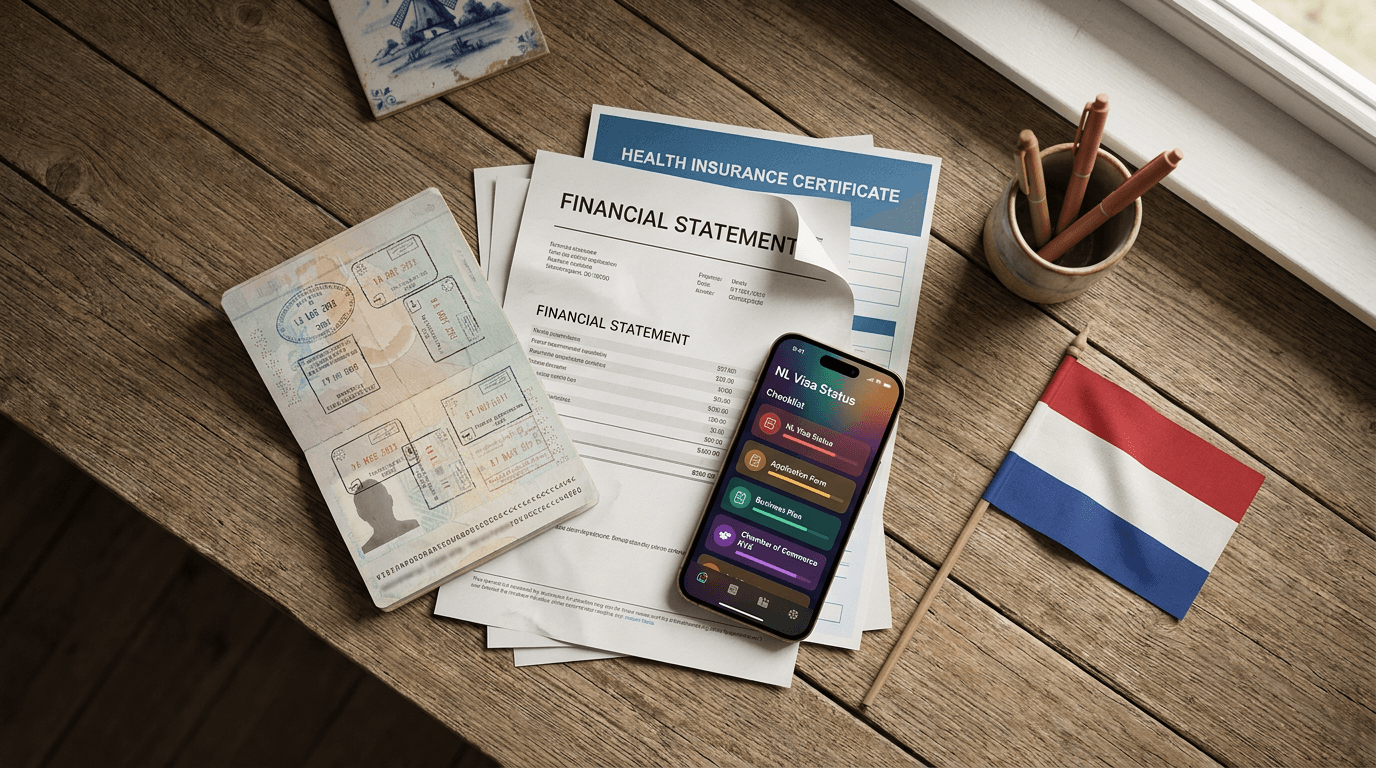
Netherlands Self-Employed Residence Permit
Visa Data Sheet
- $1,874 / mo
- $455 – $465
- 13 weeks
- 60 months
The Netherlands self-employed residence permit is the country’s main route for non-EU, non-EEA and non-Swiss nationals who want to run their own business or freelance from a Dutch base. It’s not the same thing as a short-stay Schengen visa. That only covers visits of up to 90 days in any 180-day period and doesn’t let you set up shop long term.
This permit, usually called arbeid als zelfstandige, is for people working for their own account and risk. In practice, that means independent entrepreneurs, freelancers and contractors and sometimes founders who’ve moved on from a startup visa and are now trading on a self-employed basis.
The Dutch government looks at one big question: does your work serve an essential Dutch interest? That can include economic value, innovation or other added value to the Netherlands. The Immigration and Naturalisation Service or IND, may use a points-based assessment and can seek advice from the Netherlands Enterprise Agency.
- Who it’s for: Non-EU, non-EEA and non-Swiss nationals who want to live in the Netherlands and work as self-employed.
- What it allows: Long-stay residence and self-employed work, not ordinary salaried employment.
- Main test: Your business has to benefit the Dutch economy in a way the IND accepts.
The income bar is clear and it’s not tiny. For applications made between Jan. 1 and June 30, 2026, the required gross profit is €1,734.57 a month, including holiday allowance. If you’re applying from outside the country, you’ll usually need both an MVV, which is a provisional long-stay visa and the residence permit through the entry and residence procedure.
EU, EEA and Swiss nationals don’t need this permit at all. They can live and work in the Netherlands under free-movement rules, though they still have to handle local registration, tax and business paperwork like everyone else.
One annoying bit: the official guidance doesn’t give a simple one-size-fits-all answer on processing time or permit length in the material reviewed here, so you shouldn’t assume it’ll be fast or automatically long-term. What’s clear is that this is a real residence route, not a loophole and it’s the one self-employed applicants have to use if they want to stay beyond the short-stay limit.
The Netherlands self-employed residence permit or arbeid als zelfstandige, is for non-EU, non-EEA and non-Swiss nationals who want to work for themselves in the country. That includes freelancers, independent entrepreneurs and self-employed artists. The Dutch don’t hand this out just because you can invoice clients, though. Your work has to be judged to be of “essential interest” to the Dutch economy or to Dutch culture if you’re an artist.
There isn’t a simple age cutoff in the rules. What matters is that you can legally start and run a business, meet the general residence conditions and don’t raise public-order concerns. EU, EEA and Swiss citizens generally don’t need this permit to be self-employed in the Netherlands.
For most applicants, the real hurdle is the business case. The IND wants to see that your work is viable and that your income will meet the required threshold. In 2026, that means a projected gross profit of at least €1,734.57 a month, including holiday allowance. The official figures are published in euros only and they change periodically.
- Business registration: You must be registered or ready to register, with the Dutch Chamber of Commerce, known as the KvK.
- Income proof: Your business plan has to show that you can meet the monthly gross-profit requirement on a sustainable basis.
- Professional rules: If your trade is regulated, you still need to meet the Dutch licensing or registration rules for that profession.
- Freelancers: You need one or more commissions in the Netherlands and you have to work independently, not as someone with an employer.
There are some useful carve-outs. U.S. and Japanese nationals can apply under the treaty route, which skips the RVO points-based assessment. Turkish nationals and people with long-term EU resident status in another member state also avoid that points test. Self-employed artists are assessed a little differently too, with culture-focused review from the Ministry of Education, Culture and Science.
The fee for the main self-employed residence permit is €423 ($455 to $465, roughly). The official portal doesn’t list a fixed processing time in the material provided here, so don’t assume it’ll be quick. If you’re applying with a partner or minor children, they may be able to join you through family-reunification permits if the income rules are met.
The Dutch self-employed residence permit is paper-heavy and the IND is picky about what counts as proof. You’ll need to show that your work serves an essential interest to the Dutch economy, that you’re registered with the Dutch Chamber of Commerce Trade Register and that your income forecast clears the current threshold.
For applications submitted from Jan. 1 through June 30, 2026, the required income is a gross profit of €1,734.57 ($1,874) per month, including holiday allowance. The fee is €423 ($457). IND says it must decide within 90 days, though that period can be extended by up to 6 months if it needs advice from the RVO or if your file isn’t complete.
- Completed application form: Signed and filled out for self-employed work.
- Proof of fee payment: The receipt or other payment evidence.
- Passport copy: Identity page and travel stamps, with no empty pages.
- Passport photo and biometrics: Submitted through the embassy, consulate or IND desk.
- Business plan: It needs your personal details, product or service description, market analysis, organization and financing or balance sheet.
- Income evidence: Turnover data, annual accounts, tax data, pay slips, wage-tax declarations or income data for the 12 months before application.
- Freelancers: Copies of the Dutch assignments or commissions you’ll carry out.
- Profession-specific permits: If your line of work needs them.
- Foreign company documents: Deed of incorporation and articles of association, if you already have a business abroad.
- Antecedents declaration: The background or criminal-history appendix that comes with the form.
IND also says foreign documents must be legalized and translated into Dutch, English, French or German. If the translation is done abroad instead of by a sworn Dutch court translator, it must be legalized or carry an apostille from the issuing country. Your passport has to be valid for at least 6 more months when the MVV sticker is placed in it and the MVV itself is valid for 90 days.
Health insurance isn’t listed as a formal application document on the self-employed permit page, though you may still need Dutch cover once you’re actually living there. A TB test only comes up if you’ve said you’ll take one and then you must book with the GGD within 3 months after getting the permit. After 5 years of lawful residence, you can apply for permanent residence if you meet the conditions.
The main government charge for the Netherlands self-employed residence permit is €423 ($461). That fee covers the first application, a change of purpose and an extension, so you’re not looking at a separate higher tariff just because you apply from abroad with an MVV.
For dependants, the IND fee is lower, but it still adds up fast if you’re bringing family along.
- Spouse or partner: €254 ($277) for a first application, change of purpose or extension.
- Child under 18: €85 ($93) for a first application, change of purpose or extension.
- Turkish nationals on the self-employed route: €85 ($93) under the EC-Turkey association rules.
The fee is paid in euros, so your exact card charge in dollars will move with the exchange rate. Some nationals also get an MVV exemption under treaty rules, but that only affects the entry visa, not the residence permit fee itself.
The IND also reindexes fees every year on Jan. 1, so don’t rely on old blog numbers. For later planning, permanent regular or long-term EU residence is a different fee category, with adult applications also set at €254 ($277).
Then there are the costs the government doesn’t bill you for directly, but you’ll probably still pay them.
- Health insurance: Dutch basic insurance is mandatory once you’re resident and typical adult premiums run about €140 to €160 ($153 to $174) a month.
- Legalised and translated documents: The IND wants foreign documents legalised and translated into Dutch, English, French or German and the market cost can easily run into a few hundred euros.
- KvK registration: Chamber of Commerce registration for a one-person business is usually around €80 to €100 one time.
- Bookkeeping: Basic accounting for a small self-employed business often costs several hundred euros a year, depending on how much help you need.
- Legal or immigration help: Not required, but full-service applications often land in the €1,500 to €4,000 range before any extra charges for dependants.
If you’re budgeting for the move, the IND fee is only the starting point. The insurance, translations and business setup costs are the bits that usually catch people off guard.
The Dutch self-employed residence permit is usually a paper-heavy process and the route depends on where you are when you apply. If you’re outside the Netherlands, you normally apply through a Dutch embassy or consulate for an MVV and residence permit in one go. If you’re already lawfully in the country, you can apply directly to the Immigration and Naturalisation Service, known as the IND.
How the application works
- Check the income rule: For applications decided between Jan. 1 and June 30, 2026, the required gross profit is €1,734.57 per month, including holiday allowance. The IND treats this as gross profit, not salary, so your business plan and financials need to show the business can realistically reach that level.
- Prepare your documents: The IND says the exact document list is set out in the application form, but you should expect a valid passport, passport photo, business plan, proof of professional qualifications, financial projections and, for freelancers, one or more Dutch contracts or assignments.
- Book your embassy appointment: If you’re applying abroad, you’ll attend a Dutch mission in your country of origin or legal residence. At that appointment, the mission records your application, takes biometrics and gives you a V-number.
- Submit and pay: After the embassy or consulate has done its part, you send the application to the IND in the Netherlands and pay the fee of €423.
The standard decision period is 90 days. The IND can extend that by up to 6 more months if it needs advice from the Netherlands Enterprise Agency or the Ministry of Education, Culture and Science or if your file is incomplete. That’s the part that slows things down, so a clean application matters.
What the IND looks for
Your business has to count as being of “essential interest” to the Dutch economy or to Dutch culture if you’re applying as an artist. The IND assesses that through your experience, your business plan and the added value you bring. If your work is in a regulated profession, you may also need separate registration or licensing, such as BIG registration for some healthcare roles.
The permit is valid for a maximum of 2 years at a time. You can renew it if you still meet the conditions, including the income requirement and after 5 years of lawful residence you can usually apply for permanent residence if you meet the long-term stay rules.
The Dutch self-employed residence permit is temporary, but it’s not a dead end. The permit is normally issued for up to 2 years at a time, then you can apply again if your business still meets the rules.
IND classifies it as a type I, temporary regular residence permit. In plain English, that means you don’t get an open-ended stay on the first approval and there’s no automatic rollover. You need to keep proving that your work is still viable and still counts as self-employment under Dutch rules.
Renewals are handled in 2-year blocks. The official guidance doesn’t set a hard maximum number of years you can keep extending it, so if you keep meeting the conditions and renew on time, there’s no stated cap on how long you can stay on this route.
- Initial validity: up to 2 years
- Renewal pattern: extend in 2-year periods
- Renewal test: IND checks that you still meet the self-employment and income conditions
- Fee: the self-employed permit application fee is €423 for the main application; the renewal fee isn’t stated in the permit page and should be checked on the current IND fees list
Don’t let the permit expire before you act. IND says you should apply for an extension before your current card runs out, because a gap in lawful residence can cause problems later, especially if you want permanent residence.
The long-term payoff is decent. After 5 years of lawful residence, if your stay has been continuous and your permit has been for a non-temporary purpose of stay, you can usually apply for permanent residence. The self-employed route can count toward that 5-year clock, which is the main reason people stick with it instead of treating it like a short-term fix.
That permanent-status step matters. Once you move onto permanent residence, your stay is no longer tied to your freelance income in the same way and it also puts you on the usual path toward Dutch citizenship if you later meet the naturalization rules.
Taxes and local considerations
The self-employed residence permit is a migration status, not a tax deal. Hold it and you’re still taxed under the normal Dutch rules for residents or non-residents, with no special income-tax regime attached to this permit.
For most people who move to the Netherlands and register locally, tax residency follows the facts of where you live, work and keep your life. The Dutch Tax Administration doesn’t use a simple 183-day test as its main rule. If the Netherlands becomes your center of life, you’re generally treated as a resident taxpayer and taxed on worldwide income, with relief for double taxation where a treaty or Dutch unilateral rules apply.
That means your business income doesn’t sit in some special nomad category. It falls under the standard Dutch box system and the treatment depends on what kind of income you have.
- Box 1: self-employment profits and other income from work and home, taxed at progressive rates up to 49.5% in 2026.
- Box 2: income from a substantial interest in a company, generally 5% or more, with a top rate of 31% in 2026.
- Box 3: savings and investments, taxed on a deemed return, with a 36% rate in 2026 and a personal exemption of €59,357.
Foreign income doesn’t get a free pass just because your clients are abroad. If you’re a Dutch resident taxpayer, foreign business income, employment income and investment income can all fall into the Dutch tax net, though treaty relief may reduce or eliminate double taxation.
If you’re living outside the Netherlands, the rules narrow. In that case, you’re generally taxed only on specified Dutch-source income, such as profits tied to a Dutch permanent establishment or Dutch real estate. The Belastingdienst also has a “qualifying non-resident taxpayer” category, which can give some people access to resident-like deductions and credits if they meet the conditions.
One practical point matters more than people expect, registration in the Municipal Personal Records Database or BRP, is a strong signal that you’re resident for tax purposes. Add Dutch health insurance and the rest of normal resident life and the tax office will usually treat you like someone who actually lives here. That’s the part that catches people out.
Netherlands Digital Nomad Guide
Cost of living, internet, healthcare, coworking, and every visa option for Netherlands.
Visa rules change. We'll tell you.
Get notified about policy updates and new requirements for the Netherlands Self-Employed Residence Permit and other Netherlands visas.
