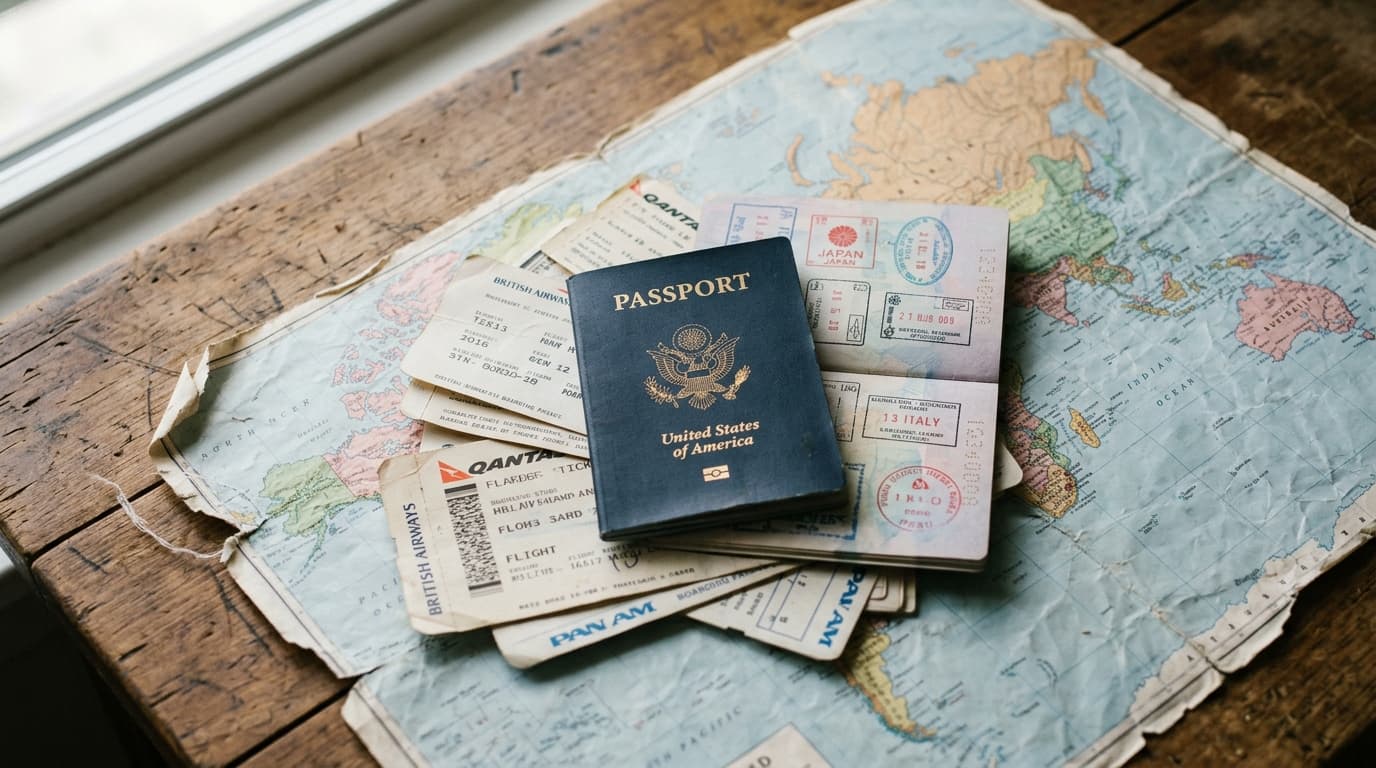
Every new city comes with a setup fee for digital nomads


I've lived in Virginia, New York, New Jersey, All over Florida, California, Vietnam, Thailand, and that's not even mentioning the countless places I've visited for a few days, weeks or month. With that said, as a nomad, one thing's for certain no matter where you're going...
Every new city comes with a setup fee
Unpacking boxes doesn't unpack the cognitive load. A longitudinal study of relocating employees in England found that relocation-specific stress remained very high after the move, even when general stress declined. The stress didn't travel in the same box as the anxiety. It had its own timeline.
This matters because relocation stress isn't just "adjustment." It's a distinct, measurable psychological burden, separate from whatever else is happening in a nomad's life. And according to MBO Partners' State of Independence report, American digital nomads average 6.6 locations per year at 5.7 weeks per stay. That's a setup cycle roughly every month and a half. Six locations a year means six setup fees.
What the fee actually covers
The cash cost is the most visible part. Global digital nomad spending runs approximately $787 billion annually worldwide on housing, coworking, transport and food. That number is large and largely beside the point.
The real fee gets paid in three currencies: time, cognitive load and social capital. Time goes to logistics, orientation, finding the right grocery store, figuring out which transit app works here. Cognitive load goes to decision fatigue, re-learning systems, remembering which SIM card is still active. Social capital goes to rebuilding trust and belonging from zero, again.
A 2025 dyadic study tracking couples relocating for work across 12 domains found that administrative tasks, relocation finances, losing social ties and moving away from family were consistently rated more stressful than rewarding. The "freedom" narrative papers over a real ledger. Nomads aren't avoiding this cost. They're paying it repeatedly.
The "it gets easier" assumption deserves scrutiny
Experience helps, but not as reliably as nomad discourse suggests. A study of employees undergoing job relocation found a U-shaped stress curve: people with very few prior moves and people with very many prior moves both reported the highest post-relocation stress. The middle range did best. More experience isn't a straight line to less suffering.
The same 2025 dyadic study found that most relocation stressors did decline over time and that rewards increased. Adaptation is real. But it requires repeated exposure to new logistics before it kicks in, which means the early months of any stay are always the most expensive. Always.
Infrastructure lowers the fee. It doesn't waive it.
Bangkok now delivers around 272 Mbps fiber in well-connected neighborhoods, with dozens of coworking spaces and entire districts built around short-stay remote workers. The logistical floor has risen significantly across popular nomad hubs. That's genuinely useful.
But better infrastructure reduces the practical setup fee while doing almost nothing for the social one. In that same MBO Partners report, 26% of digital nomads cite being away from family and friends as a top challenge. No coworking space solves that. No fiber connection closes the gap.
There's also a paradox baked into popular hubs. The more a city is tailored toward nomads, the more it attracts transient residents. Which means everyone is mid-setup, all the time. Genuine community is harder to build in a city where half the people you meet are leaving in three weeks.
As of 2026, more than 40 jurisdictions worldwide have introduced digital nomad or remote-work visas, each with its own income thresholds, insurance requirements and documentation rules. Each new visa program adds a layer of compliance work to the setup fee that doesn't show up in anyone's Instagram post.
For nomads who want to compare what's actually required across destinations, a side-by-side destination comparison is worth running before committing to a new location.
The cost that compounds across a lifetime
Here's the data that should give nomads pause. A 29-year longitudinal study found that higher frequencies of residential moves between ages 13 and 21 were strongly associated with greater psychosocial stress and "vital exhaustion" at ages 32 and 42, even after adjusting for confounders. The fee may not just be per trip. It may compound across a lifetime.
The survivorship bias in nomad discourse is also worth naming directly. The people writing enthusiastically about city-hopping are, by definition, still doing it. The ones who burned out quietly went home. The sample is self-selected in the most obvious possible way.
Deciding what the fee is worth
The research doesn't say frequent moves are bad. It says they carry a measurable cost that deserves honest accounting. That's a different conversation than the one most nomad content wants to have.
A practical starting point: audit the last three moves across those same 12 domains from the 2025 study. Housing, social networks, logistics, finances, family proximity, career impact. Which costs declined over time? Which stayed flat? Which ones are being quietly absorbed without being acknowledged?
If the setup fee never fully disappears and infrastructure can only reduce part of it, the real variable is what's being bought with it. Whether the answer is new experiences, lower costs, professional flexibility or something harder to name, that's a legitimate return. But nomads who've never actually stopped to check the receipt are paying blind. That's not freedom. That's just expensive inattention.
For anyone still figuring out where to base themselves next, Stamped Nomad has country guides, visa breakdowns and city profiles that at least reduce the logistical slice of the fee. The social slice is still on nomads to solve themselves.