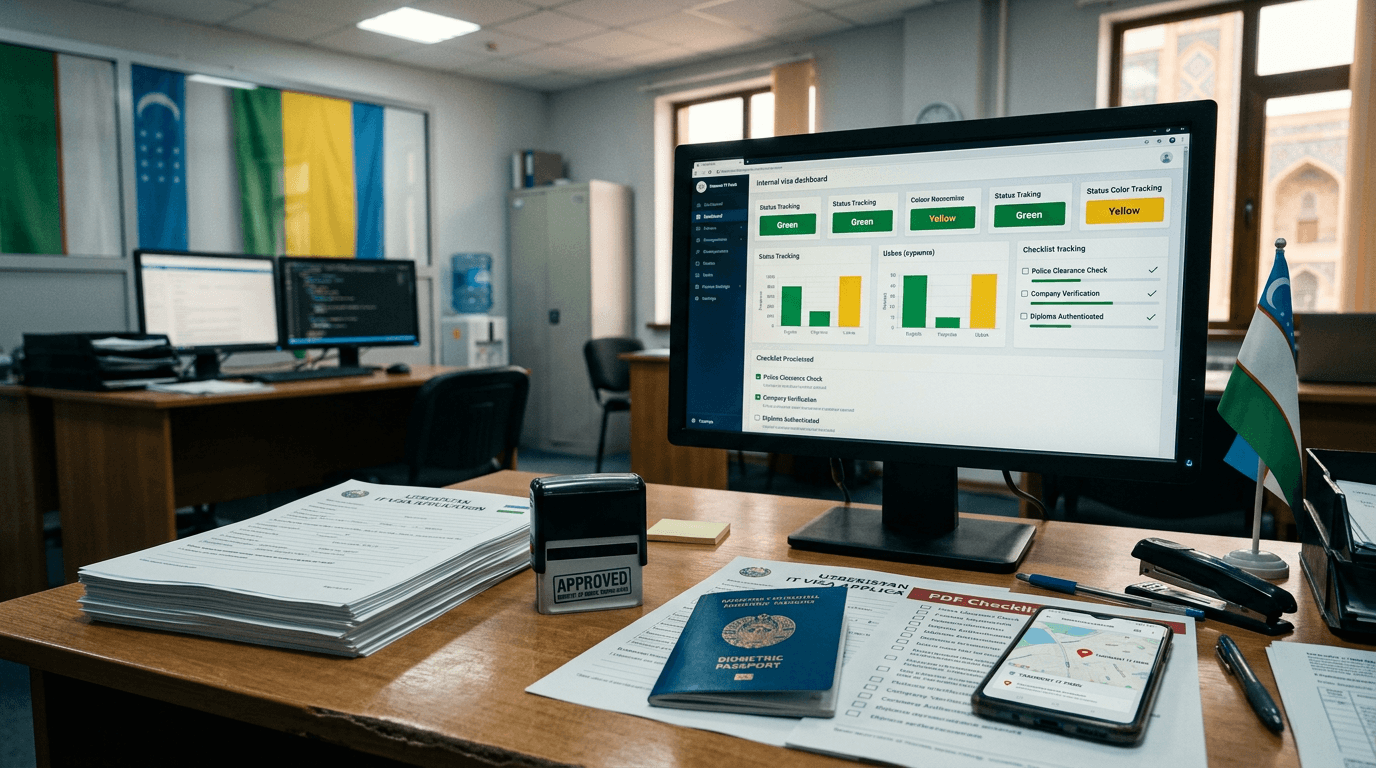
Uzbekistan IT Visa
Visa Data Sheet
Uzbekistan doesn’t have a separate visa labeled “digital nomad,” but the IT Visa is the closest thing to a long-stay option for remote tech workers and founders. It’s a multiple-entry visa for foreign IT specialists, founders of IT Park resident companies and investors in Uzbekistan’s tech sector and it lets you live and work in the country without a separate work permit.
The draw here is simple: it’s built for people who are actually tied to the tech economy, not short-term tourists. Holders get equal social rights with citizens, can stay for up to 3 years and can renew without leaving Uzbekistan. Family members can also be included, which makes it more practical than the usual short-stay visa shuffle.
Who it’s for
- Foreign IT specialists: Professionals working in tech who can show qualifying IT-related income.
- Founders and executives: Startup founders and executives of IT Park resident companies are among the eligible groups under updated rules.
- Investors: People financing Uzbekistan’s tech sector can also qualify through IT Park-linked activity.
- Academic IT experts: Recent policy updates have widened eligibility to include academic specialists in IT.
That said, this isn’t a casual backdoor into long-term stay. The visa is tied to IT Park participation and the official process is meant to screen for real industry involvement. For tourists or general business visitors, the e-visa is still the simpler route, but it only gives you a short stay and doesn’t come with work rights.
Why people use it
The IT Visa sits in a useful middle ground between a tourist visa and full residency. It’s more stable than repeated 30-day entries and it gives you a legal base in Uzbekistan for work, business and family stays. It also comes with a notable perk: visa holders can purchase real estate of any value in Uzbekistan.
Official guidance doesn’t give every detail in one place and some of the newer eligibility rules have appeared in policy announcements before they were fully folded into the main service pages. So if you’re applying, check the current IT Park and government instructions closely, especially if you’re coming in as a founder, executive or investor. The category is real, but the fine print still matters.
Uzbekistan’s IT Visa isn’t for casual remote workers. It’s aimed at foreign IT specialists, founders of IT Park resident companies and investors backing the country’s tech sector. The payoff is real, though, because the visa is multiple-entry, can be issued for up to 3 years and lets holders live and work in Uzbekistan without a separate work permit.
The official eligibility rules break the visa into three main tracks:
- IT specialists: You need a qualification or specialization in information technology, employment with a legal entity that's a resident of Uzbekistan in an IT specialty and confirmed IT income of at least $30,000 over the previous 12 months.
- Founders: You must be a founder of a legal entity that's a Technopark or IT Park, resident and is entered in the Unified Register of Residents.
- Investors: You need to be an individual or a representative of a foreign investment company financing at least $10,000 to an IT legal entity in Uzbekistan under an agreement.
The government has also widened the circle in recent guidance to include startup founders, executives of IT Park residents and academic IT experts. The core portal still centers on the three categories above, so if your profile is unusual, expect to prove how you fit rather than assume you’re covered.
Family members can be part of the application. The official service says information is collected for spouses, parents and children, which is a strong sign dependents are allowed under the IT Visa framework. It doesn’t spell out separate nationality caps or extra eligibility rules for family members, so those details may be handled case by case.
This visa is a much better fit than a tourist e-visa if you actually plan to work from Uzbekistan. A tourist visa only covers short stays and doesn’t give you work rights or the same access to IT Park benefits. If you’re not in tech, don’t meet the income test or can’t show the right company link, you’re probably looking at a different visa path.
Uzbekistan’s IT Visa is built for foreign IT specialists, founders of IT Park resident companies and investors tied to the country’s tech sector. It’s a multiple-entry visa, it can be issued for up to 3 years and it doesn’t require a separate work permit. That’s the real draw, since a tourist e-visa won’t give you work rights or the same access to IT Park benefits.
The official service lists a fairly specific document set for individual IT specialist applicants. The paperwork isn't complicated, but it's picky.
- Passport copy: A clear copy of the applicant’s passport.
- Income proof: Evidence of at least $30,000 in annual IT-related income for the past 12 months, verified by a bank or another authorized body.
- Employer petition: A letter from a resident Uzbek legal entity, usually the employer, confirming its intent to hire the applicant as an IT specialist.
- IT qualification proof: A diploma, certificate or résumé showing IT specialization and relevant qualifications.
- Family details: Information on accompanying family members, including a spouse, parents and children.
The visa is tied to the IT Park system, so the company involved needs to be a resident Uzbek legal entity operating in approved IT activities. In practice, that means the employer or investing company has to go through the IT Park channels and submit an economically justified business plan. If you’re a founder, executive or academic IT expert, recent rules have widened eligibility, but the government’s public service page is still clearer on the core specialist route than on every newer category.
One thing the official materials do not spell out is a fixed list of extra consular-style requirements. There’s no explicit mention of mandatory health insurance, police clearance, medical exams or special apostille and translation rules in the IT Visa guidance. Those may still come from general Uzbek visa or migration rules, so don’t assume the IT Visa page covers everything.
Passport validity is also not stated in a precise number of months on the IT Visa page. Still, your passport has to be valid for the visa period, so don’t cut it close with an expiring document.
Uzbekistan’s IT Visa is one of the few paths here that’s built for actual long-term work, not just short visits. It’s a multiple-entry visa for foreign IT specialists, founders of IT Park resident companies and investors in the tech sector and it can be issued for up to 3 years. It also covers accompanying family members and it doesn’t require a separate work permit.
The annoying part is that the official materials don’t publish a fixed visa fee. Neither the government service page nor the IT Park guidance gives a clear state fee or consular charge for the IT Visa itself, so there’s no reliable number to put on a budget line. That means any exact fee you see floating around should be treated with caution unless it comes straight from an official channel.
- IT specialist eligibility: You must show at least $30,000 in IT-related income over the last 12 months.
- Investor eligibility: The official minimum investment threshold is $10,000.
- Visa length: Up to 3 years, with renewal possible without leaving Uzbekistan.
- Family coverage: Spouse and children can be included under the visa rules.
Those income and investment figures are eligibility thresholds, not application fees. That distinction matters, because the real out-of-pocket cost will usually come from the usual extras, like translations, document prep and any legal help you choose to pay for. The government sources don’t give a clean price list for those either.
If you’re trying to compare it with a tourist e-visa, the IT Visa is in a different league. A tourist visa is for short stays and doesn’t give you the same work rights or IT Park status. The IT Visa is pricier in the practical sense because you have to qualify for it, but the official fee itself isn’t publicly set out in the sources available.
Uzbekistan’s IT Visa is handled through IT Park and the Ministry of Internal Affairs and it’s the right route if you’re a foreign IT specialist, founder, executive or investor tied to an IT Park resident company. It’s a multiple-entry visa, usually valid for up to 3 years and it can be renewed without leaving Uzbekistan. That’s the real draw. It also gives you the right to live and work in the country without a separate work permit, which is something the tourist e-visa doesn’t do.
The application starts with a recommendation from IT Park or the relevant directorate. That body reviews your documents and decides whether you qualify before the visa is issued. Official guidance says applications are submitted before arrival, which means you should plan ahead and not assume you can sort it out after landing.
- Passport copy: You’ll need a clear copy of your passport.
- Income proof or investment proof: The service looks at your IT-related income or your investment in the sector.
- Employer petition: Applicants connected to an IT Park resident company may need a petition from the employer.
- Qualification evidence: The authorities ask for proof of your professional background.
- Family information: If your spouse or children are applying with you, include their details too.
The government service page doesn’t give a fixed public checklist beyond those document types and it doesn’t clearly say whether the whole process can be done fully online from abroad. What it does confirm is that an expert committee or responsible authority reviews the file first, then the Ministry of Internal Affairs issues the visa after a positive recommendation.
Processing time is a bit messy in the official materials. The service statistics mention an indicative timeframe of around 30 days, though that’s not presented as a hard guarantee. Family members can be included, but in practice their visas may be shorter depending on consular handling.
If you’re comparing this with the tourist e-visa, the difference is simple. The tourist route is for short stays and doesn’t give you work rights or IT Park access. The IT Visa is for people who can actually show they’re part of that ecosystem and the paperwork reflects that. It’s more work up front, but it’s also the only visa in this guide that really fits serious tech workers who want to stay in Uzbekistan long term.
Uzbekistan’s IT Visa is built for long stays, not short visits. The official description puts it at up to 3 years and it’s a multiple-entry visa, so you can leave and come back during its validity without starting over each time.
That matters because the IT Visa isn’t just a fancier tourist stamp. It’s meant for foreign IT specialists, founders of IT Park resident companies and investors in the technology sector and it lets holders work in Uzbekistan without a separate work permit. Family members can also be covered under the same general regime.
The other useful point is renewal. The visa can be extended without leaving Uzbekistan, which is a lot less annoying than doing border runs or reapplying from scratch. The official portal doesn’t spell out a fixed maximum number of renewals or a total cumulative stay cap, so don’t assume there’s an automatic path to permanent stay just because the visa is long-term.
- Valid for: up to 3 years
- Entry type: multiple-entry
- Work rights: allowed without a separate work permit
- Renewal: possible inside Uzbekistan
- Family coverage: available for accompanying family members
There’s also a practical upside for people planning to stay put. The IT Visa gives holders equal social rights with citizens in the areas covered by the program and it can reduce the need to chase some of the usual residence-permit hurdles tied to real estate thresholds. That said, it’s still a visa regime, not a shortcut to permanent residence or citizenship.
If you’re trying to build a longer-term base in Tashkent or anywhere else in Uzbekistan’s tech scene, this is the cleanest option on the table. Just don’t confuse “renewable” with “indefinite.” The rules support long stays, but the government hasn’t published a simple forever-track here.
Taxes & considerations
Uzbekistan’s IT Visa is a migration tool first, not a tax shortcut. The official IT Visa pages focus on entry, stay and work rights, but they don't spell out a special personal tax regime for visa holders, so you’re still governed by Uzbekistan’s general tax rules.
That means the big question is tax residency. If you spend more than 183 days in Uzbekistan, you may become a tax resident and be taxed on worldwide income under the general system. The IT Visa itself doesn’t change that and the core government materials don’t publish any separate rule just for IT Visa holders.
What the official materials do say:
- Visa length: The IT Visa is typically issued for up to 3 years and can be renewed without leaving Uzbekistan.
- Work rights: It lets foreign IT specialists, founders and investors live and work in the country without a separate work permit.
- Family: Accompanying family members can be included under the same status.
- Tax detail: The IT Visa pages don’t define a special personal income tax rate, foreign-income rule or treaty process.
There is one practical upside. Uzbekistan’s IT Park regime gives resident companies tax incentives, including lower taxes and social contributions and public material suggests that IT Visa holders working for IT Park residents can benefit indirectly from that setup. That still isn’t the same as a personal tax exemption, so don’t assume your foreign freelance income is automatically off the hook.
If you’re planning a long stay, especially if you’re close to the 183-day mark or earning from multiple countries, get local tax advice before you settle in. The visa is generous. The tax rules are less clear and the official IT Visa documentation doesn’t do much hand-holding.
Uzbekistan Digital Nomad Guide
Cost of living, internet, healthcare, coworking, and every visa option for Uzbekistan.
Visa rules change. We'll tell you.
Get notified about policy updates and new requirements for the Uzbekistan IT Visa and other Uzbekistan visas.
