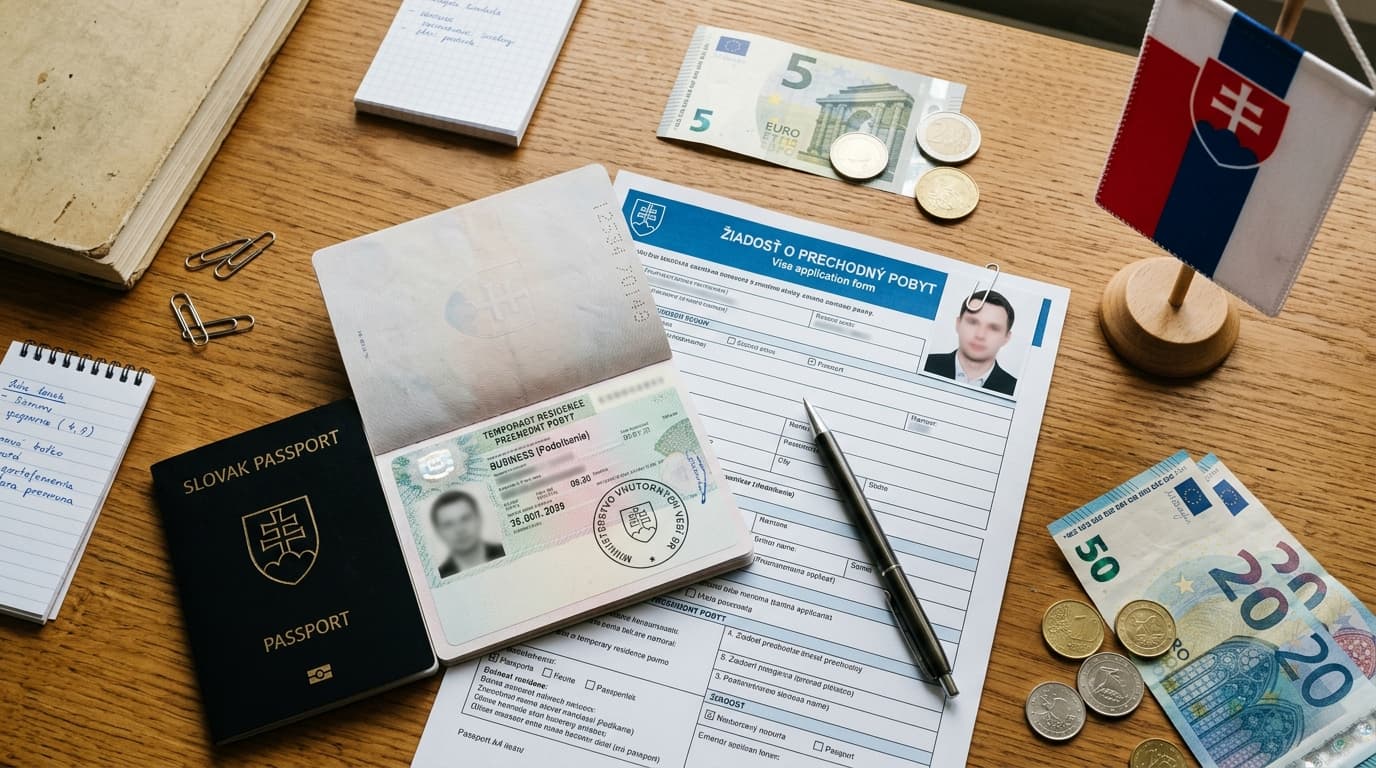
Slovakia Business Temporary Residence

At a Glance
- €5,904.40 one-time20 times the subsistence minimum (EUR 295.22 from 2026-07-01), held in a business account separate from the personal account · sole trader (natural person doing business)
- €350 one-timefirst application at an embassy or consulate
- 3 yearsgranted for three years
- Renewable at the Foreign Police in Slovakia. A sole trader must show taxable business income for the previous tax period above the threshold in Section 32(1) of the Income Tax Act; a company representative must show business tax paid at least at the level in Section 46b(2) of that act. No tax, social or health insurance arrears are allowed.
- In person at a Slovak embassy or consulate abroad accredited for the passport-issuing country or the country of residence; each embassy accepts only a fixed number of business applications per calendar year.
- 90 daysup to 90 days
- Yes
- Yes
- EU long-term residence after five years of lawful, continuous stay in Slovakia.
Temporary residence for the purpose of business is Slovakia's permit for non-EU nationals who run a real business in the country, either as a sole trader or as the person acting for a company or cooperative. It is not a digital nomad visa: the business has to operate in Slovakia, and the Ministry of Economy reviews a business plan before the police decide (Act 404/2011, Section 22).
- Status: open (active), with an annual cap on applications
- Permit length: 3 years, renewable in Slovakia
- Business funds: from €5,904.40 for a sole trader, held in a separate business account
- Application fee: €350 at an embassy or consulate
- Where to apply: in person at a Slovak embassy or consulate abroad
The cap is the main hurdle. Since July 1, 2025, Government Regulation 182/2025 limits business applications to 700 a year across all Slovak embassies, split into small per-embassy limits such as 8 in Washington and 6 in London (Regulation 182/2025). Ask the embassy whether a slot is still free before preparing the file.
The permit is for third-country nationals, meaning people without EU, EEA or Swiss citizenship. It covers two groups: sole traders doing business in Slovakia and people who act for a Slovak company or cooperative as its statutory representative. It is a business permit, not an employee work permit, and remote employees of foreign companies do not fit it.
Applicants prove funds for the business in an account that is separate from their personal account (Act 404/2011, Section 32). The amounts are multiples of the subsistence minimum, which the labor ministry resets every July 1 (labor ministry):
- Sole trader: €5,904.40
- Person acting for a company or cooperative: €29,522
- Company representative with an innovative project: €11,808.80
Separately, applicants show funds for their own stay in an account in their name. The act does not state that amount, so confirm it with the embassy. A clean criminal record and a business plan that the Ministry of Economy can assess complete the core conditions.
The embassy checks the full file at submission. The core documents under Act 404/2011 are:
- Passport: a valid travel document.
- Business plan: on the prescribed form, with the trade license, company register entry or other documents that show the business purpose.
- Criminal record extracts: from the home country and, where the act requires it, other countries of recent residence.
- Personal funds: a recent statement from an account in the applicant's name.
- Business funds: a statement from the separate business account showing at least €5,904.40, €29,522 or €11,808.80, depending on the role.
- Accommodation: proof of housing in Slovakia, such as a lease or a host's declaration.
- Photos: recent color photos.
Foreign documents usually need an official Slovak translation and an apostille or superlegalisation unless a treaty exempts them (IOM Migration Information Centre).
Two documents follow approval. Health insurance must be arranged within three working days of receiving the residence card, with proof given to the Foreign Police within 30 days, and a medical certificate showing no disease that threatens public health is also due within 30 days (Act 404/2011, Section 32).
- Application at an embassy: €350 one-time (Act 145/1995)
- Renewal in Slovakia: €200 one-time
- Business funds to hold: €5,904.40 for a sole trader, €29,522 for a company representative or €11,808.80 for an innovative project, as of July 1, 2026
The business funds are not a fee: the money stays in the business account. The subsistence minimum behind them changes every July 1, so the amounts move with it.
Other costs fall outside the state fee: the residence card, certified translations, apostilles, the medical certificate, health insurance and any legal or accounting help.
- 1. Check the quota: confirm that the competent embassy still has a business slot for the calendar year.
- 2. Apply: In person at a Slovak embassy or consulate abroad accredited for the passport-issuing country or the country of residence; each embassy accepts only a fixed number of business applications per calendar year.
- 3. Pay the fee: €350 at the embassy (Act 145/1995, item 242).
- 4. Review: the embassy sends the file to the Foreign Police, which decides within 90 days of a complete application. The Ministry of Economy gives its opinion on the business plan within 60 days of the police request.
- 5. Enter Slovakia: the residence lapses if the holder does not enter Slovakia within 180 days of approval.
- 6. After arrival: collect the residence card, arrange health insurance and hand in the insurance proof and medical certificate on time.
First applications cannot be filed with the Foreign Police inside Slovakia, even by someone already in the country on a short stay (Act 404/2011, Section 31).
The police grant the permit for 3 years (Act 404/2011, Section 22). Older pages that say "for the expected duration of the business" describe the earlier wording.
Renewable at the Foreign Police in Slovakia. A sole trader must show taxable business income for the previous tax period above the threshold in Section 32(1) of the Income Tax Act; a company representative must show business tax paid at least at the level in Section 46b(2) of that act. No tax, social or health insurance arrears are allowed.
The renewal fee is €200. In short, renewal turns on proof that the business is real and earns taxable income, with taxes and insurance paid up. A permit also lapses if the holder does not enter Slovakia within 180 days of approval.
Longer term: EU long-term residence after five years of lawful, continuous stay in Slovakia. Family members can apply for temporary residence for family reunification under their own conditions.
The permit carries no special tax regime. Holders follow the general Income Tax Act and run the business under the usual accounting, tax and insurance rules.
A person becomes tax resident after 183 days in Slovakia in a calendar year, counted continuously or in several periods, or by having a home in Slovakia (Act 595/2003, Section 2).
Renewal depends on taxable business income and on having no tax, social insurance or health insurance arrears, so tax compliance is part of keeping the permit. Check treaty relief with a Slovak tax adviser when income also comes from abroad.
Frequently Asked Questions
Is the Slovakia business residence a digital nomad visa?
No. It is for people who run a business in Slovakia as a sole trader or act for a Slovak company. Remote employees of foreign companies do not qualify.
How much money is needed for Slovak business residence?
Business funds of €5,904.40 for a sole trader, €29,522 for a company representative or €11,808.80 for an innovative project, held in a separate business account, plus personal funds for the stay.
Is there a limit on applications?
Yes. Slovakia accepts 700 business applications a year across all embassies, with small limits per embassy, so check for a free slot before applying.
Can the application be filed inside Slovakia?
No. First applications go in person to a Slovak embassy or consulate abroad. Renewals are filed with the Foreign Police in Slovakia.
How long is the permit valid?
3 years. It can be renewed in Slovakia for €200 if the business shows taxable income and has no tax or insurance arrears.
How It Compares
Similar visas elsewhere
| Program | Country | Income | Fee | Max stay | Renewable |
|---|---|---|---|---|---|
| Kuwait Freelance Residency (Announced, Not Launched) | Kuwait | - | - | - | |
| Sweden Self-Employed Residence Permit | Sweden | SEK 200,000 saved | SEK 2,000 | 24 mo | |
| Finland Startup Permit | Finland | €1,210/mo | €650 | 24 mo | |
| Belgium Professional Card | Belgium | - | €140↓ | 24 mo |
Slovakia Digital Nomad Guide
Cost of living, internet, healthcare, coworking, and every visa option for Slovakia.
Visa rules change. We'll tell you.
Get notified about policy updates and new requirements for the Slovakia Business Temporary Residence and other Slovakia visas.