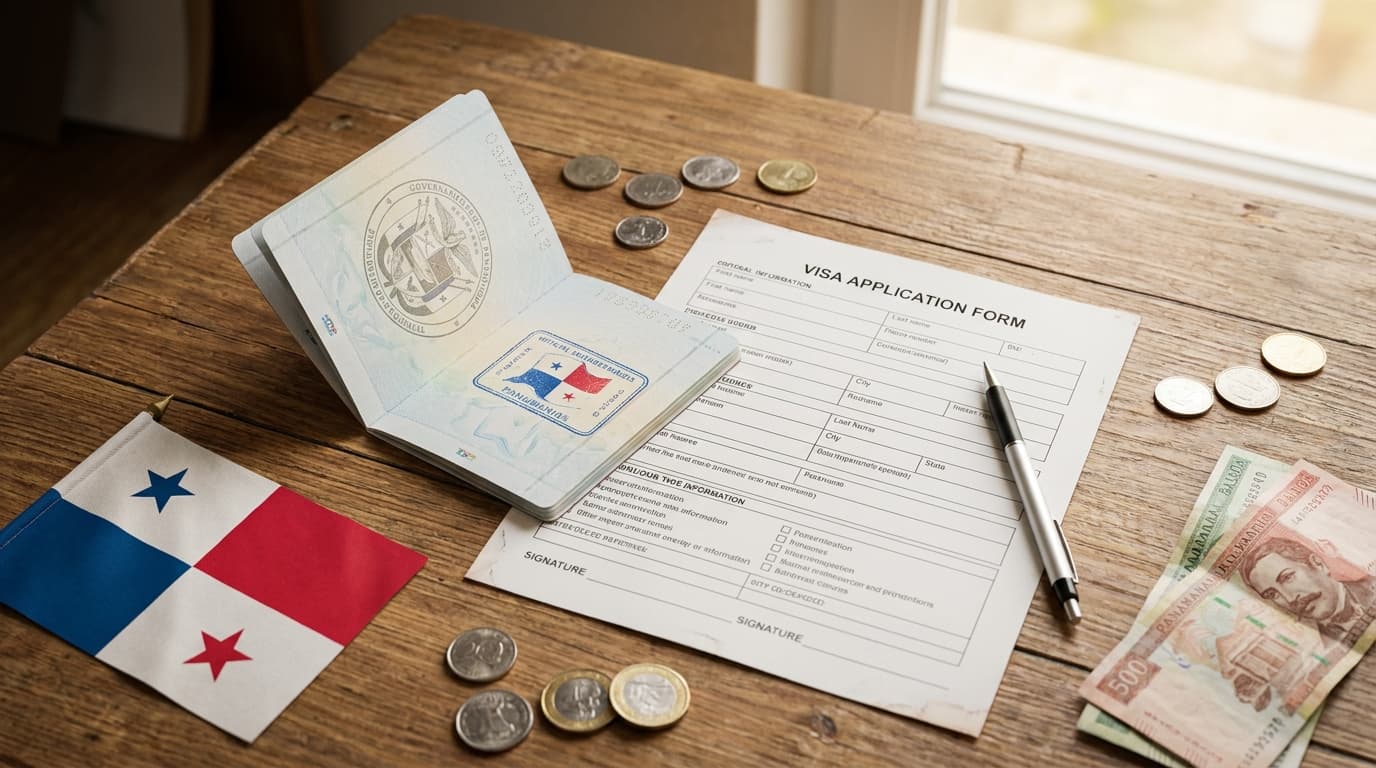
Panama Digital Nomad Visa
Visa Data Sheet
- $36,000 / yr
- $300
- 18 months
Panama’s digital nomad option is officially the Short-Stay Visa as a Remote Worker. It was created under Executive Decree No. 198 of May 7, 2021 and it’s still the country’s main visa path for people who want to work remotely from Panama without switching into residency.
The permit is nonresident, so it doesn’t give you temporary or permanent residency and it doesn’t open a direct path to citizenship. What it does give you is a legal way to stay in Panama for up to 18 months, if you qualify and renew once.
Here’s the basic setup:
- Initial validity: 9 months
- Extension: One additional 9-month renewal
- Income requirement: At least B/.36,000 a year or B/.3,000 a month
- Visa card fee: B/.50
- Immigration service fee: B/.250
This visa is built for people with foreign clients or foreign employers. Panama wants the work to be done remotely, with the income coming from outside the country. If you’re taking local jobs, serving Panamanian clients or acting as a local representative of a foreign company, that can put your permit at risk.
The paperwork is more involved than a tourist entry and that’s the tradeoff. You’ll need a Panamanian lawyer to file the application at the National Migration Service, plus standard documents like a passport copy, photos, police clearance, a medical certificate, sworn declarations and proof of health insurance. Foreign documents must be apostilled or legalized, which adds friction if you’re not organized.
Panama does let many travelers enter as tourists first, then apply from inside the country. That’s the normal route for this visa. The official process doesn’t list a fixed processing time, so don’t assume it’ll be quick just because the program itself is straightforward.
If you want a clean, legal base in Panama for remote work, this is the visa to look at. Just don’t confuse it with tourism, because Panama treats those as two different things.
Panama’s remote worker visa is officially called the Short Stay Visa as Remote Worker. It’s a nonresident permit for foreigners who work for an employer or business outside Panama and the country keeps the rules pretty tight about that.
To qualify, you need to earn at least B/.36,000 a year, which is effectively $3,000 a month because the balboa is pegged to the U.S. dollar. The work has to be remote, your income has to come from abroad and your professional activity can’t be aimed at the Panamanian market.
The official requirements cover two main applicant types. Employees need a contract with a foreign transnational company. Independent workers need proof of their own foreign-registered business plus a sworn statement explaining their clients, services and payment flow. The portal doesn’t list nationality caps, age limits or a special family track for this visa, so the safest read is that it’s built for adult applicants filing individually.
You’ll also need to show you’re in good standing medically and legally. The required file includes a criminal background certificate, a health certificate and proof of medical insurance valid in Panama for the full stay. On top of that, you must sign a sworn declaration saying you won’t take local work or provide services inside Panama to residents, tourists or Panamanian companies.
- Income proof: Bank certification or bank statements showing foreign-source income at or above B/.36,000 a year.
- Employee documents: A letter from the foreign company confirming your role, monthly pay, remote-work setup and repatriation commitment, plus proof the company exists.
- Independent worker documents: Proof of your foreign company and a notarized declaration of clients, services, income and payment frequency.
- General documents: Notarized power of attorney and application, three photos, certified passport copy, background check, health certificate, sworn personal background form, insurance copy and the no-local-work declaration.
- Fees: B/.250 for immigration services and B/.50 for the visa card.
The official sheet doesn’t give a fixed processing time and that’s annoying if you’re trying to plan a move. It also doesn’t spell out every rejection scenario, but if your income falls short, your money isn’t clearly foreign-sourced or your paperwork misses the insurance, criminal record or declarations, your application isn’t going anywhere.
Panama’s remote worker visa is officially called the Visa de Corta Estancia como Trabajador Remoto. It’s a short-stay, nonresident visa, so the paperwork is lighter than a residency file, but it still asks for a proper paper trail.
To qualify, you need to work for a foreign employer or run your own business abroad in a telework setup. Your work has to produce its effects outside Panama and your income has to come from a foreign source. The income floor is B/.36,000 a year, which is roughly $36,000 or about $3,000 a month.
- Power of attorney and application letter: Granted to a Panamanian lawyer. The power of attorney must include your parents’ names and nationalities.
- Three passport photos: Standard carné-size photos.
- Passport copy: A certified copy, notarized or authenticated by the competent authority.
- Criminal background certificate: For the applicant, legalized by apostille or consular channels.
- Medical certificate: A health certificate for the applicant.
- Sworn personal background form: The official declaration of personal background.
- Health insurance: A policy that covers your stay in Panama for the full period requested, with international coverage accepted.
Employees also need a letter from the foreign company on letterhead, signed by the legal representative. It has to list your job title, duties, monthly income, payment schedule and confirm that you work remotely for a foreign source. The letter also needs to say the company will cover return or repatriation costs if needed.
Self-employed applicants have a different set of documents. You’ll need proof that your own company is registered abroad, plus a notarized declaration explaining your client relationships, the services you provide, how much you earn, where the money comes from and how often you get paid.
- Income proof: A bank certification letter, bank statements or both, showing the money comes from abroad and matches the work you declared.
- Application form: The official form, which also includes a commitment to cover return or repatriation expenses if necessary.
- Proof of foreign employer or business: For employees, certification that the foreign company exists where it’s registered.
The government documents don’t give a fixed passport-validity period or a specific background-check validity window, so those points can depend on how your lawyer files the case. That part is annoyingly vague, which means you’ll want to keep your paperwork fresh and consistent before you submit it.
Panama’s digital nomad visa is one of the cleaner fee structures in the region, but the paperwork can still nick away at your budget. The fixed government costs are simple enough: B/.250 for the application and B/.50 for the visa card, for a total of B/.300, which works out to about $300 because the balboa is pegged to the dollar.
That’s the official part. Everything else depends on how much hand-holding you need and how messy your documents are.
- Application fee: B/.250, paid to the National Immigration Service.
- Immigration card: B/.50 for the corresponding carné.
- Income threshold: At least B/.36,000 a year or B/.3,000 a month, in foreign-source income.
Panama’s rules also require a medical insurance policy that covers your full stay, but the government doesn’t publish a minimum premium or coverage amount. So there’s no official price tag there. In practice, what you pay will come down to your age, health and insurer and that can vary a lot.
Then there are the annoying extras. The visa process can involve notarized documents, certified translations and apostilles or consular legalization for papers issued abroad. The authorities require these formalities, but they don’t set fixed prices for them, so those costs are market-based and can easily add a few hundred dollars to the bill.
Legal fees are the biggest wildcard. The application has to be filed through a lawyer, but Panama doesn’t publish a standard attorney fee for the remote-worker visa. If you’re applying alone, you might pay less than a family filing with more document prep, but there’s no official fee schedule to lean on.
- Government costs: $300 total, fixed.
- Insurance: No official minimum price listed.
- Translations, notarization and legalization: Variable, usually paid privately.
- Lawyer fees: Private and unregulated by the visa rules.
One loose end is the extension fee. Panama allows a single nine-month renewal, but the official guidance doesn’t clearly restate what that prórroga costs. If you’re planning to stay the full 18 months, budget for a second round of expenses and confirm the extension charge directly before you file.
How to apply
Panama’s short-stay visa for remote workers is filed inside Panama, not from abroad. You need a Panamanian lawyer to submit the case at the Servicio Nacional de Migración in Panama City, through the Special Procedures Window. The official process is in-person and the applicant must already be in Panamanian territory.
The visa is for remote workers who earn at least $36,000 a year or about $3,000 a month, from outside Panama. That money has to be documented as foreign-source income tied to your remote job or business. Panama also requires a sworn statement that you won’t take local work while on this visa.
- Application fee: B/.250, which is treated as $250 because the balboa is pegged 1:1 to the U.S. dollar.
- Initial stay: 9 months.
- Extension: One 9-month extension is possible, for a maximum stay of 18 months.
- Residency path: None. This visa doesn't lead directly to permanent residency.
For the core filing, expect to gather a notarized power of attorney, the application letter, three passport photos, a certified copy of your passport, a criminal record certificate, a medical certificate issued in Panama, proof of international health insurance and the official sworn declaration form. You’ll also need proof of income, either a bank certification letter or bank statements showing incoming funds from abroad.
If you work for a foreign company, the file also needs proof the employer exists and a letter on company letterhead confirming your role, remote-work setup, income and that the company will cover repatriation costs if needed. Freelancers and business owners need proof that their business is registered outside Panama plus a sworn declaration about their foreign clients and payments. Most foreign documents need apostille or consular legalization, so don’t leave this to the last minute.
The official pages don’t list a fixed processing time and that’s consistent with how Panamanian immigration usually works. Build in slack, keep copies of everything and let your lawyer chase the filing details. It’s not a quick online form and it’s definitely not a leave-it-until-next-week kind of application.
Panama’s digital nomad visa, officially the Visa de Corta Estancia como Trabajador Remoto, starts with a 9-month stay. It’s a non-resident, short-stay visa, so it lets you work remotely from Panama, but it doesn’t give you resident status.
The catch is the renewal. You can extend it once for another 9 months, for a maximum stay of 18 months. That’s it. There’s no legal route to keep rolling this visa over and the official rules don’t build in a direct path to permanent residency or citizenship.
- Initial validity: 9 months
- Renewal: One extension for 9 more months
- Total stay: 18 months maximum
Renewal isn’t just a formality. The same conditions that applied to the first application still need to hold up. That means you’ll need to keep showing foreign-source income of at least B/.36,000 a year, plus updated bank certification and or bank statements proving the money is tied to your remote work abroad.
Health insurance has to stay valid for the full period too, including the extension. If your income drops, your paperwork goes stale or your insurance lapses, the extension can be denied and your stay ends at the original 9-month mark.
- Income requirement: B/.36,000 annually or about $3,000 a month
- Proof of income: Updated bank certification and or bank statements
- Insurance: Must cover your stay for the full visa period
Fees are straightforward on paper, though the extension filing isn't separately itemized in the public materials. The initial application carries a B/.250 government fee and a B/.50 card fee. The extension article refers to the same requirements and service fees, so the safest move is to assume the same structure and confirm it directly with the National Immigration Service before you file.
If you want to stay longer than 18 months, you’ll need to switch to a separate residency category. This visa doesn’t convert on its own, so Panama time alone won’t get you to permanent residence.
Panama’s Digital Nomad Visa sits inside the country’s normal territorial tax system. That means the visa itself doesn’t create a special tax deal, lower rate or exemption. If your income is foreign-source and you’re working remotely for non-Panamanian clients or employers, Panama generally doesn’t tax it.
The key point is source, not the visa sticker in your passport. The short-stay remote worker visa is a non-resident immigration status and it’s built for people whose work has effects abroad and whose money comes from outside Panama. If you start earning Panama-source income, that’s a different story and normal income tax rules can kick in.
- Visa length: 9 months, with one extension for another 9 months.
- Income requirement: $36,000 a year or about $3,000 a month, from foreign sources.
- Residency trigger: Staying more than 183 days in Panama or establishing a permanent home there, can make you a tax resident under DGI rules.
That last part matters. Holding the visa doesn’t automatically make you a Panamanian tax resident, but it also doesn’t shield you if your facts change. If you spend more than 183 days in-country or set up a permanent home, you may end up in tax-resident territory even though the visa itself is still just a short-stay status.
Panama’s tax treatment is still pretty friendly, just not magical. Foreign-source income stays outside the tax net even for tax residents, while Panama-source income is taxed at the normal progressive rates. If you’re dealing only with foreign clients and foreign payroll, the practical result is usually zero Panamanian income tax.
- Progressive rates on Panama-source income: 0% up to $11,000, 15% from $11,000 to $50,000, 25% above $50,000.
- Tax treaties: Any double-tax relief comes from Panama’s general treaty network, not from the digital nomad visa.
- Reporting: If you do become a Panamanian taxpayer, ordinary DGI filing and registration rules apply.
One more thing, the visa’s sworn promise not to accept local work isn’t just paperwork. If you take Panamanian clients or run a local business, you can move yourself into taxable Panama-source income fast. That’s the point where you’ll want proper local tax advice, not guesswork.
Panama Digital Nomad Guide
Cost of living, internet, healthcare, coworking, and every visa option for Panama.
Visa rules change. We'll tell you.
Get notified about policy updates and new requirements for the Panama Digital Nomad Visa and other Panama visas.
