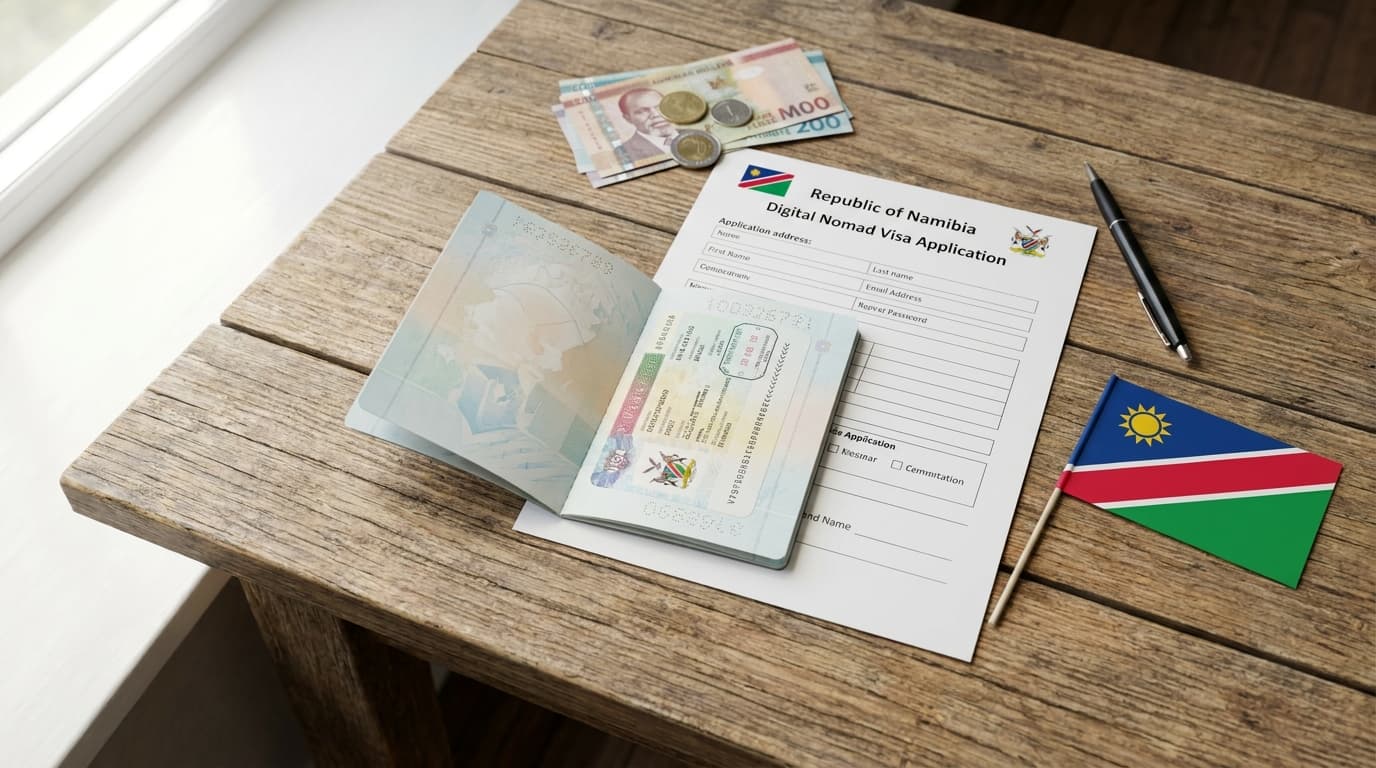
Namibia Digital Nomad Visa

Visa Data Sheet
- $2,000 / mo
- $180 – $200
- 6 months
Namibia’s Digital Nomad Visa is an official six-month visa for remote workers who want to live in Namibia while earning their income from outside the country. It’s active, still being promoted by Namibian authorities and it’s not the same thing as a tourist visa.
The visa is aimed at remote employees, freelancers and self-employed professionals whose employers or clients are based abroad. The point is simple: you can work remotely from Namibia, but you can’t take local employment or compete in the Namibian job market.
To qualify, applicants must show stable foreign income. The current thresholds listed by the Namibia Investment Promotion and Development Board are $2,000 a month for the main applicant, plus $1,000 a month for a spouse and $500 a month for each child. Those amounts need to be backed up with documents such as payslips, employment contracts and six months of bank statements.
What the visa allows
- Stay length: Up to six months in Namibia.
- Work permission: Remote work only for foreign employers or clients.
- Family members: Spouses and children can be included if you meet the higher income thresholds.
- Status: It’s a visitor-type visa, not a residence permit and not a path to permanent residence.
The visa is non-renewable. If you want to apply again, you have to wait 12 months after the expiry date. The official text also says no change of condition is allowed, so this isn’t a backdoor route into a local work permit or a different immigration status.
That’s where it differs from a standard tourist visa. Tourist and visa-on-arrival options are built for short visits, usually up to 90 days and they don’t explicitly cover remote work. The Digital Nomad Visa comes with a longer stay, a specific income floor and a much heavier document checklist, including medical and radiological forms, police clearance, insurance and a motivation letter tied to the program.
The application itself is handled through the Namibia Investment Promotion and Development Board, while the visa is issued by the Ministry of Home Affairs, Immigration, Safety and Security. The current fee listed by the program is N$3,300, payable after approval. The portal doesn’t give a fixed processing time, so don’t assume it’ll be quick.
Namibia’s Digital Nomad Visa is built for remote workers, not job seekers. You qualify if you work for clients or employers outside Namibia, can show at least $2,000 a month in income and have the paperwork to back it up. It’s a six-month visa and it’s non-renewable.
The official rules don’t publish a nationality blacklist, so it appears open to most applicants who meet the visa conditions. That said, you still have to pass Namibia’s normal entry checks, including holding a valid passport and meeting the country’s general visa requirements where they apply.
- Work source: You must be employed by, freelancing for or running work that comes from outside Namibia.
- Income: The main applicant needs at least $2,000 per month.
- Family income add-ons: Add $1,000 for an accompanying spouse and $500 for each accompanying child.
- Insurance: You need valid international health and or travel insurance.
- Clearance: You must submit police clearance, plus the required medical and radiological reports.
Family members can come with you, but they’re not folded into one application. The spouse files a separate application and you’ll need marriage certificates and birth certificates where relevant. The income threshold rises with dependants and the authorities want to see that the household can cover itself.
One thing this visa doesn't do and that’s the annoying part, is give you a way into local work. You can’t use it to take a Namibian job or earn Namibian-source income and it doesn’t lead straight to long-term residence. If your plan is to stay and switch status later, this visa won’t help with that.
The financial proof has to look real, not theoretical. Namibia’s official guidance points to payslips or an employment contract, plus a six-month bank statement. Savings alone don’t seem to be enough, so you should assume they want ongoing remote income, not just a healthy balance sheet.
Documents & requirements
The Namibia Digital Nomad Visa is built for remote workers who earn foreign income. The main income rule is straightforward, if a bit unforgiving: you need at least USD 2,000 a month from outside Namibia. Add a spouse and child and the threshold rises by USD 1,000 for a spouse and USD 500 per child.
The official visa is valid for six months and it’s non-renewable. You can reapply only 12 months after it expires and you can’t change status on this visa, so don’t expect to turn it into a work permit from inside Namibia.
NIPDB lists the core documents you’ll need for the application. Some are routine, some are a headache and a few are only relevant if you’re bringing dependants.
- Completed application form: Form 3-1/0033, signed by the applicant, plus a separate form for each dependant.
- Medical paperwork: Medical Certificate Form 3-1/0003 and Radiological Report Form 3-1/0004.
- Passport and status copy: A certified copy of your passport or proof of legal status if you’re already in Namibia.
- Insurance: Proof of medical insurance or comprehensive travel insurance.
- Income proof: Payslips and/or an employment contract showing the monthly income threshold, plus a six-month bank statement.
- Employer letter: A motivation letter from your employer.
- Qualifications: Copies of degrees or professional certificates.
- Police clearance: Original, notarised or certified copy from your country of origin, translated into English if needed.
- Fees: Proof of payment of the applicable NAD 3,300 fee, paid after approval.
NIPDB also submits a motivation letter directly to the Ministry of Home Affairs, Immigration, Safety and Security, so that part isn’t something you draft and upload yourself. The official guidance doesn’t give a fixed processing time, which is annoying but true, so build in a buffer of several weeks and don’t book around a hard deadline unless the ministry confirms it in writing.
Passport validity isn’t spelled out on the digital nomad page, but Namibia’s visa practice generally expects a valid passport with enough blank pages and at least six months left on it. If yours is close to expiry, renew it before you apply.
Namibia’s digital nomad visa isn’t cheap and the rules are fairly tight. The applicant needs to show USD 2,000 in monthly income, then budget for the visa fee itself and any extra admin costs tied to insurance, translations or document prep.
The main government fee listed on the official NIPDB page is NAD 3,300, which the page says is payable after approval and before arrival. A local representative can pay it on the applicant’s behalf. The Ministry’s general visa page also lists a separate NAD 80 handling fee for visas in general, but the official material I checked doesn’t clearly say that this charge applies to the digital nomad visa specifically.
Income threshold
- Applicant: USD 2,000 per month.
- Accompanying spouse: USD 1,000 per month.
- Accompanying child: USD 500 per child, per month.
Fees
- Digital nomad visa fee: NAD 3,300, about USD 179 to USD 195 depending on the exchange rate used. NIPDB says this is required upon approval.
- General visa handling fee: NAD 80, about USD 4 to USD 5. The Ministry lists it for general visa applications, but it’s not clearly tied to this visa.
There’s no official processing timeline on the government pages I found, so don’t assume a quick turnaround. The visa is valid for six months, it’s non-renewable and applicants can reapply 12 months after it expires. That makes the upfront cost more annoying, because you’re paying for a short stay with no extension option.
Official sources also say the visa fee excludes other expenses. So you should expect extra out-of-pocket costs for medical or travel insurance, certified copies and any English translations needed for police clearance or other documents.
Typical extra costs
- Medical or travel insurance: required by the official checklist, but no standard price is published.
- Translations: police clearance must be translated into English if needed.
- Notarization or certification: may be needed for supporting documents, but the government doesn’t publish a standard fee.
Namibia’s Digital Nomad Visa is handled remotely, not at an embassy counter. You apply by email through the Namibia Investment Promotion and Development Board, then the Ministry of Home Affairs, Immigration, Safety and Security processes it. If approved, you pay the fee and receive the visa on arrival in Namibia.
The visa itself is straightforward on paper, but the rules aren’t especially flexible. It gives you a six-month stay, it’s non-renewable and you can’t switch it into another immigration category once you’re in the country. If you want to apply again, you have to wait 12 months after the visa expires.
What you need to submit
- Completed application form: Form 3-1/0033, signed by you, plus a separate form for each dependent.
- Health documents: Medical Certificate Form 3-1/0003 and Radiological Report Form 31/0004.
- Passport and status proof: A certified copy of your passport or proof of legal status if you’re already in Namibia.
- Insurance: Medical insurance or comprehensive travel insurance covering your stay in Namibia.
- Income proof: Bank statements for the last six months, plus payslips or an employment contract showing at least $2,000 a month for the main applicant. A spouse needs another $1,000 a month and each child $500 a month.
- Supporting letters: A motivation letter from your employer if you work for someone else and the NIPDB motivation letter, which the board prepares and submits with your file.
- Police clearance and qualifications: A police clearance certificate from your home country, translated into English if needed, plus copies of your qualifications.
- Family documents: Marriage and birth certificates if dependants are coming with you.
The fee listed by NIPDB is N$3,300, payable after approval. Older guidance has mentioned a different amount, but that doesn’t match the current official figure, so N$3,300 is the one to plan for. The official portal doesn’t publish a fixed processing time, which is annoying, but that’s where things stand.
How the application is filed
- Step 1: Gather the forms and documents while you’re outside Namibia or while already in the country with legal status.
- Step 2: Send the completed package by email to NIPDB.
- Step 3: Wait for approval from the Ministry of Home Affairs, Immigration, Safety and Security.
- Step 4: Pay the N$3,300 fee once approved.
- Step 5: Receive the visa on arrival in Namibia.
There’s no sign of a walk-in process and the paperwork is a bit fussy. If your documents are incomplete, expect delays rather than flexibility.
Namibia’s Digital Nomad Visa gives you a six-month stay. That’s the whole period and the current official wording is blunt about it: the visa is non-renewable.
You can’t extend it in country and you can’t roll it into a longer stay under the same category. If you want to come back on another digital nomad visa, you’ll need to wait 12 months after the expiry date of the previous one before applying again.
There’s no official shortcut to make this a long-term status. The visa also doesn’t lead to permanent residence or citizenship and the government hasn’t published any pathway that turns digital nomad time into residence time.
- Initial validity: 6 months
- Renewal: Not allowed
- Reapply after expiry: After 12 months
- Path to permanent residence: None published
The visa is also a dead end if you were hoping to switch status while you’re in Namibia. The official guidance says no change of condition is allowed, so you can’t convert it in country to a work permit, student status or residence permit.
That leaves you with a simple but restrictive pattern, six months in Namibia, then a 12-month wait before you can apply again. There’s no official cap on how many times you can repeat that cycle, but each new application will be treated as a fresh application under whatever rules are in place then.
The fee is charged per approved visa, not per year. The current official amount is N$3,300, which the government lists as about $195. Since the visa isn’t renewable, there’s no separate renewal fee, just the normal fee for a new application if you qualify again later.
If you’re planning a return application, the income test starts over too. The official checklist asks for a minimum monthly income of $2,000 for the main applicant, plus $1,000 for a spouse and $500 for each child.
Namibia doesn’t give digital nomads a special tax break. The visa is handled by the Namibia Investment Promotion and Development Board, but tax is still governed by Namibia’s ordinary, source-based income tax rules and any double-taxation treaty that applies.
That matters because Namibia taxes income earned from work done in Namibia, not just income from a Namibian employer. So if you’re physically in Namibia and doing remote work for a foreign company or foreign clients, that income can still fall into the Namibian tax net. Where the money is paid from doesn’t change that.
There’s also no clear public “183-day rule” on the Namibian tax authority’s website for individual residence. Public guidance focuses more on source of income and filing obligations. In practice, that means your tax position is less about a neat day-count test and more about where the work is actually performed.
For many digital nomads, the bigger question is treaty relief. Namibia has double-taxation agreements with a limited set of countries, including Botswana, France, Germany, India, Malaysia, Mauritius, Romania, Russia, South Africa, Sweden and the United Kingdom. If a treaty applies, some employment income may be taxable only in your home country, but the usual short-stay conditions still have to be met.
- No special DNV tax regime: the visa itself doesn’t create an exemption or reduced rate.
- Namibian-source income is taxable: remote work done while you’re in Namibia can count, even if the payer is abroad.
- Residence status isn’t the whole story: source rules still pull work income into Namibia’s tax system.
- Treaty relief may apply: check the exact treaty text before assuming you’re exempt.
The practical downside is simple: you can’t assume “foreign employer” means “no Namibian tax.” If you expect to spend six months working from Namibia, it’s smart to check both your home-country rules and Namibia’s filing expectations before you arrive.
How It Compares
Similar visas elsewhere
| Program | Country | Income / month | Fee | Max stay | Renewable |
|---|---|---|---|---|---|
| Slovenia Digital Nomad Visa | Slovenia | €3,391/mo | €50↓ | 12 mo | |
| Belize Work Where You Vacation Program | Belize | $75,000-100,000/yr | BZD 200-500 | 6 mo | |
| Kazakhstan Neo Nomad Visa | Kazakhstan | $3,000/mo | £170↓ | 12 mo | |
| Bahamas Digital Nomad Visa | Bahamas | - | $25↓ | 12 mo |
Namibia Digital Nomad Guide
Cost of living, internet, healthcare, coworking, and every visa option for Namibia.
Visa rules change. We'll tell you.
Get notified about policy updates and new requirements for the Namibia Digital Nomad Visa and other Namibia visas.