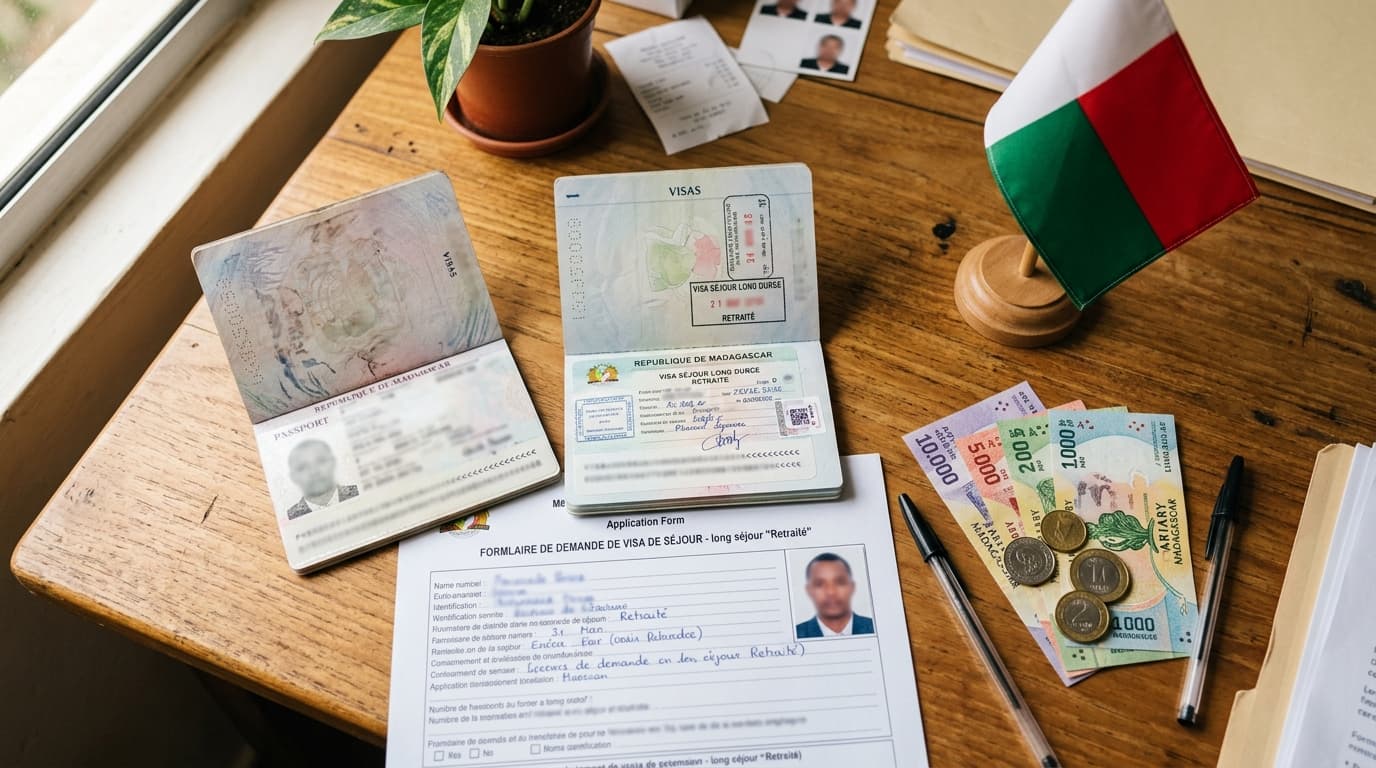
Madagascar Retirement Residence Permit

At a Glance
- €500 a monthminimum monthly international transfer of the pension into a Madagascar bank account · applicants filing at the Embassy of Madagascar in Paris
- €39 one-timeParis embassy fee for the one-month transformable visa; the Brussels embassy charges EUR 30 for the same visa (code VisaLJ90+) · applicants filing at the Embassy of Madagascar in Paris
- Renewable. A renewal request must be filed three months before the current visa expires and meets the same conditions as the first visa.
- Transformable visa at a Madagascar embassy or consulate (or through the Foreign Ministry where there is no mission); then, within one month of arrival, the long-stay visa and residence card at the Ministry of the Interior immigration service in Antananarivo or the EDBM one-stop shop.
- 3 days3 working days at the Paris embassy for the transformable visa; in Madagascar, the notification letter 3 weeks after the photo, then the residence title 72 hours after payment at the cashier or 45 days after payment at a bank · Paris embassy (transformable visa)
- The long-stay visa is issued with a residence card (carte de resident). No official page reached sets a path from it to permanent residence for retirees.
Madagascar's retirement residence permit is the retiree long-stay visa with a residence card (carte de résident). The Ministry of the Interior lists retirement among its long-stay visa categories, and the route is active (Ministry of the Interior).
It runs in two steps. Retirees first get a transformable visa, valid for 1 month, from a Madagascar embassy or consulate, then apply in Madagascar for the long-stay visa and residence card within one month of arrival (Embassy of Madagascar in Paris).
- For: retirees with a regular pension paid into a bank account in Madagascar
- Not for: remote workers; Madagascar has no digital nomad visa
- Income: €500 a month at the Paris embassy; other missions ask for proof of regular pension deposits
Applicants need to show they are retired and that a pension reaches Madagascar regularly:
- Retired status: a retirement certificate or pension notice.
- Pension transfer: the Embassy of Madagascar in Paris requires a bank certificate showing an international transfer of at least €500 a month, set up by the pension fund or a foreign bank (Paris checklist). The Interior Ministry and other embassies ask for a bank certificate showing regular deposits without naming an amount (Ministry of the Interior).
- Bank account in Madagascar: proof that an account has been opened to receive the pension.
- Clean record: a criminal record extract less than three months old.
A short-stay visa cannot be converted into this route, so the transformable visa must be issued before travel (Embassy of Madagascar in Paris).
The Paris embassy checklist for the transformable retiree visa (Embassy of Madagascar in Paris); other missions publish their own lists:
- Application form for the transformable long-stay visa, completed, dated and signed, with one recent photo.
- Passport valid more than 6 months after the return date, with at least two blank pages, plus a copy of the data page.
- Retirement certificate or pension notice.
- Bank certificates: one for the account opened in Madagascar and one for the international pension transfer. A transfer certificate issued by a bank in Madagascar is not accepted.
- Criminal record extract less than three months old.
- Change of residence certificate from the town hall of the current place of residence.
- Flight ticket: a one-month return ticket or a changeable ticket.
In Madagascar, the same documents go in as originals, with a bank certificate from Madagascar, proof of accommodation, a foreigner census certificate and a residence certificate from the local Fokontany (Ministry of the Interior).
- Transformable visa: €39 at the Paris embassy (Paris checklist). Fees differ by mission, and visa fees are not refunded.
- Long-stay visa and residence card: fees paid in Madagascar are not published on an official page, so confirm them with the Interior Ministry before filing.
- Income test: €500 a month at the Paris embassy. It is an eligibility test, not a fee.
- Other costs: criminal record extract, translations, flights and bank charges on the monthly transfer.
- Apply abroad for the transformable visa at a Madagascar embassy or consulate. The Paris embassy processes complete files in 3 days, counted in working days; it cannot be issued at the airport (Embassy of Madagascar in Paris).
- File in Madagascar within one month of arrival. Transformable visa at a Madagascar embassy or consulate (or through the Foreign Ministry where there is no mission); then, within one month of arrival, the long-stay visa and residence card at the Ministry of the Interior immigration service in Antananarivo or the EDBM one-stop shop.
- Wait for the decision. The Interior Ministry issues a notification letter about three weeks after the photo is taken, then the residence title 72 hours after payment at its cashier or 45 days after payment through a bank (Ministry of the Interior).
Missions may ask for extra documents, and incomplete files are not processed.
- Transformable visa: valid 1 month; the long-stay application must be filed within one month of arrival.
- Residence status: The long-stay visa is issued with a residence card (carte de resident). No official page reached sets a path from it to permanent residence for retirees.
- Renewal: Renewable. A renewal request must be filed three months before the current visa expires and meets the same conditions as the first visa.
- Records for renewal: the criminal record extract comes from the court in Antananarivo (Interior Ministry list).
Sources: Embassy of Madagascar in Paris and Ministry of the Interior.
Under Madagascar's tax code, people whose main place of stay is Madagascar for a cumulative 183 days over 12 months are tax residents, as are those whose main professional activity or center of economic interests is there (Code général des impôts). Tax residents are taxed on worldwide income.
The residence card is an immigration status and does not set a tax regime for pensions. Retirees should check whether a tax treaty between Madagascar and the country paying the pension changes where it is taxed.
Frequently Asked Questions
Is there a retirement visa in Madagascar?
Yes. Retirees use the retiree long-stay visa with a residence card: a transformable visa from an embassy, then the long-stay visa and residence card in Madagascar.
How much pension income is required?
The Paris embassy asks for a pension transfer of at least €500 a month. Other missions and the Interior Ministry ask for proof of regular pension deposits without naming an amount.
How much does the visa cost?
The transformable visa costs €39 at the Paris embassy. Other missions set their own fees, and the fees paid in Madagascar are not published officially.
Can a tourist visa be converted into a retirement visa?
No. A short-stay visa cannot be converted, so the transformable visa must be issued before arrival.
When must the residence card be renewed?
A renewal request must be filed three months before the current visa expires and must meet the same conditions as the first application.
How It Compares
Similar visas elsewhere
| Program | Country | Income | Fee | Max stay | Renewable |
|---|---|---|---|---|---|
| Suriname Residence Permit for Retirees | Suriname | - | $150 | 24 mo | |
| Honduras Pensionado Visa | Honduras | $1,500/mo | $300 | 60 mo | |
| Indonesia Retirement KITAS (E33F and E33E) | Indonesia | $3,000/mo | IDR 7,000,000 | 12 mo | |
| Ecuador Pensioner Visa (Jubilado) | Ecuador | $1,446/mo | $50 | 24 mo |
Madagascar Digital Nomad Guide
Cost of living, internet, healthcare, coworking, and every visa option for Madagascar.
Visa rules change. We'll tell you.
Get notified about policy updates and new requirements for the Madagascar Retirement Residence Permit and other Madagascar visas.