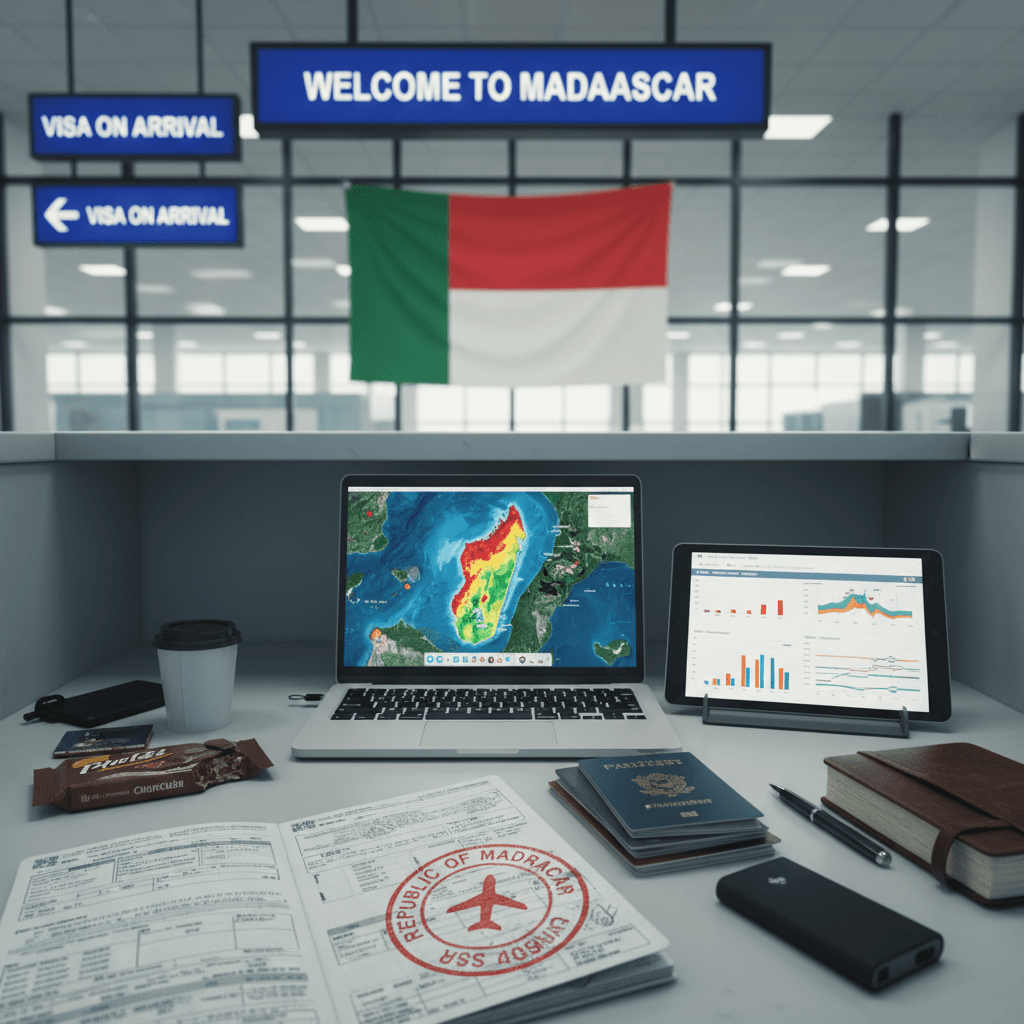
Madagascar

Policy Stability
Stamped Nomad ExclusiveHow likely visa and immigration policies are to remain unchanged
Quick Facts
N/A
3 months
Yes
$1,100/mo
19 Mbps
3/10
Low
Low
Low
EAT (UTC+3)
Entry Methods Available
Best For
Understanding Your Options
Madagascar is one of the more straightforward destinations for digital nomads when it comes to entry requirements. While there is no dedicated "digital nomad visa" yet, the country makes it easy for most nationalities to enter using an e-visa or by picking one up at the airport. You just need to decide how long you plan to stay before you land.
The government recently adjusted its fee structure in February 2026. The most notable change was a significant price hike for the shortest stay option. If you are planning a quick scouting trip, be prepared for higher costs than in previous years. For everyone else, the pricing for longer stays has remained relatively stable.
The E-Visa System
The most efficient way to handle your entry is through the official e-visa portal. This system is open to almost all nationalities and allows you to secure a single-entry tourist visa for up to 60 days. You should submit your application at least 3 days before your flight. Once validated, the processing typically takes about 72 hours. It saves you from standing in the longest queues at Ivato International Airport.
Current pricing for the e-visa is based on your length of stay:
- Up to 15 days: €30 (US$35)
- 16 to 30 days: €35 (US$41)
- 31 to 60 days: €40 (US$47)
- Up to 90 days: €50 (US$59)
Visa on Arrival
If you prefer to wing it, you can obtain your visa at any of Madagascar's international airports or seaports. The costs are identical to the e-visa fees. This option is available to almost every passport holder, with the exception of citizens from Palestine and Burundi. Make sure you have cash in Euros or US Dollars to pay the fee, as card machines can be unreliable at the border.
Business and Long-Stay Visas
If you are heading to Madagascar for more than just a laptop-on-the-beach lifestyle, you might consider a Business Visa. These are for professionals and investors who have specific local ties. You will need a bit more paperwork for this, including a valid passport with 6 months of life left, a confirmed return ticket, and an official invitation letter from a Madagascar-based business contact.
The country also offers a wide range of specialized visas if your nomadic journey involves more than remote work:
- Scientific Research visas for those studying the unique biodiversity.
- Film and Media visas if you are producing professional content.
- Investment visas for those looking to start a local company.
- Yachting visas for those arriving by sea.
Extending Your Stay
Sometimes the red soil and lemurs get a hold of you and you want to stay longer. You can extend a tourist visa at local immigration offices within the country. The fee for an extension is roughly 210,000 ariary, which is about €41 or US$48. Give yourself plenty of time for this, as the paperwork usually takes between 5 and 10 business days to process.
Keep in mind that you cannot extend a tourist visa beyond a total of 90 days. If you want to stay longer, you will need to do a "visa run." This involves flying out of the country, perhaps to nearby Reunion or Mauritius, and re-entering to start a fresh visa period. Most nomads find this the easiest way to maintain a long-term presence on the island.
The Fine Print
While Madagascar doesn't offer a "visa-free" list for most Western countries, the ease of the e-visa and arrival systems makes it feel nearly the same. Just ensure your passport is in good condition and has at least two blank pages. If you are coming from a country with a high risk of Yellow Fever, you may be asked to show your vaccination certificate upon arrival. Always check with the nearest Madagascar Embassy or the US State Department travel advisories before you book your flight to ensure no local regulations have shifted.
Source 1 | Source 2
The Reality of Remote Work in Madagascar
If you are looking for a flashy, dedicated "Digital Nomad Visa" with a streamlined application portal, Madagascar will require a bit of a reality check. There is currently no official visa category specifically designed for remote workers. Instead, nomads who make this massive island their home base generally piece together their stay using the standard tourist framework or more formal long-stay options.
Most travelers arrive on a tourist eVisa, which is straightforward but strictly temporary. For those planning to stay longer than a couple of months, the process shifts from a simple online form to physical paperwork at an embassy or the immigration office in Antananarivo. It is a bit old-school, but it works for those who are patient.
The Visa Path for Nomads
Since the digital nomad program does not exist, you have to choose the category that best fits your timeline. Most people start with the first option and see how they like the local internet speeds before committing to anything longer.
- Tourist eVisa: This is the easiest entry point. It allows for a stay of up to 60 days and is a single-entry permit. It is best for "workations" or scouting locations.
- Business Visa (Type D): Often used by consultants or those with external employment, this covers you for up to 3 months. It can sometimes be extended to 12 months once you are on the ground.
- Long-Stay Visa (Visa Long Séjour): If you plan to stay beyond 90 days, you must apply through a Malagasy embassy before you arrive. This requires more documentation but offers the most stability for long-term residency.
What You Need to Prepare
The requirements are fairly standard, but immigration officers appreciate a paper trail. Keep physical copies of everything, as digital files are not always accepted in government offices. You will need a passport with at least 6 months of validity remaining from your date of entry.
For anything beyond a basic tourist stay, be ready to provide proof of your remote employment or a steady income from outside the country. You should also have your accommodation details and proof of sufficient funds to support yourself without seeking local work. While there is no official minimum income threshold, having bank statements that show a stable balance will smooth over most conversations with officials.
Application Steps
The process depends entirely on which route you take. If you are going for the 60-day tourist option, you can handle it online. You should apply anywhere from one week to six months before your flight. Once you pay the fee, you usually receive an authorization within 72 hours.
For the long-stay or business routes, you must visit a consulate or embassy. You will submit your passport, recent photos, and your proof of funds. If you are already in the country and realize you want to stay longer, you must head to the immigration office in Antananarivo to apply for an extension before your current visa expires. Do not wait until the last minute, as the bureaucracy moves at its own pace.
Renewals and Stay Limits
The tourist visa is generally capped at 60 days, though some travelers have successfully extended their total time in the country up to 180 days by working with local immigration. If you are on a long-stay or business visa, you can often renew these annually onshore. Just remember that these are single-entry visas by default; if you leave the island, you may need to start the process over unless you have secured a specific re-entry permit.
Tax and Legal Fine Print
Madagascar does not have a specific tax regime for nomads. Generally, if your income is earned from a company located outside the country and you are not performing work for Malagasy clients, you will not be taxed locally. However, if you stay longer than 183 days, you may be considered a tax resident under local law. It is a gray area that most nomads avoid by keeping their stays under the six-month mark.
The biggest rule to remember is that you cannot take a local job. Working for a Malagasy company requires a formal work permit from the Ministry of Labor, which is a much more difficult hurdle to clear. Stick to your laptop and your international clients, and you will stay on the right side of the law. Also, check if you need a yellow fever certificate; it is mandatory if you are arriving from an endemic area.
Source 1 | Source 2
The Short Stay: 15-Day Entry
If you are just landing for a quick scouting trip to check the internet speeds in Antananarivo, the 15-day entry is your simplest path. You will pay an administrative fee of €30 (roughly $35) upon arrival. This is technically an e-Visa process, even if you do it at the airport. You just need a passport with six months of validity and a confirmed flight out of the country.
The E-Visa System
Madagascar has moved most of its bureaucracy online, which is a win for anyone who hates visiting embassies. The official government portal allows you to apply for a single-entry visa between one week and six months before you fly. Once you register and pay, you usually get your authorization within 72 hours. You can print this out or just keep it on your phone to show the officers when you land.
The costs for the e-Visa scale depending on how long you plan to stay. Here is the breakdown of what you will pay:
- 15 Days: €30 ($35)
- 16 to 30 Days: €35 ($41)
- 31 to 60 Days: €40 ($47)
- Up to 90 Days: €50 ($59)
While the e-Visa is the smoothest route, you can still get a visa on arrival at the international airports. The prices are the same, but the lines at the eVisa counters can sometimes be a test of patience after a long-haul flight.
Staying Longer and Extensions
If you fall in love with the rainforests and decide to stay past your original date, you can extend your tourist visa at a local Commissariat of Police. The hard limit for any tourist stay is 90 days total. To get an extension, you should head to the station before your current visa expires. The fee is generally around 80,000 Ariary plus the cost of some photocopies. Expect the process to take about 24 hours, so do not leave it until the afternoon of your flight.
Entry Requirements to Remember
Immigration officers in Madagascar are generally straightforward, but they do check the paperwork. Make sure you have these items ready before you board:
- A passport with at least two blank pages for stamps.
- Proof of a return or onward ticket to another destination.
- A Yellow Fever vaccination certificate if you are arriving from a country where the disease is endemic.
The Risks of Overstaying
It might be tempting to stay an extra week in Nosy Be without filing the paperwork, but the penalties are steep. Overstaying can lead to heavy fines, detention, or deportation. Most importantly, you risk being blacklisted from returning to Madagascar in the future. If you are caught with an expired visa at the airport, you will likely miss your flight while the authorities process your file, which turns a cheap administrative fix into a very expensive travel headache.
Some travelers talk about "border runs" to nearby islands like Reunion or Mauritius to reset their 90-day clock. While this is not strictly illegal, it is not a guaranteed strategy. Immigration officers have the discretion to deny entry if they think you are living in the country permanently on a tourist visa. If you plan to stay longer than three months, it is better to consult the Madagascar Embassy about a long-term professional or investor visa rather than cycling through tourist entries.
Source
The Long-Stay Reality
Madagascar is a place that rewards the patient traveler. If you find yourself falling for the red soil and the slow pace of life, you will quickly realize that the island does not have a "Digital Nomad Visa" in the modern sense. There is no slick online portal where you can upload a few pay stubs and receive a remote work permit in your inbox.
Instead, staying here long-term requires a bit of old-school legwork. You have to enter the country on a specific one-month convertible visa obtained from a Malagasy embassy before you fly. Once you land in Antananarivo, the clock starts ticking. You have 30 days to submit your application for a residence permit (carte de résident) at the Ministry of Interior.
The Retirement Pathway
This is arguably the most straightforward route for those who have a steady passive income. You do not necessarily need to be of "retirement age" in the traditional sense, but you do need to prove you aren't competing for local jobs. The financial bar is relatively low compared to European standards. You need to show a monthly pension or recurring income of at least €500.
- Proof of Funds: You must set up a local Malagasy bank account and show regular deposits.
- Clean Record: An official criminal record check from your home country, less than 3 months old, translated into French or English.
- Health Coverage: Valid health insurance that covers you within Madagascar.
- Duration: Initial permits usually last 1 to 2 years and are renewable. After a few cycles, you can move toward a 10-year permanent residency.
The Investment Route
If you want to do more than just hang out on the beach, the investment path is the way to go. This is handled through the Economic Development Board of Madagascar (EDBM). While there is no hard-coded minimum investment in the law, professionals generally suggest having around $150,000 ready for sectors like tourism or agriculture.
- Company Setup: You will need to incorporate a local business, which costs roughly $1,000 in administrative fees.
- Job Creation: The government expects your business to eventually create employment for Malagasy citizens.
- The One-Stop Shop: The EDBM office in Antananarivo acts as a concierge for investors, helping you bypass some of the standard bureaucratic hurdles.
The Freelancer Gap
Since there is no dedicated freelancer visa, remote workers usually find themselves in a gray area. Most nomads either rely on 60-day tourist visas and leave the country to reset, or they try to qualify under the investment category by starting a small local consultancy. If you choose the tourist route, remember that you cannot convert a standard tourist visa into a residency permit once you are already on the island. You must leave and re-enter on that specific "convertible" visa type.
Costs and Logistics
The price of residency varies depending on how long you plan to stay and which embassy you are dealing with. Generally, you should budget between €100 and €500 for the permit fees alone, not including the "facilitation" costs of getting documents notarized and translated.
- Location: All residency business happens in Antananarivo. If you plan to live in Nosy Be or Fort Dauphin, factor in a trip to the capital for your paperwork.
- Processing Time: Expect to wait several weeks or even months for your physical card. You will be issued a receipt that acts as your legal proof of stay in the meantime.
- Permanent Residency: There is no "Golden Visa" shortcut. You earn permanent status by renewing your temporary permits over several years, usually moving from a 1-year to a 3-year, then a 5-year, and finally a 10-year card.
The process is heavy on paper and requires physical signatures and stamps. It is a slow dance with the Ministry of Interior, but for those who want to call this island home, it is the only way to get legitimate peace of mind.
The Geography of Your Budget
Madagascar remains one of the most affordable frontiers for the digital nomad community. While the island's infrastructure presents its own set of adventures, your dollar stretches remarkably far here. Most nomads find they can live a high-quality lifestyle for a fraction of the cost of Southeast Asia or Eastern Europe.
Monthly expenses for a single person typically range from $376 on a strict budget to $2,132 for a premium experience. Most remote workers land in the "comfortable" middle ground, spending between $900 and $1,300 per month. This middle tier allows for a private apartment with reliable power, regular dining out, and weekend excursions to the national parks.
Cost Breakdown by Nomad Hub
Prices fluctuate based on where you plant your flag. Antananarivo offers urban convenience but higher rents, while coastal spots like Toamasina offer a slower pace for less. Nosy Be commands a premium for its island-resort atmosphere and tourist-centric amenities.
Antananarivo (The Capital)
- Rent (1BR): $200 to $500. Prices vary wildly depending on whether you want a modern apartment in the city center or a quieter spot in the hills.
- Coworking: $50 to $300 per month. Spaces like Red Zone provide the most stable internet in the country.
- Food: $160 to $250. Local markets are incredibly cheap, but Western-style grocery stores in the capital will inflate your bill.
- Transport: $45 to $70. Taxis are the primary way to get around the hilly terrain if you want to avoid the crowded local buses.
Toamasina/Tamatave (The Port City)
- Rent (1BR): $120 to $150. This is one of the most budget-friendly coastal options for long-term stays.
- Food: $120 to $180. Seafood is abundant and affordable here since it is a major port hub.
- Transport: $15 to $40. The flat terrain makes it easier to navigate via tuk-tuks or bicycles.
- Coworking: Limited. Most nomads here rely on high-end hotel Wi-Fi or local SIM cards with 4G hotspots.
Nosy Be (The Island Vibe)
- Rent (1BR): $250 to $550. Beachfront villas and high-demand tourist rentals push prices higher than the mainland.
- Food: $200 to $300. Expect to pay more for imported goods and meals at restaurants catering to international travelers.
- Coworking/Co-living: $100 to $150. Several boutique co-living spots have emerged to serve the growing nomad crowd.
- Transport: $50 to $100. Scooter rentals are the best way to explore the island and usually cost around $5 to $8 per day.
Day-to-Day Expenses
Eating like a local is the secret to keeping your costs down. A meal at a local "hotely" can cost as little as $2, while a three-course dinner at a mid-range French-Malagasy fusion restaurant usually hits around $15 to $20. Domestic beer is cheap, often under $1.50 at a local bar.
Healthcare is surprisingly affordable for routine issues. A visit to a private GP usually costs around $15 out of pocket. However, you should still maintain a nomad insurance policy for major emergencies. Plans from providers like SafetyWing typically range from $40 to $56 per month, which is a small price to pay for peace of mind in a remote location.
Utilities and connectivity require a bit of strategy. In a "comfortable" tier home, expect to pay $60 to $100 for electricity and water, especially if you use air conditioning. Fiber optic internet is becoming more common in Antananarivo, but having a secondary 4G data plan is a requirement for any serious remote worker. Data bundles are affordable, but the speeds can be inconsistent during peak hours.
Lifestyle Tiers at a Glance
- Budget ($400 - $600): Best for those who enjoy local markets, use public transport, and stay in modest Malagasy-style apartments or shared houses.
- Comfortable ($900 - $1,300): Includes a modern 1BR apartment, frequent meals at international restaurants, a dedicated coworking membership, and regular weekend trips.
- Premium ($1,800+): This buys a luxury villa with a pool, full-time domestic help, private drivers, and frequent domestic flights to explore the far reaches of the island.
Antananarivo: The Urban Nerve Center
If you need reliable infrastructure to keep your job, the capital is your best bet. Antananarivo, or Tana, is the only place in Madagascar where you will find a traditional coworking environment. Regus has a presence here, offering hot desks for around $66 a month or hourly rates at $7. The internet speeds hover around 18 Mbps, which is plenty for video calls and heavy uploads.
The city has a community of roughly 200 remote workers, so you won't be totally alone. When you close the laptop, head to the Isoraka or Ambatonakanga neighborhoods for the best nightlife. Spots like Chill Out Cafe or Isambo Club are popular for networking and decompressing. Just keep your wits about you after dark; petty crime is common, and the city isn't the most walkable for solo travelers at night.
- Pros: Best coworking options, highest concentration of nomads, and great cafe culture.
- Cons: Heavy traffic, air pollution, and safety concerns after sunset.
- Estimated Monthly Cost: $1,491
Nosy Be: The Island Office
Nosy Be is where you go to trade the office chair for a beach lounger. While it lacks formal coworking spaces, the tourist-heavy infrastructure means many cafes and hotels offer decent WiFi. It is a budget-friendly tropical escape where the nightlife revolves around sunset beach bars rather than loud clubs.
The nomad community is growing here, fueled by platforms like Punta that help travelers connect. It is generally safer than the capital, though you should still avoid wandering lonely stretches of beach at night. It is the perfect spot if your "office" needs to be within walking distance of the ocean.
- Pros: Stunning beaches, relaxed pace, and a growing expat community.
- Cons: Crowded during peak tourist seasons and lack of dedicated quiet workspaces.
- Estimated Monthly Cost: $800
Mahajanga: The Coastal Hideaway
Mahajanga, also known as Majunga, offers a unique balance of work and relaxation. Surprisingly, you can find internet speeds between 20 and 40 Mbps in specific spots via Telma. It is much more laid back than Tana and significantly cheaper, with costs aligning closer to the national average of $534 a month.
The nomad scene is small, so do not expect networking events. Power outages are a regular part of life here, so a laptop with a good battery and a backup power bank is a requirement. It is a great choice if you want a local experience without the capital's chaos.
- Pros: Solid internet for a coastal town and very low cost of living.
- Cons: Frequent power cuts and almost no nomad-specific infrastructure.
- Estimated Monthly Cost: $534
Toamasina: The High-Speed Port
Toamasina, or Tamatave, is a bit of a wildcard. It actually boasts some of the fastest internet in the country, with speeds reaching 55 Mbps. This makes it a hidden gem for nomads who handle massive data sets or high-res video. The city has a gritty, port-town energy and is slightly cheaper than the capital.
The community is still in its infancy, and you will likely be working from your rental or a few select cafes. It is a functional city rather than a picturesque one, but the speed of the fiber connection is a massive draw for serious professionals.
- Pros: Fastest internet in Madagascar and affordable living.
- Cons: Limited aesthetic appeal and a very small nomad presence.
- Estimated Monthly Cost: $1,630
Fianarantsoa: The Cultural Retreat
Located in the highlands, Fianarantsoa is for the nomad who wants to disappear into Malagasy culture and nature. The internet is sporadic, averaging 18 Mbps when it works, and there are no coworking spaces. However, it is incredibly safe, quiet, and cheap.
This is the place to go for a "deep work" retreat. You are close to national parks and surrounded by terraced vineyards. Just don't expect any nightlife; the city goes to sleep early, and the nomad community is almost non-existent.
- Pros: Beautiful scenery, very safe, and authentic atmosphere.
- Cons: Unreliable connectivity and no social scene for remote workers.
- Estimated Monthly Cost: $534
The Connectivity Landscape
Madagascar offers a surprisingly high-speed experience for digital nomads who stick to the urban centers. While the island is famous for its remote rainforests, the internet infrastructure in cities like Antananarivo is some of the most affordable in Africa. You will find fixed broadband speeds averaging 20-25 Mbps download, but mobile data is often the real winner here, frequently hitting 40 Mbps or higher on 4G networks.
Reliability is the main variable. In the capital, fiber optic is becoming the standard, but as soon as you head into the highlands or toward the coast, the signal can drop off. If you are planning to handle heavy video calls or large file uploads, your best bet is a combination of a fiber-connected base and a local SIM card as a fail-safe.
Fiber and Fixed Internet
Telma dominates the fiber market with a massive backbone that stretches over 10,000 km across the country. Thanks to recent submarine cable upgrades, fiber is now incredibly cheap. You can get a 200 Mbps plan with a 100 GB cap for roughly $10.70 USD per month. This makes Madagascar one of the most cost-effective places in the world for high-speed home internet, provided you are staying in a neighborhood where the lines are already laid.
Starlink has also entered the frame, offering speeds around 50 Mbps. This is a game-changer for those looking to stay in more rural areas or coastal spots where traditional cables haven't reached yet. Just keep in mind that latency generally sits around 100 ms, which is fine for most work but might feel a bit laggy for real-time gaming or high-stakes financial trading.
Top Coworking Spots in Antananarivo
The capital is the only place with a true coworking culture. These spaces offer the most stable electricity and internet backups on the island.
- Le BOP: Known for a collaborative, natural atmosphere that feels less like a corporate office and more like a creative hub.
- Red Zone Coworking: A reliable staple with multiple locations across the city, popular with international freelancers.
- COWORKING SPACE HABAKA: A modern, quiet environment located in the tech district, perfect for deep work sessions.
- ActionSpace: The best budget pick for short-term visitors, offering day passes for about 15,000 MGA ($3.30 USD).
- Regus: Located in the Explorer Business Park, this is the high-end corporate option with hot desks starting around $7 per hour.
The Cost of Staying Connected
Monthly passes for dedicated coworking spaces can vary wildly depending on how you book. While some international platforms list desks for as high as $350 to $380 USD per month, you can often negotiate much better rates on the ground. Local spots like ActionSpace suggest you can find monthly arrangements for under $100 USD if you pay in local currency. Outside of the capital, especially in Nosy Be, you will mostly be relying on "work-friendly" cafes rather than formal offices.
Cafe WiFi and Mobile Data
Do not rely on cafe WiFi for anything mission-critical. Most spots in Antananarivo and Nosy Be offer speeds between 3-5 Mbps, which is barely enough for emails and basic browsing. Many nomads carry a "Mango Box" or similar signal booster to help with weak hotel signals.
Mobile data is your most reliable backup. Local SIM cards are cheap, usually costing about 3,000 MGA at the airport or local shops. Here is how the main providers stack up:
- Telma: Great for heavy users. You can get 2.5 GB for 30 days for $3.30 USD, or go big with 58 GB for about $38 USD.
- Orange: Solid coverage with "unlimited" monthly plans for roughly $17 USD, though speeds may throttle after a certain threshold.
- Airtel: Best for basic needs, offering 3 GB bundles for about $2.60 USD.
- eSIM (Nomad): Convenient but pricey, starting at $11 USD for just 1 GB. It is better to get a physical local SIM if your phone allows it.
Public vs. Private Realities
Madagascar’s healthcare system is divided by a sharp line between public necessity and private comfort. Public facilities are chronically underfunded and understaffed, with only about one-third of the population able to access basic care. For a digital nomad, public hospitals are best avoided due to poor hygiene, long waits, and a lack of reliable equipment.
Most expats and remote workers head straight for private clinics in Antananarivo. These facilities offer modern equipment, specialist consultations, and standards that align more closely with international expectations. While these clinics are significantly better, they are still concentrated in urban centers, meaning your quality of care drops the further you venture into the rainforest or toward the coast.
Top Medical Facilities in Antananarivo
If you need medical attention, the capital is your best bet. Keep these specific locations and contacts saved in your phone:
- Care & Medical Assistance Hospital (CMA): Located at Clinique et Maternité d’Anosibe. Call +261 33 15 836 60.
- Clinique Reine Marie: Found at 22 Lalana Pasteur. Call +261 34 20 239 72.
- Hôpital Soavinandriana: Located at 6 bis, Rue du Dr Moss. Call +261 20 23 397 51.
- Hôpital Joseph Ravoahangy Andrianavalona: A public university hospital on Route Nationale 1. Call +261 20 22 279 79. Use this primarily for stabilization in major emergencies.
For anything complex or life-threatening, local facilities often reach their limit. In these cases, medical evacuation to South Africa, Mauritius, or Réunion is the standard procedure.
Insurance and Evacuation Coverage
Standard travel insurance won't cut it here. You need a robust international health plan that specifically includes medical evacuation and repatriation. Local public insurance, like the MAMA plan, costs just $10–$20 per month but offers very little for a foreigner.
Expect to pay anywhere from $50 to $500 per month for a high-quality international plan. Reliable providers for this region include:
- MSH International: Known for a solid mobile app and easy claims.
- April International: Offers paperless reimbursements which is a lifesaver when traveling.
- AXA: Provides virtual doctor consultations and second opinions.
- Cigna: Features one of the largest global networks of providers.
What You’ll Pay Out of Pocket
Medical costs in Madagascar are low by global standards, but they can spike quickly if you aren't insured for private care. Here is a breakdown of what to expect for common services:
- GP Visit: Public costs $5–$10; Private costs $20–$50.
- Specialist Visit: Public costs $10–$20; Private costs $50–$100.
- Hospital Stay (per night): Both public and private range from $20–$50, though private amenities are far superior.
- Basic Surgery: Starts around $100–$500 in public facilities, with private rates varying significantly higher based on the procedure.
Managing Your Medications
Pharmacies are easy to find in Antananarivo but become a rare sight in rural areas. While many medications are available over the counter without a prescription, there are risks with counterfeit drugs and inconsistent stock. Each town operates a pharmacie de garde, a rotating 24-hour pharmacy for after-hours needs.
If you take chronic medication, bring a 2–3 month supply with you. Importing specific drugs from France or ordering through local hubs like Pharmacie Akoor Digue is possible, but it takes time you might not have.
Emergency Response
Don't count on a quick ambulance response. Outside of major cities, they are largely unreliable. In the capital, you can try dialing 124, +261 0 34 90 235 55, or +261 0 32 23 217 17. However, most people find that taking a taxi or a private car is the fastest way to reach a hospital.
Urban emergency services generally cover a 100km radius and handle a mix of trauma, surgery, and maternity cases. Because there is no national 911-style dispatch, the police or fire departments often end up routing calls. Your best safety net is always a private hospital contact and a solid evacuation plan through your insurer.
The Banking Reality for Nomads
Madagascar is a cash-heavy society where the financial infrastructure is still catching up to the digital nomad lifestyle. While the scenery is world-class, the banking system is notoriously bureaucratic. For most short-term visitors, opening a local bank account is more trouble than it is worth. Unless you have a formal residency permit or are setting up a local business, you will likely be locked out of traditional personal accounts.
If you are an entrepreneur looking to establish a footprint, you can open a foreign currency account in EUR, USD, or GBP without being a resident. You will need your passport, business incorporation documents, and a SWIFT bank reference from your home country. For everyone else, your strategy should revolve around a mix of international neobanks and local mobile money solutions.
Managing Your Cash and Cards
The official currency is the Malagasy Ariary (MGA). You will encounter notes ranging from 500 to 20,000 Ariary. While some high-end hotels might quote prices in Euros, you should always pay in Ariary to get the best rate. Avoid street money changers at all costs; stick to official bank branches or airport kiosks for currency exchange.
Visa and Mastercard are accepted at mid-to-high-end establishments in Antananarivo and major tourist hubs like Nosy Be. However, once you head into the "bush" or smaller coastal villages, plastic becomes useless. Always carry enough cash to cover your expenses for several days.
ATMs and Fees
ATMs are common in cities but scarce in rural areas. Look for BNI or BOA machines, which generally have the best reliability for international cards. Expect to pay a local convenience fee of around 9,000 MGA (roughly €2) per transaction, on top of whatever your home bank charges.
- Withdrawal limits are often low, frequently capped at around 400,000 MGA (approx. $90) per transaction.
- Always choose "Decline Conversion" if the ATM asks; let your home bank handle the exchange rate.
- Carry a backup card. It is common for specific machines to reject certain foreign chip types without explanation.
The Power of Mobile Money
If you want to live like a local and simplify your life, get a local SIM card and set up MVola, Orange Money, or Airtel Money. This is the primary way people pay for everything from groceries to electricity bills. You can "push" money from apps like Taptapsend or WorldRemit directly into your local mobile wallet.
- MVola: The most widespread network with the most agents for cashing out.
- Orange Money: Excellent coverage and very reliable app interface.
- Airtel Money: A solid third choice, particularly useful in specific northern regions.
Best Ways to Move Money
Sending money to yourself or local landlords requires a bit of planning. Standard bank transfers are secure for large sums but can take 3 business days and involve high intermediary fees.
- Mobile Money: Best for daily expenses and small payments. It is nearly instant and has the lowest fees.
- Neobanks (Revolut/Wise): If you already have these cards, they work well for ATM withdrawals. You can use Revolut to send MGA to local bank accounts, which usually takes 1 to 2 days.
- Transfer Agents: Western Union and MoneyGram are everywhere. They are expensive but indispensable if you lose your cards and need an emergency cash pickup.
A Note on Crypto
Cryptocurrency exists in a legal gray area in Madagascar. There are no specific laws banning it, but the central bank has issued warnings regarding its volatility. You won't find crypto ATMs, and very few merchants accept it directly. Some nomads use P2P exchanges to trade tether (USDT) for mobile money credits, but this carries personal risk and offers zero consumer protection.
Navigating the Move with Children
Moving a family to Madagascar requires a bit more logistics than a solo nomad trip, but the rewards of raising kids in such a biodiverse environment are massive. You will need to get your paperwork in order long before you land. Every child needs their own visa application. If you are traveling as a single parent, you must have a notarized consent letter from the absent parent or legal proof of sole custody. For those pursuing family reunification, keep your family booklet, marriage certificates, and criminal record extracts ready for the authorities.
Education Options and Tuition
Most digital nomad families gravitate toward Antananarivo because it hosts the country's top international schools. The American School of Antananarivo (ASA) is the gold standard for English-language instruction. For the 2025-2026 academic year, tuition sits at $23,147 for elementary students and scales up to $29,320 for high schoolers. New families should also budget for a one-time $6,000 capital fee and a $250 annual registration fee.
If you prefer a French curriculum or a more mid-range price point, the Lycée français de Tananarive is a popular alternative. Fees there range from approximately €3,000 to €12,000 per year. For those on a stricter budget, local private schools are available for $1.50 to $200+ per month, though these may not always align with international university tracks. A realistic annual budget for a family of three including international schooling and quality housing typically falls between €15,000 and €25,000.
Family-Friendly Hubs
While Madagascar is vast, certain cities are better equipped for expat life than others. Here is where most families settle:
- Antananarivo: The capital offers the most infrastructure, including the Tsimbazaza Zoo, the Pirate Museum, and the sports clubs at Mahamasina Municipal Stadium.
- Toamasina: A coastal city featuring the Ivoloina Zoological Park and several private tennis and swimming clubs.
- Mahajanga: Known for its relaxed seaside vibe, local museums, and the Mahajanga Zoo.
- Antsiranana: Located in the north, this city provides easy access to Amber Mountain National Park for weekend family hikes.
Childcare and Healthcare
One of the biggest perks of living here is the accessibility of domestic help. Private nannies are common and relatively affordable, with experienced caregivers typically charging between $101 and $200 per week. This allows parents to maintain their remote work schedules while children receive one-on-one care. You can find reliable help through local expat Facebook groups or platforms like GreatAuPair.
On the medical front, stick to private facilities in the capital for anything beyond basic care. Public health centers provide primary services, but they often face resource shortages. Ensure your family has comprehensive international health insurance that includes medical evacuation. Before arriving, make sure all childhood vaccinations are up to date, and bring a yellow fever certificate if you are traveling from an endemic region.
Safety and Vigilance
It is important to be realistic about safety. While most visits are trouble-free, petty crime like pickpocketing is frequent in crowded urban areas. Violent crime, including home invasions and carjackings, does occur, particularly after dark or in remote regions. Foreigners are sometimes targeted, so it is wise to live in well-regarded neighborhoods like Ivandry, Ambatobe, or Ankorondrano. Avoid isolated beaches and always use reputable travel operators when exploring the southern or western national roads.
Keeping Your Wits in the Red Island
Madagascar is a place of incredible sensory overload, but it comes with a steep learning curve regarding personal safety. While the average Malagasy person is incredibly welcoming, the economic reality means foreigners are often viewed as targets for opportunistic crime. Street crime is a reality here, particularly in Antananarivo. You should avoid walking alone after dark in any major city, and keep your phone out of sight when you are in a vehicle to prevent smash-and-grab robberies.
Violent crime rates are higher than what most nomads are used to in Southeast Asia or Latin America. Numbeo ratings for the country sit at a high 74.17, with specific concerns around muggings and home invasions. If you are heading into rural areas, stick to daytime travel; banditry on the roads is a legitimate threat once the sun goes down. Stick to registered taxis or reputable private drivers rather than trying to navigate the bush taxis (brousse) at night.
Scams and Street Hustles
Most scams you will encounter are relatively low-level but can be draining. You will likely deal with "friendly locals" who offer to show you around only to demand an exorbitant fee at the end, or fake tour guides who lack the proper permits for national parks. Always book your excursions through verified agencies or your accommodation.
- The "Free" Gift: Someone hands you a trinket or handmade item, then creates a scene when you try to walk away without paying.
- Taxi Overcharging: Always negotiate the price before you sit down in the car, as meters are non-existent.
- Wi-Fi Sniffing: Use a VPN in public cafes in Antananarivo and Nosy Be to protect your data from identity theft.
Cultural Taboos and Etiquette
Malagasy culture is governed by "fady," which are local taboos that vary from village to village. These can be as specific as not pointing your finger at a tomb or not eating certain foods on a Tuesday. If a local tells you something is fady, respect it immediately without questioning. It is also polite to use your right hand for everything from eating to handing over money, as the left hand is traditionally considered unclean.
Elders hold a high status in society. When dining, wait for the oldest person at the table to begin eating before you pick up your fork. Learning a few words of Malagasy, like "Misaotra" (thank you), goes a long way in building rapport. While French is widely spoken in business, English is quite rare, so a translation app is your best friend for daily interactions.
LGBTQ+ and Social Climate
Same-sex activity is legal for anyone over 21, and you will find a small, underground queer scene in the capital. There are even occasional Pride events and inclusive cafes in Antananarivo. However, the country remains socially conservative. Public displays of affection are generally frowned upon for any couple, but they can draw unwanted negative attention for LGBTQ+ travelers. Discretion is the best policy, especially once you leave the main urban hubs.
The Expat and Nomad Scene
The nomad community is small but tight-knit. Most people congregate in Antananarivo or the island of Nosy Be. You can find your feet by joining Facebook groups like "Expats in Madagascar" or attending InterNations events. These groups are the best way to find reliable housing and tips on which neighborhoods are currently safe.
- Networking: Look for the Alliance Française for language classes and cultural mixers.
- Co-working: Antananarivo has a handful of dedicated spaces where you can find decent Wi-Fi and fellow remote workers.
- Integration: Volunteering for local solidarity projects is a great way to meet locals and understand the social fabric beyond the tourist bubbles.
Patience is a requirement here. Everything runs on "Malagasy time," which is significantly slower than the pace of a typical Western workday. Instead of fighting it, lean into the slower rhythm. Building genuine relationships with the people in your neighborhood is your best security measure; when people know you, they are more likely to look out for you.
Understanding Tax Residency
Madagascar doesn't make things as simple as a 183-day countdown, though that is a common benchmark used in practice. The tax authorities primarily look at where you keep your "home" or your "habitual abode." If you own property, have a long-term lease, or simply make the island your primary base of operations, you are likely a tax resident in their eyes.
Once you cross that threshold into residency, Madagascar expects a slice of your worldwide income. This means your remote salary or freelance earnings from abroad fall under the local tax umbrella. If you stay short-term and maintain a primary residence elsewhere, you generally only owe taxes on money actually earned from Malagasy sources.
Income Tax Brackets (IRSA)
The personal income tax, known locally as IRSA, follows a progressive scale. While the percentages might look low compared to Western Europe or North America, the thresholds are quite low because they are calculated in Malagasy Ariary (MGA). For most digital nomads, you will quickly hit the top bracket.
- Up to MGA 350,000 monthly: 0%
- MGA 350,001 to 400,000: 5%
- MGA 400,001 to 500,000: 10%
- MGA 500,001 to 600,000: 15%
- Above MGA 600,000: 20%
- Minimum Tax: Every taxpayer pays at least MGA 3,000 regardless of income level.
If you are running a small business or freelancing with a turnover under MGA 400 million, you might fall under a simplified 5% synthetic tax. This is often an easier route for independent contractors than navigating the complex corporate tax system.
The Crypto Catch
If you are funding your travels through Bitcoin or Ethereum, don't expect a free pass. The Malagasy government treats cryptocurrency as an intangible asset, similar to stocks. This means you are on the hook for a 20% capital gains tax on any profits. If your crypto activities are frequent enough to be considered a primary income, those rates can climb as high as 35%.
You are required to keep meticulous records of every transaction. This includes the date of the trade, the price at the time of the transaction, and the total gain or loss. The tax office also applies a 20% VAT on transactions, making Madagascar a relatively expensive place for heavy crypto traders.
Double Taxation and Treaties
Madagascar has a very limited network of double taxation treaties. Currently, formal agreements only exist with Canada, France, Mauritius, and Morocco. These treaties are vital because they prevent you from paying full tax to two different governments on the same dollar. If you are from the US, UK, or Australia, you won't have this specific protection, so you will need to look into foreign tax credits offered by your home country.
Special Regimes and Reporting
There is currently no official "Digital Nomad Visa" that provides a clear-cut tax holiday. While you might hear whispers about 15% reduced rates or exemptions for remote workers, these are often legal grey areas or require specific work permits that are hard to obtain for solo travelers. Most nomads operate in a "don't ask, don't tell" capacity, but if you stay longer than six months, you are legally required to file a return.
- Filing Requirements: Residents must report all worldwide salary income.
- Record Keeping: Keep all invoices, bank statements, and crypto logs for at least three years.
- Business Filings: If you register a local entity, expect monthly or quarterly filings depending on your revenue.
The tax landscape here is evolving. While enforcement on remote workers has historically been light, the government is increasingly looking for ways to formalize the digital economy. Staying compliant usually means getting a local tax ID (NIF) if you plan on making the Red Island your long-term home.
Getting Connected: SIM Cards and Data
Staying online is your first priority when landing in Madagascar. Head straight to the kiosks at Ivato International Airport to grab a local SIM. The big three providers are Telma, Orange, and Airtel. You will need your passport for the registration process, but the cards themselves are incredibly cheap, costing between MGA 2,000 and 5,000. Data bundles start as low as MGA 5,000, and you can easily top up your balance using mobile money services like MVola or Orange Money.
If your phone supports eSIM technology, platforms like Nomad or eSIM.net offer instant activation. These plans usually start around USD 11 for 4G or 5G data. While these are convenient for immediate use upon landing, a physical local SIM is often more reliable for long-term stays and accessing local mobile payment apps.
Getting Around the Red Island
You will not find Uber or Bolt here. Instead, download Misy, the local go-to for ride-hailing. The app is versatile, offering Classic cars for standard trips, Motos for dodging traffic, and 4x4s if you are heading into more rugged territory. You can pay via mobile money or cash. For longer trips or pre-booked airport transfers in cities like Antananarivo or Nosy Be, Taxi-Madagascar.com allows you to book via WhatsApp. Always confirm the fare before the wheels move and share your live location with a friend for safety.
Where to Set Up Your Base
Most nomads gravitate toward Antananarivo for its infrastructure. If you want a quiet, modern vibe with the most reliable internet in the city, look at Ivandry. It is home to many expats and embassy staff. For a more social atmosphere, Isoraka is the place to be. It is packed with cafes and close to coworking hubs like SKIILLZ or Red Zone.
Expect a monthly budget of around USD 1,400 to live comfortably in these prime spots. Other areas like Ankorondrano and Analakely are great for nightlife and networking, though they can get crowded and noisy during the day.
Finding Your Home
Standard platforms like Airbnb and Booking.com work well for short-term stays, but for a true nomad setup, check Mapmelon or Coliving.com. These sites list furnished rooms that include kitchens and dedicated workspaces. If you are looking for something specifically geared toward remote work, Nomad Stays lists properties that prioritize connectivity.
- Studio/Shared Room: USD 400 to 1,700 per month.
- Average Internet Speed: 19 Mbps.
- Pro Tip: Always check recent reviews specifically for power reliability and Wi-Fi speed before booking.
Food and Logistics
When you are deep in a flow state and cannot leave your desk, use AZ+. It is Madagascar’s premier super app for food delivery and e-commerce. You can order everything from traditional Malagasy dishes to international comfort food and track the delivery in real-time. Outside the major cities, delivery options disappear quickly, so plan to rely on local markets or hotel restaurants in more remote regions.
Breaking the Language Barrier
French and Malagasy are the dominant languages. English is rarely spoken outside of high-end hotels and tourist centers, so learning a few phrases is a massive help. Use LinGo Play for Malagasy-specific lessons or Duolingo to brush up on your French. Even a simple "Misaotra" (thank you) goes a long way in building rapport with locals.
Safety and Emergency Contacts
Keep these numbers saved in your phone just in case. For the police, dial 117. For medical emergencies, use 124 or 211-70. If you are in the capital, the Military Hospital can be reached at 403-41. Avoid walking alone after dark, especially in crowded urban centers, and keep your valuables tucked away. Using the Misy app or a hotel-vetted taxi for nighttime transport is the smartest move.
Common Pitfalls to Avoid
The biggest mistake new arrivals make is packing too much. Transport can be bumpy and space is often limited, so travel light. Do not wait to get your SIM card; roaming fees will eat your budget faster than you think. Also, remember to balance your work schedule. It is easy to get caught up in the struggle for a good Wi-Fi signal and forget to explore. Always have a backup power bank and a secondary data source to avoid burnout when the local grid fluctuates.
More Guides from Africa

Stay Updated on Madagascar
Get notified about visa changes, policy updates, and new information for digital nomads in Madagascar.