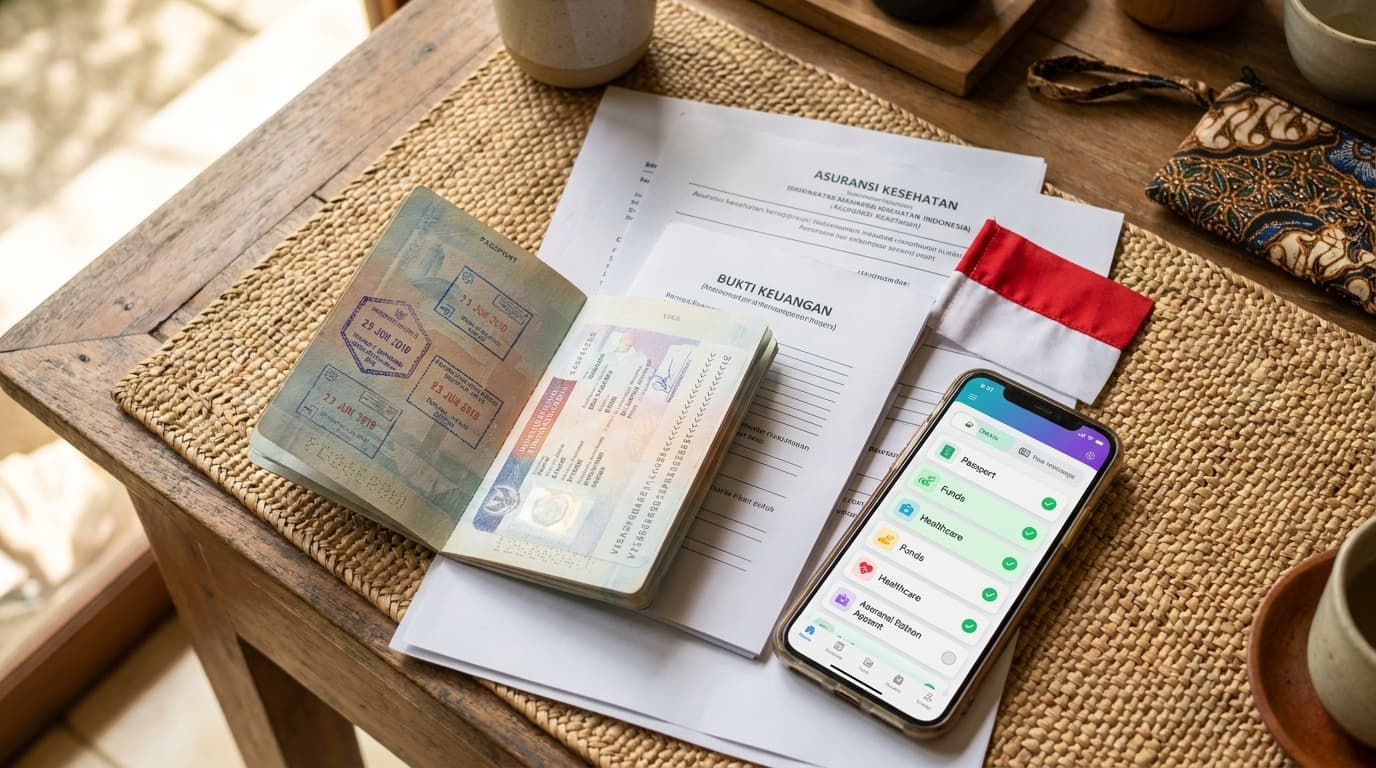
Indonesia Second Home Visa (E33)

At a Glance
- $130,000 one-timefunds in an account in the applicant's own name at a state-owned bank, met and reported within 90 days of entry and kept while the ITAS is valid (Permenkumham 22/2023 Art. 56(2)(a)) · main applicant (deposit route)
- $1,000,000 one-timepurchase of an apartment or strata unit (rumah susun) in Indonesia worth at least US$1,000,000, within 90 days of entry (Permenkumham 22/2023 Art. 56(2)(b)) · main applicant (property route)
- IDR 13,000,000 one-timeRp 500,000 visa + Rp 2,000,000 verification + Rp 7,000,000 5-year ITAS + Rp 3,500,000 5-year re-entry permit = Rp 13,000,000 · main applicant
- 5 yearsfirst ITAS valid up to 5 years (Permenkumham 22/2023 Art. 105(10)(a)) · main applicant
- Extendable online via evisa.imigrasi.go.id, with total ITAS time capped at 10 years; convertible to other stay permitsofficial E33 page; Permenkumham 22/2023 Arts. 112 and 113(2) · E33 holders
- 10 yearsofficial E33 page; Permenkumham 22/2023 Art. 113(2) · E33 holders
- Online at evisa.imigrasi.go.id by the applicant; no sponsor neededofficial E33 page; Permenkumham 22/2023 Art. 56(1) (filed by the foreigner) · all applicants
- 4 daysfour working days after payment · all applicants
- Yes, after a dual-activity report to the immigration officework, study or other activities allowed after reporting a dual activity (rangkap kegiatan) to the immigration office that issued the ITAS; selling goods or services is prohibited · E33 holders
- Yesofficial E33 page · family of E33 holders
- Second home ITAS holders can apply to convert to a permanent stay permit (ITAP)Permenkumham 22/2023 Art. 120(1)(f)(1) as amended by 11/2024 and Art. 173(f)(1); application within 30 days before the ITAS expires (Art. 174) · E33 holders
Last checked Sept. 23, 2026
The E33 second home visa is for foreigners who want to live in Indonesia without a sponsor. The applicant backs the permit with an immigration guarantee instead: a deposit in a state-owned Indonesian bank or an apartment purchase. The official visa list tags E33 as a Golden Visa.
E33 leads to a limited stay permit (ITAS) of up to 5 years, extendable to 10 years of total ITAS time, with the right to leave and re-enter while the permit is valid. The current rules come from Permenkumham 22/2023, in force since Aug. 24, 2023.
- Deposit route: at least $130,000 in a state-owned bank account in the applicant's own name.
- Property route: an apartment or strata-title unit in Indonesia worth at least $1,000,000.
- Government fees: IDR 13,000,000 for a stay of up to 5 years.
- Sponsor: none needed.
- Work: allowed after a dual-activity report to the immigration office.
E33 is for foreigners who want to live and settle in Indonesia without an individual or corporate sponsor, according to the official E33 page. The page sets no nationality limit, age limit or income test.
The qualifying test is the immigration guarantee, met in one of two ways within 90 calendar days of entry:
- Deposit: at least $130,000 in an account in the applicant's own name at a state-owned bank.
- Property: the purchase of an apartment or strata-title unit (rumah susun) in Indonesia worth at least $1,000,000.
The guarantee has to stay at the committed value while the ITAS is valid.
Holders can shop, travel and visit family and friends. They can also work, study or take on other activities after reporting a dual activity to the immigration office that issued the ITAS; the immigration page doesn't cover employer-side work permits. Selling goods or services is prohibited unless the holder's work requires it.
Holders can bring family to live in Indonesia under immigration rules. The E33 page doesn't describe how family members apply; the official visa list includes family visas for spouses (E31B) and children (E31E) of ITAS holders.
Applicants upload these files, as PDF or JPEG, according to the official E33 page:
- Passport: a national passport valid for at least six months.
- Bank statement: a personal statement for the last three months showing at least $2,000 or the equivalent, with name, period and balance.
- Photo: a recent color photo taken within the last year.
- CV: a curriculum vitae.
- Travel history: past travel and a planned itinerary.
- Guarantee commitment: a signed statement committing to the deposit or the apartment purchase.
After arrival, the holder reports proof of the deposit or property to the immigration office that issued the ITAS, within 90 calendar days of entry. Health insurance, a medical check and a police certificate aren't on the official list.
Government fees for a stay of up to 5 years total IDR 13,000,000, according to the official E33 page. The package covers the limited stay visa, a verification fee, the ITAS and the re-entry permit. It isn't refunded if the application is refused.
The page doesn't publish extension fees or separate fees for family members.
The guarantee is the bigger outlay: $130,000 kept on deposit or an apartment worth at least $1,000,000.
The deposit stays in the holder's own account. The official pages don't say whether it can be released after a move to a permanent stay permit.
- Account and upload: register at evisa.imigrasi.go.id and upload the documents directly; no sponsor is needed.
- Pay: pay the fee at a designated bank using the billing code the system issues.
- Processing: Immigration checks the file, verifies payment, approves and issues the visa within 4 days of payment, counted in working days.
- Travel: enter Indonesia within 90 calendar days of the visa's issue date. The ITAS and re-entry permit are issued automatically at the border.
- Guarantee: within 90 calendar days of entry, complete the deposit or apartment purchase and report it with proof to the immigration office that issued the ITAS.
The first ITAS runs up to 5 years. It can be extended online through evisa.imigrasi.go.id as long as total ITAS time stays within 10 years. It can also be transferred to another stay permit.
Where a permit rests on a commitment, Permenkumham 22/2023 (Art. 112) allows an extension only after the commitment is fulfilled. The deposit or purchase has to be in place first.
Second home ITAS holders can apply to convert to a permanent stay permit (ITAP) under Permenkumham 11/2024 (Art. 120).
No official source sets a special tax regime for second home visa holders. The visa decides immigration status; tax residency follows the general rules.
Under tax regulation PER-23/PJ/2025, a foreigner is an Indonesian tax resident if they live in Indonesia, spend more than 183 days there within any 12-month period or are in Indonesia during a tax year with the intent to live there.
An ITAS valid for more than 183 days counts as evidence of that intent. The E33 ITAS runs up to 5 years.
Tax residents are taxed on worldwide income, including interest, dividends and rent from abroad, under Finance Minister Regulation 18/PMK.03/2021. Holders who spend most of the year elsewhere should check where they are resident, including under any tax treaty.
Frequently Asked Questions
How much money does Indonesia's second home visa require?
An immigration guarantee: at least $130,000 on deposit in a state-owned Indonesian bank in the applicant's own name or an apartment worth at least $1,000,000. Either must be in place within 90 calendar days of entry.
How long can a second home visa holder stay?
The first ITAS runs up to 5 years and can be extended, with total ITAS time capped at 10 years.
Can second home visa holders work in Indonesia?
Yes, after reporting a dual activity to the immigration office that issued the ITAS, according to the official E33 page.
What are the government fees?
IDR 13,000,000 for a stay of up to 5 years, covering the visa, verification, ITAS and re-entry permit. The fee isn't refunded if the application is refused.
Does the second home visa lead to permanent residence?
Second home ITAS holders can apply to convert to a permanent stay permit (ITAP) under Permenkumham 11/2024.
How It Compares
More Indonesia programs
| Program | Country | Income | Fee | Max stay | Renewable |
|---|---|---|---|---|---|
| Indonesia C1 Tourist Visa (formerly B211A) | Indonesia | $2,000 saved | IDR 1,000,000↓ | 2 mo | |
| Indonesia Digital Nomad Visa (E33G Remote Worker KITAS) | Indonesia | $60,000/yr | IDR 7,000,000↓ | 12 mo | |
| Indonesia Golden Visa | Indonesia | $350,000 saved | IDR 13,000,000-19,500,000 | 60 mo | |
| Indonesia Retirement KITAS (E33F and E33E) | Indonesia | $3,000/mo | IDR 7,000,000↓ | 12 mo |
Similar visas elsewhere
| Program | Country | Income | Fee | Max stay | Renewable |
|---|---|---|---|---|---|
| Paraguay Permanent Residency | Paraguay | - | PYG 2,926,925↓ | 120 mo | |
| France Long-Stay Visa | France | €1,478/mo | €99↓ | 12 mo | |
| Panama Friendly Nations Visa | Panama | $200,000 saved | $250↓ | 24 mo | |
| Georgia 1-Year Visa-Free Stay | Georgia | - | - | 12 mo |
Indonesia Digital Nomad Guide
Cost of living, internet, healthcare, coworking, and every visa option for Indonesia.
Visa rules change. We'll tell you.
Get notified about policy updates and new requirements for the Indonesia Second Home Visa (E33) and other Indonesia visas.