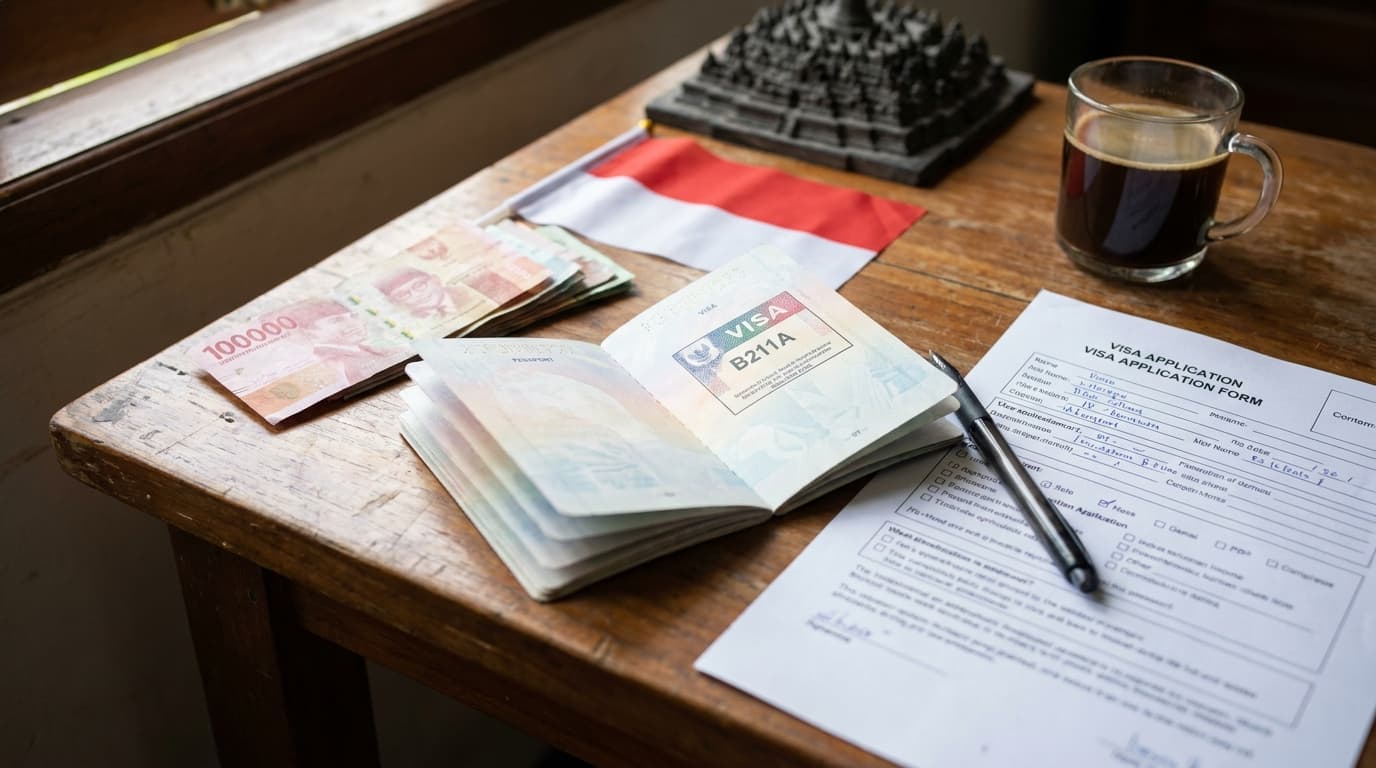
Indonesia C1 Tourist Visa (formerly B211A)

At a Glance
- $2,000 one-time3-month bank statement in the name of the applicant or sponsor showing at least US$2,000 or equivalent in another currency · main applicant
- IDR 1,000,000 one-timeC1 visa fee Rp 1,000,000 plus verification fee Rp 0 · each applicant
- 60 dayssingle entry; stay permit of up to 60 days from the date of arrival · C1 holders
- Extendable online via evisa.imigrasi.go.id, several times, up to 180 days in totalofficial C1 page · C1 holders
- 180 daysthe 60-day stay permit can be extended several times up to 180 days in total · C1 holders
- Online at evisa.imigrasi.go.id or at an Indonesian embassy or consulate; no sponsor needed except for stateless applicants, holders of non-national travel documents and citizens of listed (calling visa) countriesofficial C1 page (sections Penjamin, Pengajuan visa and the two application processes) · all applicants
- 5 daysfive working days after the visa payment is received · all applicants
- Noholders may not sell goods or services or receive pay from individuals or companies in Indonesia · C1 holders
- No direct residency route; the C1 stay permit can be converted to a limited stay permit (ITAS) when the requirements of an ITAS category are metofficial C1 page · C1 holders
Last checked Sept. 23, 2026
C1 is Indonesia's single-entry tourist visit visa and the successor to B211A. B211A was a single-entry visitor visa index under Permenkumham 29/2021. Permenkumham 22/2023 revoked that regulation when it took effect in August 2023. The official visa list now files tourist visits under C1 and business visits under C2.
A C1 holder gets one entry and a first stay of up to 60 days, counted from the arrival date. The stay can be extended several times, to a maximum of 180 days.
- Main uses: tourism, family visits and attending meetings, conventions or exhibitions.
- Government fee: IDR 1,000,000.
- Proof of funds: a bank balance of at least $2,000.
- Sponsor: not needed by most applicants.
- Work: no paid work or sales in Indonesia.
For a longer stay tied to a job with a company abroad, Indonesia has a separate remote worker visa, E33G.
C1 covers tourism, family visits, personal development and cruise travel. Holders can also attend meetings, incentive trips, conventions and exhibitions, according to the official C1 page and the 2025 visa classification decree. The official page also allows business talks, contract signings and site visits at offices, factories and planned investment sites.
Holders may not sell goods or services, take pay from individuals or companies in Indonesia or appear as a speaker at an event. Business trips also have their own index, C2.
The official page sets no nationality limit. Three groups need an Indonesian sponsor: stateless people, holders of travel documents other than a national passport and citizens of countries on Indonesia's calling visa list. Everyone else applies without one.
Some nationalities can instead enter visa-free (index A1) or with a visa on arrival (index B1); both indices are on the official visa list.
The official C1 page lists three core documents, uploaded as electronic files:
- Passport: valid for at least six months. Other travel documents, such as emergency passports, must be valid for 12 months.
- Bank statement: the last three months, in the applicant's or sponsor's name, showing at least $2,000 or the equivalent in another currency.
- Photo: a recent color photo taken within the last year.
Stateless applicants and holders of non-national travel documents also need a re-entry permit for the country where they apply and a return or onward ticket. The page lists no other special requirements.
Embassies that accept C1 applications may ask for more. Extra items on one embassy's checklist apply only to applications filed there.
The government fee is IDR 1,000,000 for a stay of up to 60 days, according to the official C1 page. All of it is the visa fee; C1 carries no verification charge.
Payment goes through designated banks, using the billing code shown in the eVisa system after the application is filed. The page doesn't publish the fee for extending the stay.
The $2,000 bank balance is proof of living funds, not a fee. Most applicants file through their own eVisa account, so no agent is required.
Applicants need an account at evisa.imigrasi.go.id before applying, according to the official C1 page. The application can then go to Immigration online or through an Indonesian embassy or consulate.
- Online: upload the passport, bank statement and photo, then pay at a designated bank using the billing code the eVisa system issues.
- At an embassy or consulate: officers check the file, scan it, verify the payment, approve the application and print, sign and hand over the visa.
- Processing: 5 days after the fee payment is received on either route, counted in working days.
The visa must be used within 90 calendar days of issue; after that, a new application is needed. The length of stay is separate from that validity and starts on arrival.
Stay extensions are filed online through the same eVisa account.
A C1 stay lasts up to 60 days from the arrival date. Holders can extend it online through their eVisa account several times, up to 180 days in total.
C1 covers one entry, so a return trip after leaving Indonesia needs a new visa or another entry route.
The stay permit can also be converted into a limited stay permit (ITAS) when the holder meets the requirements of an ITAS category, the official page says. C1 isn't a residence route on its own.
Frequent visitors can compare the multiple-entry tourist visit visa, index D1, on the official visa list.
The official C1 page says nothing about tax, so Indonesia's general income tax rules apply to visitors.
Under tax regulation PER-23/PJ/2025, a foreigner is an Indonesian tax resident if they live in Indonesia, spend more than 183 days there within any 12-month period or are in Indonesia during a tax year with the intent to live there.
Days in that count don't have to be consecutive. A part day counts as a full day.
Tax residents are taxed on worldwide income, under Finance Minister Regulation 18/PMK.03/2021. A visitor who is also resident in a country with a tax treaty with Indonesia has that status settled under the treaty.
Repeat visitors should count every day spent in Indonesia over the past 12 months, since separate trips add up.
Frequently Asked Questions
Does the B211A visa still exist?
No. B211A was a single-entry visitor visa index under Permenkumham 29/2021, which Permenkumham 22/2023 revoked in August 2023. The single-entry tourist visit visa is now C1.
How long can a C1 holder stay in Indonesia?
Up to 60 days from arrival. The stay can be extended online several times, to a maximum of 180 days.
How much does the C1 visa cost?
The government fee is IDR 1,000,000. The official page doesn't publish the fee for extensions.
How much money does a C1 applicant need to show?
A bank statement for the last three months, in the applicant's or sponsor's name, showing at least $2,000 or the equivalent in another currency.
Can a C1 holder work in Indonesia?
No. Holders may not sell goods or services or take pay from individuals or companies in Indonesia.
How It Compares
More Indonesia programs
| Program | Country | Income | Fee | Max stay | Renewable |
|---|---|---|---|---|---|
| Indonesia Digital Nomad Visa (E33G Remote Worker KITAS) | Indonesia | $60,000/yr | IDR 7,000,000 | 12 mo | |
| Indonesia Golden Visa | Indonesia | $350,000 saved | IDR 13,000,000-19,500,000 | 60 mo | |
| Indonesia Retirement KITAS (E33F and E33E) | Indonesia | $3,000/mo | IDR 7,000,000 | 12 mo | |
| Indonesia Second Home Visa (E33) | Indonesia | $130,000 saved | IDR 13,000,000 | 60 mo |
Similar visas elsewhere
| Program | Country | Income | Fee | Max stay | Renewable |
|---|---|---|---|---|---|
| Paraguay Permanent Residency | Paraguay | - | PYG 2,926,925 | 120 mo | |
| France Long-Stay Visa | France | €1,478/mo | €99↓ | 12 mo | |
| Panama Friendly Nations Visa | Panama | $200,000 saved | $250↓ | 24 mo | |
| Georgia 1-Year Visa-Free Stay | Georgia | - | - | 12 mo |
Indonesia Digital Nomad Guide
Cost of living, internet, healthcare, coworking, and every visa option for Indonesia.
Visa rules change. We'll tell you.
Get notified about policy updates and new requirements for the Indonesia C1 Tourist Visa (formerly B211A) and other Indonesia visas.