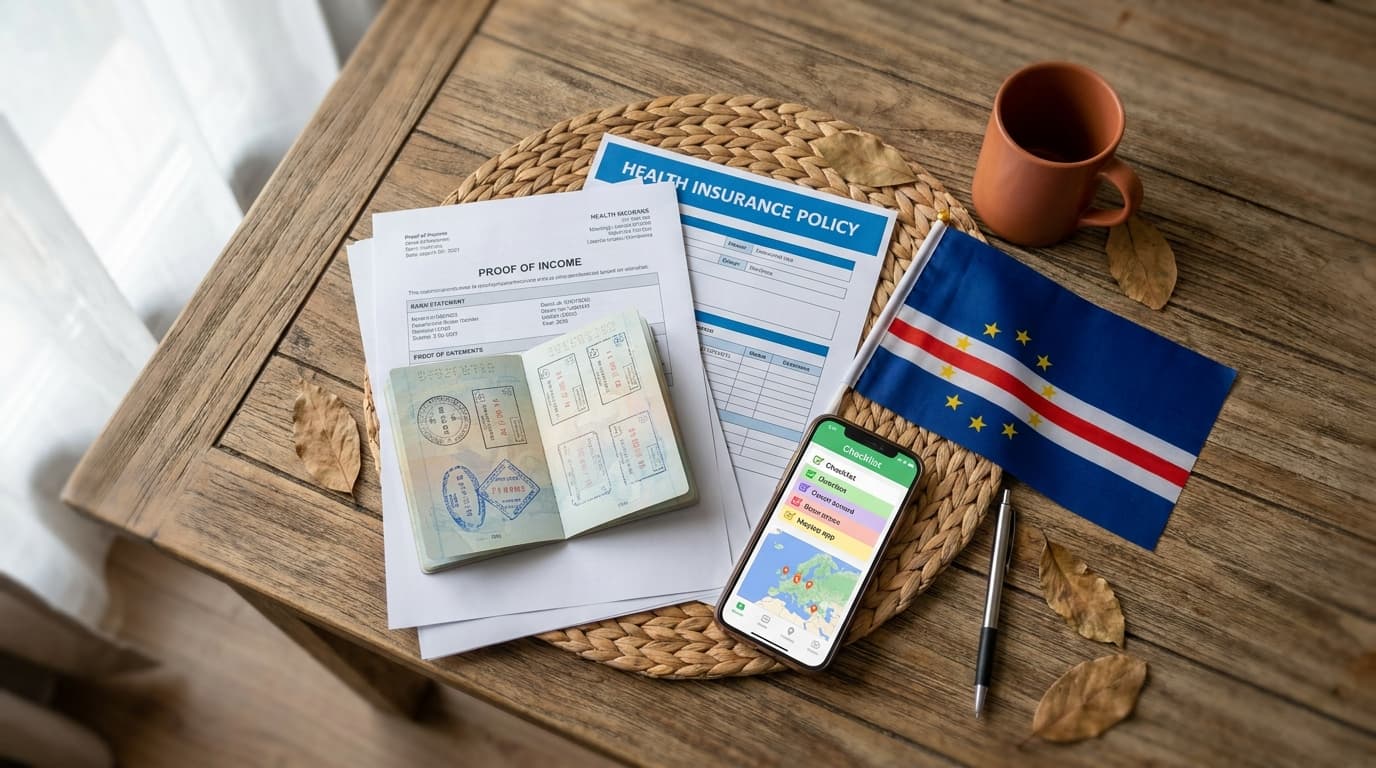
Cape Verde Remote Working Program

Visa Data Sheet
- $1,630 – $2,940 in savings
- $22
- 2 weeks
- 12 months
The Cabo Verde Remote Working Program is the country’s temporary visa for remote workers, freelancers and their families. It lets eligible applicants live and work from Cabo Verde for 6 months, with one renewal for another 6 months, so you can stay up to 12 months in total if you qualify again for the extension.
This isn’t a tourist visa with a fancy label. It’s a residence-style authorization for people whose income comes from outside Cabo Verde and whose work is done remotely for an employer or clients abroad. The official framework was updated in 2023 to regulate remote professional activity more clearly and current DEF and e-Portal materials lay out the application channel and the documentation they expect.
Why people apply: the program is built for longer stays, not quick visits. It also comes with a tax advantage, since official materials say remote workers in the program are exempt from Cabo Verdean income tax.
The main practical point is that you’ll need to prove your remote work setup and your foreign income. The portal also treats this as a formal residence visa process, which makes it stricter than a standard entry stamp and a bit more annoying to prepare for, but it’s the right route if you want to stay longer than a normal tourist visit allows.
- Validity: 6 months
- Renewal: one extra 6-month period
- Who it’s for: remote employees, freelancers and self-employed workers with income from outside Cabo Verde
- Family members: can be included
- Tax treatment: official materials say program participants are exempt from Cabo Verdean income tax
- Application channel: DEF digital platform or in person at DEF or Polícia Nacional counters
The Cabo Verde Remote Working Program is open to foreign remote workers, freelancers and their family members who can live off income from outside Cabo Verde. It’s a temporary visa, not a standard tourist stamp and it’s meant for people doing their job online while staying in the country for a longer stretch.
There’s a real geographic limit on who can apply. Official and quasi-official sources say the program is restricted to citizens of Europe, North America, CPLP countries and ECOWAS countries. If you’re outside those groups, the public guidance doesn’t show a path into this visa.
Applicants also need to show they can support themselves. The reported minimum average bank balance over the previous six months is €1,500 for an individual application and €2,700 for a family application. That’s proof of means, not a local salary requirement and the income still has to come from abroad.
- Valid passport: It needs at least 6 months left.
- Remote work or freelance activity: The work has to be for an entity outside Cabo Verde.
- Accommodation in Cabo Verde: You’ll need proof of where you’re staying.
- Family proof, if applying together: You have to show your relationship to any dependents.
The official materials also point to a clean criminal record and general immigration admissibility, though they don’t spell out a long list of extra disqualifiers. They also don’t give a separate age minimum. One thing is clear, local employment isn’t what this visa is for. The legal description focuses on remote professional activity performed for employers or clients outside the country.
The visa is usually issued for 6 months and can be renewed once, for a total stay of 12 months. Official sources also describe it as tax-advantaged for participants, with an exemption from Cabo Verdean income tax on remote work income under the program.
The Cabo Verde Remote Working Program is a temporary visa, not a tourist stamp. It lets eligible remote workers, freelancers and their families stay for 6 months, with one renewal for a total of 12 months. The paperwork is a little more involved than a normal visit, because the government wants proof that you work for clients or an employer outside Cabo Verde and that your income is stable.
The official portal’s document list is short, but it’s not casual. You’ll need to gather the core items before you apply and border officials can ask to see them on arrival if that’s how your entry is being handled.
- Passport: It must be valid for at least 6 months.
- Criminal record certificate: From your country of origin.
- Proof of work relationship: An employment contract or service agreement showing your remote link to the company or client.
- Proof of income: Documentation that matches the program’s financial thresholds.
- Proof of accommodation: Evidence that you’ve arranged a place to stay in Cabo Verde.
- Medical certificate: Atestado médico.
The program also points to proof of income through an average bank balance, with minimum figures of €1,500 ($1,625) for an individual and €2,700 ($2,925) for a family over the last six months. That’s the part most applicants need to plan for early, because a short-term cash transfer probably won’t do the job if the bank history doesn’t back it up.
Health insurance is required in practice, though the current DEF portal page doesn’t spell it out as a separate upload item. The official materials also don’t list a fixed processing time and they don’t say anything specific about translation or apostille rules for this program. If those apply, they’d come from general immigration procedures rather than the nomad program page itself.
Applications and extensions can be handled through the digital platform or directly with the Directorate of Foreigners and Borders. The visa is also described in official materials as tax-advantaged, with remote workers in the program exempt from Cabo Verdean income tax.
The money side of Cabo Verde’s Remote Working Program is pretty straightforward, but there are two different fee figures in play depending on which official route you’re looking at. The Visit Cabo Verde program page lists a €20 visa fee per person and a €34 airport fee per person, so the total comes to €54.
That €54 is the clearest government-backed figure for the tourist-linked remote working program. The visa fee is also charged again on renewal, while the airport fee is paid once on arrival. Official materials don’t list any separate higher application fee for that version of the program.
- Visa fee: €20 per person, payable again on renewal
- Airport fee: €34 per person, paid once on arrival
- Total program fee: €54 per person
There’s also a separate legal reference for the residence-style remote work visa under Law No. 27/X/2023, which cites a charge of 5,000 CVE. That appears to apply to the regulated remote residence visa processed through the DEF and not necessarily the Visit Cabo Verde tourism-linked program. The official materials don’t spell out how those two fee structures line up, so don’t assume they’re interchangeable.
What the portal doesn’t give you is a clean breakdown of the other costs people usually end up paying. It doesn’t publish fixed numbers for private health insurance, translations or legal help, so those expenses are on you to price out separately. That lack of detail is annoying, but it’s honest and it means you shouldn’t budget off guesswork.
The Cabo Verde Remote Working Program is the route for remote workers who want to stay in the country for longer than a tourist visa allows. It’s a six-month temporary visa and it can be renewed once for a total stay of 12 months. The program is set up for people who earn money from outside Cabo Verde, including freelancers, employees and their family members.
The application process starts online through the official program platform or through the digital DEF system. You can also apply at the Divisão de Estrangeiros e Fronteiras or at regional police commands, though the online route is the cleaner option if you’re applying from abroad.
- Step 1: Register for the Remote Working Program online and submit your application.
- Step 2: Wait for approval. The official materials point to a decision period of about two weeks, but they don’t give a tighter fixed range.
- Step 3: After approval, you receive an entry permit.
- Step 4: Travel to Cabo Verde and present the required documents at the border to get the visa stamp.
- Step 5: If you want to stay longer, apply for renewal on the ground through DEF or the digital platform.
The official guidance says the visa is treated differently from a standard tourist entry because it’s tied to remote professional activity and longer stays. It also comes with a tax advantage, since remote workers in the program are exempt from Cabo Verdean income tax under the official materials consulted.
One part of the process is still a little clunky. You don’t just get everything done before departure, because the final visa stamp happens after arrival at the border, once you’ve shown the required documents and paid the airport fee.
The Cabo Verde Remote Working Program gives you a 6-month stay to live and work remotely, with the option to renew once for another 6 months. That means the program tops out at 12 months total. It’s not a tourist visa dressed up with nicer branding, it’s a temporary residence-style authorization built for remote work.
The official materials treat it as a limited-term visa, not a path to permanent residence or citizenship. None of the sources consulted say it automatically leads to either, so if you want to stay longer after the 12 months, you’d need to look at Cabo Verde’s general immigration rules, not this program.
Renewal is straightforward on paper, but not exactly generous. The program says you can extend it on the ground and official materials point to the same visa fee structure for renewal, including a €20 per person renewal fee mentioned in the program’s cost section.
- Initial validity: 6 months
- Renewal option: One additional 6-month extension
- Total stay under the program: Up to 12 months
- Renewal fee: €20 per person
The key thing to watch is timing. The program is set up for a temporary stay, so don’t assume you can just keep rolling it forward. The official portal doesn’t spell out any longer cumulative stay for this visa category and it doesn’t describe a direct switch into a long-term residence route.
The Cabo Verde Remote Working Program is one of the cleaner tax setups in the region, at least on paper. Official program material says remote workers taking part in the scheme are exempt from Cabo Verdean income tax, so income earned from remote work for foreign employers or clients isn't taxed locally under this authorization.
That said, the tax picture isn’t fully spelled out in the program documents. The official materials don’t explain general tax residency triggers, like day-count rules and they don’t walk through how the remote-work exemption fits with Cabo Verde’s broader tax law. So if you’re planning a longer stay, don’t assume the visa answers every tax question for you.
The program itself is a temporary work and tourism visa, valid for six months and renewable once for a total of 12 months. It’s meant for self-employed applicants and employees whose income comes from outside Cabo Verde, which is the main reason the income tax exemption matters. If your earnings are local or your wider tax situation is tied to another country, you’ll need to sort that out separately.
The official materials also don’t spell out any program-specific double-taxation treaty treatment or reporting obligations. Those issues would fall under Cabo Verde’s general tax rules and whatever treaty network applies to you, not the remote work program itself.
What the official materials do make clear:
- Income tax: Remote workers in the program are exempt from Cabo Verdean income tax.
- Stay length: The visa lasts six months and can be renewed once, for a total of 12 months.
- Scope: It’s aimed at foreign remote workers, freelancers and their families whose income comes from outside Cabo Verde.
- Unclear points: The portal doesn’t give a full breakdown of tax residency rules, treaty treatment or reporting duties.
That leaves one practical takeaway. The visa gives you a tax break on qualifying remote income, but it doesn’t replace proper tax advice if you’ve got income, residency or treaty issues in more than one country.
How It Compares
Similar visas elsewhere
| Program | Country | Income / month | Fee | Max stay | Renewable |
|---|---|---|---|---|---|
| Slovenia Digital Nomad Visa | Slovenia | €3,391/mo | €50 | 12 mo | |
| Belize Work Where You Vacation Program | Belize | $75,000-100,000/yr | BZD 200-500 | 6 mo | |
| Kazakhstan Neo Nomad Visa | Kazakhstan | $3,000/mo | £170 | 12 mo | |
| Bahamas Digital Nomad Visa | Bahamas | - | $25 | 12 mo |
Cape Verde Digital Nomad Guide
Cost of living, internet, healthcare, coworking, and every visa option for Cape Verde.
Visa rules change. We'll tell you.
Get notified about policy updates and new requirements for the Cape Verde Remote Working Program and other Cape Verde visas.