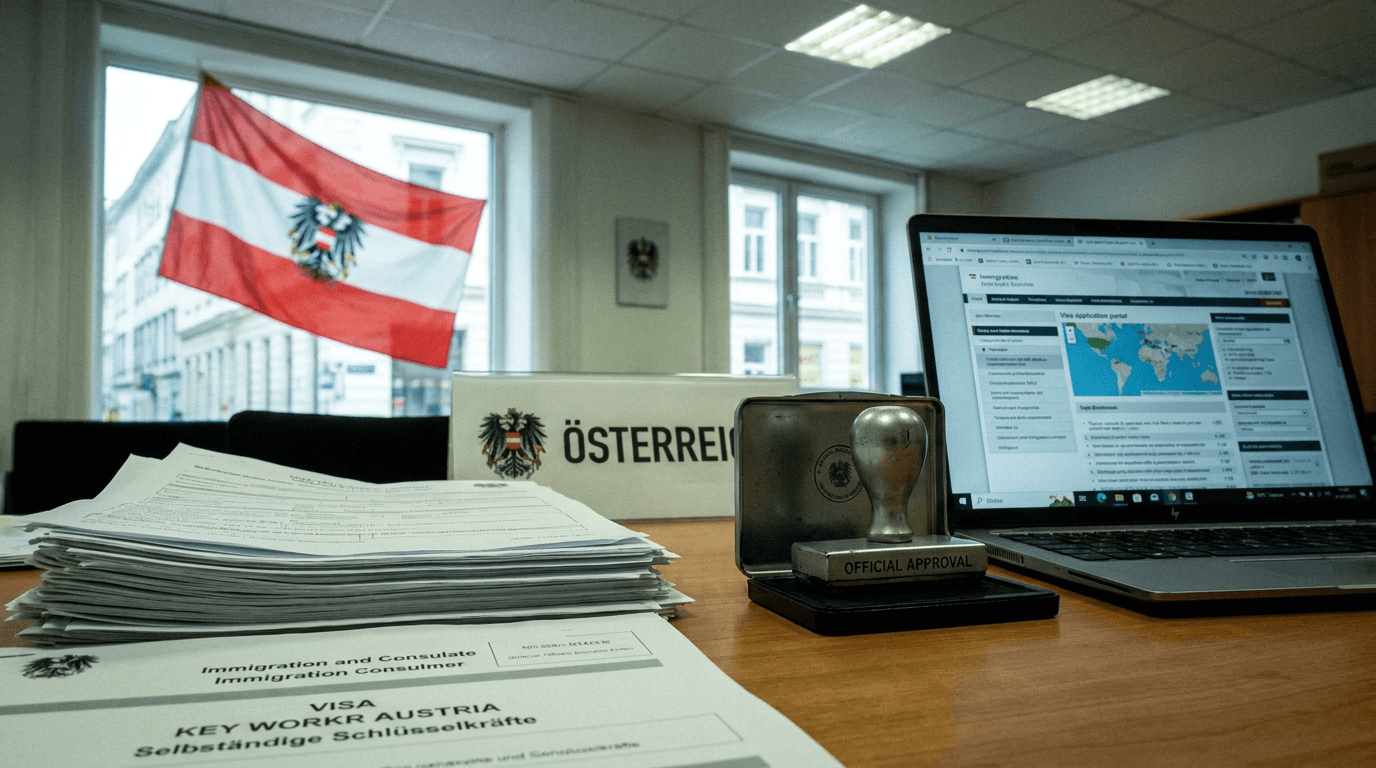
Austria Self-Employed Key Worker Visa (Selbständige Schlüsselkräfte)

At a Glance
- €1,308.39 a monthgeneral requirement for all residence titles: income at or above the standard income rate (ASVG Ausgleichszulagenrichtsatz); EUR 2,064.12 for married couples plus EUR 201.88 per child; rent and loan payments above a free allowance raise the amount · single applicant
- €100,000 one-timesustained transfer of at least EUR 100,000 of investment capital to Austria; one of several alternative ways to show macroeconomic benefit (new or secured jobs, transfer of know-how or new technology, regional significance) · main applicant
- €218 one-timeper applicant
- 24 months
- After the 24-month card, a settlement permit (Niederlassungsbewilligung) for the same self-employed activity if all requirements are still met; after two years of total settlement it can be issued for three years
- In person at the Austrian embassy or consulate in the home country or country of residence; after legal entry, at the competent residence authority in Austria (district administration, city council, MA 35 in Vienna)
- 3 weekstime allowed for the Public Employment Service (AMS) expert opinion only; the residence authority's total decision time is not published · the AMS expert-opinion stage only
- Only the self-employed activity described in the application; employment needs a switch to another Red-White-Red Card category
- Yescore family members (spouse or registered partner, unmarried minor children) who meet the general requirements
- Yes: after five years of uninterrupted lawful settlement, holders can apply for the Long-term Resident EU permit if they meet the general requirements and have completed Module 2 of the Integration Agreement (German at B1)
Status: active. The Red-White-Red Card for Self-employed Key Workers lets third-country nationals settle in Austria to run a self-employed business that brings a macroeconomic benefit beyond its own profit (Austrian migration portal).
The card is issued for 24 months and covers only the self-employed activity described in the application. There is no points system for this route; the Public Employment Service (AMS) judges the business case.
It is not a digital nomad visa. The official page does not address remote work for foreign clients, and a freelancer without a business that benefits the Austrian economy will not qualify.
The self-employed activity must bring a macroeconomic benefit to Austria. The migration portal names four ways to show it; one is enough (Austrian migration portal):
- A sustained transfer of at least €100,000 of investment capital to Austria.
- New jobs, or existing jobs secured, in Austria.
- A transfer of know-how or the introduction of new technology.
- A business of considerable significance for a whole region.
The €100,000 is an investment in the business, not a savings requirement.
General requirements: like every Austrian residence title, the card needs health insurance covering all risks and enough income to live on. In 2026 that means at least €1,308.39 a month for a single applicant, with higher amounts for couples and for each child (Austrian migration portal).
Family: Yes. A spouse or registered partner and unmarried minor children can join on a Red-White-Red Card plus, which gives free access to the labor market, if each meets the general requirements.
Every applicant submits (Austrian migration portal):
- A valid travel document, such as a passport.
- A photo, 45 x 35 mm, no older than six months.
- Proof of health insurance covering all risks in Austria.
To show the macroeconomic benefit:
- A business plan describing the activity, its objectives, the market, the competition and the location.
- Evidence of the capital transfer and of any jobs created or secured.
- Proof of the qualifications needed for the activity.
- Company agreements and trade licenses (Gewerbeberechtigungen), where needed.
Many authorities also ask for a criminal record extract from the country of nationality, ideally no more than three months old, and from any country lived in for more than six months before the move. Originals and copies are needed, with translations into German or English, and the authority may ask for legalized versions.
Application fee: €218 per applicant (Austrian migration portal). Applicants who must enter on a visa D pay that visa's fee separately.
The investment of €100,000, where that is how the benefit is shown, goes into the business and is not a fee. Health insurance, translations, legalization of documents and any legal advice add to the cost and vary by provider.
Family members apply for their own Red-White-Red Card plus and pay their own fees.
Where to apply: In person at the Austrian embassy or consulate in the home country or country of residence; after legal entry, at the competent residence authority in Austria (district administration, city council, MA 35 in Vienna).
- File the application in person with the documents above and pay the fee.
- The residence authority sends the file to the AMS, which gives its opinion on the macroeconomic benefit within 3 weeks.
- If the AMS opinion is positive and the general requirements are met, the residence authority issues the card, and the embassy or consulate informs the applicant.
- Applicants who need a visa to enter Austria apply for a visa D and collect the card from the residence authority.
The AMS deadline of 3 weeks covers only its opinion. The residence authority publishes no total decision time, so the whole process usually takes longer.
The card is valid for 24 months (Austrian migration portal).
Next step: After the 24-month card, a settlement permit (Niederlassungsbewilligung) for the same self-employed activity if all requirements are still met; after two years of total settlement it can be issued for three years.
Work allowed: Only the self-employed activity described in the application; employment needs a switch to another Red-White-Red Card category. That switch needs the points and a binding job offer of the new category.
Long term: Yes: after five years of uninterrupted lawful settlement, holders can apply for the Long-term Resident EU permit if they meet the general requirements and have completed Module 2 of the Integration Agreement (German at B1) (Austrian migration portal).
No special tax regime: holders who live in Austria have unlimited tax liability on worldwide income under the normal rules (Austrian business service portal).
Who is resident: A domicile in Austria, or a usual place of residence there; a stay of more than six months creates unlimited tax liability retroactively from the first day. Austria's test is a domicile or usual residence, not a 183-day count.
Double taxation agreements decide which country taxes foreign income when another country also claims it. Where no agreement applies, Austria grants general relief under its own rules (Austrian business service portal).
Frequently Asked Questions
Is there a minimum investment for the Austrian self-employed Red-White-Red Card?
A transfer of at least €100,000 of investment capital is one way to show the required macroeconomic benefit. Creating or securing jobs, bringing in know-how or new technology, or regional significance can count instead.
How long is the card valid?
The card runs 24 months. Holders who still meet the requirements then move to a settlement permit for the same activity.
How much does it cost to apply?
The application fee is €218 per applicant. A visa D fee applies on top for nationals who need a visa to collect the card.
How long does the decision take?
The AMS gives its opinion within 3 weeks of receiving the file. The residence authority publishes no total decision time.
Can the card be used for remote work as a digital nomad?
No. It covers a self-employed business in Austria that benefits the Austrian economy, and the official page does not address remote work for foreign clients.
How It Compares
Similar visas elsewhere
| Program | Country | Income | Fee | Max stay | Renewable |
|---|---|---|---|---|---|
| Lithuania Startup Visa | Lithuania | €1,153/mo | €160↓ | 24 mo | |
| Ethiopia Digital Nomad Visa (Not Available) | Ethiopia | - | - | - | - |
| Antigua Nomad Digital Residence (Closed) | Antigua and Barbuda | - | - | - | - |
| Palau Digital Residency ID (Not a Visa) | Palau | - | $288 | - |
Austria Digital Nomad Guide
Cost of living, internet, healthcare, coworking, and every visa option for Austria.
Visa rules change. We'll tell you.
Get notified about policy updates and new requirements for the Austria Self-Employed Key Worker Visa (Selbständige Schlüsselkräfte) and other Austria visas.