Argentina Pensionado / Rentista Visa — Argentina

Visa Program Briefing

Argentina Pensionado / Rentista Visa

ArgentinaPassive Income Visa
Brandon Richards
Brandon Richards ·

Visa Data Sheet

Income Requirement
$2,100 / mo
Application Fee
$250 – $400
Maximum Stay
36 months
RenewableResidency PathRemote Work
The Full Briefing

Argentina’s Pensionado and Rentista visas are temporary residence routes, not tourist status. That distinction matters, because these permits are meant for people who will actually live in Argentina while supporting themselves with money from outside the country.

The Rentista route is for foreigners who live off passive income from assets abroad, such as real estate, financial instruments or company shares. The income can’t come from personal work and it has to be brought into Argentina through banks or financial institutions authorized by the Central Bank.

The Pensionado route is for foreigners who receive a regular and permanent pension from a government, international organization or private company for work done abroad. The pension has to be documented with an official certificate and it needs to be stable, not occasional.

Both categories require income equal to or greater than five Salarios Mínimo Vital y Móvil, Argentina’s statutory minimum wage. The official pages don’t give a fixed dollar figure, which is annoying if you’re trying to plan from abroad, but that’s because the peso amount shifts whenever the minimum wage changes.

On paper, both visas grant temporary residence for one year, renewable. The official entry-permit framework also allows these categories to be authorized for up to three years total, which fits Argentina’s broader temporary-residence system. If you stay longer, you can usually move toward other residency steps instead of living on tourist stamps.

You can apply in two ways:

  • In Argentina: if you’re already in the country legally, you apply through RaDEX, the Migration Directorate’s online system, then attend an in-person appointment.
  • From abroad: you usually need a temporary entry permit first, then you go through an Argentine consulate.

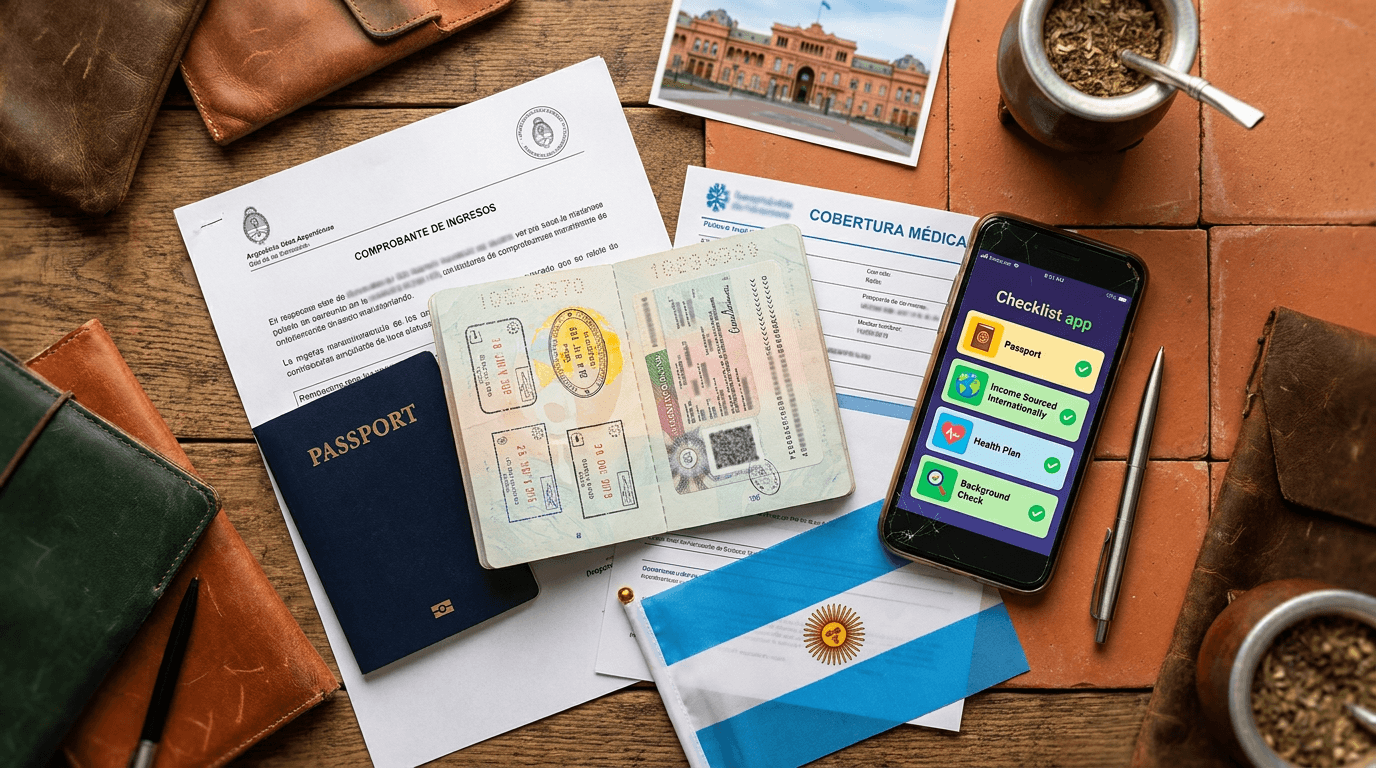
Expect the paperwork to be real, not symbolic. You’ll need a passport, Argentine criminal record check, police clearances from countries where you lived for more than a year in the last three years, proof of address in Argentina and income documents specific to either rentista or pensionado status.

  • Rentista documents: proof that the income is passive, comes from qualifying assets and enters Argentina through authorized financial channels.
  • Pensionado documents: an official certificate showing a regular, permanent pension, plus recent payment records if requested.
  • Document rules: foreign documents need an apostille or consular legalization and anything not in Spanish needs a certified translation in Argentina.

These visas aren't the fast, casual way to hang around the country. They’re formal residence routes and that’s exactly why people use them.

Argentina’s pensionado and rentista routes are temporary residence categories, not a separate remote-work visa. They’re meant for people with stable income from outside Argentina and the law doesn’t give special treatment by nationality or age.

The main rule is simple, even if the paperwork isn’t. You need to show passive foreign income equal to at least 5 times the minimum wage. For both categories, that means your money has to be regular, documented and coming from abroad.

Who qualifies for pensionado

The pensionado category is for foreigners who receive a pension from a government, an international organization or a private employer for work done outside Argentina. The income has to be permanent and clearly tied to retirement or past service, not current employment.

  • Income source: A pension from abroad, paid regularly.
  • Minimum amount: At least 5 times the minimum wage, measured in Argentine pesos.
  • Proof: Pension certificate plus recent payment slips or statements showing the funds are actually being received.

Who qualifies for rentista

Rentista is for people living off assets, not labor. That can include rental income, dividends, interest or other passive returns from property, investments or company shares abroad. If the money comes from freelance work, consulting or a job, it doesn’t fit this category.

  • Income source: Passive income from assets, not wages or self-employment.
  • Minimum amount: At least 5 times the minimum wage.
  • Proof: Ownership documents, contracts or investment statements, plus bank records showing the payments.

There’s no age cutoff in the rules and MERCOSUR nationals can use their regional travel documents instead of a passport if applicable. What matters is the income trail. If you can’t show that the money is stable, foreign and passive, this route usually falls apart fast.

Source 1 | Source 2

Argentina treats the Rentista and Pensionado routes as temporary residence categories and the paperwork is almost the same for both. The difference is simple: rentistas prove passive foreign income, while pensionados prove a pension or retirement benefit.

The official income rule isn't a fixed dollar amount. Both categories must show monthly income equal to or greater than 5 Salarios Mínimo Vital y Móvil (SMVM) and that figure changes with the national minimum wage. DNM doesn't publish a stable USD conversion, so any private-site dollar estimate should be treated as a rough guide only.

  • Valid passport: It must be valid and in force. The official pages don’t give a specific extra validity period.
  • Criminal record checks: Applicants over 16 need an Argentine criminal record certificate, which is usually pulled through RaDEX, plus foreign police certificates from any country where they lived for more than one year in the last three years.
  • Proof of domicile in Argentina: DNM requires address proof, though the portal doesn’t spell out one single accepted format.
  • Income proof for pensionado: A certificate from a government agency, international organization or private company showing a regular, permanent pension at or above 5 SMVM.
  • Income proof for rentista: Documents showing monthly passive income at or above 5 SMVM, plus proof that the money comes from lawful sources and is transferred into Argentina.
  • Translations and legalization: Foreign documents generally need apostille or legalization, then a certified Spanish translation where required.

The government’s residence pages also mention a consular route and the RaDEX online system, so you can start either outside Argentina or after arrival. The basic checklist doesn’t change much, which is a relief. The annoying part is that the income evidence has to be clean, consistent and documented, not just claimed on a bank statement.

Both categories are granted for 1 year and are renewable. The official service pages don’t clearly state, in plain terms, how many renewals you get or exactly when permanent residence becomes available, so don’t rely on recycled blog claims there. The safest move is to keep every income document, translation and legalization in order from the start.

Source 1 | Source 2

Argentina doesn’t make the Pensionado or Rentista route cheap, but it’s not a money trap either. The main government fee for a temporary residence application filed in Argentina is 100 UMSM for extra-MERCOSUR nationals and the current official unit value is ARS 1,000 per UMSM, so the fee lands at roughly ARS 100,000. The government publishes this in pesos, not dollars, so your real cost in USD will move with the exchange rate.

If you start the process through a consulate instead of in Argentina, you’ll usually pay a separate consular visa fee too. That fee is set by the specific consulate, not by a single national price list and the research only supports a rough working budget of about $150 to $300 per main applicant. In other words, don’t assume one consulate’s number applies everywhere.

  • Initial residence fee in Argentina: 100 UMSM or about ARS 100,000 for extra-MERCOSUR applicants.
  • Renewal or extension fee: usually the same 100 UMSM for extra-MERCOSUR applicants.
  • Consular fee abroad: varies by consulate, often roughly $150 to $300.
  • Urgent processing: an extra 100 UMSM can apply in special company-request cases, though that’s not the normal Rentista or Pensionado path.

The income requirement is a separate issue, but it affects your real budget. For both Rentista and Pensionado applicants, the official rule is income equal to 5 times the SMVM each month. The government doesn’t give a fixed ARS or USD figure on the page itself, because the SMVM changes by decree.

Then there are the boring extras that catch people out. Health insurance is commonly required by consulates and often by migration officials and the price depends entirely on age, coverage and provider. You should also expect to pay for legalization, apostilles and certified Spanish translations, but there’s no single official tariff for those services.

So the cleanest way to budget is simple: count on the government fee, add the consular charge if you’re applying abroad, then leave room for translations, legalizations and insurance. That’s where most applicants spend more than they expected.

Argentina handles both the Pensionado and Rentista applications as temporary residency and the cleanest path is usually to apply inside the country through RaDEX. You can also start from abroad through a consulate, but that route uses a separate temporary entry permit and is more cumbersome.

The income rule is the same for both categories. You need at least five times the Salario Mínimo Vital y Móvil, which works out to 1,815,000 Argentine pesos per month based on the May 2026 minimum wage. The government doesn’t publish an official USD equivalent for the visa, so any dollar figure you see online is just an estimate.

How the RaDEX application works

  • Enter Argentina legally: RaDEX only accepts applicants who are already in the country with a valid entry stamp.
  • Open a RaDEX account: Register online and choose “Residencia temporaria, Rentista” or “Residencia temporaria, Pensionado.”
  • Upload your documents: The system asks for scanned copies and the supporting details for your category.
  • Pay the fee: RaDEX calculates the migration fee online. The official fee table uses UMSM units, but the peso amount changes with the system.

The paperwork is very similar for both visas, but the proof of income is different. Pensionado applicants need evidence of a regular pension from a government, international organization or private company. Rentista applicants need passive income from abroad, not salary and the funds have to come through banking channels accepted by the Central Bank.

  • Passport: Valid passport or MERCOSUR ID where applicable.
  • Police checks: Foreign police certificates for every country where you lived more than one year in the last 3 years.
  • Argentine address: Rental contract, utility bill or sworn declaration accepted by Migraciones.
  • Translated and legalized documents: Apostille or legalization plus a sworn Spanish translation if the original isn’t in Spanish.
  • Income proof: Pension letters, pay slips, bank statements or asset income documents, depending on the route.

If you want to apply from outside Argentina, an apoderado in the country can request a “permiso de ingreso” with Migraciones so you can finish the visa at an Argentine consulate. The official process doesn’t give a fixed processing time, so expect some waiting and a fair amount of back-and-forth.

The pensionado and rentista routes are temporary residence categories, not short-stay visas. The usual setup is simple enough on paper, a 1-year grant that can be renewed, but the paperwork can still be slow and a bit fussy.

Under Argentina’s migration rules, these permits can be granted for up to 3 years in temporary residence status. The official pensionado service page, though, says the residence is issued for 1 year and is prorrogable, so that’s the cycle most applicants should expect.

Renewal is handled through the RaDEX system. You’ll need to submit the renewal online, pay the fees, upload the required documents and then show up for the in-person appointment Migraciones assigns. The official portal doesn’t publish a fixed processing time, so don’t assume it’ll be quick.

  • Renewal rhythm: annual in practice, based on the 1-year temporary residence grant.
  • Income check: you must still prove your pension or retirement income is at least 5 SMVM, which changes over time.
  • Fees: you pay the government charges for the original application and again for each prórroga, but the official pages don’t list a fixed ARS amount.

What’s less clear is the long game. Public-facing guidance doesn’t spell out a hard maximum for how many times you can keep renewing and it doesn’t give a neat, category-specific rule for when pensionado holders move to permanent residence.

That matters because the law and the service pages aren’t saying quite the same thing in plain language. The law framework allows temporary residence in this category and points to a path toward permanent residence after lawful stay, but the exact pensionado-to-permanent timeline isn’t clearly set out on the official pages used by applicants.

So the safe approach is to treat the first year as just that, a first year. File for renewal early, keep your income proof current and don’t let the status lapse while you wait on Migraciones. If your long-term plan is permanent residence, it’s smart to assume the rules may need a fresh read before each renewal.

The Pensionado and Rentista visas don’t come with a special tax break. Argentina treats them under the same general tax rules it uses for everyone else, so the big question is whether you’ve become an Argentine tax resident under AFIP rules.

If you do become a tax resident, Argentina taxes you on worldwide income, not just money earned locally. AFIP also says residents can generally claim a credit for analogous taxes paid abroad, but only within the limits set by law. If you’re still a nonresident, Argentina taxes only Argentine-source income.

For immigration, the Rentista category is for people living off income from assets or funds coming from abroad and it explicitly excludes pay for personal work. The minimum income is the equivalent of five SMVM and the money has to come through financial institutions authorized by the Central Bank. The Pensionado category also uses the equivalent of five SMVM and it applies to regular, permanent pension income from a government, international organization or private company for work done abroad.

The annoying part is that the tax clock is separate from the visa clock. AFIP says foreign nationals become tax residents if they get permanent residence or if they stay in Argentina with temporary authorizations for 12 months. That means a one-year Rentista or Pensionado stay can push you into resident tax status even if you never meant to stay that long.

There’s no official “non-dom” style regime published for these visa holders and the immigration rules don’t mention any reduced tax rate either. So if your income is from pensions, rentals, dividends or investments, you should assume standard resident rules apply once AFIP considers you resident.

  • Before 12 months: Usually taxed only on Argentine-source income if you’re still a nonresident.
  • After 12 months or permanent residence: Taxed on worldwide income under general resident rules.
  • Treaty relief: Available where Argentina has a double-taxation treaty and the income fits that treaty.
  • Planning point: Keep records of foreign taxes paid and income source documents, because you may need them later.

Full Country Guide

Argentina Digital Nomad Guide

Cost of living, internet, healthcare, coworking, and every visa option for Argentina.

Stay Current

Visa rules change. We'll tell you.

Get notified about policy updates and new requirements for the Argentina Pensionado / Rentista Visa and other Argentina visas.