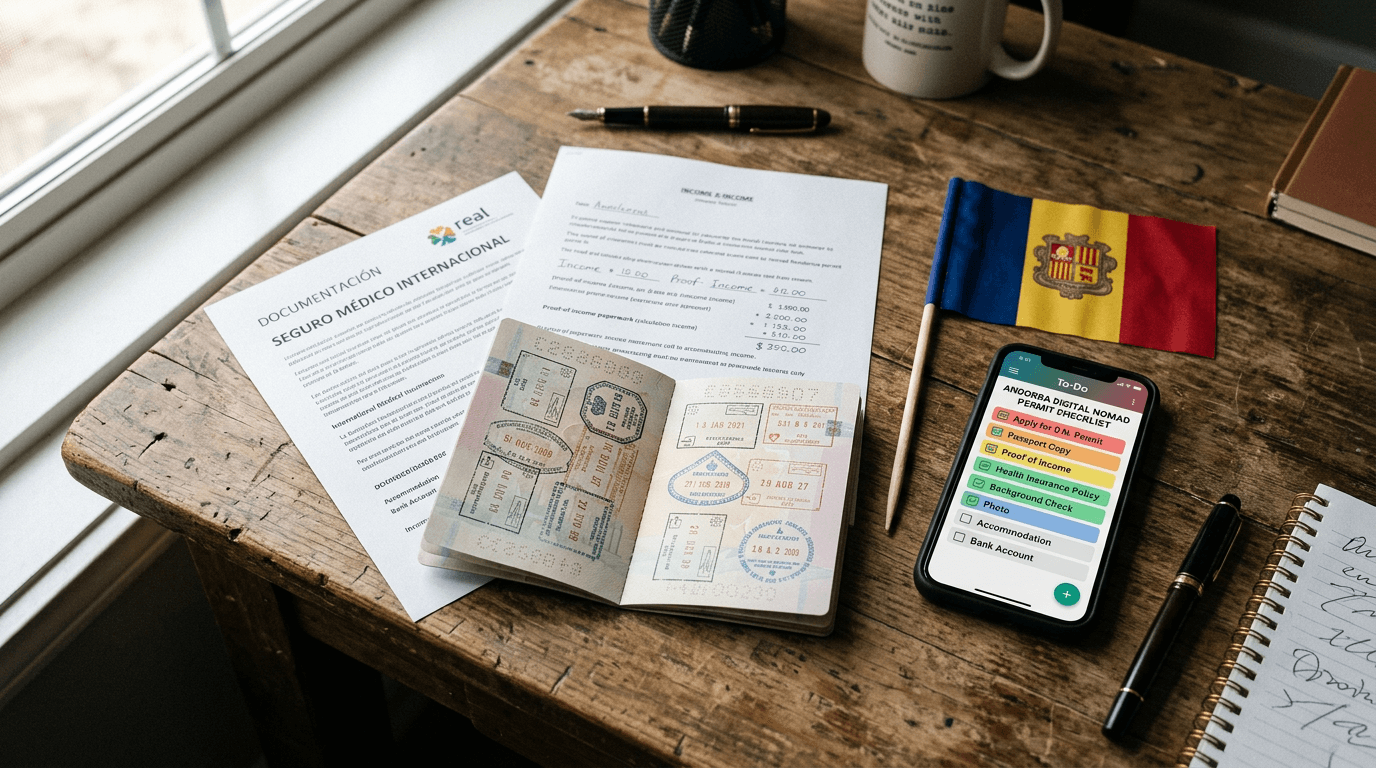
Andorra Digital Nomad Residence Permit

At a Glance
- €56,471.76 a year300% of the annual minimum wage (minimum monthly wage x 12 x 3), per the official technical sheet's example · main applicant
- €224.61 one-timefee for delivery of the initial residence authorisation in the digital economy category (Llei 9/2012 art. 152 item 34, art. 154) · main applicant
- 2 yearsinitial authorisation · all applicants
- First renewal 2 years, second renewal 3 years, later renewals 10 years each; different terms for nationals of states with an agreement with AndorraLlei 9/2012 art. 32.2 to 32.5 via art. 33 bis · all applicants
- Two steps: a favorable decision from the ministry responsible for the economy, then the residence application (form T2 G037) to the Servei d'Immigracio in AndorraD.3 page and form T2 G037 · all applicants
- Nomay work from Andorra only for a foreign employer or as self-employed for non-resident clients or a foreign company; any other lucrative activity needs a separate immigration authorisation · all holders
- Yesdependents of the applicant or of the spouse or stable partner; means and insurance must cover them; reunification under Title IX (art. 102.3) · spouse or stable partner and dependents
- Renewable on the 2 + 2 + 3 year cycle, then in 10-year periods; no separate permanent status namedrenewal cycle on the D.3 page · all holders
Andorra's D.3 residence for digital nomads lets newcomers live in the country while working for clients or employers abroad. According to the Govern d'Andorra, it is for people whose work does not need a fixed location and is done through telecommunications and technology.
The category was added to the immigration law (Llei 9/2012) in 2022. Holders may work from Andorra only for a foreign employer or as self-employed for non-resident clients or foreign companies. Places are limited by a quota set by regulation.
Key terms
- Status: active, subject to a quota
- Means: €56,471.76 a year under the government's guideline of 300% of the minimum wage
- Initial fee: €224.61
- Initial permit: 2 years
- Presence: at least 90 days a year in Andorra
- Work for Andorran clients or employers: No
The official D.3 page and the immigration law (Llei 9/2012) set these conditions:
- A favorable decision from the ministry responsible for the economy, confirming the applicant qualifies as a digital nomad.
- A place within the quota set by regulation.
- Making Andorra the principal and effective residence for at least 90 days per calendar year.
- Sufficient means for the applicant and any dependents. The law leaves the amount to regulation; the government's technical sheet uses 300% of the annual minimum wage, €56,471.76 a year at the rate in force from July 1, 2026.
- Health and disability insurance valid in Andorra for the applicant and dependents for the whole permit. Minors and people over 60 need health cover only.
Work is limited to a foreign employer or non-resident clients; any other paid activity in Andorra needs a separate immigration authorization.
Family: Yes. A spouse or stable partner and dependents join through family reunification, and the means and insurance must cover them. No official per-dependent amount is published for D.3.
The application file is built around the conditions above:
- The favorable decision from the ministry responsible for the economy
- The residence application on form T2 G037, which asks for the date of entry to Andorra and the current Andorran address
- Proof of sufficient means for the applicant and dependents
- Health and disability insurance valid in Andorra
- Consent to the immigration medical check
- A signed commitment to live in Andorra for at least 90 days per calendar year
The D.3 chapter of the immigration law sets no deposit, unlike passive residence, which requires one. Claims of a EUR 50,000 deposit for digital nomads on private websites do not match the law.
The form lists the full set of supporting documents, and applicants should check it before filing.
- Initial residence authorization: €224.61, set in article 154 of the immigration law (Llei 9/2012)
- Renewals and family reunification: charged separately under the same article, at lower rates
Private costs depend on the applicant: health and disability insurance, document translations and any legal help. No deposit is required for D.3.
- Apply to the ministry responsible for the economy for a favorable decision on digital nomad status.
- File the residence application (form T2 G037) with the Servei d'Immigracio. The form asks for an Andorran address and date of entry, so filing takes place in Andorra; no consulate route is published.
- Complete the immigration medical check.
- After approval, register with the comu (parish) of residence within one month.
These steps follow the official D.3 page and the form. No official processing time is published, and approval also depends on quota places being available.
The first authorization lasts 2 years, according to the official D.3 page. First renewal 2 years, second renewal 3 years, later renewals 10 years each; different terms for nationals of states with an agreement with Andorra.
Each renewal depends on still meeting the conditions, including at least 90 days a year of residence in Andorra. Renewal applications are filed no more than 60 days before the permit expires.
Path to residence: Renewable on the 2 + 2 + 3 year cycle, then in 10-year periods; no separate permanent status named.
No special tax regime for D.3 holders; general IRPF rules apply: tax resident after more than 183 days in a calendar year or with the core of economic interests in Andorra; flat IRPF rate 10%.
The minimum stay of 90 days a year is a condition of the permit, not a tax test. Under article 8 of the personal income tax law (Llei 5/2014), a person is tax resident after more than 183 days in Andorra in a calendar year, or when the core of their activities or economic interests is in Andorra. A spouse and minor children living in Andorra create a presumption of residence that can be rebutted.
A holder who spends only the minimum time in Andorra may stay tax resident elsewhere, so applicants should check the rules in their current country of tax residence.
Frequently Asked Questions
How much income does the Andorra digital nomad residence require?
The law leaves the amount to regulation. The government's guideline is 300% of the annual minimum wage, €56,471.76 a year from July 1, 2026, and the means must also cover dependents.
Can D.3 holders work for Andorran companies?
No. Holders may work only for a foreign employer or for non-resident clients; other paid work needs a separate authorization.
How long must holders live in Andorra each year?
At least 90 days per calendar year. That is a permit condition; tax residency starts after more than 183 days.
Is a deposit required for the D.3 permit?
No. The D.3 chapter of the immigration law sets no deposit, unlike passive residence.
How much does the permit cost?
The initial residence authorization costs €224.61. Insurance, translations and any legal help are extra.
How It Compares
Similar visas elsewhere
| Program | Country | Income | Fee | Max stay | Renewable |
|---|---|---|---|---|---|
| Seychelles Workcation Program | Seychelles | - | €10↓ | 12 mo | - |
| Namibia Digital Nomad Visa | Namibia | $2,000/mo | NAD 3,300 | 6 mo | |
| Montserrat Remote Worker Stamp | Montserrat | XCD 189,000/yr | XCD 1,350 | 12 mo | |
| Curaçao @HOME in Curaçao Program | Curaçao | - | XCG 535 | 6 mo |
Andorra Digital Nomad Guide
Cost of living, internet, healthcare, coworking, and every visa option for Andorra.
Visa rules change. We'll tell you.
Get notified about policy updates and new requirements for the Andorra Digital Nomad Residence Permit and other Andorra visas.