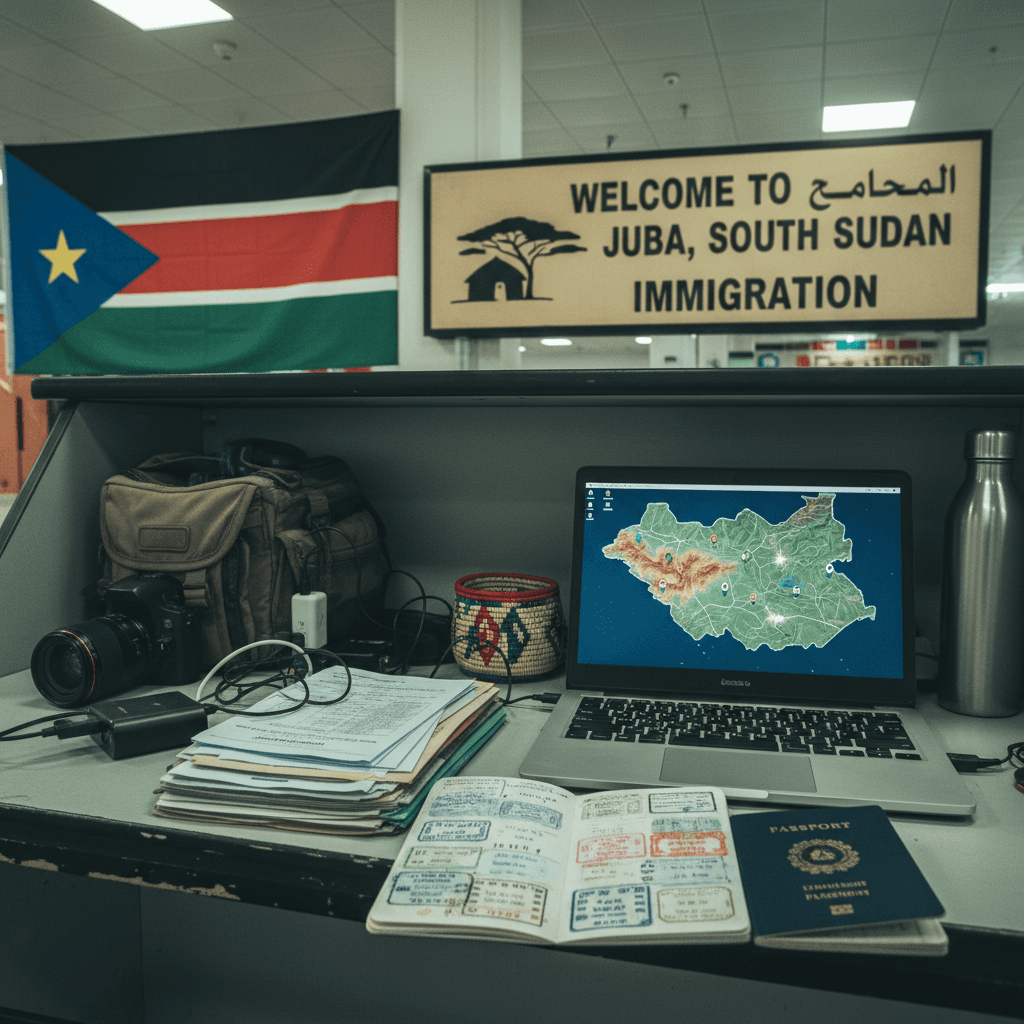
South Sudan

Policy Stability
Stamped Nomad ExclusiveHow likely visa and immigration policies are to remain unchanged
Quick Facts
N/A
3 months
Yes
$800/mo
16 Mbps
3/10
Low
Low
High
CAT (UTC+2)
Entry Methods Available
Best For
The Basics of Entry
Entering South Sudan as a digital nomad requires a bit more legwork than your average beach destination. While the country is slowly modernizing its systems, the process remains relatively formal. Most travelers will need to secure a visa before they land in Juba, either through a physical embassy or the newer electronic portal.
The government primarily issues single entry visas for tourism or business. If you are planning a longer stay or need to pop in and out of the country, multiple entry visas exist but are generally issued at the discretion of immigration officials. Most visitors find it easiest to start with a single entry and handle extensions once they are on the ground.
The E-Visa System
The electronic visa portal is the most efficient route for most nationalities. You create an account, fill out the digital forms, and pay via credit or debit card. Once submitted, the approval usually arrives as a PDF in about 72 hours. When you land, you present this printout at the immigration desk for a quick verification process that typically takes about 5 minutes.
- Processing Time: Approximately 72 hours
- Payment: Credit or debit card via the portal
- Entry Requirement: Printed PDF approval and a passport valid for at least 6 months
Tourist Visa Requirements
If you prefer the traditional route or your nationality requires an embassy visit, the tourist visa is your standard entry point. Since South Sudan does not publish a universal fee schedule, costs vary depending on which embassy you visit. You should plan to submit your application at least 7 working days before your departure.
- Passport: Must be valid for at least 6 months from your date of entry.
- Health: A Yellow Fever certificate is mandatory for entry.
- Documentation: You will need a return flight ticket, a confirmed hotel booking, and one recent passport photo.
- Extensions: If you decide to stay longer, you can visit the immigration office in Juba. Extensions typically cost between USD 100 and USD 250 and take 5 to 10 days to process.
Business Visas for Nomads
If you are traveling for work or consulting, the business visa is the appropriate category. This requires a bit more paperwork than the tourist version, specifically regarding your professional ties. These can be issued for single or multiple entries depending on your specific needs and the embassy's current policy.
- Invitation Letter: You must provide a formal letter from a registered South Sudanese firm or organization.
- Company Records: A copy of the inviting company's registration or your professional contract.
- Financial Proof: You may be asked to show proof of sufficient funds for the duration of your stay.
- Standard Items: Passport, Yellow Fever certificate, and a passport photo.
Visa-Free and On-Arrival Entry
South Sudan has bilateral agreements with several neighboring countries, particularly within the East African region. While the official lists are subject to change without public notice, citizens of Uganda, Kenya, and Tanzania have historically enjoyed easier entry. Additionally, holders of diplomatic or official passports from any country generally qualify for a courtesy visa.
Visa on arrival is extremely limited. Currently, only a few nationalities, such as citizens of Burundi and Rwanda, are consistently reported to receive this service at ports of entry. For everyone else, showing up without a pre-approved e-visa or an embassy stamp is a significant risk. Stick to the e-visa portal to avoid being turned away at the border.
Important Considerations
While the country is developing its e-services, the administrative environment can be fluid. There are no major policy changes scheduled for 2025 or 2026 regarding general eligibility, but local enforcement of rules can vary. Always carry physical copies of your documents, as digital versions on a phone might not always satisfy local officials during routine checks.
Source 1 | Source 2
The Current Status of Remote Work Permits
South Sudan is one of the newest countries in the world, and its immigration system is still catching up to the global remote work trend. Currently, no dedicated digital nomad visa exists for the country. If you are planning to work from Juba or other regions, you will need to navigate the standard entry systems used by tourists and business consultants.
The government has not yet carved out a specific legal niche for people who earn their income from foreign employers while residing in the country. This means you will effectively be operating in a grey area. While the authorities are generally focused on traditional employment within their borders, you should remain discreet about your professional activities to avoid any confusion regarding local labor laws.
The e-Visa System: Your Primary Entry Route
Most nomads rely on the South Sudan e-Visa portal to gain entry. The system is surprisingly streamlined for a country with such complex infrastructure. You can apply for a single-entry tourist or business visa online, and the official processing time is typically around 72 hours. Once approved, you simply download a PDF and present it at the border.
When you arrive, the verification process at the airport is usually quick, often taking less than five minutes to get your passport stamped. You will need to bring a printed copy of your e-visa approval, as digital copies on your phone might not be accepted by every immigration officer.
Standard Requirements and Paperwork
Since there is no nomad-specific application, you must meet the standard criteria for a visitor. The barrier to entry is relatively low compared to some neighboring nations, but the documentation must be exact to avoid delays at the airport.
- Passport Validity: Your passport must be valid for at least 6 months from your date of entry.
- Yellow Fever Certificate: This is a non-negotiable requirement for entry into South Sudan.
- Proof of Onward Travel: You should have a confirmed return ticket or a flight booking out of the country.
- Accommodation Details: A hotel booking or an invitation letter from a local host is required for the application.
- Digital Photo: A recent passport-sized photograph must be uploaded during the online process.
Duration, Renewals, and Extensions
The standard e-visa is typically issued for short stays, often 30 to 90 days. If you intend to stay longer, the process becomes significantly more complicated. There is no simple online "renew" button for digital nomads. For extended stays, you generally have two options: leave the country and apply for a new e-visa, or visit the Ministry of Interior in Juba to request a stay extension.
If you require a multiple-entry visa, the e-visa portal is usually not the best route. These are typically handled through South Sudanese embassies and consulates abroad. If you plan to use Juba as a base while exploring East Africa, securing a multiple-entry sticker in your passport before you arrive is the most reliable strategy.
Income, Taxes, and Legal Realities
One benefit of the current lack of a nomad visa is that there is no official minimum income requirement. You do not need to prove you earn $5,000 a month to be allowed in. However, South Sudan is an expensive destination due to the high cost of logistics and imported goods, so you will need a healthy bank balance to live comfortably.
Regarding taxes, the situation is straightforward but requires caution. As long as you are not employed by a local South Sudanese company and your stay is short, you likely won't fall under the local tax net. However, if you stay longer than 183 days in a year, you could technically be considered a tax resident. There are no specific tax breaks or incentives for remote workers, so consulting with a local legal expert is a smart move if you plan on a long-term stay.
Avoid seeking local employment on a tourist or business visa. The government is protective of the local job market, and any competition with local workers can lead to fines or deportation. Stick to your foreign clients and your foreign bank account to keep things simple.
Source 1 | Source 2
The Entry Reality
South Sudan isn't a place where you can just show up and hope for the best at the border. The government keeps a tight leash on who enters, which means you need to have your paperwork squared away before you even think about booking a flight to Juba. Most travelers will need a visa, though the process has moved into the digital age recently, making it significantly less of a headache than it used to be.
The standard entry requirement for almost everyone is a passport with at least six months of validity remaining. You also cannot get past the health desk without a physical Yellow Fever vaccination certificate. Keep that yellow card with your passport at all times; they check it before you even reach the immigration booths.
The E-Visa System
The electronic visa portal is now the primary way for digital nomads to gain entry. It is a relatively straightforward process where you create an account, upload your documents, and pay the fee via credit card. You will need a digital copy of your passport photo, your main passport page, and your vaccination record. Some applicants are asked for a letter of invitation or proof of funds, so have a bank statement or a hotel reservation handy just in case.
Expect a turnaround time of about 72 hours. Once approved, you get a PDF via email. You must print this in color and bring it with you. When you land in Juba, the immigration officer verifies the code, which usually takes about five minutes, and then stamps your passport. This e-visa is typically valid for a single entry and gives you a 30-day stay.
Visa-Free and On-Arrival Options
The list of people who can skip the pre-application process is very short. If you happen to hold a passport from Burundi or Rwanda, you are eligible for a visa on arrival. Everyone else needs to use the e-portal or visit an embassy. There are some limited exemptions for citizens of specific adjacent countries for stays under 14 days, but for the average nomad coming from Europe, North America, or Asia, the e-visa is the only reliable path.
If you are just passing through, transit visas are available but they are strictly limited to 72 hours. It is rarely worth the effort unless you have a very long layover and want to see a bit of the capital.
Costs and Extensions
Pricing for South Sudanese visas can be a bit fluid. While the e-visa portal will give you a specific price based on your nationality, you should budget between $100 and $200 USD for the entry permit. This fee includes the service charges for the online system. Always pay through the official portal to avoid middleman markups.
If you fall in love with the raw energy of Juba and want to stay longer than a month, you will need to visit the Directorate of Nationality, Passports, and Immigration (DNPI). Their office is in Juba, and you should start the extension process at least a week before your current stamp expires. The process can take 5 to 10 days, and you will need to provide a reason for your stay and proof that you can support yourself financially.
Staying Legal
Whatever you do, do not let your visa expire. South Sudan takes immigration status seriously. Overstaying makes you an "undesirable alien" in the eyes of the law, which can lead to hefty daily fines, detention, or even deportation. Unlike some neighboring countries where a "border run" to reset your visa is common practice, South Sudan doesn't officially recognize this. If you leave and immediately try to re-enter on a new e-visa, you might face some tough questions at the desk.
Summary of Requirements
- Passport Validity: Minimum of 6 months.
- Health: Mandatory Yellow Fever certificate.
- Standard Stay: 30 days for tourists and nomads.
- Processing Time: Approximately 72 hours for e-visas.
- Extension Hub: DNPI office in Juba.
Source
The Reality of Staying Long-Term
South Sudan doesn't have a traditional digital nomad visa or a streamlined path for remote workers. If you are planning to call Juba home for more than a few months, you won't find a "freelancer" category in the application portal. Instead, you have to work within a system designed primarily for NGOs, government contractors, and large-scale investors.
Most nomads here operate on business visas initially, but for a true long-term setup, you will need a Residency Permit. These permits are almost always tied to a sponsor. This means you either need a local business to vouch for you, your own registered company, or a contract with an international organization.
Residency Permit Tiers and Costs
The government offers renewable permits that allow you to stay for several years at a time. These are managed by the Directorate of Civil Registry, Nationality, Passports and Immigration. While the paperwork can be dense, securing one of these is the only way to avoid constant border runs or short-term renewals.
- 3-Year Residency Permit: Approximately $1,250 USD.
- 5-Year Residency Permit: Approximately $1,680 USD.
- Standard Work Permit: Required alongside residency if you are locally employed; fees vary based on your profession and skill level.
Keep in mind that while these prices are based on official structures, the actual cost in local currency can fluctuate. You should always pay fees through official government channels to ensure your permit is valid and recorded in the national database.
The Investment Route
If you have significant capital, you can secure residency through investment. South Sudan doesn't have a "Golden Visa" with a set real estate price tag like you might find in Europe or the Caribbean. Instead, investment residency is discretionary. You will need to show the Ministry of Trade that your business venture contributes to the local economy or creates jobs.
The process involves registering a business, obtaining a tax identification number, and then applying for residency based on your status as a business owner. It is a bureaucratic heavy lift, but it provides the most stability for someone looking to build a long-term base in the country.
Permanent Residency and Citizenship
Moving from a temporary resident to a permanent one is a steep climb. There is no automatic "pathway" where five years of living in Juba grants you a permanent card. Permanent status is rare and usually reserved for those with deep ties to the country or those making massive, long-term contributions to national development.
Citizenship is even more restrictive. If you are looking to naturalize, the standard requirement is 10 years of continuous residency. You are also expected to demonstrate a level of integration that goes beyond just paying rent. This includes:
- Fluency in Juba Arabic.
- Proof of ethnic affiliation or strong community ties.
- Testimonials from local community members.
- A clean criminal record and a background check by the Ministry of Interior.
Practical Advice for Nomads
Since there is no independent freelancer visa, your best bet is to enter on a Business e-Visa, which is usually approved within 72 hours. This gives you time to network on the ground and find a local partner or employer who can sponsor a longer residency permit. Do not expect to handle this process entirely online. While the initial e-Visa is digital, the long-term residency paperwork requires physical visits to immigration offices in Juba.
Always carry physical copies of your sponsorship letters and payment receipts. The bureaucracy here relies heavily on paper trails, and having your documentation organized will save you a lot of headaches during routine checks or renewals.
The Financial Reality of Life in South Sudan
Living in South Sudan as a digital nomad presents a strange paradox. On paper, it is one of the most affordable countries on the planet, with basic survival costs hovering around $500 to $530 per month. However, the gap between "local survival" and "nomad comfort" is a massive chasm. While you can find a room for pennies, the infrastructure required to actually work remotely is a rare, expensive luxury.
Most nomads stick to Juba, the capital. It is the only place where you will find a semblance of an expat community and the specialized services required to maintain a digital career. Venturing to cities like Malakal or Wau might shave a few dollars off your monthly bill, but you will pay for it with near-total isolation and even less reliable power and connectivity.
Budgeting by Lifestyle Tier
To get an accurate picture of what you will actually spend, you have to look past the rock-bottom averages. Prices vary wildly depending on whether you are living like a local or trying to replicate a Western lifestyle.
The Budget Tier: $400 to $550 Monthly- 1BR Rent: Approximately $150 in Juba or $140 in Malakal. These are basic, non-furnished local dwellings.
- Food: $150 to $200, focusing heavily on local markets and staples.
- Transport: $15 to $30 for local transit options.
- Health: $50 to $60 for basic nomad insurance, as local facilities are not reliable.
- 1BR Rent: $400 to $600 for mid-range expat housing.
- Food: $250, allowing for more imported goods and occasional meals out.
- Coworking: $200 to $500 for shared office spaces with better uptime.
- Transport: $50 for more frequent use of taxis.
- 1BR Rent: $1,000 to $2,500 for high-end, furnished apartments in secure zones.
- Food: $400, including consistent dining at expat-focused restaurants.
- Coworking: $1,000+ for private office suites or dedicated high-speed setups.
- Transport: $100+ for private drivers or car rentals.
City Breakdown
While costs are relatively similar across the country, Juba remains the most expensive hub by about 3% to 4%. This is the "infrastructure tax" you pay for the slightly better access to resources.
Juba
- Average Total Cost: $527
- Nomad Readiness: Moderate. This is the only city with dedicated shared offices, though a private 30m² space can command $1,500 or more.
- Rent: Expect to see furnished listings for nomads starting at $1,200.
Malakal
- Average Total Cost: $508
- Nomad Readiness: Very low. This is the cheapest major city, but it lacks the amenities most remote workers consider non-negotiable.
Wau
- Average Total Cost: $520
- Nomad Readiness: Low. Costs reflect the national average, but like Malakal, there is no formal coworking infrastructure.
A Note on Hidden Expenses
When planning your budget, remember that healthcare is a major variable. Local medical facilities are generally inadequate for serious issues. You should factor in $56 to $250 per month for global health insurance that includes medical evacuation. Additionally, since public transport is often unreliable or non-existent for expats, your transport costs may spike if you rely on private hires for safety and speed.
The Reality of Nomad Life in South Sudan
Let’s be direct: South Sudan is not your typical laptop-lifestyle destination. While the digital nomad community thrives in hubs like Nairobi or Cape Town, this young nation remains one of the most challenging frontiers for remote work. Major governments currently maintain "Do Not Travel" advisories due to persistent civil unrest, kidnapping risks, and violent crime. It is a destination only for the most experienced, risk-tolerant travelers, typically those involved in NGO work or specialized consultancy.
The infrastructure reflects these challenges. Outside of the capital, reliable electricity and stable internet are luxuries rather than standards. While the monthly cost of living sits at a staggeringly low average of $520, the trade-off is a lack of personal safety and a near-total absence of a traditional nomad scene. If you choose to base yourself here, your footprint will be small, and your focus will likely be on Juba.
Juba: The Only Viable Hub
Juba is the heartbeat of the country and truly the only city where a digital nomad can function, albeit with significant precautions. It is a city of contrasts, where dusty roads meet a growing skyline of international hotels and aid organization compounds. While the rest of the country lacks the basic framework for remote work, Juba has seen the emergence of a few dedicated spaces designed for professionals.
You can find surprisingly decent internet speeds in specific pockets of the city, often averaging around 15 Mbps. This is enough for standard Zoom calls and emails, though you should always have a local SIM card as a backup. The social scene is small but tight-knit, mostly revolving around the expat and humanitarian community who frequent the riverside lounges and hotel bars.
- The Space Juba: This is the primary coworking destination. It provides a rare reliable environment with consistent power and high-speed internet, which is hard to find elsewhere in the city.
- Naicouba Institute: Another emerging spot that caters to professionals and offers a structured environment for those tired of working from hotel rooms.
- Cafe Culture: A few upscale cafes provide a temporary workspace, though most nomads prefer the security of their guesthouses or dedicated offices.
- After Hours: When the sun goes down, the Nile Secret Lounge and Air Club are the go-to spots for a drink. However, movement after dark is generally discouraged due to security risks.
Cost of Living in Juba
- Monthly Total: Approximately $527
- Rent: $300 - $450 for a secure room or modest apartment
- Meal at an inexpensive restaurant: $5 - $10
- Local Beer: $2 - $3
The Pros and Cons of Juba
The biggest draw here is the cost. Your dollar goes incredibly far, and for those interested in frontier markets or international development, the networking opportunities are unique. English is widely spoken, making it easy to navigate daily interactions without a massive language barrier.
The downsides are heavy. Crime is a significant concern, particularly robberies that target those perceived to have money or electronics. You cannot simply wander the streets with a MacBook in your bag. Beyond the safety risks, the "nomad community" is almost non-existent; you will mostly be hanging out with aid workers and diplomats rather than fellow freelancers.
Other Cities: Wau and Malakal
It is worth mentioning cities like Wau and Malakal only to advise against them for remote work. While they are significant urban centers within South Sudan, they lack the basic digital infrastructure required for a nomad lifestyle. These areas are frequently more volatile than Juba and suffer from frequent power outages and a total lack of coworking facilities. Unless your work specifically requires you to be in these regions, they are best avoided for any professional stay.
Ultimately, South Sudan is a destination for the mission-driven traveler rather than the casual wanderer. If you decide to go, prioritize your security above all else, secure a spot in a reputable guesthouse, and keep your travel plans flexible.
The Connectivity Landscape
Working from South Sudan isn't for the faint of heart or those with back-to-back Zoom calls. The country is still building its digital backbone, and while things are improving in Juba, the rest of the country remains largely off the grid. Internet penetration sits at roughly 12.1%, meaning you are part of a very small group of people trying to access high-speed data.
If you stay within the capital, you can find surprisingly decent fiber optic connections. Providers like IPTEC offer enterprise-grade fiber with speeds reaching 1 Gbps. These connections are stable, boasting low latency between 25 and 50ms, but they are mostly confined to high-end hotels and corporate offices. Once you step outside the Juba city limits, your options shift almost entirely to satellite or expensive mobile roaming.
Coworking and Workspaces
Dedicated coworking spaces as we know them in Bali or Lisbon don't really exist here yet. The infrastructure is too fragmented for a bustling hub of freelancers. You won't find a local "Impact Hub" in Juba; the nearest one is across the border in Khartoum, Sudan, which isn't helpful for your day-to-day needs in the south.
Most nomads and remote consultants treat the major hotels as their de facto offices. The Radisson Blu and the Pyramid Continental are the most reliable spots. They offer steady power and the best WiFi in the city, though you will be paying a premium for a coffee or a meal to secure your seat. Outside of these hubs, you should expect frequent power outages and internet drops. Always have a backup power bank and a secondary data source ready.
Mobile Data and eSIM Options
Since you can't rely on finding a cafe with open WiFi, a solid data plan is your lifeline. Local SIM cards are available, but many travelers prefer the convenience of an eSIM to avoid the registration hurdles. Several providers offer coverage, though prices are high compared to neighboring East African countries.
- Nomad: Offers a 10GB plan for $50 USD valid for 30 days. For those moving between borders, their Global plan gives you 20GB for $99 USD.
- Saily: A good budget entry point with 1GB for 7 days at $10.79, or 3GB for a full month at $25.99.
- eSIMs.io: Generally the cheapest for light usage, with small 1GB to 2GB packages starting around $2.32.
- MobilityPass: Best for emergency backups, offering a pay-as-you-go rate of $0.09 per MB.
Reliability in Secondary Cities
If your travels take you to Wau, Malakal, or Bor, your digital strategy needs to change. Terrestrial fiber doesn't reach these areas. Most NGOs and professional setups in these regions rely on VSAT or satellite providers like SES and BusinessCom. If you are staying at a guesthouse in these towns, do not assume they have WiFi. You will likely be tethering from your phone, and even then, 3G speeds are often the best you can hope for.
The golden rule for South Sudan is redundancy. If your work depends on being online at a specific time, you need a fiber connection as your primary source, a local SIM as a backup, and an eSIM from a different network as a third option. Power is just as fickle as the internet; most reliable workspaces run on heavy-duty generators, so keep your devices charged whenever you see a functioning outlet.
Understanding the Medical Landscape
South Sudan presents one of the most challenging healthcare environments for digital nomads. The system is heavily strained by years of conflict and underfunding. While you will find public clinics, they are often overcrowded and face chronic shortages of basic supplies and trained staff. For anyone visiting from abroad, public facilities are not a viable option for anything beyond the most basic stabilization.
In Juba, the situation improves slightly with a handful of private facilities. These clinics offer better diagnostic equipment and shorter wait times, but they still operate under significant resource constraints. Outside the capital, medical infrastructure is almost non-existent for civilians, often relying on international NGOs like MSF for emergency interventions. If you are planning to work from here, your health strategy should focus on prevention and a very robust exit plan.
Private Medical Facilities in Juba
If you fall ill, your best bet is one of the private centers in Juba. These facilities typically have English-speaking staff and can handle general medicine, minor surgeries, and basic radiology. Keep in mind that "international standard" is a relative term here; these hospitals are the best available but do not compare to facilities in Nairobi or Dubai.
- Juba Medical Complex: Located on Unity Avenue, this is one of the more advanced options. They offer CT and MRI scans, surgery, and oncology services. Contact them at +211921004658.
- Care Plus International Medical Centre: Situated on Airport Road in Tong Piny, they are convenient for those staying near the heart of the city. They provide general medicine and radiology. Reach them at +211925371599.
- AmbuMed Hospital: Located in Gudele Block 9, they handle general surgery and emergency care. Their contact number is +211921070001.
- Gudele Hospital: Another option in the Gudele area (Block 7) for general consultations and imaging. Call +211911355222 for assistance.
Insurance and Medical Evacuation
Standard travel insurance usually won't cut it here. You need a high-end international health plan that specifically includes "War and Terrorism" coverage and, most importantly, emergency medical evacuation. Most serious conditions or injuries will require an airlift to Kampala or Nairobi, as local hospitals cannot handle complex trauma or advanced cardiac issues.
Providers like Allianz, AXA, or Expat Financial offer plans tailored for high-risk zones. Expect to pay at least $1,500 per year for a quality expat plan. While some nomads use SafetyWing, you must verify if their current underwriters cover South Sudan, as many digital nomad policies exclude active conflict zones. Local public insurance is not available to foreigners, so you will be paying for everything out of pocket if your paperwork isn't in order.
Costs and Payments
Cash is king in South Sudanese healthcare. Even with insurance, you should expect to pay upfront for consultations and diagnostics, then seek reimbursement later. While a basic consultation might seem affordable, specialized care and imported medications are hit with massive markups. Some studies show private sector medicines priced at 4.6 times the international median.
- Routine Consultations: Generally affordable but varies wildly by clinic.
- Advanced Procedures: Serious surgeries can cost thousands of dollars locally, while complex treatments requiring evacuation can exceed $90,000.
- Medication: Expect to pay a premium for trusted brands. A full course of treatment for chronic conditions can cost the equivalent of 33 days of local wages.
Pharmacies and Prescriptions
Pharmacy access is hit or miss. In Juba, you can find 24-hour spots like International Pharmacies, but stock levels fluctuate. Only about 50% to 65% of standard medicines are consistently available across the country. There is also a significant risk of counterfeit or substandard drugs entering the supply chain. If you rely on specific maintenance medication, bring a six-month supply with you. Never assume you can "just pick it up" at a local chemist.
Emergency Response
Do not expect an ambulance to arrive if you call for help. Emergency response is largely DIY or coordinated through your employer or insurance provider. In the event of a crisis, your first move should be to reach one of the private hospitals listed above for stabilization. From there, your insurance company will coordinate a flight to a neighboring country. Because infrastructure is poor and security is volatile, these evacuations can take time, making a high-quality first aid kit and basic medical knowledge a requirement for anyone staying long-term.
The Reality of Money in South Sudan
Managing your finances in South Sudan is a bit of a throwback. It is a cash-heavy environment where digital convenience takes a backseat to physical bank notes. While the South Sudanese Pound (SSP) is the official currency, the US Dollar is the unofficial backbone of the economy. You will find that many high-end rentals, hotels, and services are priced in USD, though you will pay for your daily coffee and groceries in SSP.
The exchange rate is managed by the Bank of South Sudan and floats, meaning it can be volatile. It is best to keep a mix of both currencies on you. If you are bringing USD, make sure the bills are crisp, new, and printed after 2013; older or worn notes are often rejected by local businesses and exchange bureaus.
Opening a Local Account
If you are planning to stay for more than a few months, a local account can make life easier for paying local bills or receiving a salary. Banks like Ivory Bank and Equity Bank are the most common choices for expats. You cannot do this online; you will have to walk into a branch and handle the paperwork in person.
The requirements are standard but strict. You will need to provide:
- A valid passport with your current visa or work permit.
- A residency permit (non-residents will find it nearly impossible to open an account).
- Two passport-sized photos.
- Proof of address, which can be a rental agreement or a recent utility bill.
- An employer recommendation letter or a trade license if you are running a business.
The ATM Situation
Don't count on finding an ATM on every corner. They are almost exclusively located in Juba, specifically within high-end hotels or near major bank branches. Equity Bank has one of the more reliable networks for international cards, but it comes at a price. They typically charge a 2.5% fee for non-network Visa withdrawals.
Your home bank will likely tack on another 1% to 3% for foreign transaction fees. Daily withdrawal limits are often low, so if you have a big payment due, start withdrawing cash a few days in advance. Always have a backup plan, as machines frequently run out of cash or lose connection during power outages.
Moving Money In and Out
This is where things get tricky for the modern nomad. Popular fintech apps like Wise and Revolut do not operate here. Because of international sanctions and banking restrictions, South Sudan is on their "unsupported" list. You won't be able to send money to a local bank account using these platforms.
For smaller amounts, Western Union and MoneyGram are the most reliable ways to get cash. You can send money to yourself and pick it up at an agent in Juba. For larger transfers, you will need to use traditional SWIFT bank transfers through local banks or services like Pesabase or Remit. Be aware that large transfers are subject to strict foreign exchange controls, and you might be asked to justify the source or purpose of the funds.
Crypto and Digital Wallets
If you are looking for a legal framework for Bitcoin or Ethereum, you won't find one. Cryptocurrency is currently unregulated. It isn't illegal, but there are no consumer protections either. Some nomads use crypto as a workaround for the lack of traditional banking infrastructure, but it is risky given the unstable internet and lack of local off-ramps. Treat it as a "proceed at your own risk" situation and keep your private keys secure.
Financial Quick Guide
- Local Surcharge: Expect to pay 2.5% at local ATMs.
- Foreign Transaction Fees: Usually 1% to 3% from your home bank.
- Primary Method: Cash (USD and SSP).
- Fintech Availability: None (Wise and Revolut are blocked).
The Reality of Family Life in South Sudan
Moving to South Sudan with a family is a high-stakes decision that requires more preparation than almost any other digital nomad destination. While the expat community in Juba is tight-knit and resilient, the country remains a challenging environment for children. You will find yourself balancing the adventure of a frontier location against significant gaps in healthcare, safety, and infrastructure.
Most families choose to live in gated compounds within specific neighborhoods in Juba, such as Kololo, Amarat, or Tongpiny. These areas offer the most reliable access to generators and private security. Outside of these pockets, the risks involving crime and civil unrest are high enough that many foreign agencies categorize the country as a non-family post, though independent nomads do occasionally relocate with dependents.
Dependent Visas and Paperwork
If you are working remotely under a local contract or sponsorship, your spouse and minor children can join you on dependent visas. This process is handled by the Directorate of Nationality, Passports, and Immigration. You will need to provide original marriage certificates and birth certificates, and all documents must be in English or professionally translated.
- Requirements: Valid passports for all members, proof of financial support, and the primary applicant's valid work permit.
- Medical Clearance: Dependents often need to undergo health screenings as part of the residency process.
- Work Restrictions: Keep in mind that a dependent visa typically does not grant your spouse the right to seek local employment.
Education and International Schools
Schooling options are almost exclusively located in Juba. Quality varies wildly, and while the government has attempted to cap private school fees at approximately $615 for day students and $1,535 for boarding, many international-standard institutions charge well over $5,000 per year.
- Juba Christian Academy: Often the first choice for expat families and missionaries, offering international standards in a structured environment.
- Juba Parents School: Follows a national curriculum but includes extracurricular activities. Nursery fees can exceed SSP 300,000 annually.
- Home Schooling: Many digital nomads opt for online curriculums or distance learning due to the high costs and limited spots in reputable physical schools.
Healthcare and Pediatric Services
Child healthcare is perhaps the biggest hurdle. The public system is severely underfunded, with only about 2% of the national budget allocated to health. Most facilities rely on NGOs like UNICEF for basic supplies and immunizations. For anything beyond a routine check-up, you will need to rely on expensive private clinics.
Malaria, cholera, and measles are persistent threats. It is vital to have a robust international health insurance policy that includes emergency medical evacuation. Most expats fly to Nairobi or Dubai for specialized pediatric care or emergency surgeries, as local facilities often lack the equipment to handle complex cases.
Childcare and Daily Living
Formal childcare centers are rare, reaching only about 6% of children under five. Most expat families hire private nannies or domestic help. While this is more affordable than in Western countries, finding someone with specific training in early childhood development can be difficult. Most childcare takes place within the home or compound due to the lack of public parks and safe playgrounds.
Safe Zones for Families
Juba is the only realistic hub for a family. Other towns like Wau or Yei may have basic guesthouses, but they lack the security and services required for a long-term stay with children.
- Kololo: The most prestigious area. A villa with a guard and generator typically costs between $1,500 and $2,000 per month.
- Amarat: Popular for its proximity to NGOs and slightly better road conditions.
- Tongpiny: Offers a mix of residential and office spaces, making it convenient for parents who need to be near the airport or central business hubs.
Safety Warnings
The safety situation is volatile. The U.S. and many European governments maintain "Do Not Travel" advisories due to risks of kidnapping, carjacking, and armed conflict. For families, the added risks of child trafficking and landmines in rural areas mean that movement is often restricted to "green zones" or heavily guarded areas. You must be prepared for a lifestyle that involves significant confinement to your home or compound.
Safety Reality Check
South Sudan is currently one of the most challenging environments for any traveler, let alone a digital nomad. Ongoing armed conflict, high rates of violent crime, and the threat of kidnapping mean that most Western governments maintain a strict Do Not Travel advisory. While the idea of being a pioneer is tempting, the reality involves landmines and a volatile security situation that can shift in minutes.
Crime Rates for Foreigners
Violent crime is a daily reality in Juba and beyond. Foreigners are frequently targeted because they are perceived to have significant wealth. You need to be aware of the following risks:
- Armed Robbery and Assault: These occur frequently, even during daylight hours in supposedly "safe" areas.
- Carjackings: Vehicle thefts at gunpoint are common on both urban and rural roads.
- Kidnapping: There is a persistent risk of abduction for ransom targeting Westerners and NGO workers.
Common Scams
Corruption is systemic, and you will likely encounter "officials" or police officers demanding bribes for non-existent infractions. Always keep your documents in order, but be prepared for checkpoint extortion. Fake money changers are also a major issue; they often circulate counterfeit currency to unsuspecting visitors. If you are engaging with people online before arrival, be wary of romance or financial scams that eventually lead to urgent requests for wire transfers.
LGBTQ+ Friendliness
This is a high-risk destination for LGBTQ+ individuals. Same-sex activity is strictly illegal and carries a penalty of up to life imprisonment. Security forces have been known to arrest, beat, and torture individuals based on their sexual orientation or gender identity. Transgender individuals are also criminalized under local laws. There is no public "scene," and discretion is not just recommended, it is a matter of survival.
Cultural Etiquette
South Sudanese culture is rooted in deep respect and hospitality. If you do find yourself in a social setting, keep these points in mind:
- The Right Hand: Always use your right hand for shaking hands, eating, or exchanging items. Using the left hand is considered unclean.
- Greetings: Don't rush into business. Spend time asking about a person’s family and their health.
- Modesty: Dress conservatively. For women, this generally means covering shoulders and knees. Men should avoid overly casual beachwear in professional or public settings.
- Respect for Elders: Deference to older individuals is mandatory. Avoid direct confrontation and use indirect communication to keep the peace.
Language Barriers
English and Arabic are the official working languages, which makes basic navigation easier for many nomads. However, there are over 60 indigenous languages spoken throughout the country. While you can get by with English in Juba, learning a few phrases in Juba Arabic will earn you a lot of respect. Be mindful that direct eye contact is sometimes viewed as rude or aggressive; don't be surprised if locals look away while speaking to you.
Expat Community
The expat scene is almost entirely comprised of humanitarian workers, UN staff, and diplomats. There are no "digital nomad hubs" or coworking spaces. Life for expats is largely confined to secure compounds in specific Juba neighborhoods.
- Kololo and Tongpiny: These are the primary residential areas for foreigners.
- Rent Prices: Expect to pay between $1,200 and $1,700 per month for a secure apartment.
- Social Life: Most networking happens within UN or NGO bars and restaurants rather than public cafes.
Social Integration Tips
Integration here looks different than in Bali or Lisbon. It is about building trust through long-term presence and respecting local hierarchies. If you are invited for tea or a meal, accept it, as refusing hospitality can be seen as a slight. To stay safe, you must vary your daily routines and keep a low profile. Avoid displaying expensive electronics, cameras, or large amounts of cash in public. Building a relationship with a trusted local contact or "fixer" is the only way to navigate the social and bureaucratic complexities of the country.
Tax Residency and the 183-Day Gray Area
South Sudan doesn't hand out clear-cut rulebooks for remote workers. Unlike many digital nomad hotspots, the National Revenue Authority (NRA) hasn't explicitly codified a strict 183-day rule in its public documentation. While international standards often default to that six-month threshold, the local focus remains firmly on the source of your money rather than just the stamps in your passport.
If you're living in Juba but your salary comes from a company in London or New York, you generally won't be considered a tax resident unless you establish permanent ties or start earning money from South Sudanese clients. Non-residents are only on the hook for income sourced directly within the country's borders. If you do find yourself needing to register, you'll have to grab a Tax Identification Number (TIN) through the NRA eTax platform using your passport and a local address.
Breaking Down Personal Income Tax
The tax brackets in South Sudan are relatively low compared to Western standards, but they follow a specific structure updated in the Financial Act 2023/2024. These rates have carried over into the current cycle. For those earning in local currency (SSP), the monthly breakdown looks like this:
- Up to SSP 20,000: Tax Exempt
- SSP 20,001 to 40,000: 5%
- SSP 40,001 to 57,000: 10%
- SSP 57,001 to 90,000: 15%
- Over SSP 90,000: 15% flat rate per band
Because the South Sudanese Pound fluctuates significantly, these brackets might feel quite small if you are earning a strong foreign currency. If you are working for a local entity as a contractor, expect them to apply withholding tax on your payments before they hit your account.
The Double Taxation Trap
This is where things get tricky for the long-term nomad. South Sudan is a young nation and hasn't inherited the tax treaty network of its neighbor to the north. While Sudan has treaties with countries like China, India, and Turkey, those agreements do not apply here. Currently, South Sudan has no confirmed double taxation treaties in place.
Without these treaties, there is a real risk of being taxed twice on the same income: once by South Sudan (if they deem you a resident) and once by your home country. You'll need to rely on your home nation's unilateral tax credits to avoid paying double, as the South Sudanese government won't provide that relief on their end.
Crypto and Digital Assets
If you're a crypto native, you're flying under the radar here. South Sudan has zero specific regulations regarding Bitcoin or other digital assets. The infrastructure is limited, and the government has much bigger priorities than tracking your wallet. That said, if you're cashing out crypto into a local bank account to fund your stay, the NRA could technically view those gains as general business income. In practice, however, there is no framework to enforce this.
Compliance and Reporting
Ignoring the tax office isn't a great strategy if you plan on doing business or signing official contracts. Obtaining a TIN is a requirement for anyone with taxable income, and the process is handled through the NRA's digital portals. You'll need it for customs clearances or if you decide to pivot from remote work to local consulting. Failing to report income when required is treated as a criminal offense, so keep your paperwork in order if your stay starts looking more permanent than a quick visit.
No Nomad-Specific Perks
Don't expect a specialized digital nomad visa or tax holiday. South Sudan hasn't followed the lead of countries like Cape Verde or Namibia in courting the remote work crowd. You'll likely be entering on a standard business or tourist visa. As long as your income is strictly foreign-sourced and you don't overstay your welcome to the point of establishing residency, your tax footprint will remain minimal.
Connectivity and Getting Around
Staying connected in South Sudan requires a bit of local legwork. While you can find international eSIMs like GoMoWorld starting at €3.99 or Saily for $10.79 per GB, these often struggle with reliability. Your best bet is to grab a local SIM card from MTN South Sudan. They have the most consistent coverage across Juba, particularly near the airport and main northern routes. Bring your passport to an official shop; the registration takes about 15 to 30 minutes.
For transportation, don't expect to hail a car on the street safely at night. Download Shilu ANA, the city's most reliable ride-hailing app. They even have a loyalty program where the top five weekly users get a free ride. RABA Taxi is a solid backup to have on your phone. Infrastructure is still catching up, so having both apps ready ensures you aren't left stranded when one experiences downtime.
Where to Set Up Base
Juba is a city of distinct pockets, and where you live dictates your quality of life. Most expats gravitate toward Kololo. It is the gold standard for safety and amenities, though it comes with a price tag of $1,500 to $2,000 monthly. These villas usually include gated compounds, boreholes for water, and the all-important standby generator.
- Thongpiny: Best for those who want to be near embassies and NGO offices. Expect to pay between $1,200 and $1,700.
- Amarat: A family-friendly area with paved roads and spacious yards, typically ranging from $1,200 to $1,800.
- Atlabara: A more modern feel with decent road access.
- Gudele: Budget-friendly at under $300, but be prepared for frequent power outages and higher security risks.
While Airbnb and Booking.com have some presence, they are mostly limited to high-end hotels like the Radisson Blu or Pyramid Continental. For stays longer than a month, skip the apps and talk to local real estate agents. Most of the best housing inventory never makes it onto international platforms.
Daily Essentials and Language
Hungry? Juba’s food delivery scene is surprisingly active. Yalla Delivery was the first on the scene and remains a favorite because they don't tack on hidden fees. Doyoom and Karibu App are also great for ordering from local restaurants. If you need groceries or household supplies, Hilu is an "everything app" that offers free delivery for your first 7 days.
Communication is easier if you pick up some Arabic. AlifBee is excellent for structured lessons, while Lughatuna is a lifesaver for translating specific Sudanese dialects. If you want to sound more like a local, Speak Sudanese focuses on the specific vocabulary and grammar used in the region. Always start interactions with a polite "Salam alaikum."
Staying Safe and Avoiding Trouble
The most important rule in Juba: put your camera away. Taking photos of government buildings, infrastructure, or even certain street corners can lead to immediate detention. Always ask for explicit permission before snapping a photo of anyone. Security is a constant consideration, so avoid walking anywhere after dark and keep a low profile.
Power and internet are luxuries, not guarantees. Even in premium neighborhoods, you should have a backup power bank and a secondary data source. For medical or police emergencies, the unified number is 999. Save it now. There is no specific digital nomad visa, so you will likely be on a standard 90-day single-entry visa. Keep a close eye on your expiration date, as overstaying can cause significant headaches with local immigration.
More Guides from Africa
Stay Updated on South Sudan
Get notified about visa changes, policy updates, and new information for digital nomads in South Sudan.