Seychelles

Policy Stability
Stamped Nomad ExclusiveHow likely visa and immigration policies are to remain unchanged
Quick Facts
$55
12 months
No
$1,585/mo
20 Mbps
6/10
Medium
Low
High
GST (UTC+4)
Entry Methods Available
Best For
The Seychelles Entry System
Seychelles keeps things remarkably simple for travelers. Most countries make you jump through hoops for a visa, but here, the entire world is welcome without one. Whether you are coming from New York, London, or Tokyo, you do not need to apply for a traditional visa at an embassy before you fly. Instead, every visitor receives a Visitor's Permit upon arrival.
While the permit itself is granted at the airport, there is one mandatory step you have to handle before you even head to the gate. You must apply for an Electronic Travel Authorisation (ETA) through the official government e-Border system or mobile app. This is an automated security check that replaces the old paper arrival cards. Most people get their approval within hours, but it is smart to submit your application between 9 and 72 hours before your flight departs.
Entry Requirements
Even though the process is streamlined, immigration officers will still want to see that you are prepared for your stay. When you land in Victoria, have these items ready to show:
- A passport valid for at least 6 months from your date of entry.
- A confirmed return or onward flight ticket.
- Proof of accommodation, such as a hotel booking or a rental agreement.
- Evidence of sufficient funds for the duration of your trip.
The only exception to the universal visa-free rule is for travelers using a Kosovo passport, who still require a formal visa before arriving. For everyone else, the ETA is your golden ticket to the islands.
Staying Long-Term as a Nomad
The initial Visitor's Permit is free and valid for up to 3 months. This is perfect for nomads who want to test the waters and see if island life suits their workflow. If you decide that 90 days of turquoise water isn't enough, you can extend your stay in 3-month increments.
The total time you can spend in the country on a Visitor's Permit is 12 months. Each 3-month extension costs SCR 5,000. You can handle these extensions online or visit the Immigration Division office in Victoria. Just make sure you start the paperwork at least 2 weeks before your current permit expires to avoid any last-minute stress.
Business and Professional Visits
If you are heading to Seychelles for a mix of business meetings and beach time, the rules remain the same. There is no separate business visa for short-term stays. You will enter on the standard Visitor's Permit using the ETA system. If you are asked about the nature of your visit, just be prepared to show a letter of invitation or proof of your business purpose, but for most digital nomads working remotely for overseas clients, the standard permit covers your stay.
Recent Updates for 2025 and 2026
The system is becoming more digital and efficient. Late in 2024, the government launched an online portal for permit extensions, meaning you might not even have to leave your beach chair to stay another three months. If you happen to be arriving by yacht or cruise ship instead of flying, be aware that a Maritime Travel Authorisation (MTA) is now mandatory, functioning exactly like the ETA for air travelers.
The core policy of being a visa-free nation remains firmly in place for 2025 and 2026. The government continues to prioritize a "frictionless" entry process, making it one of the most accessible tropical hubs for remote workers globally. As long as you have your ETA approved and your SCR 5,000 ready for extensions, the islands are wide open.
Source 1 | Source 2
The Seychelles Workcation Retreat
If you have ever caught yourself staring at a screensaver of a turquoise lagoon while sitting in a grey office, the Seychelles Visitors Workcation Permit (VWP) is your ticket to making that image a reality. Launched in 2021, this program is designed specifically for remote employees, freelancers, and business owners who want to swap their commute for a coastal breeze.
The VWP isn't just a standard tourist extension; it is a legal framework that allows you to live in the archipelago for up to 12 months. It provides a stable legal status that keeps you away from the "border run" cycle common in other tropical hubs. However, keep in mind this is a one-time, non-renewable deal. You get one solid year of island life, and once it ends, you must leave the country before you can consider reapplying.
Money and Taxes
One of the biggest draws of the Seychelles program is the lack of a rigid "salary floor." While many countries demand you earn a specific five-figure monthly sum, Seychelles takes a more holistic approach. You simply need to prove you are financially self-sufficient. To do this, you will need to provide six months of bank statements showing you have enough liquidity to cover your lifestyle without needing local work.
The tax situation is equally attractive. Seychelles operates on a territorial tax system. This means the local government only taxes income generated within its borders. Since you are forbidden from taking local jobs, your foreign-earned income remains untaxed by Seychelles. You can enjoy the infrastructure and beauty of the islands without worrying about filing local tax returns or losing a percentage of your paycheck to the local treasury.
Requirements and Restrictions
The "work" part of the Workcation Permit is strictly defined. To stay compliant, you must ensure your professional life stays entirely digital and international. Here are the core rules you need to follow:
- Foreign Employment: You must work for a company, own a business, or serve clients located outside of Seychelles.
- No Local Jobs: You are strictly prohibited from seeking local employment or engaging in any gainful occupation within the domestic market.
- Continuous Stay: This permit is designed for a continuous stay. If you leave the country, the permit may lapse, meaning you cannot use it as a multi-entry visa to hop back and forth between continents.
- Health Coverage: You must maintain a valid health insurance policy that includes COVID-19 coverage for the entire duration of your stay.
How to Apply
The application process is handled entirely online through the Seychelles Electronic Border System. It is relatively straightforward, but you should start the paperwork early; the government recommends applying at least 60 days before your planned arrival.
First, you will gather your documents: a passport valid for at least 6 months, proof of your employment status, your bank statements, and confirmed bookings for your initial accommodation and return flight. The application fee is modest, typically ranging between €45 and $55 depending on current exchange rates.
Once your VWP is approved, which usually takes about two weeks, you have one final step. You must complete the Health Travel Authorization (HTA) via the same online portal. This step is vital because it grants you a unique ID number. This ID is your "local pass" that can sometimes unlock specific discounts and access to local apps designed for the workcation community.
Key Details at a Glance
- Official Name: Visitors Workcation Permit (VWP)
- Permit Fee: Approximately $55
- Processing Time: Roughly 14 days
- Validity: 12 months (non-renewable)
- Income Requirement: No fixed minimum; 6 months of bank statements required
Source 1 | Source 2
The Concept of Borderless Entry
Seychelles operates on a unique philosophy compared to most digital nomad hubs. It is effectively a visa-free nation for almost every traveler on the planet. You do not need to visit an embassy, apply for an e-visa weeks in advance, or deal with complex paperwork before you land. The only exception to this rule applies to holders of Kosovo passports, who are currently restricted from entry.
Instead of a traditional visa, you are granted a Visitor’s Permit upon arrival. While the permit itself is free, there is one non-negotiable step you must complete before heading to the airport. You are required to apply for a digital Travel Authorisation (TA) through the official Seychelles Electronic Border System. Think of this as a digital landing card that vets your health and security status before you touch down in Victoria.
Applying for Travel Authorisation
You should submit your TA application between 30 days and 72 hours before your flight. The process is straightforward but requires you to have your documents organized. You will need to upload a scan of your passport, your flight itinerary showing a confirmed return or onward ticket, and proof of your accommodation for the duration of your stay.
The immigration officers also look for proof of sufficient funds. The current benchmark is approximately US$150 per day. While they might not ask to see your bank balance at the border every time, having a recent statement or a mobile banking app ready to show can prevent unnecessary delays. Once approved, you will receive a digital document with a QR code to show at check-in and upon arrival.
Staying Long-Term: Extensions and Limits
The initial Visitor’s Permit is typically valid for 3 months (90 days). For many nomads, this is the perfect window to experience the islands without getting bogged down in bureaucracy. However, if the island life hooks you, you can extend your stay in 3-month increments.
To extend, you must visit the Department of Immigration and Civil Status in Victoria. It is best to start this process at least 14 days before your current permit expires. You can continue extending your stay for up to a total of 12 months, provided you still meet the financial requirements and have a place to stay. While the initial entry is free, these extensions do come with administrative fees that are payable directly to the immigration office.
Important Compliance Details
- Entry Requirements: A passport valid for the duration of your stay, a return ticket, and a confirmed accommodation booking.
- Permit Duration: Initial 90 days, extendable up to 1 year total.
- Financial Proof: Evidence of US$150 available per day of your visit.
- Address Changes: If you move from one island or Airbnb to another, you are technically required to notify the Immigration Department of your new address.
Overstays and Border Runs
The Seychelles government takes immigration rules seriously. Overstaying your permit can lead to immediate fines, deportation, or being banned from returning to the archipelago. If you find yourself nearing the end of your permit and haven't secured an extension, it is better to depart and return later rather than risk an overstay mark on your record.
Regarding "border runs," the practice of leaving for a day and coming back to reset your clock is not a guaranteed strategy here. Immigration officers have the discretion to deny entry if they feel a traveler is using the Visitor’s Permit to reside in the country indefinitely without the proper long-term permits. Each entry is treated as a new assessment, so always ensure your paperwork and proof of funds are current every time you fly in.
Source
The Residence Permit: For Retirees and Remote Workers
If you are looking to call the Seychelles home without joining the local workforce, the Residence Permit is your primary route. This is the go-to option for digital nomads who have outgrown the shorter Workcation Permit or retirees looking for a permanent tropical base. It allows you to stay indefinitely as long as you renew it, provided you spend at least 5 days a year in the country.
To qualify, you need to show you are financially self-sufficient. While the exact threshold can vary based on your lifestyle, expect to prove an income between $1,500 and $3,000 per month through bank statements. You will also need a clean criminal record, a medical certificate, and a bank guarantee of SCR 20,000. The government wants to see that you can support yourself and any dependents without relying on local funds.
The costs for this permit are significant, reflecting the islands' premium status. There is a SCR 1,000 processing fee, and the permit itself costs SCR 150,000 for the main applicant. If you are bringing a spouse, their joint application fee is SCR 75,000. You can pick up the application forms at Independence House in Victoria or download them from the official immigration portal.
Gainful Occupation Permit (GOP)
For those who want to do more than just work on a laptop from a beach cafe, the Gainful Occupation Permit (GOP) is required. This applies if you intend to start a local business or work for a Seychellois company. Unlike the Residence Permit, the GOP allows you to earn a living within the local economy. If you are self-employed or a freelancer looking to establish a local presence, you must first get approval from the Seychelles Investment Board.
The GOP process is surprisingly fast once you have your project approval in hand, often taking between 1 and 5 days to process. The fees are also more accessible for active workers. You will pay a SCR 1,000 processing fee and a monthly fee of SCR 700 for the duration of the permit. If you are an employee, your employer usually handles this, but as a self-employed expat, the paperwork falls on you.
Requirements for the GOP include:
- Proof of project approval from the Seychelles Investment Board
- A valid passport and a detailed CV
- Police and medical clearances
- A SCR 1,000 processing fee
Permanent Residency: The Long Game
If you fall in love with the archipelago and decide to stay for the long haul, you can apply for Permanent Residency. This status is a major milestone because it allows you to work and live in the Seychelles without needing a GOP. It is generally available after you have held a Residence Permit or GOP for at least 5 years. You must demonstrate that you have not been absent from the country for more than one year without prior consent during that period.
Investors can fast-track their way to this status by injecting USD 1 million or more into a local business, provided they have maintained a 5-year affiliation with that investment. The application involves a SCR 1,000 processing fee. If your application is successful, the final fee for the grant of Permanent Residence is SCR 350,000.
Logistics and Contact Information
All long-term stay applications are managed by the Department of Immigration and Civil Status. Their main office is located at Independence House in Victoria, Mahé. It is best to handle these matters in person or via their official email channels for the most accurate updates on your application status.
- Main Office: Independence House, Victoria, Mahé
- General Inquiries: +248 4293636
- Permanent Residency Section: +248 4293600
- Email: info@immigration.gov.sc
The Price of Paradise
Living in the Seychelles as a digital nomad is a study in trade-offs. While you are surrounded by some of the most stunning coastlines on the planet, the "island premium" is a very real factor. Most goods are imported, which keeps costs higher than mainland African hubs or Southeast Asian favorites. For the 2025-2026 season, expect a monthly spend ranging from $1,500 on a tight budget to upwards of $3,500 for a high-end lifestyle.
The local currency is the Seychellois Rupee (SCR), which currently sits around 1 SCR to $0.073 USD. While credit cards are widely accepted in Victoria and major resorts, you will want a steady supply of cash for local markets and small guesthouses on the outer islands. Rent will be your largest overhead by far, often consuming half of your monthly budget.
Monthly Budget Breakdowns
Your lifestyle choices will dictate whether you stay in the $1,500 range or climb toward $3,000 plus. Here is how the tiers generally shake out for a single nomad.
Budget Tier: $1,500 to $2,000- Housing: $700 to $1,000 for a modest studio or shared apartment in Victoria.
- Food: $250 to $350 focusing on local markets and takeaway "boxes."
- Transport: $25 to $50 using the reliable public bus system.
- Connectivity: $0 to $50 relying on home Wi-Fi and local SIM cards.
- Housing: $1,100 to $1,800 for a standard one-bedroom apartment with air conditioning.
- Food: $350 to $450 with a mix of grocery shopping and occasional sit-down dinners.
- Transport: $50 to $80 using a mix of buses and occasional taxis.
- Connectivity: $50 to $100 for higher-speed home internet and data backups.
- Housing: $2,200+ for luxury apartments or villas with ocean views.
- Food: $500+ including frequent dining at resort restaurants and imported deli goods.
- Transport: $100+ which usually involves a long-term car rental for total flexibility.
- Connectivity: $100 to $200 for dedicated coworking access and top-tier data packages.
Location Matters: Mahé vs. The Islands
Where you choose to drop your anchor significantly impacts your wallet. Victoria, on the main island of Mahé, offers the most "urban" experience and the best value for long-term rentals. It is also the only place where you will find consistent infrastructure and the easiest access to the main airport.
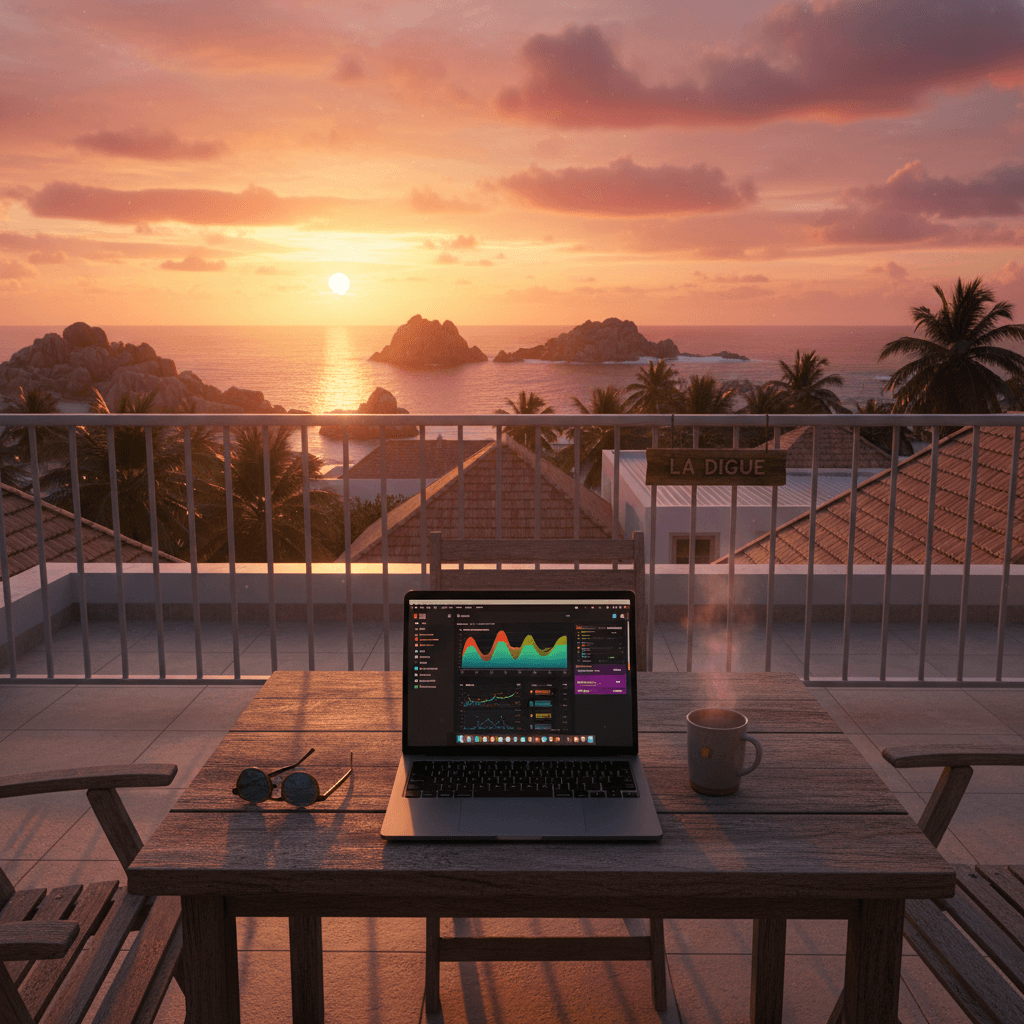
Praslin and La Digue are more expensive for nomads because the housing stock is geared almost entirely toward short-term tourists. Expect to pay a premium of $200 to $500 more per month for a one-bedroom on these islands compared to Mahé. La Digue, while incredibly charming, has almost no formal coworking facilities, so your "office" costs will likely be rolled into your high-speed home internet bill.
Mandatory Costs and Hidden Fees
If you are applying for the Workation Retreat visa, health insurance is not optional. You must prove coverage for the duration of your stay. A basic nomad-specific policy will cost between $50 and $80 per month, while more comprehensive plans that include private hospital access can run $150 to $200.
Eating out can be a budget killer if you aren't careful. A meal at a tourist-facing restaurant often starts at $30, but you can find local Creole takeaway stands selling fish and rice for $7 to $10. To keep costs down, shop where the locals shop; look for small grocery stores tucked away from the main beach strips rather than the high-end supermarkets in Eden Island.
Victoria (Mahé)
Victoria isn't just the capital; it is the heartbeat of the Seychelles and the only place that feels truly urban. For nomads who need a structured work environment, this is where you will find the best infrastructure. The city manages to blend a tropical aesthetic with the functional necessities of a modern office, making it the most practical base for a long-term stay.
The crown jewel for remote workers here is Blend, a dedicated coworking space offering 24/7 access and speeds between 60 and 80 Mbps. A day pass costs around $38 USD, which is steep, but it is the most reliable connection in the country. If you prefer a more social atmosphere, Chatterbox is a popular cafe where the Wi-Fi is decent enough for emails and light tasks over a coffee.
- Monthly Cost of Living: $3,500 to $4,800
- Average Rent: $2,000+ for a quality apartment
- Daily Meal Cost: $20 to $40 per person
- Internet: Averages 60 Mbps on premium plans
Living in Victoria gives you access to the island's reliable bus network and the most active nightlife in the archipelago. You will find a mix of locals and expats at the bars and clubs, providing a social safety net that is harder to find on the outer islands. The main drawbacks are the high price of imported goods and the occasional power cut during tropical storms.
Praslin
Praslin offers a middle ground for those who find Victoria too busy but aren't ready for the total isolation of the smaller islands. It is significantly quieter, trading shopping malls for the lush greenery of the Vallée de Mai. The nomad community here is smaller and more fragmented, so you will likely be working from hotel lounges or your own rental rather than a dedicated office space.
Connectivity is a bit more of a gamble here. Speeds typically sit under 60 Mbps, and you will want to verify the Wi-Fi situation with your host before committing to a long-term lease. It is a very safe environment where the "nightlife" usually consists of a slow drink at a coastal bar while watching the sunset.
- Monthly Cost of Living: Approximately $3,600
- Vibe: Relaxed, nature-focused, and secluded
- Pros: Stunning beaches and easy access to hiking trails
- Cons: Limited professional facilities and higher grocery costs
While Praslin is roughly 24% more expensive than La Digue, the convenience of having a few more supermarkets and better transport links often justifies the price for mid-term stays. It is the ideal spot if your priority is nature photography or hiking between deep-work sessions.
La Digue
La Digue is where you go to truly disconnect from the "real world" while staying just plugged in enough to keep your job. There are no cars here; everyone gets around by bicycle. It is the most affordable of the three main islands, though "affordable" is a relative term in the Seychelles. You can manage a month here for around $2,710 if you are mindful of your spending.
While there are no formal coworking spaces, the local cafes have stepped up to fill the gap. Le Repaire is great for a quiet morning of writing, while Chez Jules offers a more community-oriented atmosphere. Surprisingly, some spots on La Digue have reported internet speeds 300% faster than what you find on Praslin, though the overall infrastructure remains fragile.
- Monthly Cost of Living: $2,710
- Transport: Bicycle rentals are the standard
- Social Scene: Facebook groups and meetups at Fish Trap
- Internet: Variable, but reliable Wi-Fi is available at key restaurants
The lifestyle here is slow. If you need high-speed gaming or constant video calls, the connectivity issues might frustrate you. However, for those who want to spend their lunch breaks at Anse Source d'Argent and don't mind a smaller social circle, La Digue offers a level of safety and serenity that is hard to match anywhere else on the planet.
Connectivity and Speed
Seychelles has leveled up its digital infrastructure significantly over the last few years. While it used to be a place where you’d struggle to load a basic email, the archipelago now boasts some of the fastest fiber in Africa. On the main islands of Mahé, Praslin, and La Digue, fiber-optic broadband is the standard for most businesses and guesthouses. Cable & Wireless Seychelles recently rolled out 10 Gbps capabilities, and while you likely won't see those speeds at a beachside cafe, the backbone is there to support serious remote work.
For daily tasks, you can expect average download speeds around 36 Mb/s on fixed broadband. If you are relying on mobile data, Airtel often performs even better, with speeds frequently hitting 52 Mb/s. This is more than enough for seamless Zoom calls or uploading large files, provided you are on the main islands. Once you head to the more remote outer islands, expect a significant drop in reliability.
Coworking Spaces
The coworking scene is still boutique, reflecting the islands' laid-back nature. Currently, blend Seychelles is the heavy hitter for professionals. Located in the Providence district on Mahé, it’s strategically placed near the airport and the capital, Victoria. It isn't just a desk; it’s a high-end professional hub with 24-hour access, air conditioning that actually works, and soundproof phone booths for private calls.
The space is designed for those who need a traditional office environment to stay productive. You’ll find free-flowing coffee, tea, and snacks, along with printing facilities and conference rooms. However, premium service comes with a premium price tag. A monthly pass at blend is approximately SCR 55,000 (roughly $3,850 USD), which positions it more as a luxury corporate solution than a casual nomad hangout.
Cafe Culture and WiFi Reliability
If you prefer the "laptop on the beach" aesthetic, you’ll find plenty of cafes in Victoria and tourist hubs like Beau Vallon that offer decent WiFi. Most guesthouses leverage the national fiber backbone, so your "home office" setup is usually dependable. The quality of cafe WiFi has improved dramatically, but it remains one of the more expensive places in the world to stay connected.
Keep in mind that while the connection is stable, the cost of data can eat into your budget if you aren't careful. Always check if a cafe has a data cap before you start downloading large video files over your cappuccino. In the capital, the 4G signal is excellent, making it easy to tether if the local router starts acting up.
Mobile Data and eSIM Options
For most nomads, a mix of local SIMs and eSIMs is the best strategy. Local operators like Airtel offer data bundles that are fairly competitive; you can grab 12GB of data with unlimited local calls and SMS for around SCR 571 (about $40 USD). If you want to hit the ground running the moment you land, eSIM providers are a convenient alternative.
- Nomad: Offers a 10GB plan for $35 USD (valid for 30 days) or a 20GB plan for $57 USD (valid for 45 days).
- Saily: Provides flexible plans starting at $7.99 USD for 1GB, ranging up to 20GB for longer stays.
- Local Airtel SIM: Best for those staying a month or more who need a local number for reservations and services.
Note that most travel eSIMs are data-only. You won’t get a local phone number for SMS or traditional calls, so make sure your WhatsApp, Telegram, or Signal accounts are ready to go before you swap over.
Healthcare Reality in the Seychelles
Living the island life in the Seychelles comes with a unique set of medical considerations. While the local system is surprisingly robust for a small island nation, the remote geography means you need to be strategic about your coverage. The country operates a two-tier system: a government-funded public sector and a growing private sector that caters largely to the expat community and digital nomads.
Most nomads on the Workation Retreat Program visa find that while they have access to public facilities, the experience is vastly different from the private clinics. Public hospitals offer free basic services, but they are often crowded and face long wait times for anything beyond a simple consultation. For anything specialized, you will almost certainly want to go private or, in severe cases, look toward medical evacuation to Kenya or South Africa.
Public vs. Private Care
The quality of medical staff in the Seychelles is generally high, as many doctors are trained abroad. However, the facilities themselves vary significantly. Public hospitals like Victoria Hospital on Mahé are the only places equipped for major emergencies or specific needs like decompression chambers for divers. On the other hand, private clinics offer a much faster, more comfortable experience with modern equipment.
- Public Facilities: Usually free or very low cost for residents. Expect basic amenities and longer queues.
- Private Clinics: Centers like EuroMedical or Seychelles Medical Centre provide international standards of care. You will pay more, but the staff usually speaks perfect English and the wait times are minimal.
- Outer Islands: If you are staying on Praslin or La Digue, facilities are limited to basic stabilization. Anything serious requires a flight back to Mahé.
Insurance Requirements and Costs
Having comprehensive health insurance is a non-negotiable requirement for the Seychelles digital nomad visa. You must show proof of coverage before you arrive. While local insurance exists, most nomads opt for international expat plans that include emergency evacuation. This is vital because the islands simply do not have the facilities for complex surgeries or advanced oncology.
Estimated Monthly Insurance Premiums:
- Basic Local Plans: $20 to $50 (Limited to local public care).
- Private Expat Plans: $100 to $300 (Covers private clinics and specialists).
- Full International Coverage: $200 to $500 (Includes global coverage and emergency evacuation).
Typical Medical Expenses
If you choose to pay out of pocket at private facilities, prices are higher than the mainland but manageable compared to US or European private care. Most private clinics expect immediate payment via cash or credit card.
- GP Consultation: $50 to $100 in private clinics.
- Specialist Visit: $100 to $250 depending on the field.
- Dental Checkup: $50 to $150 for standard cleaning and exam.
- Hospital Room: $100 to $500 per night in a private facility.
- MRI or Advanced Imaging: $200 to $1,000.
Pharmacies and Prescriptions
You can find well-stocked pharmacies in Victoria and near major tourist hubs. Most common medications are available, though they might be sold under different brand names than what you are used to. If you rely on specific, high-end, or niche prescriptions, bring a multi-month supply and a copy of your doctor's script. A typical month of maintenance medication usually runs between $10 and $50.
Emergency Protocols
In a medical crisis, the primary emergency number is 151 for an ambulance or 999 for general emergency services. While ambulances are available on the main islands, response times can vary based on traffic and your specific location. If you are staying in a remote villa, it is often faster to arrange private transport to the nearest hospital. Always keep your insurance provider's 24-hour hotline saved in your phone, as they will need to authorize any potential air evacuation to a neighboring country.
Managing Your Finances in the Islands
Seychelles might feel like a remote paradise, but its financial infrastructure is surprisingly robust. Whether you are staying for a few months on a visitor permit or settling in for a longer stint, you will find that managing your money is relatively straightforward if you know which hoops to jump through. While the local economy still appreciates cash for small purchases at beach shacks or markets, digital payments are the norm in most established businesses.
Traditional Banking for Non-Residents
You can open a local bank account as a foreigner, though it is rarely a "walk-in and walk-out" affair. Banks here take due diligence seriously to comply with international anti-money laundering standards. Most digital nomads find that a local account is only necessary if they are signing long-term leases or dealing with local business entities.
If you decide to open an account, you will need to provide several original or notarized documents:
- A valid passport to confirm your identity and nationality.
- Proof of a physical residential address, such as a utility bill or bank statement less than 3 months old.
- A bank reference letter from your home country or a detailed CV.
- Documentation proving your source of funds, like pay slips, tax returns, or an employment contract.
The banking sector includes international names like Absa Bank and MCB Seychelles, alongside local institutions like Nouvobanq and Seychelles Commercial Bank. Expect the process to take a week or two as they verify your background.
Using Wise and Revolut
For most nomads, the easiest path is sticking with "borderless" banking. Revolut and Wise both work well for daily spending in Seychellois Rupees (SCR). You will get much better exchange rates than a traditional credit card, and the transaction fees are minimal.
There is one important catch: these services are for visitors. If you officially change your residency to Seychelles, you may lose access to these accounts because neither provider currently issues cards to Seychelles residents. Keep your account registered to your home address to ensure uninterrupted service while you are traveling.
Cash, ATMs, and Currency
The Seychellois Rupee (SCR) is the heartbeat of local trade. ATMs are easy to find in Victoria and near major tourist hubs like Beau Vallon on Mahé or Cote d'Or on Praslin. To keep your costs down, follow these rules:
- Always choose to be charged in local currency (SCR) at the ATM. Never let the machine do the conversion for you, as the rates are predatory.
- Withdraw larger amounts less frequently. Many local ATMs charge a fixed fee per transaction, so fewer, bigger hits to the machine save you money.
- Keep a stash of cash for the smaller islands or mountain trails where card machines are non-existent.
Moving Money Internationally
If you need to move large sums for a rental deposit or a big purchase, skip the traditional wire transfers. Wise is generally the top choice here because they use the mid-market exchange rate and show you exactly what you are paying upfront. Revolut is a solid runner-up, though their free plan caps currency exchanges at €1,000 per month before extra fees kick in.
The Crypto Scene
Seychelles has long been a hub for international crypto exchanges, but the government recently tightened the reins. The Virtual Asset Service Providers Act 2024, which started on September 1, 2024, requires crypto businesses to be fully licensed by the Financial Services Authority.
For you as an individual, this means a safer, more regulated environment, but also more scrutiny. If you are moving crypto worth SCR 50,000 (roughly USD 3,850) or more, "Travel Rule" compliance kicks in, meaning your identity must be attached to the transfer. The penalties for companies or individuals trying to bypass these rules are massive, with fines for individuals reaching up to SCR 3 million. If you are trading or earning in crypto, keep your records immaculate.
Visas and Residency for Dependents
If you are heading to the Seychelles on a work permit or as a resident, bringing your family along is a straightforward process, though it requires some paperwork. Spouses and minor children can apply for dependent permits, which are generally tied to the duration of the primary holder's status. Expect to provide standard documentation like marriage and birth certificates, along with proof of financial support.
The Immigration Division handles these applications. You will typically pay a SCR 1,000 processing fee and an additional SCR 1,000 per year for each permit. Keep in mind that these permits do not grant the right to work; if a spouse intends to find local employment, they will need to secure their own Gainful Occupation Permit (GOP). The reunification process usually takes between two and four months to finalize.
Education and International Schools
For nomad families staying long-term, the education scene is concentrated primarily on Mahé and Praslin. Most expats opt for international schools that follow the British curriculum, ensuring a smoother transition for kids used to global standards.
- International School Seychelles (ISS): Located in Mont Fleuri, Mahé. Term fees for international students range from SCR 12,935 to 27,580 (roughly $950 to $2,000 USD).
- Independent School: With campuses in Union Vale and Anse Royale, this is a popular choice with fees between SCR 13,200 and 22,500 per term.
- Vijay International School: The primary option for those based on Praslin, with fees ranging from SCR 17,500 to 30,250 per term.
- Ecole Française des Seychelles: A great alternative for French-speaking families or those wanting a bilingual environment.
Total annual costs for schooling generally land between $6,500 and $13,000 USD. It is wise to contact schools well in advance, as waiting lists can be common for certain year groups.
Healthcare for the Little Ones
Public pediatric care is available and generally free for citizens, but expats should rely on private international insurance. Victoria Hospital on Mahé is the main hub for medical services. While it handles emergencies and basic pediatric needs well, the archipelago lacks highly specialized care. For anything complex, families often fly to Reunion, Mauritius, or back to their home country.
English is widely spoken by medical professionals, making consultations easy. Private clinics offer a more personalized experience with shorter wait times, but you should ensure your policy covers medical evacuation and chronic care just in case.
Where to Set Up Base
Choosing the right island changes the family dynamic significantly. Mahé is the practical choice. It hosts the capital city of Victoria, the best schools, and the most reliable infrastructure. Areas like Beau Vallon are perfect because the water is shallow and the beaches are lined with amenities.
Praslin is the middle ground, offering a slower pace but still providing enough infrastructure for a comfortable life. It is home to the Vallée de Mai and kid-friendly spots like Anse Lazio. La Digue is best for short stints or families who truly want to unplug; there are very few cars, and everyone gets around by bicycle.
Childcare and Daily Life
One of the biggest perks of the Seychelles is the affordable price of local childcare. Daycare centers are surprisingly budget-friendly, often costing between SCR 450 and 1,000 per month (approximately $35 to $75 USD). Smaller, home-based setups are also common and allow for more individual attention.
Safety is rarely a concern here. The islands have a low crime rate and a culture that deeply values children. There are no dangerous land animals or tropical diseases like malaria to worry about. The biggest "dangers" for kids are usually falling coconuts or strong tides on the more exposed beaches. Standard sun protection and a bit of common sense are usually all you need to keep the family happy and healthy.
Safety and Security
Seychelles is one of the safest hubs in Africa for remote workers. Violent crime is rare, and you will likely find the atmosphere across the islands to be incredibly peaceful. That said, the "island vibe" shouldn't lull you into total complacency. Petty theft is the most common headache for foreigners, particularly in high-traffic spots like Beau Vallon Beach or the capital, Victoria.
To keep your gear safe, treat the beach like any other public space. Don't leave your laptop or smartphone unattended while you go for a swim. Small-scale thefts from rental cars and hiking trailheads happen, so keep valuables out of sight or in your hotel safe. When using ATMs, especially at night, stay aware of your surroundings and cover your PIN.
Be skeptical of overly "helpful" locals in specific scenarios. Watch out for the bird poop scam, where someone distracts you with a mess on your clothes while an accomplice picks your pocket. There is also a known bar scam where friendly strangers invite you to a specific venue only for you to be hit with a bill 5 to 10 times the standard price. Stick to reputable spots and verify prices if a place feels suspicious.
LGBTQ+ Travelers
Seychelles stands out in the region for its progressive legal stance. Same-sex activity was decriminalized in 2016, and recent 2024 legislation introduced specific protections against hate crimes. While the islands are a popular and welcoming destination for LGBTQ+ tourists, the local society remains somewhat conservative. Public displays of affection are generally uncommon for all couples, so exercising a bit of discretion in rural areas is a good way to respect local sensibilities.
Cultural Etiquette and Local Norms
The Seychellois people are known for their warmth and a "living in the moment" philosophy. Respect is the currency here. When meeting someone, a firm handshake and direct eye contact go a long way. The pace of life is slower than in Europe or North America; trying to rush a transaction or a conversation is often seen as rude.
- Dress Code: Keep the swimwear for the sand. Walking through town or into a shop in a bikini or board shorts is frowned upon. If you are visiting a church, dress modestly by covering your shoulders and knees.
- Photography: Always ask before snapping a portrait of a local resident. Most people are happy to oblige if you ask politely first.
- Social Invitations: If you are lucky enough to be invited to a local home for dinner, bringing a small gift or a bottle of wine is a standard gesture of appreciation.
Language and Communication
You won't need a translator to get by. While Seychellois Creole is the heartbeat of the islands, English and French are official languages. English is the primary language for business, government, and the tourism sector. Almost everyone you encounter will be fluent, making it incredibly easy to arrange housing or negotiate services. Learning a few Creole phrases like "Bonzour" (Hello) or "Mersi" (Thank you) isn't required, but it earns you significant points with the locals.
The Nomad Community
The digital nomad scene is centered around the Workcation Retreat Programme, which offers a one-year visa for remote workers. This has sparked a growing expat community, particularly on Mahé and Praslin. La Digue is also a favorite for those who want a car-free, ultra-quiet lifestyle.
While dedicated coworking spaces are still popping up, the community often gathers at coliving hubs or hotels like Domaine de L'Orangeraie, which hosts meetups for remote professionals. To integrate, time your visit with major events like Festival Kreol in October or National Day on June 18. These celebrations are the best way to move beyond the tourist bubble and see the real Seychelles.
The Territorial Advantage
Seychelles is one of the few tropical paradises that understands the digital nomad lifestyle. The country operates on a territorial tax system. This means that if you are earning money from clients or employers based outside of the islands, the local government generally doesn't come looking for a cut. For most nomads, this makes the archipelago a highly tax-efficient base of operations.
While the tax code can look intimidating at first glance, the Workcation Retreat Program (the official name for the digital nomad visa) simplifies things significantly. Under this program, you are typically exempt from paying local income tax on your foreign earnings. You can bring in your laptops, cameras, and gear without worrying about local taxes on your work equipment, allowing you to focus on your projects rather than paperwork.
Defining Residency
Understanding when you transition from a visitor to a tax resident is vital for long-term planning. Seychelles uses a 183-day rule to determine residency. You are considered a tax resident if you spend 183 days or more in the country during a tax year, or if you are present for that same duration over a rolling 12-month period.
If you stay under that 183-day threshold, you remain a non-resident. In this scenario, you are only liable for taxes on income actually generated within Seychelles. If you decide to stay longer and cross into residency territory, you technically become subject to tax on your worldwide income, though the territorial nature of the law still provides significant protection for foreign-sourced funds.
Income Tax Brackets
If you do find yourself earning local income or staying long enough to trigger residency, the tax rates follow a progressive structure based on monthly earnings. These rates apply after a 10% social security deduction:
- 0% for income up to SCR 8,555
- 15% for income between SCR 8,556 and SCR 10,000
- 20% for income between SCR 10,001 and SCR 83,000
- 30% for any income exceeding SCR 83,000
For most nomads on the Workcation visa, these rates are a non-issue because their income remains classified as foreign-sourced and therefore sits at a 0% effective rate.
The Crypto Question
Seychelles is a well-known hub for international business companies and crypto exchanges, but the local tax framework for individual crypto holders is still catching up. There are currently no specific laws dedicated solely to cryptocurrency taxation. Generally, digital assets are treated as property.
While some interpretations suggest a 15% tax on profits from asset sales, there is a strong argument that capital gains tax does not exist in the traditional sense here. Transactions are currently exempt from VAT, but you should keep meticulous records of your trades. The lack of a dedicated framework means a bit of uncertainty persists, so maintaining a clear paper trail is the best way to protect yourself.
Reporting and Double Taxation
If your financial life is strictly international, you likely won't have any filing obligations with the Seychelles Revenue Commission (SRC). You only need to obtain a Tax Identification Number (TIN) and file annual returns if you start generating local income. Even then, Seychelles has Double Taxation Agreements (DTAs) with about 30 countries, including the UAE, Singapore, South Africa, and several European nations. These treaties ensure you aren't taxed twice on the same dollar.
Even if you don't owe a cent to the local authorities, keep your bank statements and proof of foreign employment handy. Having these documents organized makes it much easier to prove your status as a remote worker if you are ever audited or questioned about your financial activity while living in the islands.
Connectivity and SIM Cards
Staying connected in the Seychelles is easier than it used to be, but you still need a solid plan to avoid high roaming charges. For immediate data upon landing, eSIMs are the most convenient route. Providers like Nomad, Yesim, and eTravelSim offer digital plans ranging from 1GB to 20GB. Prices typically start around $8 USD, making it a low-cost way to get your maps and messaging apps running before you even leave the airport.
If you prefer a local physical SIM for better long-term rates, head to an Airtel or Cable & Wireless kiosk. You can find these at the airport or in downtown Victoria. A 30-day plan with 10GB of data usually costs about $35 USD. Just remember to bring your passport for registration, as it is a legal requirement for all mobile users in the country.
Getting Around the Islands
Transportation varies wildly depending on which island you call home. On Mahé, the LinkUp app is your best bet for ride-hailing. It functions similarly to Uber, connecting you with local taxi drivers at fixed per-kilometer rates. You can pay via the app or with cash, which saves you the headache of haggling over prices at the curb.
For a more budget-friendly commute, the SPTC bus network is surprisingly reliable. Download the SPTC app to map out your routes. Since many stops aren't clearly labeled, it is smart to use Maps.me alongside the app to track your location in real time. Fares are roughly SCR 12 to 15 per ride, but you will need a prepaid travel card as drivers generally do not accept cash.
Where to Set Up Your Desk
Choosing the right neighborhood is the difference between a productive week and a frustrating one. Victoria, the capital on Mahé, is the primary hub for nomads. It offers the best density of supermarkets, banks, and cafes with reliable Wi-Fi. If you need to be "always on" for meetings, this is where you should stay.
- Praslin (Baie Ste Anne): Offers a balanced lifestyle. It has decent infrastructure and is close to world-class beaches like Anse Lazio, though the pace is slower than Victoria.
- La Digue: This island is famous for its bike-only transport and stunning scenery. However, the Wi-Fi is notoriously spotty. Save La Digue for a long weekend or a period when you don't have heavy video calls scheduled.
Finding a Home and Food
Airbnb is the strongest platform for finding mid-term housing. Look for listings that specifically mention fiber optic internet and check for monthly discounts, which many hosts offer to digital nomads. Booking.com and Vrbo also have a good selection of villas and apartments if you prefer a more traditional rental experience.
When you don't feel like cooking, the Knock Knock Delivery app is the local go-to. They deliver groceries, restaurant meals, and even desserts across the islands. It is a lifesaver during those long work sessions when you can't step away from your laptop.
Language and Communication
While English and French are widely spoken, learning Seychellois Creole (Kreol Seselwa) goes a long way with the locals. Use the World Schoolbooks app for structured lessons or the Seychellois Creole Translator app for quick phrases. Even a few basic greetings in Kreol can open doors and build rapport during your stay.
Safety and Emergencies
Seychelles is generally safe, but it is better to have these numbers saved in your phone just in case. The general emergency number for Police and Fire is 999. If you have a medical emergency, dial 151 for the hospital. For anything involving the water or coastal safety, the Coast Guard can be reached at 4290900.
Common Pitfalls to Avoid
One of the biggest mistakes nomads make is overpacking. If you plan on using buses or bikes, bulky luggage will become a burden quickly. Travel light and stick to breathable fabrics. Also, never assume your rental has high-speed internet just because it says "Wi-Fi included." Always ask the host for a speed test screenshot before booking, and keep a Starlink or eSIM backup ready for critical work days.
Lastly, respect the local culture. While the islands have a vacation vibe, modest dress is expected in town and public buildings. Keeping public displays of affection to a minimum is also appreciated by the local community.
More Guides from Africa
Stay Updated on Seychelles
Get notified about visa changes, policy updates, and new information for digital nomads in Seychelles.