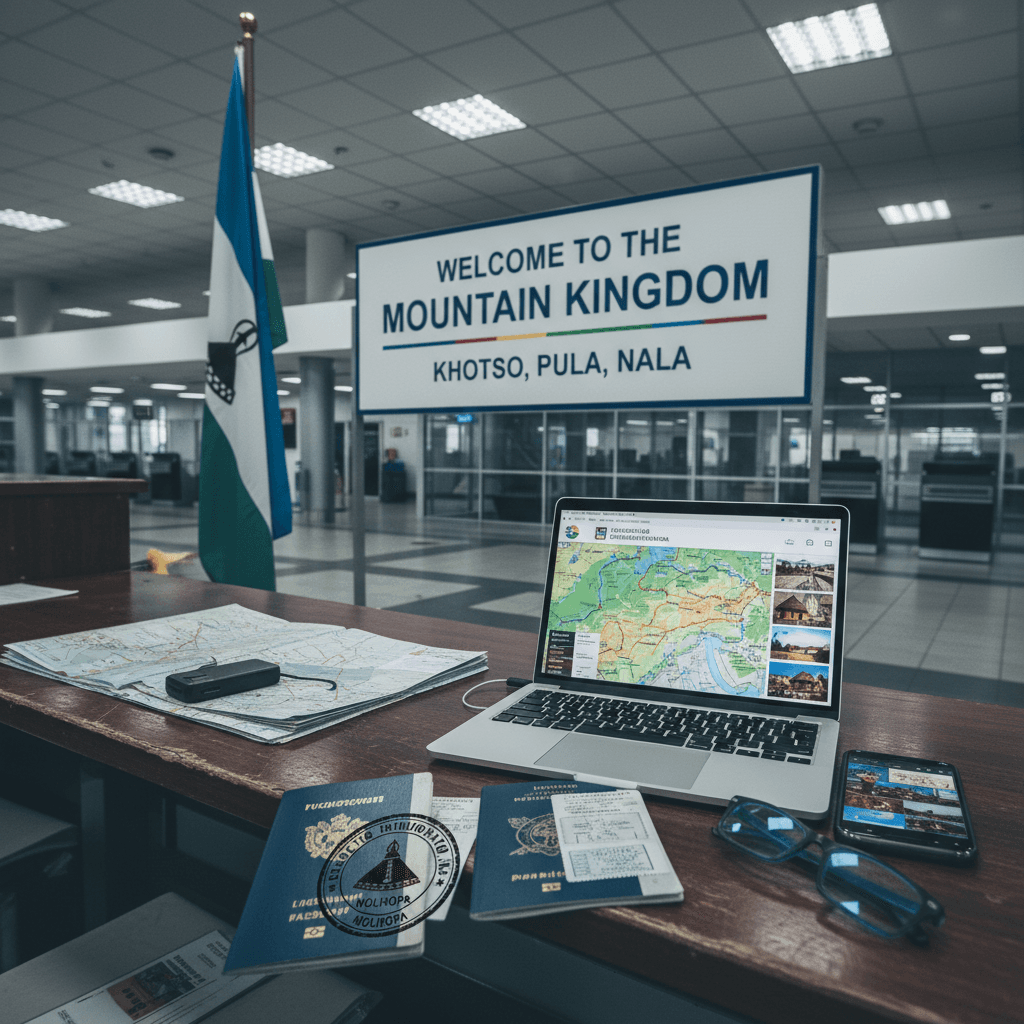
Lesotho

Policy Stability
Stamped Nomad ExclusiveHow likely visa and immigration policies are to remain unchanged
Quick Facts
N/A
6 months
Yes
$1,200/mo
21 Mbps
4/10
Medium
Low
High
GMT+2
Entry Methods Available
Best For
Navigating the Entry Process
Lesotho doesn't have a dedicated digital nomad visa yet, but the "Kingdom in the Sky" is relatively straightforward to enter if you plan ahead. Most remote workers start with a standard tourist visa or take advantage of visa-free entry if they hold a passport from specific Commonwealth or neighboring African nations. If you are from South Africa, Botswana, or Zimbabwe, for example, you can usually cross the border with just your passport.
For everyone else, the process has shifted recently. While an automated e-visa system existed previously, it has faced technical suspensions. Currently, you will likely need to submit your application via email to the Ministry of Home Affairs or visit a Lesotho diplomatic mission. It is a bit more "old school" than other hubs, but the immigration officers are generally helpful if your paperwork is in order.
Tourist Visas and Extensions
If you aren't on the exempt list, a single-entry tourist visa is your best bet for a short-term scouting trip. These visas typically cost US$150 and grant you a stay of up to 44 days. While that might feel short for a slow-traveling nomad, you can apply for an extension at the Department of Immigration in Maseru before your initial period expires.
Extensions are granted at the discretion of the immigration officer. If you want to stay longer without the hassle of frequent renewals, look into the multiple-entry visa. These are usually valid for 3 to 6 months and are perfect if you plan on hopping back and forth across the South African border for supplies or weekend trips to Durban.
The "Approval Letter" System
Since the standard visa-on-arrival is not a universal feature here, travelers from countries that require a visa must secure an approval letter before flying into Moshoeshoe I International Airport or driving across the bridge. You'll need to email your completed forms and supporting documents to the official immigration alias. Once approved, you receive a letter valid for 72 hours. You present this at the border, pay your fees, and get your passport endorsed on the spot.
Longer Stays and Residency
If you fall in love with the high-altitude lifestyle and want to stay for a year or more, you'll need to move beyond the tourist category. The government offers several residence permits that cater to different needs:
- Temporary Permits: Often issued for 90 days as a bridge for those finalizing longer paperwork.
- Two-Year Permits: These are the standard for most expats living in Lesotho long-term.
- Business Permits: These require a bit more legwork, including a work permit, police clearance, and a medical certificate.
For those looking to establish a more permanent base, Lesotho has allowed dual citizenship since 2018. This was a major policy shift that makes it easier for the global diaspora and long-term residents to maintain ties without giving up their original nationality.
Requirements and Fees
Regardless of which route you take, keep your documents organized. The authorities are particular about the details. For a standard entry, you will typically need:
- A passport valid for at least six months beyond your stay.
- The US$150 fee for single-entry processing.
- Proof of sufficient funds for your duration in the country.
- A yellow fever vaccination certificate if you are traveling from an infected area.
If you are applying for business-related stays, be prepared to provide an invitation letter and the tax clearance or trader license of your local sponsor. While the digital nomad lifestyle often exists in a gray area, staying transparent about your intentions with immigration will save you a lot of headaches at the Maseru border posts.
Source 1 | Source 2
The Current Status in the Kingdom in the Sky
If you are looking for a flashy, official "Digital Nomad Visa" with a custom logo and a dedicated government landing page, you won't find it in Lesotho just yet. While the government has discussed launching a specific program to attract remote workers, nothing has officially crossed the finish line. For now, nomads have to work within the existing immigration framework, which is surprisingly flexible if you know which permit to target.
Most travelers enter on a standard tourist visa, but those looking to set up a base in Maseru or the highlands for the long haul need to look at residence permits. You aren't technically "visiting" if you are staying for six months to two years; you are residing. Fortunately, the Lesotho Ministry of Home Affairs has established pathways that fit the remote work lifestyle, even if they don't use the modern "nomad" terminology.
Your Best Options for a Longer Stay
Since the dedicated nomad visa is still in the works, you have three primary paths to consider depending on how long you plan to keep your boots on the ground.
- Temporary Residence Permit (90 days): This is the go-to for slow travelers. It covers you for three months and is the simplest way to test the waters in the Maloti Mountains without committing to a mountain of paperwork.
- Two-Year Residence Permit: This is the gold standard for serious nomads. It is designed for self-employed individuals and business owners. If you can prove you have a stable income from abroad, this permit gives you a solid 24-month window to live in the country.
- Business Permit: This falls under the residence permit umbrella but is tailored for those who might want to register a local entity or consultancy. It requires more documentation regarding your professional activities.
Navigating the Application Process
The application process is a mix of digital convenience and old-school boots-on-the-ground requirements. You can start the process online through the official ministry portal or via VFS Global, but you will eventually need to visit the Residence Permit Facilitation Centre in Maseru.
To get your permit approved, you will need to gather a specific set of documents:
- A valid passport with at least 6 months of validity remaining.
- Two passport-sized photos.
- A medical certificate issued by a public doctor within Lesotho.
- Police clearance from your home country for first-time applicants.
- Local police clearance from the Lesotho authorities.
- A formal letter addressed to the Director of Immigration Service requesting residency.
- Proof of payment for the application fees.
One specific rule to remember: all business travelers and long-term residents must register with the Directorate of Immigration within 7 days of arriving in the country. Don't let this slide, as the authorities take registration deadlines seriously.
Income and Tax Realities
The most important criteria for digital nomads is the source of funds. To qualify as a self-employed resident, your primary source of income must come from outside Lesotho. The government wants to ensure you are bringing capital into the country rather than competing for local jobs.
Regarding taxes, the official immigration guidelines are silent on remote work income earned from foreign employers. Generally, you won't be pulled into the local tax net for short stays, but if you opt for the two-year permit, it is wise to speak with a local tax professional in Maseru. The country does not currently have a specific tax-exempt status for nomads, so your liability may depend on how many days you spend in the country per calendar year.
Final Logistics
While the lack of a "Digital Nomad Visa" might seem like a hurdle, the two-year residence permit actually offers more stability than many nomad visas in other countries. It treats you as a legitimate resident, which can make things like opening a local bank account or signing a long-term lease much easier. Just ensure your paperwork is spotless and you have your local medical and police checks completed early in your stay.
Source 1 | Source 2
The Lowdown on Entering the Kingdom
Lesotho is tucked away entirely inside South Africa, but don't let its geography fool you into thinking it's just another province. It is a sovereign nation with its own distinct entry rules. For most digital nomads, getting in is surprisingly straightforward, though the digital infrastructure for visas is currently in a bit of a transition phase.
The "Kingdom in the Sky" is one of the most open borders you will find. Citizens of about 95 countries can enter without a visa. This includes most Commonwealth nations and many Western countries. If you are carrying a U.S. passport, you can stay for up to 180 days without a formal visa, though border agents typically stamp you in for 30 days initially. You just need to visit the immigration office if you decide to stay longer.
The E-Visa Situation
If you aren't on the visa-exempt list, you need to be aware of a major technical hurdle. The official Lesotho e-Visa portal is currently suspended. While it was once a slick 72-hour process, the system is offline for the time being. You cannot simply hop onto a website and upload your photos.
To get a visa now, you have to go old school. You must email the Ministry of Home Affairs directly at VISA-Applications.Immigration@gov.ls or visit a Lesotho Embassy in person. If you are already in South Africa, the Lesotho High Commission in Pretoria or the consulates in cities like Johannesburg and Cape Town are your best bets for getting paperwork sorted before you hit the border.
Costs and Duration
For those who do require a visa, the fees are relatively standard for the region. Keep these figures in mind for your budget:
- Single-Entry Visa: $150 (Valid for up to 44 days)
- Multiple-Entry Visa: $250 (Valid for up to 180 days)
There is no formal "visa on arrival" for people who aren't already visa-exempt. If your nationality requires a visa, do not show up at the Maseru Bridge or Sani Pass expecting to buy one at the booth. You will likely be turned back to South Africa.
Extending Your Stay
If you fall in love with the mountain scenery and want to stay past your initial stamp, you need to head to the Office of Immigration at the Ministry of Home Affairs. Don't wait until the last minute. You should start the process at least a week before your current permit expires.
Extensions are granted on a case-by-case basis. You will generally need to show proof of where you are staying and have a clear reason for sticking around. It helps to have your bank statements ready to prove you can support yourself without looking for local employment.
The Border Run Reality
Since Lesotho is surrounded by South Africa, "border runs" are a common tactic for nomads. You can exit through one of the major gates like Maseru Bridge or Ficksburg Bridge, spend a night in South Africa, and re-enter. Most major border posts are open from 06:00 to 22:00 daily. Just be aware that immigration officers have the discretion to question frequent back-and-forth travel if they suspect you are living there permanently without the right residency permits.
A Warning on Overstays
Lesotho takes its exit dates seriously. If you overstay your permitted time, you aren't just looking at a small fine. The government frequently issues travel bans that can last between 1 and 5 years. This will effectively lock you out of the country and potentially complicate your entry into other Southern African Customs Union nations. Always keep a close eye on that blue entry stamp in your passport.
Source
The Reality of Long-Term Stays in the Kingdom
If you are looking for a traditional "Digital Nomad Visa" with a flashy landing page and a streamlined online portal, you won't find it in Lesotho just yet. While the government has discussed launching a specific remote work permit, the current system relies on more traditional immigration categories. For most nomads, the journey starts with a 90-day temporary permit, which serves as your initial landing pad while you figure out if the "Kingdom in the Sky" fits your lifestyle.
Staying longer than three months requires a shift into the residence permit system. Lesotho offers a two-year residence permit that serves as the primary bridge for foreigners looking to plant roots. This isn't a "set it and forget it" process; it requires a specific reason for residency, such as business investment, teaching, or medical work. If you are a freelancer, you will likely need to approach your stay through the lens of a business owner.
The Business People Permit
For those with the capital and intent to run a business within Lesotho, the Business People Permit is the most viable long-term path. This is a document-heavy process that requires you to prove your legitimacy to both the Ministry of Home Affairs and the Department of Labor. You will need to be prepared for a fair amount of paperwork and local administrative hurdles.
- Medical Certificate: You must obtain this from a government medical practitioner located within Lesotho.
- Police Clearances: You need two of these; one from your home country and one from the Lesotho police.
- Tax Compliance: You must provide personal and company tax clearances from the Lesotho Revenue Authority.
- Regulatory Proof: This includes a traders license from Trade and Industry and a certified work permit.
- Financial Evidence: Expect to provide bank statements and a formal letter requesting permission to reside.
The Path to Permanent Residency
If you fall in love with the high-altitude lifestyle and want to stay indefinitely, the Indefinite Permit is your goal. This is Lesotho's version of permanent residency. While the application window for these permits was previously suspended, the gates are open again. There are two main ways to qualify for this status.
The first is employment-based. If you have lived in the country legally for 5 or more years on valid work permits and maintained stable employment, you can apply to stay forever. The second path is for high-impact investors. If you have made a significant investment in local property or a registered business and can prove tax compliance and financial stability, the government may grant you indefinite status.
Citizenship and Dual Nationality
Lesotho recently modernized its laws regarding nationality. After 5 years of lawful residence, you become eligible to apply for citizenship. The most significant change for expats came with the 8th Amendment to the Constitution Act, which finally allows for dual citizenship. This means you can commit to Lesotho without being forced to renounce your original passport, making it a much more attractive prospect for long-term global travelers.
Important Clarifications
You might see information online regarding retirement visas with specific monthly income requirements around R37,000. Be careful with your research here; those requirements actually belong to South Africa's immigration system. Lesotho does not currently offer a dedicated retirement visa or any form of "Golden Visa" program where residency is granted in exchange for a flat real estate purchase.
The application process is centralized through the Residence Permit Facilitation Centre in Maseru. While some initial steps can be handled via the VFS Global portal, expect to spend some time on the ground in the capital city to finalize your documentation. It is a boots-on-the-ground process that rewards patience and local networking.
The Bottom Line on Budgeting
Lesotho remains one of the most affordable frontiers for the remote work crowd. If you are coming from North America or Western Europe, your dollar stretches incredibly far here. A budget-conscious nomad can scrape by on $500 to $1,000 a month, while a $1,500 monthly budget buys a premium lifestyle that includes high-end housing and frequent weekend excursions into the mountains.
The currency, the Lesotho loti (M), is pegged 1:1 with the South African Rand. With the current exchange rate hovering around 18 M to 1 USD, your purchasing power is high. Most of your spending will happen in Maseru, as it is the only city with the infrastructure to truly support a digital workflow. While smaller towns offer significant savings, the trade-off in internet reliability is often too steep for those with daily Zoom calls.
Maseru: The Hub for Productivity
Maseru is where you will likely plant your flag. It is the only spot in the country with dedicated coworking spaces and a consistent "city" feel. You can find basic studio apartments for as little as $60 to $114, though most nomads opt for comfort-tier rentals in safer, well-connected areas for $200 to $300. If you want a luxury gated villa, expect to pay $400 or more.
- Rent: $200–$300 for a comfortable, nomad-friendly apartment.
- Food: $350 covers a mix of groceries and dining at mid-range spots.
- Transport: $50 a month for local commutes; private taxis cost roughly $6 per ride.
- Coworking: $55 (approx. M1000) for a monthly desk at spots like Progressive Hub.
Teyateyaneng: The Quiet Alternative
Located about an hour north of the capital, Teyateyaneng (commonly called "TY") is famous for its tapestry weavers and slower pace. It is about 15% to 20% cheaper than Maseru across the board. However, you will be relying on mobile hotspots and local cafes rather than dedicated offices. It is a great spot for a writer's retreat, but perhaps not for a software engineer on a sprint.
- Rent: $100–$200 for a solid mid-range house or flat.
- Food: $300 for a monthly grocery and dining budget.
- Internet: Expect speeds to cap out around 5 Mbps, making heavy uploads a challenge.
- Transport: Local fares are cheap at around $1.20 (M22) for short hops.
Everyday Expenses and Lifestyle
Groceries are generally affordable, though many processed goods are imported from South Africa, which can spike prices for specific brands. Local produce and staples like maize meal are very cheap. Dining out is a steal; a solid meal at a local eatery will rarely set you back more than $10, while a high-end dinner in Maseru might hit $25.
Health insurance is a variable you should not skip. Most nomads use global plans like SafetyWing, which typically range from $45 to $85 a month for basic coverage. If you plan on doing high-altitude trekking or pony trekking in the highlands, ensure your plan covers "adventure sports," as medical evacuation from the mountains can be pricey.
Connectivity is your biggest hidden cost. While Maseru has decent fiber in pockets, you will likely spend $50 to $100 a month on data backups and coworking fees to ensure you stay online. In secondary cities like Mafeteng or Hlotse, your rent might drop to $50, but you will spend that "saved" money on premium mobile data bundles just to keep your inbox refreshed.
The Hub: Maseru
If you are planning to work remotely from the Kingdom in the Sky, Maseru is where you will spend the vast majority of your time. It is the only true urban center in Lesotho with the infrastructure to support a digital nomad lifestyle. With a population of over 300,000, it offers a blend of Basotho culture and the basic modern conveniences you need to stay productive.
The nomad scene here is tiny. You won't find the crowded laptop-friendly cafes of Cape Town or Nairobi. Instead, you will find a small, tight-knit community of expats and local entrepreneurs. The pace is slower, the people are friendly, and the cost of living is one of the lowest you will find anywhere in Southern Africa.
Workspace and Connectivity
Internet reliability is the biggest hurdle in Maseru. While providers like Vodacom and Econet offer speeds between 20 Mbps and 42 Mbps, consistency can be an issue. Do not rely on cafe WiFi for important video calls; most local spots are better suited for answering emails than heavy uploading.
For serious work, head to the city's dedicated coworking spaces. These are the only spots where you can guarantee high-speed fiber and a professional environment. The top options include:
- Progressive Co-workers Hub: A reliable spot with high-speed internet, kitchen access, and even showers for those long sessions.
- Executive Floor: Offers a more corporate feel with stable connections and meeting rooms.
- News Cafe: A popular backup for casual work, though the noise levels can pick up during lunch hours.
Cost of Living in Maseru
Your dollar goes incredibly far here. A single person can live comfortably on roughly $650 per month. This estimate covers everything from a decent apartment to your grocery bill and internet. Because the local average salary is around $751, a typical nomad budget allows for a very high quality of life compared to the local standard.
- Monthly Rent: $130 to $230 for a one-bedroom apartment.
- Monthly Food and Groceries: Around $310.
- Internet and Utilities: Approximately $33 for basic home setups.
Lifestyle and Safety
Maseru is not a city that stays awake all night. After dark, the city quiets down significantly. If you want a drink or some music, Kasi Kota is a local favorite for catching the vibe of the city. For your morning caffeine fix, Renaissance Coffee & Cafe is one of the better spots to mingle with locals.
Safety requires a bit of common sense. Petty crime is common in the capital, particularly near border crossings and busy market areas. Avoid walking alone at night and keep your tech gear out of sight when moving between your apartment and coworking spaces. The city is generally peaceful, but it is better to use private transport after the sun goes down.
Secondary Options: Beyond the Capital
If Maseru feels too hectic, there are other towns like Teyateyaneng (pop. 75,000), Mafeteng (pop. 40,000), and Hlotse. These towns are great for weekend trips or a few days of "off-grid" living, but they are difficult to recommend for long-term stays.
Infrastructure in these secondary cities is basic. You will find local markets and stunning mountain views, but coworking spaces are non-existent and power outages are more frequent. If you choose to stay in these areas, you must have a high-quality mobile data plan and a backup power bank to keep your laptop running.
The Verdict
Lesotho is a destination for the adventurous nomad who values nature over nightlife. Maseru is your best bet for a home base. It provides just enough "office" to keep your clients happy while putting you within a short drive of the breathtaking Maloti Mountains. It is affordable, unpretentious, and serves as the perfect gateway to the high-altitude wilderness that makes this country famous.
The Connectivity Landscape
Working from the "Kingdom in the Sky" offers a unique set of challenges and rewards. While Lesotho boasts some of the best mobile network performance in Southern Africa, your experience will vary wildly depending on your altitude and proximity to Maseru. In the capital, you can find median mobile download speeds of 20-21 Mbps, which is plenty for video calls and standard workflows. However, fixed broadband remains a rare luxury with a penetration rate of just 0.4%. Outside the urban centers, internet usage drops significantly, and you will be relying almost exclusively on cellular data.
Fiber is available through Econet Telecom in specific pockets of the capital, pushing speeds up to 150 Mbps. If you are planning to stay long-term, prioritize accommodation that already has a fiber line installed. Be prepared for occasional power outages; a solid power bank and a fully charged laptop are your best friends here. Most nomads find that a combination of 4G mobile data and a dedicated coworking space is the only way to maintain a professional output.
Top Coworking Spots in Maseru
For a reliable professional environment, Progressive Co-workers Hub in Maseru is the local favorite. It offers a genuine collaborative atmosphere with dedicated desks, high-speed WiFi, and a boardroom for private meetings. The hospitality here is top-notch, making it a great place to network with local freelancers and entrepreneurs. Other solid options include:
- Executive Floor (Maseru): Provides a more corporate feel with flexible desk options and basic business amenities like printing and parking.
- The Hub at Morija: Located about 45km south of the capital, this is a creative space perfect for those who want to escape the city bustle while maintaining a connection.
What You Will Pay
Coworking costs in Lesotho are relatively high compared to other regional hubs, largely because the infrastructure is expensive to maintain. While exact local rates fluctuate, expect to pay around 6,000 LSL (approximately $330 USD) for a monthly dedicated desk. Many spaces offer day passes and weekly rates if you are just passing through. Private offices are available at a premium and usually include cleaning and utilities in the price. Always inquire directly for the most current local currency rates, as many online listings use foreign currency equivalents.
The Cafe Culture Reality
If you enjoy the "laptop and a latte" lifestyle, keep your expectations in check. Cafe WiFi in Maseru is inconsistent at best. Most public hotspots have low reliability scores, and the connection is often too throttled for anything beyond basic messaging or emails. If you do work from a cafe, do not rely on their router. It is much smarter to bring your own 4G hotspot. Use the cafe for the ambiance and the coffee, but bring your own data to ensure you actually get your work done.
Mobile Data and SIM Cards
Since fixed line internet is hit-or-miss, your SIM card is your most important tool. Vodacom and Econet are the two main players. Vodacom has extensive 4G coverage reaching roughly 85% of the population. You can pick up a prepaid SIM easily and load it with bundles. Current Vodacom pricing includes:
- 4GB: 150 LSL
- 10GB: 400 LSL
- 24GB: 850 LSL (Valid for 30 days)
Econet offers competitive alternatives, such as 5GB for 99 LSL or a heavy-duty 45GB plan for 580 LSL. They also offer "night bundles" which are great for large downloads. For those who prefer to land with data already active, eSIM providers like Nomad or Yesim offer Lesotho packages starting around $4.50, though local SIMs remain the more cost-effective choice for heavy users.
The Reality of Healthcare in the Mountain Kingdom
Living as a digital nomad in Lesotho means trading urban convenience for some of the most stunning landscapes in Africa. However, that trade-off includes a healthcare system that is still finding its footing. While you will find basic medical services in Maseru and larger towns, the infrastructure is limited. Most expats and long-term travelers treat Lesotho as a place for minor fixes and South Africa as the destination for anything serious.
Public facilities are often overcrowded and deal with frequent shortages of supplies and specialized staff. For anything beyond a basic consultation or stabilization in an emergency, you will want to lean heavily on the private sector or cross-border options.
Public vs. Private Care
The public system, anchored by Queen Mamohato Memorial Hospital, handles the bulk of the country's medical needs. It is affordable, but the wait times are long and the equipment is often dated. It is a reliable spot for emergency stabilization, but it lacks the specialized departments found in Western hospitals.
Private facilities are the standard choice for the nomad community. They offer cleaner environments, faster service, and a higher level of English-speaking staff. You should expect to pay upfront for services or provide proof of high-end international insurance before being admitted. The primary private players include:
- Maseru Private Hospital: The go-to for many expats, featuring 32 beds, an operating theater, and radiology services.
- Willes Private Hospital: Known for 24-hour casualty services and a more comfortable inpatient experience.
- Phomolong Medical Center: A solid option for general consultations and outpatient care.
The South Africa Safety Net
One of the biggest perks of being a nomad in Lesotho is the proximity to Bloemfontein, South Africa. Just a 90-minute drive from Maseru, Bloemfontein hosts world-class medical facilities like Mediclinic. For complex surgeries, specialist consultations, or advanced diagnostic imaging, most nomads simply cross the border. If you have a chronic condition, plan your specialist visits around trips to South Africa.
Insurance Requirements for Nomads
Local public insurance isn't an option for non-citizens, so a robust international private medical insurance (IPMI) policy is a requirement, not a suggestion. You specifically need a plan that covers medical evacuation. If you are injured in a remote mountainous area, the cost of a private helicopter transfer to South Africa can be astronomical without coverage.
Several providers offer flexible plans tailored to the nomad lifestyle, allowing you to pay monthly or annually. Popular choices include:
- Allianz or Cigna Global: Best for comprehensive, long-term expat coverage.
- William Russell: Offers specific digital nomad plans that cover 150+ countries.
- April International: Known for flexible inpatient and outpatient tiers.
- SafetyWing: Useful for basic travel medical coverage, though check the limits for high-altitude activities.
Costs and Payments
Medical costs in Lesotho are lower than in the US or Europe, but the "pay-to-play" nature of private clinics means you need liquid cash or a credit card ready. Most private hospitals require a deposit for inpatient stays. While exact pricing for every procedure isn't publicly listed, referrals to South Africa give a good benchmark for regional private costs:
- Radiotherapy: Approximately 10,000 to 41,000 ZAR ($550 - $2,300 USD).
- Chemotherapy: Around 4,500 ZAR ($250 USD) per session.
- General Surgery: Costs vary wildly, but minor cases often start around 1,000 to 1,500 ZAR ($55 - $85 USD) for the surgeon's fee, excluding hospital costs.
Pharmacies and Prescriptions
You can find pharmacies (look for the green or red cross) in Maseru and larger hubs like Butha-Buthe. Maseru Private Hospital operates a 24-hour pharmacy for emergencies. However, the supply chain can be inconsistent. If you rely on specific brand-name medications, bring a multi-month supply and a copy of your prescription. Generics are widely available and cheap, but niche "originator" drugs are expensive and often out of stock.
Emergency Services
The national emergency number is 112, but ambulance response times are notoriously slow and vehicles are often under-equipped. In an emergency within Maseru, it is usually faster to take a taxi or private vehicle to a private hospital casualty ward. For remote emergencies, the Lesotho Red Cross provides paramedic responses in certain districts. Always keep your insurer's emergency hotline saved in your phone, as they will be the ones coordinating a transfer to South Africa if things get serious.
The Dual Currency System
Understanding the money situation in Lesotho starts with the Loti (LSL). The local currency is pegged 1:1 to the South African Rand (ZAR), and they are used interchangeably across the country. You can pay for your coffee in Rand and receive change in Loti without a second thought. This peg makes the Loti relatively stable compared to other regional currencies, though it remains tied to the fluctuations of the South African economy.
Opening a Local Bank Account
If you plan on staying in the Mountain Kingdom for an extended period, setting up a local account is surprisingly straightforward for foreigners. The banking sector is dominated by familiar regional giants: Standard Lesotho Bank, Nedbank Lesotho, and First National Bank (FNB) Lesotho. These institutions are reliable and offer modern digital banking apps that make managing your funds easier while exploring remote areas.
To get started, you will need to visit a branch in person. The process usually takes 3 to 5 days for verification. Bring the following documents to your appointment:
- A valid passport.
- A residence permit (if you have one).
- Proof of address from the last 3 months; this can be local or international.
- Your last 3 months of bank statements or proof of income.
- A minimum opening deposit, which typically ranges from 500 to 1,000 LSL (roughly $30 to $60 USD).
Using Wise and Revolut
For most digital nomads, a local account might be overkill because Wise and Revolut work exceptionally well here. You can use your Visa or Mastercard at almost any merchant in Maseru or other major towns. While you cannot hold a balance specifically in Loti within these apps, the cards convert your funds on-the-fly using mid-market exchange rates.
Wise is particularly useful for its low-fee ATM withdrawals, while Revolut is often the cheapest way to send money to a local Lesotho bank account if you are paying rent to a landlord. One golden rule: when a card terminal or ATM asks if you want to be charged in your home currency or the local currency, always choose LSL. Declining the dynamic currency conversion will save you from hidden markups and poor exchange rates.
ATMs and Cash Strategy
Cash is still king once you leave the urban centers. ATMs are easy to find in cities, but they become scarce very quickly in the highlands. Most machines charge a fee for foreign cards, so it is smarter to withdraw larger amounts less frequently rather than making small, daily trips to the machine. Keep an eye on the screen, as the machine will usually warn you about the specific fee before you confirm the transaction.
Moving Money Internationally
If you need to move larger sums of money, digital-first services are your best bet. Wise and Revolut offer the fastest transfers and the best rates for sending money to Lesotho bank accounts or arranging cash pickups. If those are not an option, traditional wires via FNB or Standard Bank are reliable but come with higher fees and slower processing times. MoneyGram is also widely available for quick cash transfers in a pinch.
The Crypto Situation
Lesotho is currently in a "wait and see" phase regarding cryptocurrency. There are no comprehensive laws on the books yet, and the Central Bank of Lesotho does not recognize crypto as legal tender. While it is not strictly illegal for individuals to hold or trade, the government warns of risks regarding tax and exchange controls. If you are running a crypto-related business, you are expected to register with the Financial Intelligence Unit. Formal regulations are not expected to arrive until mid-2026, so keep your crypto activities private and rely on traditional banking for your daily needs.
The Family Logistics: Visas and Paperwork
Moving your family to the "Kingdom in the Sky" is relatively straightforward from a bureaucratic standpoint. If you are holding a temporary or indefinite residence permit, your children and spouse can join you via the Spouse Joining Spouse or Joining Relative permits. These are managed through the Ministry of Home Affairs and VFS Global. The process is digital, but you will need to provide certified copies of birth certificates, marriage licenses, and medical certificates issued by a Lesotho government practitioner.
One major perk for families is that children under 21 are exempt from visa fees. Furthermore, if your kids are under 16, you can skip the police clearance requirement from your home country. You will still need to provide a letter of request from the sponsor and proof of relationship, but the lack of fees for minors makes the initial move much lighter on the wallet.
Schooling in Maseru
If you are working remotely while the kids are in class, you will almost certainly want to base yourself in Maseru. It is the only city with a concentrated selection of international schools that follow global curricula. The American International School of Lesotho (AISL) is a popular choice, though it comes with a premium price tag of approximately $12,500 USD per year. It offers a familiar Western environment and small class sizes that help expat kids adjust quickly.
For those looking for the International Baccalaureate (IB) path, Machabeng College is the heavy hitter in the region. It provides both day and boarding options. If your children are younger, Maseru Preparatory School follows the Cambridge curriculum for ages 4 to 11. Space in these schools is often limited, so it is wise to start the enrollment conversation months before you plan to land.
Healthcare and Pediatric Services
Lesotho’s public healthcare system is often overstretched, so private insurance is a non-negotiable for nomad families. Maseru Private Hospital and Willes Private Hospital are the primary facilities for expats. These centers are equipped for routine check-ups, lab work, and minor emergencies. They serve as the first line of defense for stabilizing patients before a referral.
For serious specialized pediatric care, most families drive across the border into South Africa. It is a common practice to keep an active international health insurance policy from providers like Allianz or Cigna. This ensures you have access to the high-end private hospitals in Bloemfontein or Johannesburg if a complex medical issue arises.
Cost of Childcare and Daily Life
While international school tuition is high, local childcare is surprisingly affordable. A private preschool or full-day kindergarten averages around M532 (approximately $29 USD) per month. This is significantly lower than what you would find in neighboring South Africa or Europe. However, formal "expat-style" daycare centers are rare, so many nomads opt to hire a private nanny or au pair through local word-of-mouth networks in Maseru.
When it comes to weekend fun, Maseru is the most practical hub. You will find playgrounds, flea markets, and family-centric spots like the Avani Lesotho. Outside the capital, towns like Teyateyaneng offer beautiful scenery and a slower pace, but you will sacrifice the convenience of malls and specialized kids' amenities.
Safety Realities for Families
Safety is a topic that requires a realistic approach. Lesotho has high crime rates, particularly regarding theft and muggings. The crime index sits at about 68/100, with specific concerns around corruption and opportunistic street crime. You should avoid walking with children after dark and stay vigilant in crowded areas like markets or bus terminals.
The government passed new child protection laws in 2023 to improve safety nets for minors, which is a positive step for the country's social infrastructure. Most expat families manage the risk by living in gated communities or secured housing and using private transport rather than walking. As long as you maintain a high level of situational awareness, the mountain kingdom offers a unique, rugged upbringing that most children find unforgettable.
Safety Realities for the Modern Nomad
Lesotho is a place of stunning beauty, but it requires a high level of situational awareness. While the Basotho people are generally welcoming, the economic disparity means foreigners are often viewed as high-value targets for opportunistic crime. Urban centers like Maseru, Leribe, and Maputsoe see regular reports of muggings and armed robberies. It is best to avoid walking alone after dark; the lack of street lighting in many areas makes nighttime travel risky even in the capital.
Scammers in Maseru have developed a few specific "plays" you should watch out for. Common tactics include:
- The Picture Trap: A local asks you to take their photo, then drops the camera and blames you for the break, demanding cash for repairs.
- ATM Skimming: Stick to machines inside bank branches rather than on the street to avoid card cloning.
- The Bird Poop Trick: Someone splashes a messy substance on you and "helps" clean it off while their partner picks your pockets.
- Bar Scams: Overly friendly locals may lead you to a specific bar where drinks are priced at 5 to 10 times the normal rate, with staff forcing you to an ATM to settle the bill.
Cultural Etiquette and Social Norms
Basotho culture is deeply rooted in respect and hospitality. Greetings are the foundation of every interaction. You should never jump straight into a business question or a request for help without first saying hello. Use "Dumela" as a general greeting, and add "N'tate" for men or "M'e" for women to show respect. Addressing elders this way is vital; ignoring a greeting is seen as a major personal insult.
Emotional restraint is highly valued here. If you encounter a delay or a bureaucratic hurdle, keep your cool. Showing anger or raising your voice will likely cause the other person to shut down, making your problem much harder to solve. If you are invited into a home, accept the offered tea or food. Leaving a plate full can be interpreted as a rejection of the host's generosity.
Language and Communication
While Sesotho is the primary language for over 90% of the population, English is the official language for government and business. You will find that most educated residents in Maseru speak English fluently. However, once you head into the rural highlands, English proficiency drops significantly. Learning a few phrases in Sesotho goes a long way in building rapport with locals, as it shows you aren't just passing through but actually care about the culture.
LGBTQ+ Considerations
The legal landscape for LGBTQ+ travelers has improved, with homosexuality decriminalized in 2012 and new employment protections introduced in 2024. Despite these legal strides, the social climate remains conservative. Same-sex marriage is not recognized, and public displays of affection may draw unwanted attention or harassment. While organizations like the Matrix Support Group are active and annual pride marches take place, it is generally safer to keep a low profile regarding your private life in public settings.
The Nomad Infrastructure
Lesotho is still a frontier for digital nomads. You won't find the bustling nomad hubs of Cape Town or Nairobi here. Maseru is your best bet for a stable base, as it hosts various NGOs and international agencies. The city has a handful of cafes and a couple of coworking spaces, but be prepared for slow internet speeds, often averaging around 5 Mbps. Outside the capital, power stability is a concern, so a solid power bank and a local SIM card for backup data are mandatory gear for anyone trying to work remotely.
Integration Tips
- Dress the part: Basotho culture leans conservative. Dressing neatly and professionally will earn you more respect in business and government offices.
- Be patient: Things move at a slower pace here. Rushing people is considered rude and rarely yields faster results.
- Join the community: Look for coliving spots in Maseru. These are small but offer the best chance to meet other remote workers and find reliable networking opportunities.
- Build rapport: Don't just talk work. Ask locals about their families and their well-being; these small social gestures are the "glue" of Basotho society.
Understanding Tax Residency
In Lesotho, your tax status isn't just about how many days you spend in the country. The Revenue Services Lesotho uses four distinct tests to decide if you owe tax on your worldwide income. You are considered a resident if you maintain a normal place of abode and visit even briefly, or if you stay for more than 182 days in any 12-month period. They also look at "ordinary residency" factors like whether you've moved your family there, maintained a home, or established strong social and business ties.
If you don't meet these residency criteria, you are only taxed on income sourced directly within Lesotho. However, once you trigger residency, the tax man expects a cut of your global earnings. There is a silver lining for expats: if you are a non-citizen working on a technical contract, you might qualify for exemptions on income generated from property located outside the country.
The 182-Day Rule
The physical presence test is a bit different here than in other digital nomad hubs. Instead of a standard calendar year, Lesotho looks at a rolling 12-month window that overlaps with their tax year, which runs from April 1 to March 31. Partial days count as full days. If you are a slow traveler who hops in and out of the country frequently, those days add up quickly and could inadvertently trigger full tax residency.
Income Tax Rates for 2025/2026
Lesotho uses a progressive tax system for both residents and non-residents. For the 2025/2026 tax year, the rates are broken down by your annual chargeable income. If you are a resident, you also benefit from a non-refundable tax credit that lowers your overall bill.
- First M74,040 (~$4,200 USD): Taxed at 20%
- Income above M74,040: Taxed at 30%
- Resident Tax Credit: M11,640 per year (deducted from tax owed)
- Minimum Taxable Threshold: M74,040 per year
Non-residents generally do not get the tax credit unless they are full-time local employees. If you're picking up side gigs or part-time work locally as a non-resident, expect a flat 30% tax on that secondary income.
Double Taxation Treaties
To avoid paying tax twice on the same dollar, Lesotho has signed Double Taxation Agreements (DTAs) with several countries, including South Africa, the UK, Mauritius, Botswana, and Eswatini. These treaties are your best friend if you're staying short-term. Usually, if you stay less than 183 days, work for a non-local employer, and your salary isn't paid by a local branch, the treaty protects you from being taxed in Lesotho.
Crypto and Digital Assets
Don't expect specific crypto-friendly laws here. Lesotho treats cryptocurrency gains under general income and capital gains tax rules. If you're trading or selling crypto, your profits are typically taxed as standard income at rates up to 30%. Because there are no dedicated regulations yet, keeping meticulous records of your transactions is your only real defense if the tax authorities ask questions.
Reporting and Filing
The tax year ends on March 31. If you are working for a local entity, they will handle your PAYE (Pay As You Earn) withholdings monthly. However, as a resident nomad with worldwide income, you are responsible for filing your own returns. Individuals must register with the Revenue Services Lesotho and file their annual returns by June 30. Non-residents usually have their tax handled via final withholding taxes on local payments, but you can elect to file an assessment if you want to deduct business expenses.
Nomad Specifics
Lesotho does not currently offer a dedicated digital nomad visa or any specific tax breaks for remote workers. You fall into the same bucket as any other foreign professional. Short-term nomads who stay under the 182-day limit and don't earn money from local clients generally have a very light tax footprint, usually owing nothing to the local government.
Staying Connected
Getting online in Lesotho is straightforward, but you need to be proactive. As soon as you land at Moshoeshoe I International Airport or walk into a mall in Maseru, look for a Vodacom or Econet outlet. A physical SIM card only costs about LSL 10 to 20, though you will need your passport for the mandatory registration process. Data bundles typically start around LSL 50.
If your phone supports eSIM technology, providers like Nomad or eSIM.net are excellent alternatives. You can grab a plan starting at USD 4.50 before you even clear customs. This saves you the hassle of swapping physical chips while giving you immediate access to 4G and 5G networks across the country.
Getting Around Maseru
Maseru doesn't have a massive public transit system, so ride-hailing apps are your best friend. inDrive is the most popular choice because it allows for fare negotiation. You propose a price, the driver counters, and you agree before they ever show up. It also has built-in safety features like GPS sharing and an emergency button.
For a more traditional taxi experience, Pick Me Up offers 24/7 bookings. If you use the promo code PMULS, you can often snag a discount on your first few rides. While you will see plenty of shared minibuses (locally called taxis) zooming around, they can be a bit overwhelming for newcomers. Stick to the apps until you get your bearings.
Recommended Neighborhoods
Where you park your laptop matters. Most nomads gravitate toward these three areas in Maseru:
- Moshoeshoe II: This is the professional hub. It is modern, relatively quiet, and offers the most reliable infrastructure for remote work.
- Khubetsoana: A vibrant spot with a high density of shops and local eateries. It is great if you want to be close to the action.
- Qoaling: This neighborhood offers a nice balance of community feel and convenience, making it a solid choice for mid-term stays.
Regardless of where you stay, keep your wits about you. Avoid walking through isolated or poorly lit areas after dark, as petty crime can be an issue in the capital.
Finding a Home Base
Airbnb is the most reliable platform for finding furnished apartments with functional kitchens and WiFi. When browsing, always message the host first to ask for a speed test. You should expect average speeds of 5 to 8 Mbps in Maseru. For those looking for community-focused living, check Nomad Stays, which specifically vets properties for internet reliability. Booking for a month at a time usually unlocks significant discounts compared to nightly rates.
Food and Provisions
Food delivery is still finding its footing here. You won't find a "one-app-rules-all" service yet. Instead, use the KFC Lesotho app or message Galito’s via WhatsApp for quick meals. For sit-down restaurant delivery, Piri Piri is a local favorite. Many establishments prefer orders handled through mobile money or direct app interfaces rather than international credit cards.
Language and Communication
English is widely used in business and government, but Sesotho is the heart of the culture. Learning a few phrases goes a long way in local markets or if you head into the mountains. Download Lingvanex or an English-Sesotho Translator for offline use. A simple "Dumela" (hello) can change the entire energy of an interaction.
Emergency Contacts
Keep these numbers saved in your phone. Do not rely on finding them when you are in a panic:
- Police: 2232 2099 or 2231 2934. If you cannot get through, try the secondary line at +266 5888 1010 or dial 112.
- Ambulance: +266 800 12121.
Avoiding Common Pitfalls
The biggest mistake nomads make is overpacking. Lesotho’s terrain is rugged; travel light so you can move easily between the city and the highlands. Always use a VPN when connecting to public or cafe WiFi to keep your data secure. Most importantly, never hike solo in the mountains. The weather changes fast, and trails aren't always well-marked. Hire a local guide; it supports the economy and keeps you off the evening news.
More Guides from Africa

Stay Updated on Lesotho
Get notified about visa changes, policy updates, and new information for digital nomads in Lesotho.