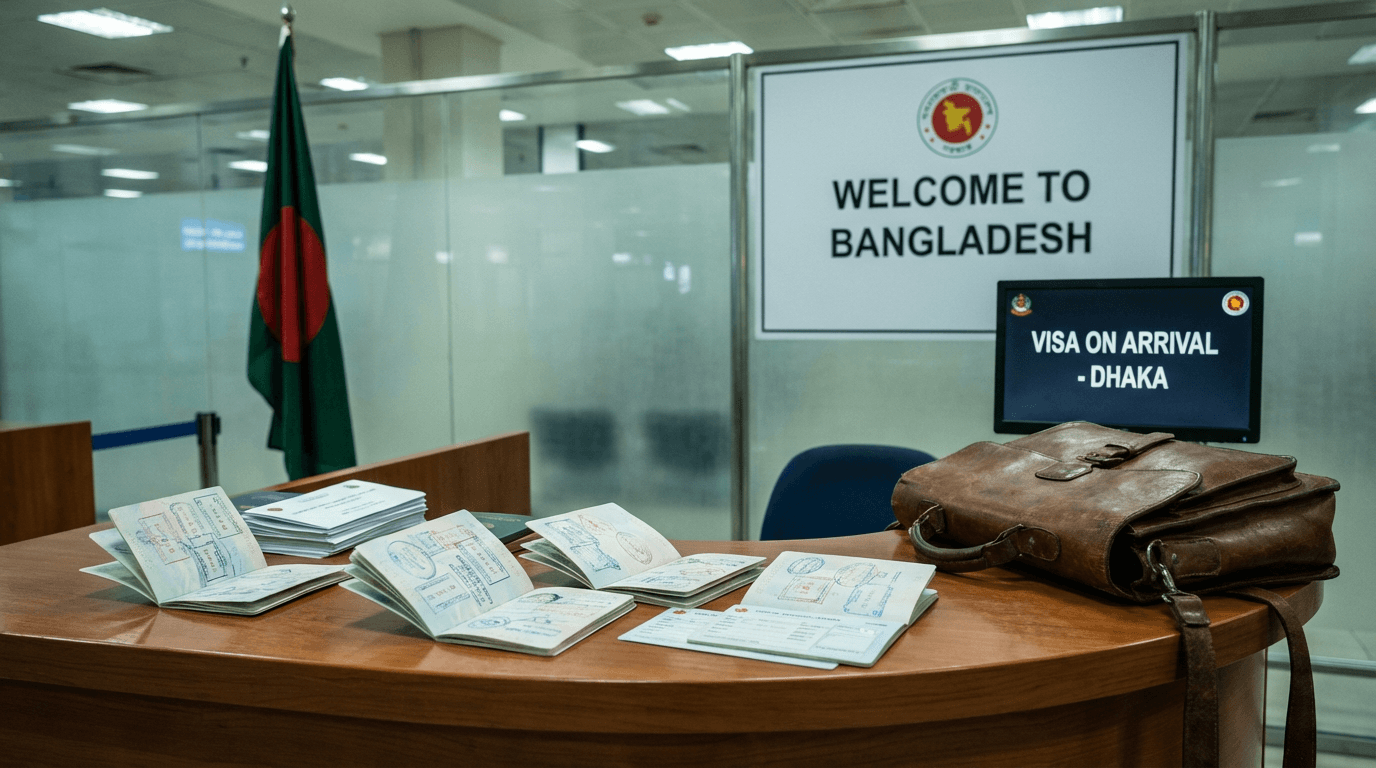
Bangladesh

Policy Stability
Stamped Nomad ExclusiveHow likely visa and immigration policies are to remain unchanged
Quick Facts
N/A
2 months
Yes
$500/mo
30 Mbps
4/10
Low
Medium
Medium
GMT+6
Entry Methods Available
Best For
Bangladesh doesn't typically top the list of digital nomad hotspots, but for those seeking an off-the-beaten-path experience with an incredibly low cost of living, the visa process is surprisingly straightforward. While the country hasn't launched a specific "digital nomad visa" yet, the existing framework for tourists and business travelers covers most remote work setups quite well.
New arrival requirement: Bangladesh's Special Branch has launched an online ED Card system for foreign passport holders traveling on international air routes. The free portal lets foreign travelers pre-submit their E-Arrival and E-Departure cards before flying, which is intended to speed up border control and airport clearance. Paper cards are still available during the rollout, and no cutoff date for paper processing has been announced.
The Visa on Arrival (VOA)
For many nomads, the Visa on Arrival is the path of least resistance. If you hold a passport from the United States, Canada, Australia, New Zealand, Russia, China, Japan, Singapore, South Korea, or most EU nations, you can fly into Dhaka and secure a 30-day entry permit. This costs US$51 (payable in cash, so bring crisp bills) and is generally extendable for another 30 days once you are on the ground.
One caveat to keep in mind: there is a scheduled temporary suspension of the VOA program from January 15 to February 15, 2026. If your travel plans fall within that window, you will need to secure your paperwork in advance through a consulate.
Applying Online: The E-Visa
If you prefer to have your paperwork sorted before you land, or if you aren't eligible for the VOA, you should apply through the Bangladesh online visa portal. This system handles tourism, business, and transit applications. The process usually takes between 2 and 7 days, and once approved, you simply print the document to present at immigration.
Tourist visas (Category T) are the standard choice for those visiting for leisure or visiting friends. These are typically issued for 30 to 90 days. While the price for most nationalities is modest, US citizens currently pay around $160 for a five-year multiple-entry visa, which is a fantastic value if you plan on using Dhaka as a regional hub.
Business Visas for Long-Term Stays
If you are working with local startups or have a registered entity back home, a Business Visa (Category B) might be more appropriate. These often allow for multiple entries and stays of up to 6 months. You will need a formal invitation letter or a recommendation from a recognized business body to qualify. Extensions for business visas are possible but usually require a recommendation from your sponsor and a local police report.
Key Visa Categories
- Tourist (T): Best for short-term stays, religious visits, or attending workshops.
- Business (B): Requires an invitation letter; better for those staying 6 months or longer.
- Student (S): Requires an institutional letter and proof of bank solvency.
- Work (E): For those employed by a local company; requires BOI or BEPZA recommendation.
- Investor: Specifically for those bringing capital into the country, requiring official BOI clearance.
Extending Your Stay
If you fall in love with the chaotic charm of Dhaka or the tea gardens of Sylhet, you can extend your stay at the Department of Immigration and Passports in Dhaka. Extensions typically range from 15 to 90 days. You should begin this process at least a week before your current visa expires. Fees for extensions vary by nationality but generally fall between $20 and $60. You will need to show proof of sufficient funds and your place of residence, such as a rental agreement or hotel booking.
Practical Considerations
- Passport Validity: Your passport must be valid for at least 6 months from your date of entry.
- Payment: At the airport, the VOA desk prefers US Dollars or Euros. Credit card machines are notoriously unreliable in the immigration hall.
- Overstays: Bangladesh takes visa dates seriously. Overstaying can result in daily fines that escalate quickly, so always track your exit date.
- Proof of Onward Travel: You may be asked for a return ticket or a flight out of the country when boarding your flight or at the immigration desk.
- ED Card: Foreign nationals arriving or departing by air must complete the online ED Card form before travel, including passport, flight, lodging, and visa details. Bangladeshi citizens are exempt.
The Reality of Remote Work in Bangladesh
Bangladesh is a fascinating frontier for the adventurous traveler, but from a legal standpoint, the country hasn't quite caught up with the remote work revolution. If you are looking for a streamlined, one-click digital nomad visa, you won't find one here. The government currently lacks a dedicated category for location-independent workers, which means you have to get a bit creative with existing frameworks.
Most nomads entering the country do so on a standard tourist visa. While this is the easiest way to get your boots on the ground in Dhaka or Sylhet, it is technically a legal gray area. Local authorities are strict about work authorization. Even if your boss is in London or New York, working on a tourist visa can theoretically lead to fines or deportation. If you plan to hunker down for more than a few weeks, you need to understand the formal options available.
Before flying to Bangladesh, foreign passport holders on international air routes must also complete the online ED Card system launched by the Special Branch of Bangladesh Police. The free portal covers both E-Arrival and E-Departure cards; paper cards are still available during the rollout, and Bangladeshi citizens are exempt.
Your Best Visa Alternatives
Since the "Nomad Visa" is a myth for now, you will likely end up with one of these three options depending on your risk tolerance and professional setup.
- Tourist Visa: This is the path of least resistance. It usually grants you 30 days for a fee of about $51. You can extend this for roughly $20 per month at the Department of Immigration and Passports in Dhaka. It is perfect for a scouting trip, but it does not grant you the right to work.
- Business Visa: If you are a freelancer or a business owner, this is often a safer bet than a tourist visa. It is typically valid for 30 days and shows you are there for professional reasons, even if those reasons involve meetings rather than local employment.
- Employment Visa (E Visa): This is the "heavy duty" option. It requires a formal contract with a registered Bangladeshi company. You will need a medical certificate, police clearance, and a passport with at least 6 months of validity. While it is the most secure way to stay long-term, the bureaucracy involved usually makes it overkill for most nomads.
Legal and Tax Hurdles
Bangladesh takes its labor laws seriously. If you are caught working without the right permits, you risk being blacklisted from the country. This isn't meant to scare you off, but rather to remind you that staying "under the radar" is the standard operating procedure for most remote workers here.
If you are planning an extended stay of 6 months or more, you should talk to a local tax consultant. Once you cross a certain threshold of residency, you might find yourself liable for local taxes, regardless of where your income originates. It is a complex system that favors those who have their paperwork in order before they land.
What is on the Horizon?
There is some chatter in government circles about finally introducing a specific visa for remote workers. The proposed plan would target self-employed individuals and business owners who can prove their income comes from outside the country. However, these plans are still in the "discussion" phase.
For now, the best strategy is to enter on a tourist or business visa, keep your head down, and ensure your passport has plenty of blank pages for those monthly extensions. You can keep an eye on official updates through the Bangladesh Online Case Management System to see if any new categories have been added before you fly.
Quick Reference Checklist
- Standard Tourist Visa Fee: Approximately $51
- Extension Fee: Roughly $20 per month
- Initial Duration: 30 days
- Passport Requirement: Minimum 6 months validity remaining
- Proof of Funds: Occasionally requested upon arrival to ensure you can support your stay
- ED Card Requirement: Foreign nationals arriving or departing by international air route must complete the online E-Arrival/E-Departure form; travelers can pre-submit passport, flight, lodging and visa details, and may add accompanying family members under one submission
Source
Visa-Free Entry
While Bangladesh isn't wide open to everyone, a select group of travelers can skip the paperwork entirely. Most Western nations don't make the cut, but if you hold an ordinary passport from countries like Barbados, Bhutan, Fiji, Gambia, Jamaica, Maldives, or Zambia, you can stay for up to 90 days without a visa. If you happen to hold a diplomatic or service passport from Japan or an ASEAN member state, you're looking at a 30 to 90-day window depending on the specific agreement.
Visa on Arrival (VOA)
For most digital nomads coming from the USA, UK, Canada, Australia, Japan, South Korea, or the EU, the Visa on Arrival is the path of least resistance. You can pick this up at major airports like Dhaka or Chittagong, as well as select land borders. It is a single-entry visa valid for a maximum of 30 days.
To keep things smooth at the immigration desk, have these items ready:
- A passport with at least 6 months of validity remaining.
- A printed return or onward flight ticket.
- A confirmed hotel booking or a formal invitation letter from a local host.
- Exactly $51 USD (or 51 Euro) in crisp, clean cash.
For international air travel, foreign passport holders must also complete Bangladesh's free online E-Arrival/E-Departure (ED Card) portal before flying. The form asks for passport details, flight information, and stay details such as lodging address, local phone number, and email. Bangladeshi citizens are exempt, and paper cards are still available at immigration desks during the rollout.
Keep an eye on the calendar if you're planning a trip in early 2026. There are temporary restrictions scheduled from January 15 to February 15, 2026, where VOAs may be suspended for certain groups.
The E-Visa Process
If you prefer having your ducks in a row before you land, or if you're from a country like India or Pakistan, the e-visa is your go-to. You'll need to head over to the official Bangladesh Online Visa portal to start the process. While the initial stay is usually capped at 30 days, these visas are often granted as multiple-entry and can be valid for up to 60 months.
The digital application requires a recent 45x35mm photo in JPEG format under 300KB, your local address in Bangladesh, and proof of vaccination. For Indian citizens, the visa itself is often free, though you'll pay a service charge of around 825 INR. For others, the fee typically ranges between $15 and $50 USD.
On international air routes, foreign travelers can also pre-submit the separate free ED Card online before departure. The portal covers both arrival and departure cards and can include accompanying family members under a single submission.
Stay Duration and Extensions
Both the VOA and the standard tourist e-visa give you an initial 30 days on the ground. If you fall in love with the chaos of Dhaka or the tea gardens of Srimangal, you can extend this once for another 30 days. You’ll need to visit the Department of Immigration and Passport office in the Agargaon area of Dhaka. Bring your sponsor documents and be prepared to show a police clearance if requested. Getting beyond 60 total days on a tourist status is rare and usually requires a very compelling reason.
The Reality of Border Runs
In theory, you can hop across a land border and come back for a fresh VOA. In practice, the immigration officers in Bangladesh are sharp; they track patterns. If they see you've been "resetting" your visa multiple times, they can and will deny you entry. It's much safer to handle your extensions through the official channels in Dhaka rather than risking a refusal at a dusty border crossing.
Overstay Penalties
Bangladesh does not take overstays lightly, and the fines add up fast. If you miss your exit date, you'll be paying 1,000 BDT (about $8 USD) per day for the first 15 days. That jumps to 2,000 BDT per day if you're over by 15 to 90 days. If you go past 90 days, the fine hits 3,000 BDT daily and you risk legal action under the Foreigners Act, which can lead to deportation and a permanent ban. You have to settle these fines in cash at Sonali Bank or the immigration office before you're allowed to board a flight out.
The Reality of Staying Long-Term
Bangladesh doesn't exactly roll out the red carpet for digital nomads with a dedicated "laptop and a dream" visa. If you're planning to stay here for more than a quick scouting trip, you'll need to think more like an entrepreneur or a corporate hire than a backpacker. The paths are narrow, but they do exist for those willing to deal with a bit of bureaucracy.
Most nomads start on a standard tourist visa, which usually grants 30 days. While you can extend this, it isn't a sustainable strategy for living here. To really settle in, you'll likely be looking at investment or employment routes, both of which require heavy involvement with the Bangladesh Investment Development Authority (BIDA).
Investment Visa (PI Visa)
If you have some capital to deploy, the PI Visa is your most straightforward ticket to a long-term stay. This is designed for people investing in industrial or commercial projects, whether you're starting your own 100% foreign-owned company or entering a joint venture.
- Investment Threshold: You'll generally need to show a minimum investment of $75,000 to be taken seriously for residency paths.
- Validity: Initial visas are usually issued for 1 year, but they can be extended for up to 5 years through the Department of Immigration and Passports.
- Costs: BIDA registration fees scale based on your investment, ranging from BDT 5,000 to 100,000, plus a 15% VAT.
- Requirements: You must get a recommendation from BIDA or BEPZA confirming that your investment is genuine and active.
The Freelancer Workaround
There is no specific freelancer or digital nomad visa in Bangladesh. If you want to work legally while living here, you'll need to apply for an Employment (E) visa. This requires a local sponsoring employer and a formal work permit.
For most remote workers, this means setting up a local entity and "hiring" yourself, or finding a local partner. You'll need to provide proof of your qualifications and contracts. The annual fee for a work permit is approximately BDT 5,000 plus 15% VAT, and the processing time usually takes between 2 to 6 weeks. Be prepared to provide medical clearances and police reports from your home country.
Residency Permits
A residency permit is different from your visa; it's the document that actually allows you to live in the country day-to-day. These are typically tied to your work permit or your status as an investor.
- Duration: Permits are issued for 1 to 5 years.
- Cost: Work permits themselves cost between $100 and $300.
- Security: Any extension of your stay will require a fresh security clearance, so keep your records clean.
Retirement and Golden Visas
Bangladesh does not currently offer a retirement visa program. If you're looking to spend your golden years in Dhaka or Sylhet, you'll have to qualify under the investment or employment categories mentioned above. Similarly, there is no "Golden Visa" or citizenship-by-investment scheme available for purchase. While you might see news about Golden Visas in local papers, these articles are almost always referring to schemes in the UAE that are open to Bangladeshi citizens, not the other way around.
Pathways to Permanent Residency (PR)
If you fall in love with the country and decide to stay forever, the path to PR is a long game. It generally requires 5 years of continuous legal residence. However, this can be shortened to 2 years for spouses of citizens or key investors.
To be eligible, you should demonstrate significant economic contribution, such as an investment of $200,000 or having worked in the country for at least 6 months with a valid permit. Once approved, you'll receive a "Blue Card" which acts as your permanent ID. The application process for this status is thorough and can take anywhere from 4 to 6 months to finalize. While not strictly required for PR, learning Bengali will significantly help your case if you eventually decide to pursue full citizenship.
Source
Monthly Cost Breakdown by Tier
Bangladesh remains one of the most affordable hubs in South Asia for remote workers. While inflation has nudged prices up, your dollar still goes incredibly far here. You can live a basic lifestyle for $400, but most nomads find their sweet spot in the mid-range bracket.
- Budget Tier: $388–$550/month. This covers a modest apartment outside the city center, local street food, and public transport.
- Comfortable Tier: $800–$1,100/month. This is the standard nomad experience, including a central apartment, frequent cafe visits, and a dedicated coworking desk.
- Premium Tier: $1,650–$1,900/month. This gets you a high-end serviced apartment in a neighborhood like Gulshan, private drivers, and upscale dining.
Housing and Accommodation
Rent is your biggest variable. In Dhaka's nomad-friendly neighborhoods like Uttara or Banani, a one-bedroom apartment typically runs between $250 and $300. If you venture into the quieter outskirts, those prices can drop as low as $150.
In Chittagong, the coastal alternative, you'll generally pay about $150 for a central one-bedroom. Keep in mind that "Western-style" amenities like reliable backup generators and elevators will push you toward the higher end of these price brackets. Utilities for a standard apartment, including electricity and water, usually hover around $40 monthly.
Food and Dining
Eating like a local is where you'll save the most. A simple, filling meal at a neighborhood spot costs less than $2.00. If you're craving a burger or a fast-food combo, expect to pay around $4.75.
Specialty coffee is a growing scene in Dhaka. A flat white at a trendy shop costs about $2.10. For those who prefer cooking at home, a monthly grocery bill for one person typically ranges from $100 to $300, depending on how many imported items you toss in your cart.
Coworking and Connectivity
Reliable internet is the lifeblood of the nomad lifestyle, and Bangladesh is catching up quickly. A high-speed fiber connection for your home costs roughly $23 a month. For mobile data, a generous monthly plan is a steal at under $6.00.
Dhaka is the clear winner for workspace infrastructure. Shared desks at popular spots range from $72 to $276 monthly. Greenhub Workspace is a solid choice, offering open desks for about $108. Many nomads also recommend The Wave for its community vibe and reliable 60+ Mbps speeds.
Transportation
Getting around is remarkably cheap. A monthly pass for buses and local trains costs just over $10. Most nomads rely on ride-sharing apps or taxis; a 3km trip usually costs about $1.00. The base fare for a taxi starts at roughly $1.15, making it easy to skip the crowded buses entirely.
Health and Wellness
Don't skimp on coverage here. Basic travel medical insurance usually runs between $80 and $150 a month. If you want a more comprehensive individual plan, expect to pay $120 to $200. While local clinics are inexpensive, a stay in a high-quality private hospital can cost anywhere from $400 to over $1,000 per night, so having a good policy is a smart move.
City Comparison
Dhaka
- Average Monthly Cost: $1,105
- 1BR Rent (Center): $250–$300
- Pros: Excellent coworking options, more English speakers, better networking.
- Cons: Intense traffic and lower safety scores compared to the coast.
Chittagong
- Average Monthly Cost: $970
- 1BR Rent (Center): $150
- Pros: More affordable, higher safety rating, coastal access.
- Cons: Limited coworking spaces and slower internet infrastructure.
Bangladesh might not be the first name on your nomad bucket list, but for those who value a low burn rate and high-speed fiber, it is a fascinating frontier. You can live here on a fraction of what you would spend in Bangkok or Bali, often clocking monthly expenses under $600. While the infrastructure has its quirks, the three main hubs of Dhaka, Chittagong, and Sylhet offer distinct vibes for the remote worker.
Dhaka: The High-Energy Hub
Dhaka is the heartbeat of the country and your best bet if you need a networking scene. It hosts the largest community of remote workers and entrepreneurs in Bangladesh. You will find the most polished coworking spaces here, like Moar or Hub Dhaka, which provide reliable backup power and stable connections.
- Monthly Cost: $350 to $575 including rent.
- Internet: Average broadband speeds around 46 Mbps.
- The Vibe: Chaotic, vibrant, and packed with street food.
- Coworking: Plentiful options in neighborhoods like Gulshan and Banani.
The downside is the traffic, which is legendary and can eat your day if you do not live near your workspace. Pollution and petty crime are also factors in the denser urban areas, so staying in the northern, more affluent neighborhoods is usually the move for nomads.
Chittagong (Chattogram): The Port City
If you prefer a mix of urban energy and proximity to nature, Chittagong is the middle ground. It is significantly cheaper than Dhaka but still offers a respectable professional infrastructure. You have access to coworking spots like Orbeen and Ekotro, and the internet speeds are surprisingly competitive, often hitting 79 Mbps on fiber lines.
- Monthly Cost: Approximately $358.
- Internet: Ranges from 40 to 79 Mbps.
- The Vibe: Gritty industrial charm with easy access to the hills and Patenga Beach.
- Coworking: Growing scene with several dedicated hubs.
Safety is generally fine in the city center, though it is wise to stay updated on travel advisories regarding the nearby Hill Tracts. It is a solid choice if you want a base that feels less claustrophobic than the capital.
Sylhet: The Scenic Retreat
Sylhet is the dark horse of the region. It is tucked away in the northeast, surrounded by tea gardens and rolling hills. It is the most affordable of the three, with a single person often getting by on $321 a month. While it lacks the big coworking franchises of Dhaka, it makes up for it with some of the best fiber optic coverage in the country, with speeds reaching 100+ Mbps in many areas.
- Monthly Cost: Around $321.
- Internet: High-speed fiber up to 100+ Mbps.
- The Vibe: Laid back, green, and much quieter than the other hubs.
- Coworking: Very limited; you will likely be working from home or local cafes.
The community here is small, so do not expect a bustling nomad meetup every Friday. However, if your priority is deep work and morning walks through tea plantations, Sylhet is hard to beat. It is also regarded as one of the safer cities for foreigners due to its strong ties to the UK-based diaspora.
Quick Comparison
Dhaka
- Rent & Living: $350–$575
- Internet Speed: 46 Mbps
- Coworking: High availability
Chittagong
- Rent & Living: $358
- Internet Speed: 40–79 Mbps
- Coworking: Moderate availability
Sylhet
- Rent & Living: $321
- Internet Speed: 100+ Mbps
- Coworking: Low availability
Choosing between these three comes down to your tolerance for noise versus your need for community. If you are just starting your Bangladesh stint, grab a short-term rental in Dhaka to find your feet, then head to Sylhet when you need to focus and save.
Connectivity in the Concrete Jungle
Bangladesh is a bit of a dark horse when it comes to remote work. While it doesn't have the digital nomad fame of Bali or Chiang Mai, the infrastructure in Dhaka has quietly leveled up. You can expect fixed broadband speeds to average around 46 Mbps download and 49 Mbps upload in the capital. If you hunt down a provider like Dot Internet, those speeds can skyrocket to 133 Mbps, which is more than enough for heavy video editing or back-to-back Zoom calls.
The government is currently pushing a massive fiber optic expansion with the goal of connecting every village by 2025. They have already laid down over 153,000 km of cable. That said, the "last-mile" connection outside of major hubs can still be a gamble. In rural areas, the quality often drops because the cables aren't always telecom-grade. If you're planning to work from the countryside, always have a backup plan.
Where to Set Up Shop
Dhaka is where you'll find the real coworking community. The spaces here range from corporate and polished to creative and cozy. Most are concentrated in neighborhoods like Gulshan, Banani, and Uttara.
- The Business Center (Gulshan 2): Best for those who need a high-end, professional environment and flexible suites.
- Regus (Gulshan): The go-to for international standards and reliable amenities you'd find anywhere else in the world.
- Moar: This is the local favorite. It has multiple locations and a genuine community vibe that makes networking easy.
- WorkStation 101 (Uttara): A solid, professional setup located conveniently for those staying near the airport.
- Shoho Studio (Niketan): A hidden gem for creatives and freelancers who prefer an aesthetic, inspiring workspace.
The Cost of a Desk
Budgeting for a workspace is relatively easy here because the prices are quite low compared to Western hubs. You can find everything from a quick daily drop-in to a permanent monthly home.
- Day Pass: Usually around 500 BDT (~$4).
- Hot Desk (Monthly): Starts at 5,000 BDT (~$42) at budget-friendly spots like Greenhub.
- Dedicated Desk: Expect to pay between 13,000 and 14,000 BDT (~$110-$120) per month for your own reserved spot.
- Premium Unlimited Access: Some high-end spaces charge closer to $350 for full-service, 24/7 access.
Cafe Culture and WiFi
If you prefer the hum of a coffee shop, Dhaka’s cafe scene is increasingly nomad-friendly. Places like The Daily Star Cafe are well-known haunts for laptop users. You’ll generally find speeds around 49 Mbps in these spots, though it can fluctuate between 10 and 70 Mbps depending on how crowded the shop is. Most baristas are used to people staying for a few hours, provided you keep the coffee orders coming.
Mobile Data: Your Safety Net
Mobile data in Bangladesh is incredibly cheap and surprisingly fast, with nationwide averages around 30 Mbps. It’s a good idea to grab a local SIM card as soon as you land to use as a hotspot during power cuts or spotty WiFi moments.
- Grameenphone: 25GB for 30 days costs roughly 660 BDT (~$5.50).
- Robi: Offers a 50GB combo pack for about 700 BDT (~$6) and currently leads the pack in mobile speeds.
- Banglalink/Airtel: You can find large 50GB to 75GB packs ranging from 570 to 830 BDT.
For those who prefer the convenience of an eSIM, Nomad offers plans starting at $6 for 1GB. However, for a long-term stay, the local physical SIM cards provide much better value for your money.
Navigating the Medical Landscape
Bangladesh presents a sharp contrast in healthcare quality that every nomad needs to understand before landing. While the public system exists under the Directorate General of Health Services, it is rarely the right fit for expats. Public clinics are often overcrowded, suffer from long wait times, and frankly, lack the facilities you are likely used to. For anyone working remotely, your strategy should be simple: stick to the private sector.
Private hospitals in Dhaka offer a significantly higher standard of care. You will find English-speaking staff, modern equipment, and a level of empathy that is sometimes missing in the high-pressure public wards. These facilities are where you will go for anything from a routine check-up to a sudden emergency.
Top-Tier Hospitals in Dhaka
If you are based in the capital, you have access to several world-class facilities. These hospitals are the gold standard for the international community:
- Evercare Hospital Dhaka: This is a JCI-accredited facility and arguably the most advanced in the country. They have a dedicated emergency hotline at 10678 and specialized units for cardiology and oncology.
- Square Hospital: Located in the heart of the city, Square is known for its efficiency and high-quality surgical departments.
- United Hospital: A favorite among the diplomatic community, offering excellent inpatient care and modern diagnostic services.
- Bangladesh Specialized Hospital: A great option for trauma and specialized treatments, reachable for emergencies at 01313-777771.
Insurance That Actually Works
Local insurance exists, but it is generally designed for citizens and lacks the portability a nomad needs. You should secure a robust international plan before you arrive. These plans ensure you can access private care without paying massive sums out of pocket and, perhaps more importantly, they cover emergency medical evacuation.
Recommended providers for Bangladesh include:
- SafetyWing Nomad Health for flexible, subscription-based coverage.
- Cigna Global, which offers Silver, Gold, and Platinum tiers specifically covering hospitalization and cancer treatments.
- Allianz Care or AXA for comprehensive global benefits.
To sign up for most policies, you will need your passport, visa details, and proof of residence.
What You Will Pay
Healthcare in Bangladesh is affordable compared to Western standards, but prices in private hospitals add up quickly. Most facilities expect payment in cash or via local cards, so keep your receipts for insurance reimbursement. Here is a breakdown of common costs:
- Outpatient Visit (Public): Between BDT 48 and BDT 446 (roughly $0.40 to $3.70).
- Private Hospital Cabin: Expect to pay between BDT 5,500 and BDT 13,000 per day ($46 to $109).
- Laparoscopic Cholecystectomy: Approximately BDT 1,451 (around $12) in basic settings, though much higher in premium private suites.
- Radical Prostatectomy: Approximately $3,585 at top-tier facilities.
Pharmacies and Prescriptions
You will find pharmacies on almost every corner in urban areas like Gulshan, Banani, and Dhanmondi. However, counterfeit medication can be an issue in smaller, independent shops. To stay safe, only buy your medications from pharmacies physically located inside major private hospitals or well-known reputable chains. Many of these hospital-affiliated pharmacies operate 24/7, ensuring you have access to reliable drugs at any hour.
Emergency Situations
Dhaka’s traffic is legendary, and it can be a major hurdle during a medical crisis. Do not rely on public ambulances. Instead, use the private ambulance services provided by hospitals like Evercare or United. They are better equipped and generally faster. If you are outside of Dhaka, your priority should be stabilization and immediate transport back to the capital, as rural healthcare remains very limited.
Managing your money in Bangladesh requires a bit of a strategy. It is a cash-heavy society where digital wallets are booming, but traditional banking still involves a fair amount of paperwork. If you are staying long-term, getting a local account makes life significantly easier, especially for paying rent or local bills.
Setting Up a Local Account
Foreigners living in Bangladesh can open standard local currency (BDT) accounts or foreign currency (FC) accounts. You typically need to show up at a branch in person. Most digital nomads find the best luck with Standard Chartered, BRAC Bank, or Dutch-Bangla Bank. These institutions are used to dealing with expats and offer solid English-language support and mobile apps like NexusPay.
To get your account approved, you will generally need to provide:
- A valid passport and a copy of your visa.
- Two passport-sized photos.
- Proof of a local address, such as a utility bill or rental agreement.
- A work permit or proof of income from an international organization.
- An e-TIN certificate for tax purposes.
If you are a non-resident, your options are much slimmer. You might be able to open a fixed deposit or a limited foreign currency account, but these face heavy regulatory scrutiny and cannot be used to deposit money earned from businesses located within Bangladesh.
Using Wise and Revolut
If you already have a Wise account, you are in luck. You can hold BDT balances and use your Wise card for ATM withdrawals and point-of-sale transactions. It is often the most cost-effective way to manage your daily spending without opening a local bank account. Revolut is a different story. While you can use a Revolut card issued in your home country to spend money or withdraw cash at Bangladeshi ATMs, you cannot open a new Revolut account if you are a resident of Bangladesh.
ATMs and Fees
ATMs are everywhere in major cities like Dhaka and Chittagong. Local banks usually charge around Tk 30 (roughly $0.25 USD) per withdrawal if you are using a different bank's machine. Many banks offer the first five transactions of the month at a reduced rate of Tk 15, provided you stay under the Tk 20,000 limit.
Using an international card like Wise comes with its own set of costs. After your first $100 USD of monthly withdrawals, Wise charges 1.75% plus whatever the local ATM operator demands. Always choose to be charged in the local currency (BDT) rather than letting the ATM perform a "dynamic currency conversion," which usually carries a terrible exchange rate.
Moving Money In and Out
Sending money into Bangladesh is straightforward; getting it out is where things get tricky. For incoming transfers, skip the traditional bank wires. They are slow and expensive. Instead, use digital services like Wise, Profee, or Remitly. These services allow you to send money directly to a local bank account or a mobile wallet like bKash almost instantly.
If you have a Foreign Currency account, you can send money back abroad relatively easily. However, if your money is already in BDT, you may face strict central bank regulations and paperwork requirements to convert and transfer it back home.
The Reality of Cryptocurrency
Bangladesh maintains a very strict stance on digital assets. Cryptocurrency trading, mining, and even possession are illegal under the Money Laundering Prevention Act. The Bangladesh Bank has issued several warnings stating that virtual currencies are not recognized as legal tender. Engaging in crypto activities can lead to heavy fines or even imprisonment, so it is best to keep your digital wallet activities completely separate from your life in Bangladesh.
Quick Finance Reference
- Official Currency: Bangladeshi Taka (BDT).
- Best Transfer Apps: Wise, Remitly, and bKash for local payments.
- ATM Limit: Usually Tk 20,000 per transaction.
- Crypto Status: Strictly prohibited and illegal.
Moving your family to Bangladesh is a bold move that requires a bit of logistical gymnastics, but the country offers a surprisingly warm environment for kids. The local culture is incredibly family-centric; children are welcomed almost everywhere, and the expat community in Dhaka is tight-knit and supportive.
Visas and Paperwork
If you have Bangladeshi heritage, your children can apply for a Family Tourist (TF) Visa. This allows them to stay long-term for family purposes, though it doesn't permit employment. Most nomad families will need to provide a copy of their marriage certificate, the child's birth certificate, and a formal invitation letter from a local host or sponsor. It’s a straightforward process, but keep those original documents handy for renewals.
Schooling Your Kids
Dhaka is the heartbeat of the international schooling scene. You'll find a wide spectrum of curricula, from British and American to International Baccalaureate (IB) programs. Competition for seats at the top-tier schools is fierce, so start your applications months before you plan to land.
- Premium tier: Expect to pay between BDT 850,000 and 1,600,000+ annually. Top choices include the American International School Dhaka (AISD) and the British School Dhaka.
- Mid-tier: Options like International School Dhaka (ISD) and the Australian International School cost between BDT 450,000 and 750,000 per year.
- Budget tier: Schools like Sunbeams or specific Scholastica campuses offer quality education for BDT 150,000 to 350,000.
Don't forget the "hidden" extras. Registration fees can run up to BDT 80,000, and if your child needs English as an Additional Language (EAL) support, that’s often an extra BDT 60,000 to 150,000 annually.
Keeping the Family Healthy
Healthcare is a mixed bag. While the public system is often overwhelmed, private hospitals in Dhaka like Apollo, Square, and United Hospital provide high-quality care that meets international standards. For pediatric emergencies, Dhaka Shishu (Children) Hospital is the primary specialist facility.
Health risks are mostly environmental. Dengue is a concern in the cities, especially during the wetter months, and malaria is present in rural areas. Make sure the whole family is up to date on Hepatitis A, Typhoid, and MMR vaccinations. For emergencies, the dedicated foreigner assistance line is 0170 0700 0700, while the general emergency number is 999.
Best Neighborhoods for Families
Where you live determines your quality of life. Dhaka is the most practical choice for nomads due to the concentration of services, but Chittagong is a solid, more affordable alternative.
- Gulshan & Baridhara: These are the upscale expat enclaves. They are home to most embassies and international schools, offering the highest level of security and western-style amenities.
- Bashundhara: A modern, planned suburban area that is popular with families who want a bit more breathing room and quieter streets.
- Uttara: This is the most affordable planned development. It has great schools and is closer to the airport, making it a favorite for frequent travelers.
Childcare and Nannies
One of the biggest perks for nomad parents in Bangladesh is the affordable help. Many expat families hire live-in nannies, which typically costs between BDT 21,000 and 36,000 per month. If you prefer a daycare center, private facilities in Dhaka charge roughly BDT 8,000 to 15,000 monthly. In smaller cities like Chittagong or Sylhet, those prices often drop to BDT 5,000 to 10,000.
Safety and Seasonal Timing
General safety is manageable, but you have to be smart. Petty crime like pickpocketing is common in crowded markets. It’s best to avoid the Chittagong Hill Tracts and the Teknaf area near Cox's Bazar due to ongoing security concerns. For daily transit, most expats rely on private cars or ride-sharing apps rather than public transport.
Timing your arrival is everything. Aim for November to February. The weather is gorgeous, with temperatures sitting between 20 and 30°C. You’ll avoid the punishing humidity and the monsoon rains that can make navigating the city with children a bit of a nightmare.
Safety on the Ground
Bangladesh is a place where you will feel like a bit of a celebrity. Locals are genuinely curious and incredibly hospitable, but that spotlight means you need to keep your wits about you. Crime in Dhaka or Chittagong usually looks like what you would find in any major metro: pickpocketing in crowded markets, muggings, or the occasional burglary. Foreigners aren't specifically targeted for violent crime, and the rates for visitors are actually lower than what locals face.
If you find yourself in a pinch, dial 999 for emergency services. While the cities are generally manageable, avoid the Chittagong Hill Tracts entirely. That region has a different safety profile involving civil unrest and kidnapping risks that just aren't worth the hassle for a remote work stint.
Common Scams to Dodge
The "foreigner tax" is real here. You will likely encounter "helpers" at the airport who demand tips for unwanted bags assistance or taxi drivers who suddenly forget how their meter works. Stick to ride-sharing apps like Uber or Pathao to keep prices transparent. If a stranger approaches you with a currency exchange deal that seems too good to be true, it is. Use official banks or booths instead.
On the digital side, be protective of your phone. Scammers often target mobile banking users by trying to fish for One-Time Passwords (OTPs). Never share these codes with anyone, even if they claim to be from your service provider. If you are hiring a local guide or booking a tour, verify them through a reputable platform rather than just going with someone who approached you on the street.
The Cultural Code
This is a deeply conservative society where modesty goes a long way. To blend in and show respect, keep your shoulders and knees covered. Shorts are a rarity for men in public and a no-go for women. When you enter someone's home or a mosque, leave your shoes at the door. Use your right hand for everything: eating, passing money, or shaking hands. The left hand is traditionally reserved for hygiene and is considered unclean.
Social hierarchy matters here. Addressing people as "Bhai" (brother) or "Apa" (sister) is a quick way to build rapport. You will find that hospitality is an art form in Bangladesh. If someone invites you for tea, it is polite to accept, though you can decline a full meal invitation with a smile and a good excuse if you are busy. Avoid public displays of affection, as they are culturally frowned upon and can draw unwanted negative attention.
LGBTQ+ Reality
It is important to be realistic about the legal environment. Bangladesh criminalizes same-sex relations under its penal code. While there are discreet private networks and gatherings in urban centers like Dhaka, being "out" publicly carries significant risks of harassment or legal trouble. The Hijra (transgender) community has some level of legal recognition, but they still face intense social marginalization. If you are an LGBTQ+ traveler, the best approach is extreme discretion.
Language and Connection
Bengali is the heartbeat of the country. In expat-heavy neighborhoods like Gulshan or Banani, you can get by easily with English in cafes and coworking spaces. Once you step outside those bubbles, the English signage disappears. Learning a few Bengali phrases will transform your experience from a tourist to a welcomed guest.
The nomad community is small but tight-knit. Most expats hang out in North Dhaka, and you can find them through groups like InterNations or the Expat.com forums. With a monthly cost of living often hovering around $500, it is an affordable place to settle in if you don't mind the lack of a massive "digital nomad" infrastructure.
Pro-Tips for Integration
- Find a "Buddy": Having a local friend helps you navigate everything from haggling at the market to understanding religious holidays.
- Be Patient: Traffic and bureaucracy can be draining. A calm attitude will get you much further than frustration.
- Respect the Call to Prayer: It happens five times a day. You don't need to participate, but being quiet and respectful during these times is noticed and appreciated.
- Support Local: Buying from artisans and eating at "pitha" stalls is a great way to start conversations and support the local economy.
Understanding Tax Residency
Bangladesh doesn't care about your citizenship or where your family lives when it comes to taxes. They focus purely on the calendar. You'll be classified as a tax resident if you spend 183 days or more in the country during the fiscal year, which runs from July 1 to June 30. This doesn't have to be a continuous stay; every weekend trip or border run counts toward that total.
There is a secondary "look-back" rule that catches long-term slowmads off guard. If you spend 90 days in Bangladesh during the current year and have clocked a total of 365 days over the previous four years, you are also considered a resident. Once you hit resident status, Bangladesh claims the right to tax your worldwide income, regardless of where your clients or employers are located.
Income Tax Brackets
If you stay under the residency thresholds, you only owe tax on income sourced directly within Bangladesh. However, once you become a resident, you fall into the progressive tax system. For the current cycle, the rates for individuals are structured as follows:
- First 375,000 BDT: 0%
- Next 300,000 BDT: 10%
- Next 400,000 BDT: 15%
- Next 500,000 BDT: 20%
- Next 2,000,000 BDT: 25%
- Remaining Balance: 30%
The tax-free threshold of 375,000 BDT is a bit higher for certain groups. Women and taxpayers over the age of 65 enjoy a 0% rate on their first 400,000 BDT, while disabled taxpayers have a threshold of 475,000 BDT.
Managing Double Taxation
Bangladesh has signed Double Taxation Avoidance Agreements (DTAAs) with about 36 countries. This list includes the US, UK, Canada, Singapore, Japan, and several European nations. These treaties are your best friend because they allow you to claim credits for taxes already paid in your home country, preventing you from paying twice on the same dollar.
To take advantage of these treaties, you usually need to obtain a Tax Residency Certificate. You can coordinate this through the National Board of Revenue (NBR). Without this paperwork, you might find yourself stuck in a bureaucratic loop trying to prove where your tax obligations actually lie.
The Reality for Remote Workers
Unlike some of its neighbors in Southeast Asia, Bangladesh hasn't jumped on the digital nomad visa bandwagon. There are no special tax holidays, flat-rate incentives, or "digital nomad" exemptions. If you are working remotely from a cafe in Dhaka or a beach in Cox's Bazar, the government views you through the same lens as any other resident or foreign worker.
Crypto and Digital Assets
The legal status of cryptocurrency in Bangladesh is complicated. While the central bank has historically maintained a strict stance on trading, the tax code still expects a cut of your gains. Crypto is generally treated as property under the 1984 Income Tax Ordinance.
- Capital Gains: Profits from selling or exchanging crypto are taxed at a flat 15%.
- Mining and Staking: Income generated from these activities is treated as regular income and taxed at the progressive slab rates up to 30%.
Filing Your Returns
If your income exceeds the tax-free limit, you are required to file an annual return. The NBR has modernized this process with an e-filing portal. While filing is mandatory for most residents, it is often optional for foreign workers and expats unless they are seeking specific local services like bank loans or long-term visa renewals. If you do need to file, make sure it is completed by the annual deadline to avoid penalties.
Landing in Bangladesh as a digital nomad is a sensory explosion. It is fast, loud, and incredibly rewarding if you have your logistics sorted before you hit the pavement. To keep your productivity high and your stress levels low, you need to lean on the local digital ecosystem rather than trying to wing it.
Connectivity and SIM Cards
Do not rely on hotel or cafe Wi-Fi as your primary connection. It is often spotty and subject to the occasional power cut. Pick up a local prepaid SIM immediately at Hazrat Shahjalal International Airport or any branded shop in the city. You will need your passport and a couple of photos for registration.
- Robi/Airtel: Best for city dwellers. You can grab 10GB of data valid for 30 days for about 250 BDT (~$2.25 USD).
- Grameenphone: The gold standard for coverage if you plan to head to the Sunderbans or tea gardens in Sylhet. Expect to pay around 549 BDT for 25GB valid for 15 days.
- eSIMs: If you want to skip the airport kiosks, BitJoy offers digital activation before you land.
Getting Around the Chaos
Dhaka’s traffic is legendary, and not in a good way. Walking is rarely an option for long distances, and traditional taxis are hard to find. Download Pathao immediately. It is the local "super app" and your best friend for moving through the city.
- Pathao: Use the bike option to weave through gridlocked cars if you are brave. They also offer cars and CNG (auto-rickshaws) with upfront, transparent pricing.
- Jatri: Great for those who want to try the bus system or need multi-modal transport options.
- Safety: Stick to the apps for 24/7 tracking and insured trips, especially late at night.
Where to Set Up Your Base
Dhaka is a massive sprawl, but nomads should stay central to avoid spending four hours a day in a car. Stick to these three neighborhoods for the best experience.
Gulshan
- Vibe: The upscale expat hub. High security, international embassies, and the best "western" style cafes.
- Perks: Gulshan Lake Park for morning runs and high-end grocery stores.
Banani
- Vibe: Trendy and slightly more relaxed than Gulshan.
- Perks: This is where you will find the highest concentration of coworking spaces and boutique coffee shops.
Dhanmondi
- Vibe: The cultural heart of the city.
- Perks: More affordable than Gulshan with a great lakeside walking area and a younger, artistic crowd.
Finding a Place to Sleep
Hostels are almost non-existent here, so you will likely be looking at apartments or hotels. Mid-range hotels typically run between $15 and $35 per night. For longer stays, Airbnb and Booking.com are reliable, but always message the host first to ask for a screenshot of a speed test. If you want a vetted nomad space, check NomadStays for listings with verified internet.
Food and Essentials
When you are deep in a flow state and don't want to face the humidity, use Pathao Food. They dominate the market and can get a hot biryani to your door in under an hour. HungryNaki and Foodi are also solid backups for grocery deliveries or specific regional cuisines. If you are in Dhaka, Foodmart often offers free delivery from hundreds of local spots.
Communication and Language
While many people in the service industry speak English, a few Bengali phrases will change how you are treated. Download Simply Learn Bengali for offline access to 1,000+ phrases with native audio. For more complex interactions, Soniox is excellent for real-time speech translation that handles local accents better than most. Google Translate works fine for basic text, but don't count on it for nuanced conversations.
Safety and Emergencies
Bangladesh is generally safe for travelers, but infrastructure can be unpredictable. Keep these numbers in your phone and always carry some cash, as card readers often go offline.
- National Emergency: Dial 999 for police, fire, or ambulance. It is toll-free.
- Health Advice: Dial 16263 for 24/7 medical consultations (small fee applies).
- Human Rights/Legal: Dial 16108 if you encounter serious legal or rights issues.
Pro Tips to Avoid Rookie Mistakes
Don't be the person who assumes every cafe has Wi-Fi; they don't, and even if they do, it might not handle a Zoom call. Always have your hotspot ready. Respect local customs by using your right hand for eating and avoiding public displays of affection. Most importantly, never cross the street against a signal or try to outrun a bus; the traffic follows its own set of physics, and the apps are always a safer bet than trying to navigate the chaos on foot.
Latest Nomad News
Bangladesh restricts visa extension filings to a 14 day window before expiration
Bangladesh now limits visa extension filings to the 14 days before expiry. Foreign residents and digital nomads remain lawful while applications are processed.
Bangladesh police launched the online ED Card system for foreign travelers Aug. 19
Bangladesh's Special Branch has launched an online portal allowing foreign passport holders to fill out mandatory arrival and departure cards before travel. The digital system aims to speed up border control and airport clearance for incoming and outgoing international travelers and expats. Physical paper cards will be phased out as digital processing takes precedence at international checkpoints.
US lowers Bangladesh travel advisory to Level 2 as entry rules remain the same
The U.S. Department of State has downgraded its travel advisory for Bangladesh from 'Reconsider Travel' to 'Exercise Increased Caution.' While this eases travel justification for expats and nomads, the embassy still warns against visiting the Chittagong Hill Tracts and border regions due to security risks.
Bangladesh restores Israel travel ban text on all new passports
Bangladesh has reinstated the 'except for Israel' clause on its travel documents, reversing a previous move to modernize passport imagery. While this does not change entry rules for most foreign visitors, it restricts the mobility of dual citizens and residents using Bangladeshi travel documents.
Bangladesh consolidates visa rules into 34 categories under Visa Policy 2026
The Bangladeshi government is developing a new visa framework designed to modernize immigration systems and ease entry and exit for foreigners. The policy aims to promote tourism and foreign investment by simplifying the application process for expats and long-term travelers.
More Guides from South Asia
Stay Updated on Bangladesh
Get notified about visa changes, policy updates, and new information for digital nomads in Bangladesh.