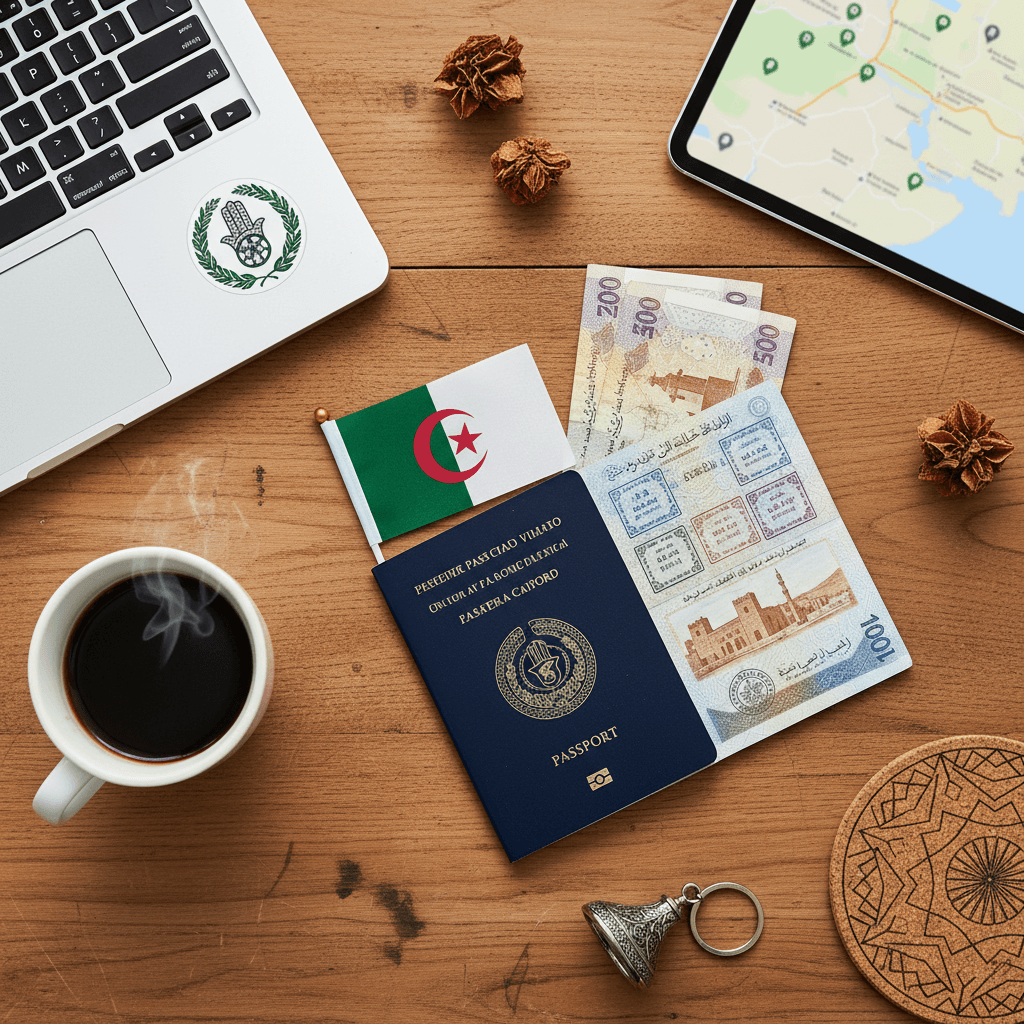
Algeria

Policy Stability
Stamped Nomad ExclusiveHow likely visa and immigration policies are to remain unchanged
Quick Facts
N/A
3 months
Yes
$1,200/mo
23 Mbps
5/10
Medium
Medium
Low
UTC+1
Entry Methods Available
Best For
Algeria is a destination that rewards the patient traveler. Unlike some of its neighbors, it hasn't opened the floodgates to mass tourism, which means the visa process remains traditional and paperwork-heavy. You will need to plan your entry well in advance, as most nomads will find themselves visiting an embassy or consulate in person before they can set foot in Algiers.
The Visa-Free Shortlist
If you happen to carry a passport from Malaysia, Tunisia, or Morocco, you are among the lucky few who can enter Algeria without a visa. This exemption also extends to citizens of Libya, Maldives, Mali, Mauritania, Seychelles, and the Sahrawi Arab Democratic Republic. Everyone else should prepare for a formal application process at their nearest Algerian diplomatic post.
The Tourist Visa: Your Most Likely Entry Point
For the majority of digital nomads, the tourist visa is the standard choice. This allows for a stay of up to 90 days per entry. Depending on your nationality and the specific consulate, you might be granted a visa valid for up to two years, though you cannot exceed a cumulative total of 180 days within a single year.
To get this sticker in your passport, you will need a few specifics:
- A passport with at least six months of validity remaining.
- Completed application forms and recent passport photos.
- Travel insurance coverage for the duration of your stay.
- A confirmed hotel booking, an invitation certificate from an Algerian host, or a confirmation from a licensed travel agency.
Fees are non-refundable and vary significantly based on your citizenship. For example, Norwegian citizens typically pay around 1270 NOK for a stay under 90 days. Expect your local rate to fluctuate based on reciprocal agreements between your home country and Algeria.
Business Visas for the Working Professional
If you are coming to Algeria for meetings or specific projects rather than just soaking up the Mediterranean views, the business visa is the way to go. The duration rules are identical to the tourist visa (90 days per entry, 180 days max per year), but the paperwork shifts. You will need a mission letter from your employer or a formal letter of invitation from an Algerian business partner. You still need to provide proof of accommodation and sufficient funds for your stay.
The Southern Exception: Visa on Arrival
Algeria does not offer a general visa on arrival for those landing in Algiers or Oran. However, there is a unique "regularization" visa for travelers heading south. If you book an organized tour through a sanctioned agency to explore the southern wilayas like Tamanrasset or Illizi, the agency can facilitate a visa that you pick up upon arrival. This is specifically for desert tourism and isn't a viable workaround for nomads planning to work from the northern cities.
Extensions and Staying Longer
If you find yourself falling in love with the architecture and the coffee culture, you can apply for an extension. You must visit a local immigration office (Bureau des Étrangers) at least 10 to 15 days before your current visa expires. Extensions can grant you up to another 90 days, provided you have a valid reason and can prove you have the funds to support yourself. Just remember, the hard limit of 180 days per year is strictly enforced.
Current Trends and Future Outlook
While there has been talk of an e-visa system for several years, it has not yet become a functional reality for the general public. Stick to the embassy route for now. One specific update for 2025 and 2026 involves Algerian nationals living abroad; those holding foreign passports can enter using their foreign travel document alongside an Algerian ID or expired passport through December 31, 2026. For everyone else, the traditional embassy application remains the only path forward.
The Current Reality
Algeria is a destination for the bold traveler, but it hasn't quite caught up to the global trend of dedicated remote work programs. To put it simply, there is no official Digital Nomad Visa for Algeria. The government recognizes categories like business, study, and work, but "working for a company back home while sipping tea in Algiers" doesn't have its own legal box yet.
Most nomads who make the trip rely on the standard tourist visa. This is a functional workaround, though it comes with a specific set of rules. Since you aren't seeking local employment or entering the Algerian labor market, the tourist visa covers your entry for exploration, provided you keep your laptop work low-profile.
The Tourist Visa Route
Because there isn't a specialized nomad path, you'll be applying through the standard consular process. Here is the breakdown of what you can expect regarding stays and limits:
- Maximum Stay: You can typically stay for up to 90 days per entry.
- Cumulative Limit: Your total time in the country cannot exceed 180 days within a single year.
- Validity: Depending on your nationality and the consulate's discretion, visas are issued for 90 days, 180 days, 1 year, or 2 years.
- Extensions: While you can technically apply for an extension of another 90 days while in the country, these are granted exceptionally and are never guaranteed. It's better to plan your trip around your initial 90-day window.
Requirements and Paperwork
The Algerian visa process is known for being somewhat bureaucratic. You won't find a specific "minimum income" figure like you would in Portugal or Spain, but you do need to prove you can support yourself. The consulate wants to see that you have a plan and the funds to back it up.
- Proof of Funds: Recent bank statements showing you have sufficient savings for the duration of your stay.
- Accommodation: You must provide a confirmed hotel booking, a legalized invitation from a host in Algeria, or a certificate from a licensed travel agency.
- Travel Insurance: This must include coverage for repatriation assistance.
- Passport: Your passport needs at least 6 months of validity remaining and 2 blank pages.
How to Apply
Since there is no digital portal for these visas, you'll be doing this the old-fashioned way through an embassy or consulate. Here is the typical workflow:
First, download the visa application form from the website of the Algerian embassy in your country of residence. You'll need to fill this out in duplicate. Gather your passport, two recent photos, and your supporting documents like insurance and hotel confirmations.
Next, submit your application in person or by mail, depending on the specific consulate's rules. You will need to pay the application fee at this stage. For US citizens, this is approximately $160 USD, usually paid via money order. Processing times are actually quite reasonable, generally taking between 5 and 8 business days.
Tax and Legal Considerations
Working remotely on a tourist visa is a bit of a gray area. Technically, a tourist visa prohibits local employment. Since you aren't working for an Algerian company or earning Dinars, you aren't tapping into the local economy in a way that usually triggers work permit requirements. However, you should still keep your professional activities private.
From a tax perspective, Algeria considers you a resident if you spend 183 days or more in the country during a calendar year. Residents are subject to progressive tax rates up to 35%. By sticking to the 90-day tourist limit, you generally avoid falling into the Algerian tax net, but you'll still be responsible for taxes in your home country or wherever you claim tax residency.
A Note on Logistics
Algeria is not a "show up and get a stamp" kind of place. The requirement for an invitation or a pre-booked hotel is strictly enforced. If you plan on bouncing between different cities, ensure your paperwork reflects your first stop clearly. Once you're in, the freedom to explore the Sahara or the Mediterranean coast is yours, provided you respect the 90-day clock.
Algeria is often described as the final frontier of North African tourism. For digital nomads, it offers an untouched Mediterranean coastline and the vastness of the Sahara, but getting through the door requires more legwork than its neighbors. Unlike Morocco or Tunisia, Algeria maintains a strict visa policy that requires most visitors to plan well in advance.
The Visa-Free Exception List
Most travelers will need a sticker in their passport before they land. However, a small handful of nationalities can enter without a visa for up to 90 days. This list is primarily limited to regional neighbors and specific diplomatic partners including Libya, Malaysia, Mali, Mauritania, Seychelles, Tunisia, and the Sahrawi Arab Democratic Republic. Travelers holding Hong Kong passports are also granted a shorter stay of 14 days.
If you don't hold a passport from one of these specific countries, you must apply for a tourist visa through an Algerian embassy or consulate in your country of residence.
Applying for the Tourist Visa
There is currently no e-visa system or digital portal for tourist applications. You will need to do things the old-fashioned way by downloading forms from your local consulate's website and submitting them in person or via mail. This process usually involves providing a detailed itinerary, proof of employment or income, and a formal invitation or hotel booking confirmation.
While there is no official visa on arrival for independent travelers, there is a slight shortcut for those booking through licensed Algerian travel agencies. If you are part of an organized tour, agencies can sometimes facilitate a faster 48-hour processing window, though you still need to have the paperwork approved before you fly.
Stay Duration and Extensions
The standard tourist visa typically allows for a stay of up to 90 days per entry. Depending on your nationality and the specific consulate, you might be granted a single-entry or multiple-entry visa with a total validity ranging from 90 days to 2 years.
If you find yourself falling in love with Algiers or Constantine and want to stay longer, extensions are possible but rare. You must apply locally at a police station (Bureau des Étrangers) before your current visa expires. These are granted on an exceptional basis and can extend your stay by another 90 days, provided your total time in the country does not exceed 180 days within a single year.
Financial Expectations
The cost of an Algerian visa is not standardized. It operates on a principle of reciprocity, meaning the fee often depends on what your home country charges Algerian citizens. You should be prepared for a wide range of costs.
- Low-end fees: Some nationalities may pay as little as €0 to €40.
- High-end fees: Citizens from countries like the US or UK often pay between €100 and €200.
- Payment method: Most consulates requires payment via money order or certified check; cash is rarely accepted.
Border Runs and Overstays
Because Algeria tracks your cumulative days in the country, the "border run" strategy used in Southeast Asia or Latin America is less effective here. You are generally restricted to 180 days per calendar year. If you exit and immediately try to re-enter on a new visa, you may face heavy questioning from border officials suspicious of long-term residency without a work permit.
Strictness is the name of the game regarding your departure date. Overstaying your visa is a serious offense that can lead to significant fines, immediate deportation, or a permanent ban from returning. Always double-check your entry stamp and ensure you leave at least a day or two before your 90-day limit expires. If an emergency prevents you from leaving, you must contact local authorities immediately to request a regularization visa.
Source
Algeria is a bit of a frontier for digital nomads. It’s not the kind of place where you can just land and figure it out as you go. The bureaucracy is traditional, and the legal framework for staying long-term is rigid. You won't find a "Digital Nomad Visa" or a "Golden Visa" here. Instead, you have to fit yourself into the existing categories, which mostly revolve around formal employment or long-term residency applications.
The Work Visa Route
For most people looking to stay beyond a standard 90-day tourist window, the Work Visa is the primary path. This isn't a "laptop and a dream" setup; it requires a formal structure. You’ll need an employment contract and a Temporary Work Permit issued by the Algerian Ministry of Labor before you even head to the embassy.
The visa is typically valid for two years. For U.S. citizens, the application fee sits at $190 USD. You’ll also need to provide a letter of repatriation from your employer, promising to cover the costs of your return trip if needed. It’s a heavy lift for a freelancer, but it’s the most secure way to establish a multi-year presence.
Securing a Residency Card
If you plan to make Algeria your base for more than a few months, you need the Carte de Résident. This is your official identity document while in the country. You have to apply for this at least 15 days before your initial entry visa expires. If you miss that window, things get complicated quickly.
To qualify for the card, you have to prove you have a reason to stay. This usually means showing one of the following:
- A valid work permit and employment contract.
- Proof of enrollment in an Algerian university.
- Evidence that you are practicing a "liberal profession," which can include commercial or craft-based activities.
- Proof of sufficient means of subsistence, essentially showing you have enough money to support yourself without working locally.
The Long Game: Permanent Residency
For those who truly fall in love with the Maghreb lifestyle, there is a path to a 10-year Resident Card. This is reserved for people who have lived in Algeria legally and continuously for at least 7 years. It requires a clean record and a fiscal receipt showing you’ve paid a fee of 30,000 DZA to the tax services. It’s a marathon, not a sprint.
Standard Visa Durations and Fees
If you aren't ready to commit to residency, you’ll likely be bouncing between shorter-term visas. Algeria offers tourist, business, and cultural visas with varying validity periods. Most allow for a stay of 90 days per entry.
- Standard Visa Fee: $160 USD for U.S. citizens (Tourist, Business, Student).
- Work Visa Fee: $190 USD.
- Maximum Stay: 90 days per entry, though you can sometimes request a 90-day extension.
- Annual Limit: Your cumulative stay cannot exceed 180 days in a single year.
The Reality for Freelancers
Since there is no specific freelancer visa, remote workers often find themselves in a gray area. If you aren't employed by an Algerian company, you’ll likely enter on a Tourist or Business visa. While these are fine for short stints, they don’t provide a legal path to long-term residency. If you want to stay for years rather than months, you’ll need to look into setting up a local business entity or securing a formal contract that satisfies the Ministry of Labor.
Processing times are usually efficient, taking between 5 and 8 business days, but requirements can change depending on your specific consulate. Always check with the embassy in your home country before booking any non-refundable flights.
The Bottom Line
Algeria remains one of the most affordable frontiers for the remote work crowd heading into 2025 and 2026. You can live a very comfortable life here for a fraction of what you would spend in Southern Europe or neighboring Morocco. Most nomads find their sweet spot between $500 and $1,200 per month, depending on how much they prioritize Western-style amenities and private office space.
While the infrastructure is still catching up to the digital nomad trend, your dollar goes incredibly far. Algiers serves as the primary hub with the most reliable internet and coworking options, while coastal cities like Oran and Annaba offer a slower pace and even lower price tags.
Monthly Rent in Nomad Hubs
Housing is your biggest variable, but even "premium" options in the heart of the capital are affordable by global standards. Most nomads opt for city centers to stay close to cafes and transport links.
Algiers
- Budget: $150 to $200 for a basic studio or shared arrangement.
- Comfortable: $204 to $350 for a well-located 1BR in a safe, central neighborhood.
- Premium: $400 to $600 for modern apartments with air conditioning and reliable backup power.
Oran
- Budget: $116 for a simple local apartment.
- Comfortable: $203 for a central 1BR with decent amenities.
- Premium: $300+ for high-end builds near the waterfront.
Annaba
- Budget: $111 for a modest living space.
- Comfortable: $154 for a standard city center flat.
- Premium: $250+ for the best available units in the city.
Food and Dining
Groceries are a steal if you stick to local markets. Seasonal produce, fresh bread, and staples are very cheap. Expect to pay about $200 to $250 monthly if you cook at home and grab the occasional street food meal for around $3.
If you prefer a mix of home cooking and hitting mid-range restaurants twice a week, budget around $350. For those who want imported goods, specialty coffee, and frequent dinners out, $400 or more is a realistic ceiling. Oran and Annaba generally run about 5% to 10% cheaper for food than Algiers.
Transport and Getting Around
Getting around is remarkably cheap thanks to low fuel costs. A monthly pass for local buses usually costs around $10, though many nomads prefer the convenience of taxis and rideshares.
- Budget: $10 to $20 using public buses and walking.
- Comfortable: $20 to $50 using occasional taxis, which typically cost about $1 per trip.
- Premium: $100+ for heavy use of rideshare apps or frequent intercity travel.
Coworking and Connectivity
Dedicated coworking spaces are still a bit of a rarity outside of Algiers. In the capital, a hot desk will run you roughly $204 per month. If you are based in Oran or Annaba, you will likely rely on hotel lobbies or laptop-friendly cafes, which significantly lowers your monthly overhead but requires more flexibility with your work schedule.
Health Insurance
The public healthcare system is not designed for expats, so private insurance is a non-negotiable expense. Basic nomad-specific travel plans start around $42 per month. For more comprehensive medical coverage including private hospital access or evacuation, expect to pay between $100 and $224 depending on your age and specific needs.
The Emerging Hubs of the Maghreb
Algeria is not your typical digital nomad destination. You won't find the massive expat crowds of Bali or the high-speed fiber of Lisbon here. Instead, you get an authentic, raw experience at a fraction of the cost of Western cities. The nomad scene is small, usually under 300 remote workers per month nationwide, but the infrastructure is slowly catching up in three primary cities.
While the country is incredibly affordable, with meals often costing around $3, internet remains the biggest hurdle. You can expect speeds ranging from 2 to 44 Mbps. For anyone doing heavy video editing or constant Zoom calls, a local SIM card for mobile data or a dedicated coworking space is mandatory.
Algiers: The White City
As the capital, Algiers is the clear frontrunner for anyone needing reliable infrastructure. It feels like a Mediterranean crossroads, blending French colonial architecture with a bustling North African energy. It offers the most "cushioned" experience for remote workers, featuring over 56 coworking spaces and the fastest internet potential in the country.
- Monthly Cost: $860 to $1,860 depending on your lifestyle.
- Coworking: Hot desks average around $204 per month.
- Internet: Averages 2-44 Mbps, though it can be temperamental.
- The Vibe: Vibrant cafe culture, a subdued but present nightlife, and plenty of history in the Casbah.
The city's safety index sits at 48/100, which is moderate. It is a city of hills and damp winters, so pack accordingly. If you want to be where the (admittedly small) action is, Algiers is your best bet.
Oran: The Radiant City
If you prefer a more relaxed, coastal atmosphere, Oran is the place to be. Known as the birthplace of Raï music, it has a more liberal, upbeat spirit than the capital. It is famous for its beaches and a nightlife that is significantly more active than what you will find elsewhere in Algeria.
- Monthly Cost: $942 to $1,826.
- Coworking: Limited dedicated spaces, but coliving/coworking hybrids exist for roughly $255 per month.
- Internet: Often inconsistent, averaging around 2 Mbps.
- The Vibe: Lively, beach-focused, and culturally rich.
The trade-off for the better social scene is the infrastructure. The safety index is lower here at 31/100, and the internet is notably slower than in Algiers. It is a better fit for nomads who prioritize culture and coastal living over high-bandwidth work.
Constantine: The City of Bridges
For those who want to truly get off the beaten path, Constantine is a dramatic, historic choice. Built into the cliffs and connected by massive bridges, it is one of the most visually stunning cities in Africa. This is not a place for networking, but it is an incredible base for a "deep work" retreat.
- Monthly Cost: Approximately $1,587.
- Coworking: Very few formal spaces, though coliving options are available.
- Internet: Averages around 5 Mbps.
- The Vibe: Academic, historic, and quiet.
Nomad presence here is minimal. You will likely be the only remote worker in the cafe. It is affordable and safe, but the nightlife is almost non-existent. Come here for the inspiration, not the parties.
The Bottom Line on Costs
Across all three cities, your biggest savings will be on the basics. Rent for a one-bedroom apartment typically ranges from $150 to $680. Because costs are 70% to 95% lower than cities like New York, your budget goes incredibly far. You are trading convenience and high-speed connectivity for an adventure in a country that remains largely untouched by mass tourism.
The Connectivity Landscape
Algeria is currently undergoing a massive digital overhaul. While it was once a challenging destination for remote work, the rapid rollout of fiber optics has changed the game. In major urban hubs like Algiers and Ali Mendjeli, fixed broadband speeds now average between 30 and 60 Mbps. If you are staying in a modern apartment with a fiber-to-the-home connection, you can even find speeds reaching up to 1.5 Gbps through Algérie Télécom. The country is aggressively phasing out old copper lines, so the reliability of home internet is significantly higher than it was just a few years ago.
Mobile data is your most reliable backup and often your primary tool if you are moving between cities. Ooredoo is the preferred choice for most nomads, offering the best balance of coverage and speed, averaging around 27 Mbps. You can pick up a local SIM or activate an eSIM easily upon arrival. For about 2,000 DZD (roughly $15 USD), you can get a 30-day plan with 80 GB of data, which is plenty for heavy Zoom usage and standard workflows.
Coworking in Algiers
If you need a professional environment to stay productive, Algiers has a growing scene of high-quality coworking spaces. These spots are the only places where you are guaranteed stable, high-speed WiFi and a community of local entrepreneurs. Most spaces offer daily, weekly, and monthly passes with flexible terms.
- The Address: Located in Mohammadia Mall, this was the first real coworking space in the country. It offers a sleek environment and very fast WiFi starting at 9,000 DZD per month.
- Regus: With multiple locations across the city, this is the go-to for a corporate, polished atmosphere. Monthly passes start around 20,900 DZD.
- La Bulle Space: Found in El Mouradia, this spot has a relaxed garden vibe that feels less like an office and more like a creative retreat.
- Fadaa: Based in Birkhadem, this space is heavily focused on the local startup ecosystem and is great for networking with Algerian tech talent.
- L2C Space: A more budget-friendly option in Baba Hassen with monthly rates starting as low as 7,000 DZD.
Membership Costs and Logistics
Pricing for coworking is quite reasonable compared to European or North American standards. You can choose a setup that fits your budget and privacy needs:
- Shared Open Space: 10,000 to 25,000 DZD per month. Includes high-speed WiFi and access to common areas.
- Dedicated Desk: 20,000 to 50,000 DZD per month. Best for those who want a consistent setup and guaranteed desk space.
- Private Office: 30,000 to 70,000 DZD per month. Ideal for small teams or those requiring total silence for calls.
The Cafe Culture Reality
Algiers has a beautiful cafe culture, but it is not always conducive to deep work. While many modern cafes offer free WiFi, the speeds usually hover between 5 and 15 Mbps. These connections tend to struggle during peak afternoon hours when the shops get crowded. If you just need to clear some emails, a cafe is fine, but for any heavy lifting or video conferencing, you will want to stick to your mobile hotspot or a dedicated coworking desk.
Mobile Data Options
Local providers offer generous data buckets for very low prices. It is wise to keep a secondary SIM from a different provider if you plan on traveling into more rural provinces.
- Ooredoo: 2,000 DZD for 80 GB or 3,500 DZD for 150 GB. Generally considered the best for speed.
- Djezzy: 2,500 DZD for 30 GB or 4,200 DZD for 80 GB. A solid secondary option with good urban coverage.
- Mobilis: 2,200 DZD for 20 GB or 6,500 DZD for 120 GB. Often has the best reach in remote or desert areas.
The Reality of Healthcare in Algeria
Algeria operates a two-tier healthcare system that can be a bit of a shock if you aren't prepared. The public system, known locally as CNAS, is technically free or heavily subsidized, but it’s often plagued by long wait times and aging equipment. Most nomads and expats find the public hospitals overcrowded and difficult to navigate without a high level of French or Arabic.
The private sector is where you’ll want to focus your attention. Private clinics in cities like Algiers and Oran offer modern facilities, much faster service, and a higher likelihood of finding English-speaking doctors. While these clinics are significantly more expensive than public options, they are still relatively affordable by Western standards.
Where to Find Quality Care
If you're staying in the capital or major hubs, you have several reliable options. Algiers is the primary hub for high-end medical care, but other cities are catching up. Here are some of the most reputable facilities for international visitors:
- Athena Medical Center: A reliable choice in Constantine.
- Clinique Amina: Located in Blida, known for its professional staff.
- Clinique El Moncef: A go-to facility in Setif.
- International SOS: They operate a clinic in Hassi Messaoud that meets international standards.
Keep an eye out for the Algerian Qatari German Hospital, a massive 300-bed project designed to international standards. It’s expected to be a game-changer for specialized care in the region by the end of 2025.
Insurance and Why You Need It
Local private insurance doesn't really exist in Algeria, so you’ll need to secure a solid international policy before you land. If you're working for an Algerian company, you might get registered with CNAS, which covers about 80% of costs, but the reimbursement process for medication is a headache. For anything over 3,000 DZN, you have to pay out of pocket and file a claim later.
A high-end international plan from providers like Cigna Global or Allianz typically costs around $2,200 annually. This is money well spent, as it covers specialist visits, surgeries, and, most importantly, emergency medical evacuation. Given the country's size and the disparity in care between the coast and the interior, evacuation coverage is a non-negotiable for anyone exploring the desert regions.
What You'll Pay Out of Pocket
Even without insurance, basic care in the private sector won't break the bank, but the costs add up quickly compared to the public system. Here is a quick look at what you can expect to pay:
- GP Visit: $5 (Public) vs. $30 (Private)
- Specialist Consultation: $10 (Public) vs. $50 (Private)
- Standard Blood Test: $10 (Public) vs. $40 (Private)
- X-Ray: $15 (Public) vs. $60 (Private)
Pharmacies and Prescriptions
Pharmacies are easy to find in Algiers and Oran, but they often run low on specific or imported medications. If you take chronic medication, bring a several-month supply with you. Make sure you have your prescriptions translated into French; this helps both with customs and when explaining your needs to a local pharmacist.
The local Chifa card is used by residents for third-party payments at pharmacies. Without one, you’ll be paying cash. Most pharmacies in urban centers stay open late, but specialized drugs are often restricted to larger hospital-affiliated dispensaries.
Emergency Situations
In an emergency, dial 112. Be aware that dispatchers usually speak French or Arabic, so having a local friend or a translation app ready is a smart move. Response times can be sluggish, especially during Algiers' infamous traffic jams. In remote areas, professional ambulance service is nearly non-existent, which is why having an insurance provider with a 24/7 emergency hotline is your best safety net.
Money in Algeria: A Practical Guide
Algeria operates on a dual-economy system that can feel a bit like time travel for the uninitiated. While the digital nomad lifestyle depends on seamless transactions, you will find that cash is still king here. Managing your finances requires a mix of modern fintech apps and old-school currency exchange tactics to make your budget stretch as far as possible.
The Local Currency and the Parallel Market
The official currency is the Algerian Dinar (DZD). You will see coins and notes in various denominations, though the smaller centimes are effectively obsolete. In most countries, you would just head to a bank or an official exchange booth, but Algeria is different. There is a significant gap between the official bank rate and the "Square" or black market rate.
- Official Rate: Used by banks and for official transactions.
- Parallel Market: Often found in specific areas like Square Port Said in Algiers, where you can get 30% to 50% more value for your USD or EUR cash.
- Pro Tip: Bring plenty of crisp, high-denomination Euro or Dollar bills to exchange locally for the best value.
Banking for Residents and Nomads
Opening a local bank account has become easier over the last decade, but it still involves a fair amount of paperwork. If you are planning a long-term stay, institutions like CNEP-Banque, Crédit Populaire d'Algérie, and Banque Nationale d'Algérie are your primary options. You will typically need to visit a branch in person to get the process started.
To open an account, you generally need your valid passport, a residence certificate or lease agreement, and an initial deposit. For a checking or savings account, expect to deposit at least 10,000 DZD upfront. Be prepared for a wait; the verification process can take anywhere from a few weeks to a couple of months.
Using International Cards and ATMs
If you prefer to stick with your home bank, Wise and Revolut cards are your best friends. They work at most ATMs in major cities like Algiers, Oran, and Constantine. You can withdraw DZD directly, and the apps handle the conversion at mid-market rates. However, keep in mind that you cannot sign up for these services using an Algerian address; you must have your account established before you arrive.
ATMs are plentiful in urban hubs but become increasingly rare and unreliable once you head into rural areas or the Sahara. Most Algerian ATMs do not charge a local access fee, though some may charge around 1,000 DZD per transaction. Always choose to "Decline Conversion" on the ATM screen so your home bank handles the exchange rate instead of the local machine.
Moving Money Across Borders
When you need to send money to yourself or a local contact, digital-first platforms are much faster and cheaper than traditional bank wires. Wise is a top choice for transparency, usually charging around 0.5% in fees. Revolut is also excellent for low markups, often as low as 0.2%. For speed, Paysend and Remitly can often deliver funds within a single day.
- Western Union and Ria: Best for cash pickups if you don't have a local bank account.
- SWIFT Transfers: Possible but slow and expensive; use these only as a last resort.
- Credit Cards: Avoid using credit cards for cash advances due to high interest and fees.
A Strict No-Crypto Policy
It is vital to understand that Algeria has a very strict stance on digital assets. Under Law No. 25-10, all cryptocurrency activities are fully banned. This includes buying, selling, holding, or even mining Bitcoin and other tokens. The penalties are severe, including potential jail time of up to 1 year and fines reaching $7,700. Do not attempt to use crypto exchanges or P2P trading platforms while inside the country.
Spending and Payments
While high-end hotels and some restaurants in Algiers accept Visa or Mastercard, the vast majority of your daily expenses will be paid in cash. From street food to taxi rides, having a roll of Dinars in your pocket is a necessity. If you are using international cards for payments, stick to reputable establishments to avoid card skimming or double-charging issues.
Logistics of the Family Visa
Moving your family to Algeria is most straightforward if you have an Algerian national sponsor, such as a spouse or relative. The family-based immigration route requires a few non-negotiable documents to get started. You will need a passport valid for at least 6 months, a completed application form, and 35mm x 45mm identity photos.
The consulate will also ask for proof of your sponsor’s nationality and official documents confirming your relationship, like a marriage certificate or family booklet. You must secure an accommodation certificate to prove you have a place to live. Additionally, travel insurance is mandatory; it must cover at least 30,000 euros for medical emergencies and repatriation.
One perk of the Algerian visa process is the pricing for younger children. Fees are typically waived for kids under 6 years old. For those between 6 and 12, expect to pay a reduced rate of about 40 euros plus a 25 euro application fee. Keep in mind that embassies are strict; if your paperwork is incomplete, they will send it back immediately.
International Schooling Options
Education is likely your biggest expense and your biggest decision. Algeria offers three primary systems for expat families, mostly concentrated in the capital.
- American International School of Algiers (AISA): This is the premium option. Tuition for Pre-K starts at $12,000 annually, climbing to $25,000 for high school. They offer a 10% discount for a second child and 15% for any subsequent siblings. There is also a $200 non-refundable application fee.
- British School Algiers: Non-Algerian students pay £10,566 per year, which can be broken down into trimester payments of £3,522. They offer a flat 10% sibling discount.
- French Schools (AEFE Network): These are more affordable, with tuition around 250,000 DZD per trimester (roughly $1,875 to $2,000). The Lycée International Alexandre Dumas also charges a 20,000 DZD registration fee.
Healthcare and Daily Childcare
While public healthcare is available and covers mandatory vaccinations and basic treatments through social insurance, most digital nomads opt for private facilities. Private clinics in Algiers are modern and offer more specialized pediatric care. If you are covered by social insurance, benefits include surgery, medication, and dental care, but having that 30,000 euro medical insurance policy is a legal requirement for your stay.
On the bright side, daily childcare is incredibly affordable compared to Western standards. Private preschool for a full day averages about $70 to $73 per month. Even international primary schools outside the elite tier average around $2,465 per year, which is a fraction of what you would pay in the US or UK.
Where to Settle with Kids
Choosing the right city changes the family experience significantly. Algiers is the clear winner for infrastructure and activities.
- Algiers: Home to the Bardo National Museum and the Mohamed Boudiaf Olympic Complex. It has the best sports clubs and the highest density of international schools.
- Oran: The second-largest city features the Canastel Forest Park for hiking and an aquarium. It is a coastal city with great beaches, though it has a lower safety rating than the capital.
- Annaba: Known for the Ain Achir beaches and the Basilica of St. Augustine, it offers a more relaxed coastal lifestyle with decent family facilities.
Safety and Security
Algeria is generally safe from violent crime, but petty theft like pickpocketing is common in crowded areas. Algiers is considered the safest major city for families, with a safety index of 48, compared to 31 in Oran. This is largely due to the heavy police presence and extensive surveillance in the capital.
Stick to the coastal cities and avoid the southern or eastern border regions. Those areas are remote and have a history of instability that makes them unsuitable for families. For daily life, use common sense: put grilles on your ground-floor windows, don’t flash expensive tech in public, and stay in well-lit areas after dark.
Safety on the Ground
Algeria sits in a unique spot for digital nomads. It is remarkably safe in terms of violent crime, especially in the heart of Algiers where a heavy police presence keeps things orderly. You can generally walk around urban centers without much worry, though the vibe changes after dark. Petty theft like phone snatching or pickpocketing happens in crowded markets, so keep your tech tucked away.
The real safety concerns are geographic. Stick to the coastal cities and established hubs. The remote Sahara regions and border zones carry much higher risks, including kidnapping and smuggling activity. If you want to see the desert, book a reputable tour rather than going rogue.
Avoiding the Hustle
Scams in Algiers are usually more annoying than dangerous. You might run into the "picture scam," where someone asks you to take their photo, drops the camera, and then demands cash for the "damage." Another classic is the "bird poop" trick: someone splashes a liquid on your shoulder, offers to help clean it off, and empties your pockets while you are distracted.
- ATM Helpers: Never let anyone "assist" you at a machine; card skimming is a known issue.
- Fake Guides: In the Kasbah, men will offer impromptu tours that end with an inflated bill. Use official guides or apps.
- Street Currency Exchange: Stick to official banks or reputable hotels to avoid counterfeit bills.
Social Norms and LGBTQ+ Reality
Algeria is a deeply conservative society. For LGBTQ+ travelers, the situation is difficult. Same-sex acts are illegal and can carry prison sentences of up to 3 years. There is no public scene, and dating apps should be used with extreme caution. Discretion isn't just a suggestion here; it is a necessity for your safety.
Even for straight couples, public displays of affection are a no-go. Holding hands might pass in some modern Algiers neighborhoods, but anything more will draw negative attention. Dress modestly to blend in. Men should avoid short shorts, and women generally find life easier wearing loose clothing that covers shoulders and knees.
The Language Gap
Don't expect to get by on English alone. While the younger generation in Algiers is picking it up, the country runs on Darja (Algerian Arabic) and French. Basic tasks like explaining a medical issue or negotiating a price at the market become hurdles without some French basics. If you speak French, you will find integration much smoother.
- Sa7a: A versatile "thank you."
- Sbah el kheir: Good morning.
- Bech-hal: How much?
Cultural Etiquette and Integration
Algerian hospitality is legendary. If a local invites you for coffee or a meal, they usually mean it. Accepting these invitations is the fastest way to move from "tourist" to "guest." Always remove your shoes when entering a home and greet the eldest person in the room first. If you are offered food, it is polite to accept at least a small portion.
The expat community is small but tight. Most nomads congregate in Algiers, using coliving spaces and coworking hubs to bypass the sometimes spotty home internet. These spots are your best bet for networking and finding "fixers" who can help with local bureaucracy. To settle in, use the Heetch app for rides to avoid the "foreigner tax" on unmetered taxis, and spend your afternoons in cafes. The cafe culture is the heartbeat of social life here; grab a tea, stay off your laptop for an hour, and just observe.
Life in Algiers
- Safety Rating: Moderate (Numbeo index 52.75).
- Primary Languages: Arabic, French.
- Connectivity: Improving, but rely on coworking spaces for stability.
Understanding Tax Residency
Algeria doesn't have a specific "digital nomad" category in its tax code, so you fall under general residency rules. You become a tax resident if you spend more than 183 days in the country within a calendar year. This doesn't have to be a continuous stay; the tax man adds up every day you've been on Algerian soil.
There are other ways to trigger residency besides the day count. If you rent a home for at least one year or make Algeria the "center of your vital interests"—meaning your family or primary economic ties are there—the authorities will consider you a resident. Once you hit that status, you are liable for tax on your worldwide income, not just what you earn locally.
Income Tax Brackets
If you cross the residency threshold, you'll be subject to the Global Income Tax (IRG). The rates are progressive, meaning the more you earn, the higher the percentage. For those who stay less than 183 days and only have remote income from outside the country, these rates typically won't apply to your foreign salary, but it is a different story if you are working for an Algerian entity.
- 0 to 120,000 DZD: 0%
- 120,001 to 360,000 DZD: 20%
- 360,001 to 1,440,000 DZD: 30%
- Over 1,440,000 DZD (~$10,700): 35%
Non-residents generally pay a flat 35%, but only on income sourced directly from within Algeria. For most nomads working for clients back home, the main goal is staying under that 183-day limit to avoid the global tax net.
Double Taxation and Treaties
To avoid paying twice on the same dollar or euro, check if your home country has a treaty with Algeria. There are active agreements with many European nations like France, the UK, Germany, Italy, and Spain. These treaties often include "tie-breaker" rules that help determine which country gets to tax you if both claim you as a resident.
Americans should be aware that there is currently no tax treaty between the US and Algeria. If you are a US citizen, you'll likely need to rely on the Foreign Tax Credit to offset any taxes paid to the Algerian government against your US tax bill.
The Crypto Ban
Algeria takes a very hard line on digital assets. Since 2018, the purchase, sale, and even possession of cryptocurrencies have been illegal. This ban is strictly enforced and has been extended through 2026. Because the government doesn't recognize crypto as legal, there is no framework for taxing it; there are no capital gains taxes or reporting requirements.
However, this is not a "tax loophole." Dealing in crypto while in Algeria carries significant legal risks. It is best to keep your crypto activities completely separate from your life in the country to avoid run-ins with local law enforcement.
Reporting and Deadlines
If you do end up qualifying as a tax resident, you'll need to register with the local tax office. The annual tax return is due by April 30 each year. You'll be expected to declare all income earned during the previous calendar year. Keep meticulous records of your entry and exit dates; passport stamps and boarding passes are your best friends if you need to prove you spent fewer than 183 days in the country.
For those looking at small-scale local business, there is an "auto-entrepreneur" status with a flat tax rate between 5% and 12%, but this is primarily designed for residents and locals. Most nomads find it much simpler to maintain their business registration in their home country or a tax-friendly third jurisdiction.
Connectivity and SIM Cards
Internet reliability is the lifeline of any nomad, and in Algeria, your best bet is to bypass hotel WiFi in favor of a local 4G connection. You can pick up a physical SIM card at Algiers Airport immediately after customs. Ooredoo is generally the top choice for remote workers, offering speeds up to 100 Mbps in urban centers. Expect to pay between 500 and 1,500 DZD for the starter SIM, but the real value is in the data bundles. For about 2,000 DZD, you can get 50GB of data plus local calls for 30 days.
If you prefer to be online the second your plane touches the tarmac, Airalo and Ubigi offer eSIMs. These are convenient because they don't require the passport registration that physical cards do, though they are pricier at roughly $7 for 1GB. Keep in mind that while Mobilis and Djezzy are also viable, Ooredoo tends to have the most consistent 4G coverage for video calls and heavy uploads.
Getting Around
Public transport like buses and trams exists, but they lack integrated apps and can be a headache to figure out during your first week. Instead, download Yassir, the local "super app." It is the most reliable way to hail rides in Algiers and Oran. Heetch and inDrive are also popular, with the latter allowing you to negotiate fares with drivers directly.
- Yassir: Best for reliability and 24/7 availability.
- inDrive: Great for finding lower prices if you are willing to haggle.
- Heetch: A solid backup for peak hours in Algiers.
Taxis are incredibly affordable, often costing less than a few dollars for cross-city trips. This is a lifesaver in hilly neighborhoods where walking becomes a workout. Always keep cash on hand, as most drivers do not accept digital payments yet, and be prepared for occasional GPS glitches in older parts of the city.
Where to Set Up Shop
Algiers is a city of distinct moods. Hydra is the expat and business hub, filled with upscale cafes and coworking spaces where you won't feel out of place with a laptop. If you want a more local, high-energy vibe, Bab El Oued is famous for its markets. For those staying longer, El Biar and Ben Aknoun offer a middle ground with apartments ranging from $150 to $200 per month.
When booking, Airbnb is the primary tool, with over 7,000 listings nationwide. Studios in prime Algiers spots typically run between $25 and $55 per night. Always message the host specifically to ask about the stability of the power and internet, as older buildings can occasionally face outages. For a more community-focused stay, check Mapmelon for emerging coliving spots.
Food and Daily Life
Algerian cuisine is a highlight, and you don't always have to go out to find it. Wajeez and Fast are the leading delivery apps for everything from traditional couscous to wood-fired pizza. Like the ride-hailing apps, these mostly operate on a cash-on-delivery basis. Expect quick service, though traffic in Algiers can sometimes turn a 20-minute estimate into 45 minutes.
While French is common in business and tourism, learning a few phrases of Darija (Algerian Arabic) goes a long way. The Darija DZ app is a great resource for picking up the local dialect. Most locals are incredibly hospitable and will appreciate even a "Saha" (thank you) or "Salam" (hello).
Safety and Emergencies
Algeria is generally safe for travelers, but it pays to have the right numbers saved. Use 1548 for the police and 14 for the fire department. If you are a U.S. citizen, the embassy in Algiers can be reached at +213 770-08-2000 for consular emergencies.
Pro Tips for Avoiding Stress
- Carry Cash: Algeria is a cash-heavy society. While some upscale spots take cards, your foreign Visa or Mastercard will be most useful at bank ATMs.
- Dress Modestly: While Algiers is cosmopolitan, dressing conservatively helps you blend in and shows respect for local customs.
- Visa Prep: Never arrive without your paperwork in order. The visa process is strict and requires advance planning at your local embassy.
- Mind the Clock: During Ramadan, business hours change drastically. Most cafes and restaurants close during the day and reopen with a surge of energy late at night.
More Guides from Africa
Stay Updated on Algeria
Get notified about visa changes, policy updates, and new information for digital nomads in Algeria.